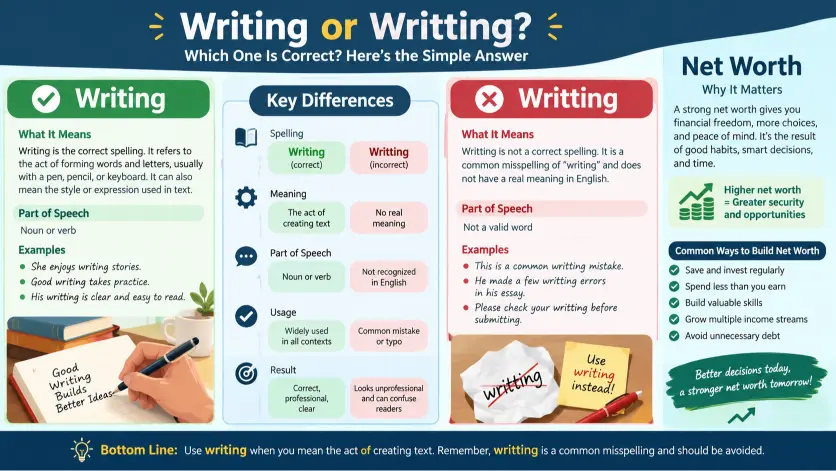
Writing is one of the most common activities in English, yet even familiar words can create spelling confusion. One frequently searched mistake is “writing or writting,” especially among students, professionals, bloggers, and English learners. At first glance, both forms may look reasonable because the word “write” changes when the suffix “ing” is added. However, English spelling rules do not always work by simply adding letters to the original word. Understanding what happens to the final e can make this spelling much easier to remember.
The correct spelling is writing, not writting. The word comes from the verb write, and when ing is added, the final silent e is removed, producing writing. The double t in “writting” is incorrect. This mistake is understandable because other English words sometimes double their final consonant before adding a suffix. Knowing why “writing” follows a different pattern helps learners avoid similar errors in words such as “making,” “taking,” and “coming.”
Whether you are writing an academic assignment, professional email, website content, or everyday message, using the correct spelling matters. A small spelling mistake can affect how polished and trustworthy your communication appears. In this guide, we will explain writing or writting, show why writing is correct, examine the spelling rule behind it, and provide clear examples so you can confidently use the word in formal and everyday English.
Writing or Writting: What’s the Difference?
First, writing is the correct spelling of the present participle and gerund form of the verb write. It refers to the act of putting words, ideas, information, or symbols into written form. For example, “She is writing a report” uses the word correctly.
Meanwhile, writting is not a standard English word. Although it may appear in searches, messages, classroom work, or informal online communication, it is considered a spelling mistake. Therefore, it should not be used in formal writing, academic assignments, professional communication, or published material.
Moreover, the difference becomes clearer when we examine the spelling transformation. The base verb is write. When the suffix ing is added, the final silent e is removed. As a result, write becomes writing, not writting.
| Feature | Writing | Writting |
|---|---|---|
| Standard English | Yes | No |
| Part of speech | Gerund or present participle | Incorrect spelling |
| Base word | Write | Write |
| Correct formation | Write + ing with final e removed | Incorrectly adds another t |
| Academic use | Appropriate | Avoid |
| Professional use | Appropriate | Avoid |
| Example | “I am writing a letter.” | “I am writting a letter.” |
Therefore, writing is the only standard form.
Likewise, writting should be treated as a spelling error rather than an alternative spelling.
Ultimately, remember that write changes to writing by removing the final e before adding ing.
Is Writing or Writting a Grammar, Vocabulary, or Usage Issue?
Primarily, this is a spelling issue rather than a grammar distinction. The two forms do not represent two different grammatical meanings. Instead, one is correct and the other is an incorrect spelling.
Furthermore, writing can function as both a gerund and a present participle. As a gerund, it can act like a noun. For instance, “Writing improves communication” uses writing as the subject of the sentence.
Similarly, it can appear as a present participle in a progressive verb construction. For example, “He is writing an email” describes an action that is happening.
By contrast, writting does not have an accepted grammatical function in standard English. Consequently, changing the context does not make it correct.
Additionally, formal and informal communication follow the same spelling rule. Although casual messages sometimes contain misspellings, writting does not become acceptable simply because the setting is relaxed.
Likewise, academic writing requires writing, while casual conversation also uses writing. Therefore, the distinction is not based on formality.
For example, a student might write, “I am writing my dissertation.” Similarly, an employee might say, “I am writing the monthly report.” In both cases, the spelling remains unchanged.
As a result, learners should remember that this is not a matter of British English versus American English either. Both major varieties use writing.
How to Use Writing Correctly
First, writing describes the process or activity of producing written material. Therefore, it can appear in everyday conversations, professional documents, academic discussions, creative work, and digital communication.
Workplace Example
For example, an employee might say:
“I am writing the proposal for tomorrow’s meeting.”
Here, writing describes an activity that is currently taking place.
Likewise, a manager could say:
“She is writing the client summary.”
Consequently, the word works naturally in professional communication.
Academic Example
Similarly, students frequently use writing when discussing essays, research papers, examinations, and assignments.
For instance:
“Academic writing requires clear organization and precise evidence.”
Here, writing functions as a noun describing a particular form of written communication.
Likewise:
“I am writing my research paper this evening.”
In this sentence, the word functions as part of the present progressive construction.
Technology Example
Furthermore, modern technology provides countless examples of writing.
For example:
“The application is writing data to the storage system.”
Likewise:
“I am writing a document on my laptop.”
Therefore, the word applies equally well to traditional writing and digital activities.
Usage Recap
Ultimately, use writing whenever you need the standard form connected with write. Moreover, use it for actions, activities, subjects, skills, and forms of written communication. Consequently, there is no standard situation in which writting should replace it.
How to Handle Writting
First, it is important to understand that writting does not have a legitimate standard usage category. Therefore, writers should not intentionally select it for academic, workplace, technical, or everyday communication.
Nevertheless, seeing the form repeatedly can make it appear familiar. Because of that familiarity, learners may mistakenly assume that it is an accepted spelling variant.
Workplace Example
For instance, a professional email might contain:
“I am writing to confirm our appointment.”
However, replacing writing with writting would introduce an obvious spelling error.
Academic Example
Similarly, a student may write:
“This chapter discusses academic writing.”
Changing the word to writting would make the sentence incorrect.
Technology Example
Likewise, technical documentation may contain expressions such as:
“The program is writing information to the file.”
Again, writting would be an error.
Usage Recap
Therefore, do not treat writting as an alternative spelling. Instead, recognize it as a common misspelling of writing. Consequently, whenever you notice the extra t, remove it.
When You Should NOT Use Writing or Writting
First, never use writting simply because the pronunciation seems to suggest two t sounds. English spelling does not always follow pronunciation perfectly.
Second, do not use writting in school assignments. Instead, choose writing because academic accuracy matters.
Third, avoid writting in resumes, applications, business correspondence, and reports. Consequently, a simple spelling mistake does not undermine an otherwise strong message.
Fourth, do not assume that writting is an informal alternative. Although informal communication often tolerates minor mistakes, the spelling remains incorrect.
Fifth, avoid using writting in website content, product descriptions, instructional material, or documentation. Therefore, standard spelling improves clarity and credibility.
Sixth, do not use writting when discussing the general skill of writing. For example, “Writing is an important communication skill” is correct.
Seventh, do not select writting merely because similar verbs sometimes double their final consonant. That spelling rule applies under specific conditions and does not apply to write in this form.
Eighth, never memorize writting as a second accepted version. Instead, remember the correct transformation from write to writing.
Common Mistakes and Decision Rules
First, learners often remember that some verbs double a final consonant before ing. Consequently, they may incorrectly apply that pattern to write.
| Correct sentence | Incorrect sentence | Explanation |
|---|---|---|
| I am writing a letter. | I am writting a letter. | The final e in write is removed before ing is added. |
| She enjoys writing stories. | She enjoys writting stories. | Writing is the standard gerund form. |
| He is writing a report. | He is writting a report. | The extra t is unnecessary. |
| Writing takes practice. | Writting takes practice. | Writing is the accepted noun form. |
| They are writing notes. | They are writting notes. | Write changes to writing without doubling t. |
Decision Rule
If you mean the action, use writing.
If you see writting, correct it to writing.
Therefore, the decision is straightforward because there is no meaning based distinction between the two forms.
Writing and Writting in Modern Technology
First, digital writing has made spelling accuracy more visible than ever. Word processors, browsers, messaging applications, and other writing platforms frequently identify writting as an error.
Furthermore, automatic spell checking can help users recognize the incorrect form. However, writers should still understand the underlying rule instead of depending entirely on correction software.
Similarly, digital communication creates situations where mistakes spread quickly. For example, a misspelled word copied from one message into another can become familiar through repetition.
Therefore, learning the correct spelling remains more useful than memorizing a correction suggestion.
Moreover, professional digital communication requires consistency. Whether someone is preparing an email, report, presentation, article, or technical document, writing remains the correct form.
Why Writing Is Spelled Without the Extra T
First, the spelling becomes easier when you return to the base verb write.
The word write ends with a silent e. When ing is added, the final e is removed. Therefore:
write + ing = writing
However, the transformation does not create:
write + ing = writting
That second version incorrectly introduces another t.
Furthermore, the pronunciation can contribute to confusion because English spelling and pronunciation do not always correspond perfectly. Nevertheless, pronunciation should not be used as the primary guide here.
As a result, remembering the base form is the simplest strategy. Whenever you are uncertain, identify the original verb first. If the verb is write, the correct progressive or gerund form is writing.
Etymology and Spelling Background
First, write has a long history in English and is related to older Germanic forms associated with scratching, marking, or recording symbols.
Over time, the word developed into the modern English write, while its related forms followed established spelling patterns.
Furthermore, the final silent e plays an important role in the base spelling. When the suffix ing is attached, that e disappears. Therefore, writing reflects a conventional spelling change rather than a random exception.
As a result, learners can understand the form more easily by studying the relationship between the base verb and its derived form.
Expert Style Observation
A useful linguistic principle is this:
“Correct spelling becomes easier to remember when learners understand how a word is formed.”
Consequently, understanding write and writing is more reliable than memorizing isolated spellings.
Two Practical Case Studies
Case Study One: Academic Assignment
First, imagine a university student preparing a research essay. The student repeatedly types writting because they assume the final consonant should be doubled.
However, during proofreading, the repeated spelling is corrected to writing. Consequently, every occurrence becomes consistent.
The practical lesson is simple. When a spelling error appears several times, correcting the underlying rule prevents the same mistake from returning throughout the document.
Case Study Two: Professional Communication
Similarly, consider an employee preparing a formal client message. The draft contains the sentence:
“I am writting to confirm the requested details.”
After checking the spelling, the employee changes writting to writing.
As a result, the final message becomes grammatically and orthographically accurate. Although the correction involves only one letter, it improves the professionalism of the communication.
Therefore, small spelling decisions can have a noticeable effect on how polished a message appears.
Error Prevention Checklist
Always use writing when
First, use writing when describing the act of producing written language.
Next, use writing when referring to the skill of producing text.
Furthermore, use writing after verbs such as enjoy, practice, and avoid when the grammatical structure requires a gerund.
Likewise, use writing in academic, workplace, technical, and casual communication.
Finally, use writing whenever you are forming the ing version of write.
Never use writting when
First, never use writting as an alternative spelling.
Next, never use it in formal documents.
Furthermore, never assume it becomes correct in casual messages.
Likewise, never teach it as a valid form.
Finally, never double the t merely because some other English verbs double their final consonant.
Related Grammar Confusions You Should Master
First, learners who confuse writing and writting may benefit from studying several related spelling patterns.
- Begining or beginning: understanding when a final consonant is doubled.
- Runing or running: learning consonant doubling with short vowel patterns.
- Makeing or making: recognizing when a final silent e disappears.
- Useing or using: applying the same silent e principle.
- Comeing or coming: identifying the correct removal of final e.
- Hopeing or hoping: distinguishing spelling from pronunciation.
- Planing or planning: understanding when consonant doubling is required.
- Stoping or stopping: recognizing short vowel and consonant patterns.
- Write or right: distinguishing words that sound similar but have different meanings.
- Wrote or written: understanding different forms of the same irregular verb.
Consequently, studying these related patterns can make English spelling much easier to understand.
Frequently Asked Questions
What is the correct spelling, writing or writting?
First, writing is the correct spelling. Meanwhile, writting is an incorrect form. Therefore, always choose writing in standard English.
Why is writing spelled with one t?
Because write loses its final silent e before ing is added. Consequently, the result is writing, with only one t.
Is writting an acceptable English word?
No. Although writting appears in informal messages and online searches, it is a misspelling. Therefore, standard English uses writing.
Is writing a noun or a verb?
Writing can function in more than one grammatical role. For example, it can be a gerund in “Writing requires practice.” It can also function as a present participle in “She is writing.”
Why do people spell writing as writting?
First, people may incorrectly apply consonant doubling rules. Furthermore, the pronunciation can make the spelling seem plausible. However, the standard form remains writing.
Should I use writing in academic work?
Yes. Writing is the appropriate form for academic assignments, research papers, essays, examinations, and scholarly communication.
Is writting a British spelling?
No. Writting is not a standard British spelling. Likewise, it is not a standard American spelling. Both varieties use writing.
How can I remember the spelling of writing?
First, remember the base verb write. Next, remove the final e before adding ing. Therefore, write becomes writing.
Is writing the same as writting?
No. Although they look similar, only writing is correct in standard English. Consequently, writting should be corrected whenever it appears.
Conclusion:
Ultimately, writing is the only correct spelling in standard English, while writting is a common misspelling. Therefore, the simplest way to remember the difference is to begin with the base verb write.
Next, remove the final silent e and add ing. As a result, you get writing.
Furthermore, the same spelling applies across academic, professional, technical, and everyday communication. Consequently, there is no formal or informal situation that makes writting an acceptable alternative.
Finally, whenever you hesitate between the two forms, remember one simple rule: write becomes writing, not writting. Once that pattern becomes familiar, this common spelling problem becomes easy to avoid.









