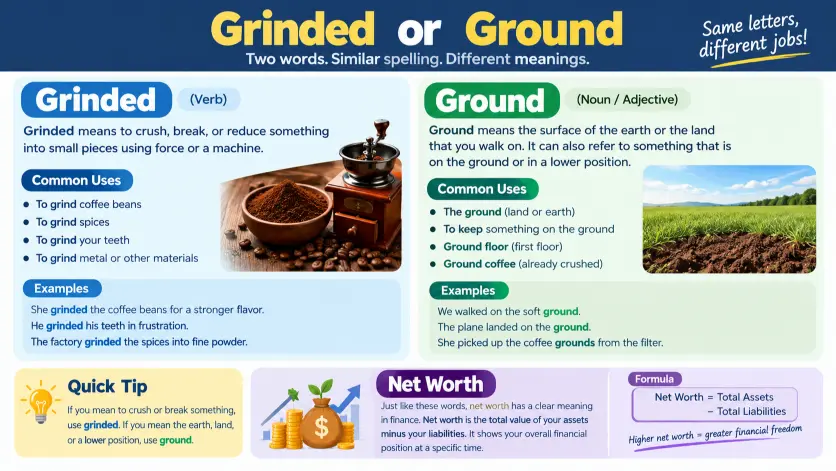
Have you ever wondered whether the correct past tense of grind is “grinded” or “ground”? You are not alone. This confusion appears frequently in everyday conversations, writing, recipes, sports discussions, and even professional communication. Although both forms can be found in modern English, they do not always carry the same meaning or function. Understanding the distinction helps you choose the right word based on context rather than relying on what simply sounds familiar.
In standard English, ground is generally the accepted past tense and past participle of the verb grind when referring to physically crushing, rubbing, or reducing something into smaller pieces. For example, “She ground the coffee beans” is grammatically standard. However, grinded can appear in specific contexts, particularly in informal language, music, sports, gaming, and expressions where “grind” has developed a specialized meaning.
This guide explains Grinded or Ground in a clear and practical way, drawing on established English grammar and modern usage. You will learn the meanings of both forms, see realistic examples, understand when each is appropriate, and discover common mistakes to avoid. Whether you are a student, writer, English learner, or simply trying to improve your everyday communication, this comparison will make the choice much easier.
Grinded or Ground: What’s the Difference?
The confusion comes from the unusual history of the verb “grind.” Many English verbs form their past tense by adding “ed.” For example, “walk” becomes “walked,” while “clean” becomes “cleaned.” However, grind belongs to a different group of verbs whose forms change internally.
The standard forms are:
| Form | Standard word | Part of speech | Example |
|---|---|---|---|
| Base form | grind | Verb | I grind coffee beans every morning. |
| Present participle | grinding | Verb | She is grinding fresh spices. |
| Past tense | ground | Verb | He ground the beans yesterday. |
| Past participle | ground | Verb | The beans have been ground finely. |
| Noun | ground | Noun | The coffee contains finely ground beans. |
| Alternative form | grinded | Verb | It appears in limited informal or specialized usage. |
Therefore, ground is normally the correct choice when describing an action that happened in the past.
For instance, “She ground the coffee beans before breakfast” is standard English.
Similarly, “The machine ground the material into powder” follows conventional grammar.
However, “grinded” may occasionally appear in particular communities, especially when “grind” has developed a newer figurative meaning.
Mini Recap
Ground is the standard past tense of grind.
Grinded is uncommon in conventional English.
Specialized or informal contexts can sometimes use grinded.
For formal communication, ground is the safer and more widely accepted choice.
Is Grinded or Ground a Grammar, Vocabulary, or Usage Issue?
Primarily, this is a grammar and usage question involving an irregular verb.
The verb “grind” does not follow the regular pattern used by verbs such as “play” or “jump.” Instead, its past form changes from grind to ground.
Consequently, saying “I ground the coffee yesterday” follows the traditional grammatical pattern.
On the other hand, “I grinded the coffee yesterday” sounds nonstandard to most readers and listeners.
Nevertheless, language changes over time. Because of that, grinded can sometimes be found in informal speech, creative writing, gaming communities, music related discussions, and other environments where grind has acquired a newer meaning.
Are the Two Forms Interchangeable?
Generally, no.
When grind means crushing, rubbing, sharpening, or processing something through friction, ground is the established past form.
For example:
“The worker ground the metal carefully.”
However, some newer uses of grind may produce grinded in particular communities. Even then, the form is context dependent rather than universally interchangeable.
Formal Versus Informal Usage
In professional writing, academic assignments, reports, examinations, and edited publications, ground is strongly preferred.
Meanwhile, grinded may occur in casual online language or specialized communities.
Therefore, context should guide your choice.
Academic Versus Casual Usage
Academic English values established grammatical conventions. Consequently, writers should normally choose ground.
Casual speech is more flexible. However, flexibility doesn’t automatically make every alternative appropriate.
Thus, if you’re uncertain, ground remains the dependable option.
When to Use Ground in Standard English
Ground is the conventional past tense and past participle of grind.
The word can describe physically crushing something into smaller pieces. It can also describe sharpening, rubbing, polishing, or processing material.
For example, a cook might grind coffee beans. Likewise, a technician might grind a metal component to alter its surface.
Workplace Example
A technician might write:
“The operator ground the metal surface before applying the coating.”
This wording is clear and professionally appropriate.
Academic Example
A chemistry student could write:
“The researcher ground the sample into a fine powder before analysis.”
Here, ground clearly identifies an action completed before another event.
Technology Example
Technical documentation might state:
“The software processed the scanned material after the machine ground the sample.”
Although the subject matter is technological, the verb still follows conventional English grammar.
Usage Recap
Use ground when describing a completed instance of grind in standard English.
It works naturally in professional reports, educational writing, technical documentation, and ordinary conversation.
Therefore, ground should be your default selection whenever you mean the conventional physical or figurative action represented by grind.
When to Use Grinded in Specialized or Informal Contexts
Grinded is much less common in traditional English. Still, it can appear in certain modern contexts where grind has developed a specialized meaning.
For example, some speakers use grind as a noun or verb related to sustained effort, repetitive activity, competition, entertainment, or gaming.
In such communities, grinded can occasionally appear because speakers apply the familiar “ed” pattern to a newer meaning.
However, this usage remains less widely accepted than ground.
Workplace Example
Imagine an informal team conversation about completing repetitive tasks:
“We grinded through the workload all afternoon.”
Some speakers may find this natural, especially in casual environments. Nevertheless, a polished workplace report would normally use a different construction.
For example:
“We worked through the workload all afternoon.”
Academic Example
Academic writing generally avoids grinded when ground is the established grammatical form.
Instead of writing:
“The participants grinded the samples.”
A formal researcher should write:
“The participants ground the samples.”
Alternatively, the sentence can be rewritten to eliminate possible ambiguity.
Technology Example
Gaming and online technology communities sometimes use grind in a specialized sense involving repeated effort to obtain progress, rewards, resources, or experience.
Consequently, users may encounter expressions such as “grinded for hours.”
Even so, this community usage does not replace the standard past tense ground in conventional English.
Usage Recap
Grinded has a restricted role.
It may occur in informal or specialized communities.
However, ground remains the safer choice for standard English.
When clarity and grammatical convention matter, choose ground.
When You Should NOT Use Grinded or Ground
Although ground is normally correct, choosing a verb form still requires attention to the sentence’s meaning.
1. Don’t Use Grinded in Formal Academic Writing
If you mean that someone physically processed something by grinding, use ground.
“The scientist ground the material.”
This is clearer and grammatically conventional.
2. Don’t Automatically Treat Grinded as the Regular Past Form
The fact that many verbs add “ed” does not mean every verb follows that pattern.
Grind is an irregular verb, so its conventional past form is ground.
3. Don’t Use Ground When You Mean the Present Action
If the action is happening now, use grind or grinding depending on the sentence.
For example:
“I grind coffee every morning.”
“She is grinding coffee now.”
4. Don’t Confuse Ground With a Different Meaning
Ground has many meanings beyond the past form of grind.
It can refer to soil, land, electrical grounding, a basis for an argument, or a place where something occurs.
Therefore, sentence context matters.
5. Don’t Replace Every Modern Use With Grinded
If you encounter grinded online, don’t assume that it is always a grammatical error.
Instead, examine what grind means in that particular community.
6. Don’t Use Grinded Simply Because It Sounds Familiar
Frequent exposure can make an uncommon form feel normal.
However, familiarity does not necessarily establish standard usage.
7. Don’t Ignore the Intended Audience
A casual gaming message and a university research paper have different language expectations.
Consequently, the appropriate form can depend on the audience and setting.
8. Don’t Treat Informal Usage as Universal Grammar
A form used by a particular community may not be suitable everywhere.
Therefore, specialized usage should remain context sensitive.
Common Mistakes and Decision Rules
| Correct sentence | Incorrect sentence | Explanation |
|---|---|---|
| She ground the coffee beans. | She grinded the coffee beans. | Ground is the standard past tense. |
| He ground the metal carefully. | He grinded the metal carefully. | Standard English uses ground. |
| They have ground the spices. | They have grinded the spices. | Ground is also the standard past participle. |
| I grind coffee every morning. | I ground coffee every morning. | Grind describes a habitual present action. |
| She is grinding the beans. | She is ground the beans. | Grinding is required after “is” for a continuing action. |
| The material was ground finely. | The material was grinded finely. | Ground is used in the passive construction. |
Decision Rule Box
If you mean the standard completed action, use ground.
If you encounter grinded in a specialized or informal setting, examine the context before judging it.
For most professional, academic, educational, and general communication, ground is the reliable choice.
Grinded or Ground in Modern Technology
Modern digital communities have influenced how people use the word grind.
For example, gaming platforms frequently describe repetitive activities as a grind. Players may grind for resources, experience, equipment, achievements, or progress.
Consequently, some speakers extend this newer meaning into forms such as grinded.
However, digital usage does not automatically change the established grammar of traditional English.
The distinction becomes especially important in software documentation, educational content, technical reports, and professional communication. These environments generally favor conventional language because readers come from different linguistic backgrounds.
Therefore, when a sentence describes the physical process of crushing, rubbing, sharpening, or processing material, ground remains the standard choice.
The Etymology Behind Grind and Ground
The unusual relationship between grind and ground has deep historical roots.
Grind comes from an old Germanic linguistic family associated with crushing, rubbing, or reducing something through friction. Over centuries, the verb developed forms that differed from the familiar “ed” pattern.
Ground became established as its historical past form.
Consequently, the difference isn’t a modern accident. It reflects an older pattern in English in which vowel changes helped indicate tense.
Other familiar verbs show similar historical behavior.
For example, sing becomes sang, while ring becomes rang. Likewise, drive becomes drove.
Thus, ground belongs to a broader family of irregular English forms.
An Expert Style Explanation
A useful way to understand the distinction is this:
“Standard English preserves ground as the established past form of grind, while newer community usage can sometimes reshape the verb according to regular patterns.”
This distinction explains why both forms can appear in modern writing while only one remains broadly standard.
Two Case Studies That Clarify the Difference
Case Study One: Coffee Preparation
Consider a café employee describing a completed task.
“The barista ground the beans before opening.”
The meaning is immediately clear. The action happened in the past, and ground functions as the standard past form.
Now compare:
“The barista grinded the beans before opening.”
The second sentence may be understood, but many readers will recognize grinded as nonstandard.
In a professional menu description, training manual, or hospitality report, the first version is therefore preferable.
Case Study Two: Gaming Culture
Now consider a gaming community discussing repeated progress.
“I grinded for rare equipment all weekend.”
Here, the writer is using grind in a modern specialized sense. The expression may sound natural within that community because participants share the same vocabulary.
However, if the same writer prepares a formal report, conventional language becomes more appropriate.
A clearer formal version could be:
“I spent the weekend repeatedly completing tasks to obtain rare equipment.”
Therefore, context changes how readers evaluate the expression.
Error Prevention Checklist
Always Use Ground When
You are writing a formal document.
You are completing an academic assignment.
You are describing the physical process of grinding.
You are writing technical instructions.
You are preparing professional correspondence.
You are unsure which form your audience expects.
You are using the conventional past participle.
Never Use Grinded When
You need standard formal English.
You are writing an academic research paper.
You are completing a grammar examination.
You are preparing edited professional content.
You mean the ordinary physical action represented by grind.
You are writing for an audience unfamiliar with specialized community vocabulary.
Related Grammar Confusions You Should Master
Understanding irregular verbs makes many other common language questions easier.
Here are several useful comparisons worth studying:
- Learned or learnt
Both forms exist, although regional preferences differ.
- Spelled or spelt
Both can be correct depending on regional English conventions.
- Burned or burnt
Both appear in established English usage, with context and regional preference influencing selection.
- Dreamed or dreamt
Both forms are recognized, although frequency varies by variety of English.
- Leaped or leapt
Both forms occur in standard English.
- Proved or proven
Proved is the normal past form, while proven frequently functions as a past participle.
- Lighted or lit
Both occur, although lit is particularly common in several established constructions.
- Dived or dove
Regional variation strongly influences which form speakers prefer.
- Got or gotten
Gotten is especially associated with North American English in certain constructions.
- Hung or hanged
These forms have different traditional uses, so meaning determines the appropriate choice.
Studying these examples demonstrates an important principle: English verbs don’t always follow one universal pattern.
Frequently Asked Questions
Is ground the correct past tense of grind?
Yes. Ground is the standard past tense of grind. It is also the conventional past participle. For example, “She ground the beans yesterday” follows standard English grammar.
Is grinded grammatically correct?
Grinded can appear in informal or specialized usage, particularly where grind has acquired a newer meaning. Nevertheless, it is not the standard past tense for the ordinary verb meaning to crush, rub, sharpen, or process.
Should I say I ground or I grinded?
In standard English, say “I ground.” For example, “I ground the coffee beans this morning” is the conventional construction.
Why is the past tense of grind ground?
Grind is an irregular verb with historical vowel change. Consequently, its established past form developed as ground rather than the regular grinded.
Is grinded acceptable in academic writing?
Generally, no. Academic writing should normally use ground when referring to the conventional verb. If a specialized community expression is being discussed, grinded may appear as an object of analysis rather than as the writer’s preferred standard form.
Can grinded be used in gaming?
Yes, it can appear in gaming communities where grind has a specialized meaning involving repeated effort. However, community usage doesn’t necessarily represent conventional formal English.
Is ground both a verb and a noun?
Yes. Ground can function as the past form of grind and can also function as a noun with meanings related to land, soil, territory, or a basis for reasoning.
What is the easiest way to remember the difference?
Remember the standard sequence: grind, grinding, ground, ground. If you are describing a completed ordinary grinding action, ground is almost always the appropriate form.
Does context determine whether grinded is acceptable?
Yes. Standard English favors ground, while certain informal communities may use grinded for newer meanings. Therefore, audience, subject, and register should all be considered.
Final Verdict:
The safest conclusion is straightforward. Ground is the standard past tense and past participle of grind in conventional English. It should be your first choice in academic writing, professional communication, technical material, examinations, and everyday standard usage.
Although grinded can appear in informal or specialized communities, especially where grind has developed a newer figurative meaning, it should not automatically replace ground.
Therefore, when you mean that someone crushed, rubbed, sharpened, or processed something through grinding, choose ground.
Once you recognize grind as an irregular verb, the distinction becomes much easier. Instead of relying on the familiar “ed” pattern, remember the established sequence and consider your audience before selecting an alternative.









