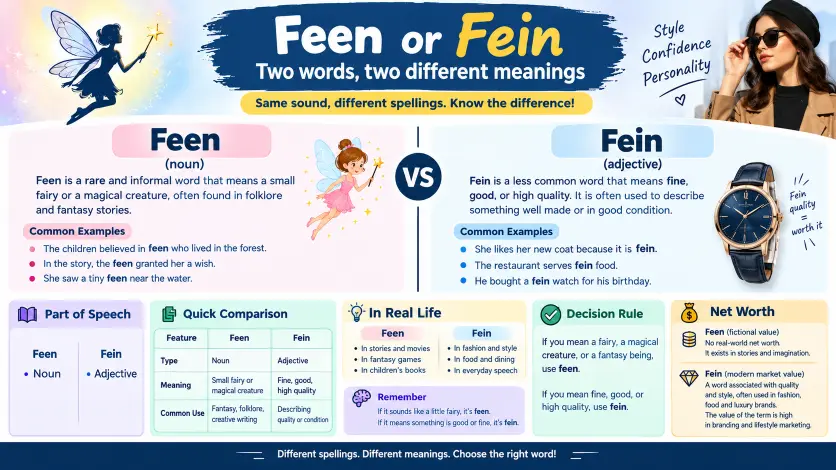
Have you ever come across the spellings feen and fein and wondered which one is correct? Similar-looking words can create confusion, especially when they appear in online searches, messages, usernames, or unfamiliar texts. Before choosing either spelling, it is important to understand the context in which the word appears. Unlike common English spelling pairs, feen and fein do not have one universally accepted distinction that applies to every situation. Their intended meanings may depend on the language, regional usage, name, or slang expression involved.
When comparing feen or fein, context is the most reliable starting point. Feen may appear in informal slang or dialectal writing, while Fein can occur as a surname or as a spelling in other linguistic contexts. Neither spelling should automatically be treated as the correct replacement for the other without knowing what the writer intends to communicate. Checking the surrounding sentence and identifying the language or expression can help prevent misunderstandings. This is especially useful when reading social media posts, searching for unfamiliar terms, or editing informal writing.
In this guide, we will examine the possible meanings of feen and fein, explain why the spellings can be confusing, and explore how context affects their interpretation. We will also look at practical examples and useful tips for deciding which form fits a particular situation. Because uncommon spellings can have different meanings across communities and languages, reliable dictionaries and the original context are important tools for confirming usage. By the end, you will have a clearer understanding of how to approach feen vs fein without assuming that similar spellings always mean the same thing.
Feen vs Fein: What’s the Difference?
The difference between feen and fein depends largely on context, because both spellings appear in informal slang. People may use either form to express a strong craving, intense enthusiasm, or an almost obsessive interest in something. However, neither spelling is the standard English form when the intended word is fiend.
For example, someone might write, “I am feening for pizza,” to explain that they really want pizza. Another person might use “fein” in a similar message. Although readers may understand both expressions, informal spellings can vary between communities and online platforms.
Furthermore, fein has an established meaning in German, where it can describe something fine, delicate, refined, or excellent. Therefore, the surrounding language helps determine which meaning applies.
What Does Feen Mean?
Feen is an informal spelling associated with slang derived from fiend and related expressions such as feening. In casual conversations, it can describe someone who strongly desires something or has an intense interest in a particular activity.
For example, a person might say, “I am a feen for chocolate,” meaning that they love chocolate or frequently crave it. Similarly, someone who constantly talks about a favorite game might be described as a gaming feen.
Nevertheless, this spelling is informal. In standard writing, fiend is the established noun, while craving or craving intensely can communicate the related idea more clearly.
What Does Fein Mean?
Fein can appear as an informal slang spelling associated with intense desire or craving. In some online conversations, it carries essentially the same intended meaning as feen.
However, fein is not exclusively an English slang expression. It is also a genuine German adjective. Depending on the sentence, the German word can mean fine, delicate, refined, or excellent.
For instance, the German expression “Das ist fein” can communicate that something is fine or satisfactory. Consequently, readers should consider the language and sentence structure before assuming that fein refers to slang.
Comparison Table
| Feature | Feen | Fein |
|---|---|---|
| Common slang meaning | Strong craving or desire | Strong craving or desire |
| Standard English spelling | No, not for the intended slang meaning | No, not for the intended slang meaning |
| Related English word | Fiend | Fiend |
| Grammatical use in slang | Informal noun or spelling variation | Informal noun or spelling variation |
| Other established meaning | Context dependent | German adjective |
| Typical setting | Texts, captions, casual conversations | Texts, captions, German writing |
| Formal writing | Generally avoid | Use only when context supports it |
Quick Recap
Feen and fein can express a similar craving related meaning in informal slang.
Neither is the standard English spelling of fiend.
Fein also has an independent meaning in German.
Therefore, context and intended meaning should guide your spelling choice.
Is Feen vs Fein a Grammar, Vocabulary, or Usage Issue?
The distinction between feen and fein is primarily a vocabulary and usage issue rather than a conventional grammar problem. Both forms appear in informal communication, but their spelling is not standardized in the same way as established English words.
Consequently, a writer needs to identify the intended meaning before deciding which form to use. In formal English, the established word fiend is usually the appropriate choice when referring to a person who is extremely interested in something or, in another sense, a cruel person or evil spirit.
Are Feen and Fein Interchangeable?
In some slang contexts, yes. Writers may use feen and fein to express a strong desire for food, music, entertainment, attention, or another interest.
For example:
“I’m feening for a burger.”
This sentence communicates an intense craving. Similarly, an informal message might use a variation of fein to convey the same idea.
However, the spellings aren’t interchangeable in every context. If fein appears in a German sentence, it may describe something refined or excellent rather than a craving. Likewise, if someone intends to use the standard English noun fiend, substituting either informal spelling may be unsuitable.
Formal and Informal Usage
In casual texting, friends may use slang to communicate excitement, exaggeration, or enthusiasm. Therefore, a message such as “I’m feening for that new album” may sound natural within an informal conversation.
In contrast, professional correspondence usually benefits from standard vocabulary. A workplace report would be clearer if it said, “The customer has a strong interest in the product,” rather than relying on unfamiliar slang.
Similarly, academic writing generally favors precise expressions such as strong desire, intense craving, or enthusiasm, depending on the intended meaning.
Academic and Casual Contexts
In academic writing, feen and fein should be explained if they appear in research about internet slang, popular culture, or language variation. Otherwise, standard English expressions are generally more appropriate.
Meanwhile, casual conversations allow greater flexibility. Social media captions, private messages, and informal comments often contain spellings that reflect pronunciation or community habits.
Ultimately, understanding the audience helps determine whether slang is appropriate. A spelling that works among friends may confuse readers in a professional document.
Practical Usage: When to Use Feen
Feen is most appropriate when you intentionally want to reproduce informal slang and your audience understands the expression. Nevertheless, because the spelling is nonstandard, it should be used carefully.
1. Workplace Example
Imagine a colleague describing a new coffee machine in a casual team chat.
Example: “I’m such a coffee feen that I use this machine every morning.”
The intended meaning is that the person loves coffee or feels strongly attached to the habit. However, for a formal workplace announcement, a clearer sentence would be:
“I really enjoy coffee and use the machine every morning.”
The second version communicates the same general idea without relying on slang.
2. Academic Example
A student researching contemporary language might examine how online communities spell words according to pronunciation.
Example: “The researcher recorded instances of feen in informal conversations about food cravings.”
In this case, the spelling is relevant because the study investigates language usage. Nevertheless, the researcher should explain that it is an informal form rather than presenting it as standard English.
3. Technology Example
On a gaming forum, a participant might write:
“I’m a feen for this game. I play it every evening.”
The message communicates enthusiasm in a casual setting. However, a product description or software review intended for a broad audience might use:
“This game has attracted players who enjoy its challenging gameplay.”
The alternative is more precise and suitable for general readers.
Usage Recap
Use feen when reproducing recognizable slang in an appropriate informal setting. Otherwise, choose fiend, craving, enthusiast, or another expression that accurately conveys your meaning.
Practical Usage: When to Use Fein
Fein requires additional attention because it has more than one possible interpretation. In slang, it may express a craving or strong desire. In German, however, it has a separate established meaning.
1. Workplace Example
Suppose colleagues are discussing a German product description that includes the word fein.
Example: “The label uses the German adjective fein to describe the product’s refined quality.”
Here, fein is appropriate because the sentence discusses German vocabulary. Replacing it with feen would change the spelling and remove the intended reference.
By contrast, if an employee writes “I’m fein for coffee” in a casual message, readers may interpret it as slang, although the wording is informal and not universally standardized.
2. Academic Example
A language student might compare German adjectives with English slang.
Example: “The student explained that fein has a German meaning distinct from its informal English slang usage.”
This sentence accurately separates two different linguistic contexts. In addition, it prevents readers from assuming that every appearance of fein expresses a craving.
3. Technology Example
A multilingual application might display German vocabulary alongside English definitions.
Example: “The language application translates fein according to the surrounding German sentence.”
The translation could involve fine, delicate, refined, or excellent, depending on context. Therefore, a reliable translation should consider the entire sentence rather than selecting one meaning automatically.
Usage Recap
Use fein when you intentionally mean the German adjective or reproduce a particular informal slang style. In standard English writing, avoid treating it as the established spelling of fiend.
When You Should NOT Use Feen or Fein
Although informal spellings can be useful in conversation, several situations call for greater precision.
- When writing a formal essay. Use established vocabulary such as fiend, craving, or enthusiast instead of unexplained slang.
- When preparing a professional report. Describe the behavior directly, especially when the audience may not recognize the expression.
- When explaining German vocabulary. Don’t replace the German adjective fein with feen merely because the spellings look similar.
- When discussing a literal craving. If the subject involves a serious health or substance related concern, use clear, appropriate language rather than relying on slang.
- When describing an enthusiastic hobbyist. In standard English, expressions such as “a coffee fiend” or “a gaming enthusiast” are clearer than “a coffee feen.”
- When teaching standard spelling. Explain the difference between informal spellings and established dictionary forms instead of presenting them as equivalent in every situation.
- When writing for an international audience. Readers may interpret fein through its German meaning, so clarify the intended sense.
- When quoting a specific song or title. Preserve the original title’s spelling and styling rather than changing it to another form.
Therefore, the best choice depends on whether you’re reproducing slang, using a German word, or writing standard English.
Common Mistakes and Decision Rules
The following examples demonstrate how spelling choices affect clarity.
| Correct sentence | Incorrect or unsuitable sentence | Explanation |
|---|---|---|
| She is a coffee fiend. | She is a coffee feen in a formal report. | Fiend is the established English noun. |
| I’m craving pizza badly. | I’m fein for pizza in a formal essay. | Craving is clearer in formal writing. |
| The German word fein can mean refined. | The German word feen means refined. | Fein is the German adjective. |
| He is a gaming enthusiast. | He is a gaming fein in a professional biography. | Enthusiast is more appropriate for formal writing. |
| I’m feening for a snack. | I’m fiending for a snack is always grammatically wrong. | Both related slang verb forms occur in informal English. |
| The writer quoted the original title accurately. | The writer changed FE!N to FEEN without explanation. | Original titles should retain their established styling. |
A Simple Decision Rule
If you mean an established English noun describing a person with an intense interest, use fiend.
If you mean informal slang about craving something, feen or fein may appear, but choose wording your audience will understand.
If you mean the German adjective, use fein.
This approach avoids treating the spellings as universally interchangeable and makes your intended meaning easier to recognize.
Feen and Fein in Modern Technology and Digital Communication
Digital communication encourages spelling variations because people often write quickly and imitate the language they encounter online. As a result, informal expressions may spread through text messages, gaming communities, video captions, music discussions, and social platforms.
Furthermore, stylized titles can influence how people recognize and reproduce particular spellings. Travis Scott’s song “FE!N,” released on the 2023 album Utopia, provides a prominent example of a title whose visual spelling differs from ordinary English conventions.
However, a stylized title does not establish a new standard spelling for every related expression. Readers should distinguish between a song title, an informal slang term, and an established dictionary word.
Similarly, spelling suggestions and automated writing tools may recognize common words without identifying the intended meaning of an unusual expression. Therefore, human review remains valuable when a word has multiple interpretations.
In multilingual writing, the challenge becomes even greater because fein has a genuine meaning in German. Consequently, surrounding words and sentence structure should guide interpretation.
Etymology: Where Do Feen and Fein Come From?
Understanding the related word fiend helps explain the informal spellings.
The English word fiend has historical roots in Old English and is related to the idea of an enemy or adversary. Over time, its meanings included an evil spirit or cruel person. In informal English, it also developed a less literal sense describing someone intensely devoted to a habit or activity.
Related slang expressions, including fiending and feening, communicate strong desire or craving. Meanwhile, spellings such as feen and fein can emerge when speakers represent informal pronunciation in writing.
Nevertheless, not every spelling variation has a single, clearly documented origin. Slang develops through speech, music, regional communities, and online interaction, so its history can be difficult to trace precisely.
The German word fein, by contrast, belongs to a separate linguistic tradition. It is an established adjective associated with qualities such as fineness, delicacy, or refinement.
Therefore, similar spelling doesn’t necessarily indicate identical origins or meanings.
An Expert Perspective on Choosing the Right Form
A useful principle in language study is to distinguish standard spelling from informal variation.
“Clear writing begins with identifying the intended meaning and selecting the word that communicates it accurately.”
This is a general editorial principle, not a quotation attributed to a particular linguist.
For example, a student discussing slang can retain feen or fein when examining how people communicate online. However, an academic explanation should identify the forms as informal and explain their relationship to fiend or feening.
Similarly, a German language lesson should preserve fein when the adjective is intended. Substituting an English slang spelling would introduce an error.
Consequently, context, audience, and purpose are more reliable guides than appearance alone.
Two Practical Case Studies
The following illustrative examples demonstrate how careful word selection can improve clarity. They are teaching scenarios rather than independently measured research studies.
Case Study 1: Editing a Student’s Essay
A student submits an essay about everyday slang and writes:
“Many people use feen to describe an intense craving.”
The teacher explains that the sentence is understandable, but the spelling needs context. The student revises the passage to clarify that feen is an informal spelling associated with craving related slang and that fiend is the established English noun.
Result: The revised sentence distinguishes informal language from standard spelling and gives readers a more accurate explanation.
Case Study 2: Revising a Multilingual Product Description
A business prepares a description of a German product and includes the word fein to communicate refinement. During editing, a reviewer notices that another section uses feen as though the two spellings were identical.
The reviewer checks the German sentence and retains fein, while replacing the unrelated English slang elsewhere with a clearer expression.
Result: The revised description preserves the German meaning and prevents confusion between two different linguistic contexts.
These examples show why spelling decisions should follow meaning rather than visual similarity.
Error Prevention Checklist
Before using either spelling, review the following points.
Always Use Feen When
- You are deliberately reproducing an informal slang spelling.
- Your audience understands the intended craving related meaning.
- You are quoting a message or discussing a particular spelling variation.
- You explain its informal status when writing for educational purposes.
Use Fein When
- You intend the established German adjective.
- You are discussing German vocabulary or translating a German sentence.
- You are reproducing a specific name or title that uses this spelling.
- You deliberately use the informal slang variation in a context where its meaning is clear.
Avoid Both When
- You need standard English in a formal essay.
- Your readers may not understand the slang.
- You are discussing a serious issue that requires precise language.
- You mean the standard English noun fiend.
- You cannot tell whether the intended expression is English slang or German vocabulary.
Ultimately, a quick context check can prevent unnecessary confusion.
Related Grammar and Vocabulary Confusions You Should Master
Learning how informal spellings differ from standard vocabulary can help you avoid other common mistakes.
- Fiend vs feen: Fiend is the established English spelling, while feen is an informal variation associated with slang.
- Feen vs fein: Both can appear in slang, but fein also has a separate meaning in German.
- Feign vs fiend: Feign means to pretend, while fiend refers to an evil being or, informally, someone intensely interested in something.
- Crave vs desire: Both describe wanting something, although their strength and context can differ.
- Affect vs effect: Affect is usually a verb meaning to influence, whereas effect is usually a noun meaning a result.
- Compliment vs complement: A compliment expresses praise, while a complement completes or enhances something.
- Loose vs lose: Loose describes something not firmly attached, while lose means to misplace or fail to retain something.
- Advice vs advise: Advice is a noun referring to guidance, while advise is a verb meaning to offer guidance.
- Their vs there: Their indicates possession, while there refers to a place or appears in certain grammatical constructions.
- Slang vs standard English: Slang reflects informal language practices, whereas standard English follows widely accepted spelling and usage conventions.
By understanding these distinctions, writers can communicate more precisely across casual conversations, academic assignments, and professional documents.
Frequently Asked Questions
1. Is feen or fein the correct spelling?
Neither is the standard English spelling when you mean the established noun fiend. However, both feen and fein appear as informal slang variations associated with craving or strong desire. The intended meaning and audience determine whether either form is suitable.
2. What does feen mean in slang?
Feen is an informal spelling associated with craving something intensely or being very interested in an activity. For example, “I’m feening for pizza” means “I’m craving pizza.” Its exact tone depends on the context.
3. What does fein mean in texting?
In some text messages, fein expresses a strong desire or craving, similar to feen. However, fein can also refer to the German adjective meaning fine, delicate, or refined. Therefore, readers should interpret it according to the surrounding conversation.
4. Is feen a real English word?
Feen appears in informal slang and certain dialect or linguistic contexts, but it is not the standard spelling of fiend. In formal English, use the established word or a clearer alternative such as enthusiast or craving, depending on the sentence.
5. Is fein a German word?
Yes. Fein is an established German adjective that can mean fine, delicate, refined, or excellent, depending on context. Its German meaning is distinct from informal English slang associated with craving.
6. What is the difference between feen and fiend?
Fiend is the established English noun for an evil being or cruel person. Informally, it can also describe someone intensely interested in an activity. Feen is a nonstandard spelling associated with related slang expressions.
7. How do you use feening in a sentence?
Feening is an informal expression for experiencing a strong craving. For example, “I’m feening for my favorite snack” means “I’m craving my favorite snack.” In formal writing, craving is generally clearer.
8. Is fein the same as the word fine?
Not necessarily. Fein is a German adjective with meanings related to fine, delicate, or refined. In English slang, it can also appear as a spelling associated with craving. Fine is the standard English spelling when you mean satisfactory or of high quality.
9. Should I use feen or fein in a professional email?
Generally, neither is the best choice for a professional email unless you are quoting or discussing slang. Instead, use clear wording such as strongly interested, enthusiastic, or craving, depending on your intended meaning.
Conclusion:
The distinction between feen and fein becomes easier once you identify the intended meaning. Both spellings can appear in informal slang associated with craving or intense desire, but neither replaces fiend as the established English noun.
Meanwhile, fein has an independent meaning in German, where it describes qualities such as fineness, delicacy, or refinement. Consequently, the same spelling can communicate different ideas in different linguistic settings.
For everyday messages, an informal spelling may be understandable when the audience recognizes the slang. However, professional and academic writing generally benefits from standard vocabulary and clear explanations.
Ultimately, choose your spelling according to context, audience, and purpose. When in doubt, use fiend for the established English noun, craving for an intense desire, or fein when the German meaning is intended.









