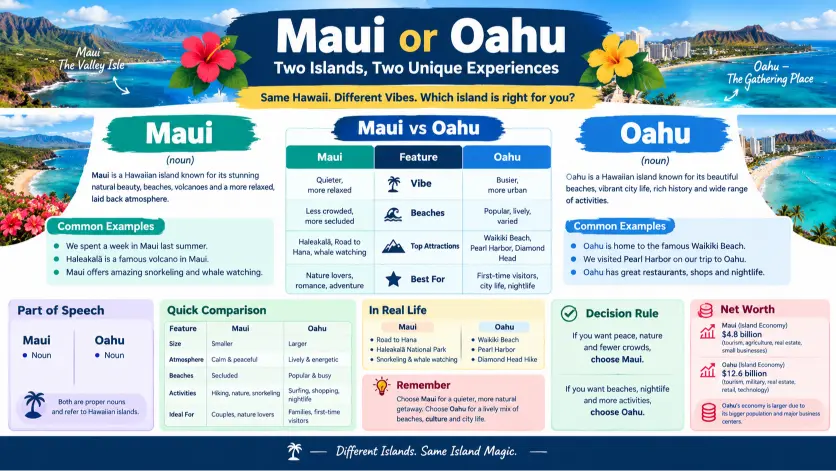
Dreaming of a Hawaiian getaway but cannot decide between Maui or Oahu? Both islands offer beautiful beaches, tropical scenery, unforgettable outdoor adventures, and rich Hawaiian cultural experiences. However, each destination has a distinct personality. Maui is famous for its scenic coastal drives, lush landscapes, resort areas, and opportunities to explore nature. Oahu combines stunning shorelines with Honolulu’s urban attractions, historic landmarks, diverse dining options, and a lively atmosphere. Choosing the right island can make a meaningful difference in how you experience Hawaii, especially when your vacation time and budget are limited.
When comparing Maui and Oahu, it helps to look beyond photographs of turquoise water and palm lined beaches. Accommodation prices, transportation, popular attractions, outdoor activities, and travel styles can all influence your decision. Oahu may appeal to travelers who enjoy combining beach time with shopping, restaurants, nightlife, and historical sightseeing. Maui may suit visitors seeking scenic drives, relaxing resort stays, dramatic landscapes, and nature focused excursions. Neither island is universally better, so the right choice depends on your interests, travel companions, and expectations.
In this guide, you will discover the main differences between Maui and Oahu, including beaches, costs, attractions, transportation, food, and activities for different types of travelers. The comparison emphasizes practical travel considerations and established destination highlights to help you make an informed decision. You will also learn what to consider when planning your itinerary, choosing accommodation, and deciding whether one island or both deserves a place on your trip. By the end, you will have a clearer idea of which Hawaiian island best matches your travel goals and how to make the most of your vacation.
Maui vs Oahu: What’s the Difference?
Maui and Oahu are two distinct islands in the Hawaiian archipelago, each offering a different vacation experience. Although both feature tropical beaches, warm weather, outdoor adventures, and Hawaiian cultural traditions, their landscapes, transportation options, accommodations, and attractions vary considerably.
Maui generally appeals to visitors seeking scenic drives, nature, snorkeling, luxury resorts, and a quieter atmosphere. Oahu, meanwhile, attracts travelers who enjoy city life, historical landmarks, nightlife, shopping, surfing, and easy access to a broad range of services.
Neither island is universally better. Instead, your ideal destination depends on how you want to spend your days, how much you intend to spend, and whether you prefer a nature focused escape or a more active urban and beach vacation.
What Is Maui?
Maui is an island in Hawaii known for its dramatic landscapes, beautiful beaches, agricultural communities, and outdoor recreation. Often associated with romantic getaways and scenic exploration, it offers a mixture of coastal resorts, small towns, lush valleys, and volcanic terrain.
One of its most famous attractions is Haleakala National Park, where visitors can experience a remarkable volcanic landscape and, when conditions permit, watch the sunrise above the clouds. Another major highlight is the Road to Hana, a winding route through tropical vegetation, waterfalls, coastal scenery, and small communities.
Furthermore, Maui is popular for snorkeling, seasonal whale watching, hiking, and beach relaxation. Areas such as Kihei, Wailea, and parts of West Maui provide different accommodation styles and access to coastal activities.
However, visitors should plan transportation carefully because many attractions are spread across the island. Rental cars are useful for exploring remote areas, although visitors should check road conditions, local guidance, access restrictions, and current community notices before traveling.
What Is Oahu?
Oahu is a Hawaiian island that combines tropical scenery with a major urban center. Honolulu, the state capital, is located here, making Oahu an important destination for business, education, culture, shopping, and tourism.
Waikiki Beach is one of the island’s best known attractions. Visitors can enjoy surfing lessons, restaurants, oceanfront hotels, shopping districts, and convenient access to entertainment. Beyond Honolulu, Oahu offers beautiful coastal viewpoints, hiking trails, historic sites, and quieter beach communities.
Pearl Harbor is a significant historical destination, while the North Shore is famous for its surf culture and powerful winter waves. Meanwhile, the windward coast offers scenic beaches, green mountains, and opportunities for outdoor exploration.
Oahu is particularly appealing to travelers who want variety without spending every day driving long distances. Nevertheless, traffic can be heavy, popular attractions can become crowded, and accommodation in desirable areas can be expensive.
Maui vs Oahu Comparison Table
| Feature | Maui | Oahu |
|---|---|---|
| Overall atmosphere | Scenic, relaxed, nature focused | Urban, energetic, culturally diverse |
| Main destination areas | Kihei, Wailea, Kahului, West Maui | Honolulu, Waikiki, North Shore |
| Famous attractions | Haleakala, Road to Hana | Waikiki, Pearl Harbor, North Shore |
| Beach experiences | Resort beaches, coastal scenery, snorkeling | Surf beaches, swimming, urban beachfront |
| Nightlife | More limited and location dependent | Broader selection in Honolulu |
| Transportation | Rental car often helpful | Public buses, rideshares, and rental cars |
| Historical attractions | Local history and cultural sites | Major military and historical landmarks |
| Shopping and dining | Resort areas and local communities | Extensive options around Honolulu |
| Ideal vacation style | Scenic exploration and relaxation | Variety, activities, and city access |
Quick Recap
Maui is a strong choice for travelers prioritizing scenic landscapes, resort relaxation, and outdoor adventures.
Oahu is especially appealing for visitors who want beaches, city attractions, history, and varied entertainment.
Both islands offer remarkable scenery and cultural experiences.
Therefore, choose according to your preferred activities rather than assuming one island is best for everyone.
Is Maui vs Oahu a Travel Preference or a Practical Decision?
The choice between Maui and Oahu is primarily a travel planning decision. However, it also involves practical considerations such as transportation, accommodation costs, accessibility, and the time available for sightseeing.
Are Maui and Oahu Interchangeable?
No. Although both islands belong to Hawaii, they offer different attractions and travel experiences.
For example, someone interested in the Road to Hana would choose Maui because that scenic route is located there. Conversely, a visitor planning to explore Pearl Harbor or spend time in Honolulu would choose Oahu.
Some activities, including swimming, snorkeling, hiking, and surfing, are available on both islands. Nevertheless, the setting, availability, travel time, and conditions differ.
Relaxed Luxury or Urban Convenience?
Maui is often associated with a resort centered vacation. Visitors can spend their days relaxing by the ocean, enjoying spa treatments, exploring coastal towns, and taking scenic excursions.
Oahu provides a different balance. Travelers can combine a beach morning with museum visits, shopping, restaurants, and evening entertainment. As a result, it may suit people who prefer a more varied daily schedule.
However, Maui also has lively communities and dining options, while Oahu has quieter coastal areas. Neither island fits a single stereotype completely.
Family Trips, Couples, and Solo Travel
Families may appreciate Oahu’s range of attractions, restaurants, and transportation choices. Meanwhile, Maui can be appealing for families who prefer resort stays and outdoor experiences.
Couples often consider Maui for romantic scenery and secluded feeling, although Oahu also offers memorable beachfront stays and sunset dining.
Solo travelers may prefer Oahu if they value public transportation, social activities, and a broader urban environment. On the other hand, independent travelers interested in hiking, photography, and natural landscapes may enjoy Maui.
Ultimately, the right choice depends on the needs of the particular traveler rather than a universal ranking.
Practical Travel Guide: When to Choose Maui
Choose Maui when your ideal Hawaiian vacation revolves around scenic landscapes, coastal relaxation, nature, and outdoor activities.
1. Workplace and Business Travel Example
Suppose a company is organizing a small leadership retreat. The participants want a quiet environment, opportunities for outdoor activities, and comfortable resort facilities.
Maui may be suitable because selected resort areas offer meeting facilities alongside beaches, golf, and scenic excursions. Nevertheless, organizers should compare hotel availability, transportation arrangements, and the cost of group activities before making a reservation.
2. Academic and Educational Travel Example
Imagine a university group studying volcanic landscapes, island ecology, or coastal environments. Maui provides opportunities to investigate Haleakala’s volcanic terrain, examine local ecosystems, and learn about environmental conservation.
However, educational visits require careful planning. Groups should check park guidance, access requirements, weather conditions, and any restrictions affecting fieldwork.
3. Technology and Remote Work Example
A remote worker seeking a change of scenery might choose a Maui accommodation with reliable internet and suitable work facilities.
Before booking, the traveler should confirm connection quality, workspace availability, electricity access, and mobile coverage. Additionally, it is sensible to plan work hours around excursions rather than assuming that every scenic location provides dependable connectivity.
Usage Recap
Choose Maui for scenic drives, volcanic landscapes, snorkeling, resort stays, and nature focused experiences. However, plan transportation in advance because some attractions are separated by substantial driving distances.
Practical Travel Guide: When to Choose Oahu
Choose Oahu when you want a mixture of beaches, history, restaurants, shopping, outdoor activities, and urban convenience.
1. Workplace and Business Travel Example
A business team attending a conference may prefer Honolulu because the city has extensive accommodation, meeting facilities, restaurants, and transportation services.
Participants can often combine professional commitments with visits to Waikiki or local cultural attractions. Nevertheless, they should allow extra time for traffic when traveling between hotels, conference venues, and activities outside the city center.
2. Academic and Educational Travel Example
Oahu is a useful destination for students studying Pacific history, international relations, marine environments, or Hawaiian culture.
For instance, a class might visit Pearl Harbor to learn about the events surrounding the attack on December 7, 1941. Students could also investigate Honolulu’s cultural institutions and the island’s coastal ecosystems.
Educational visits should include respectful engagement with local communities and careful attention to the historical significance of memorial sites.
3. Technology and Remote Work Example
A digital professional might choose Honolulu because it offers a broad range of accommodation, cafes, coworking facilities, and urban services.
Before committing to a long stay, the traveler should check internet reliability, workspace costs, accommodation policies, and the distance between the chosen neighborhood and essential services.
Usage Recap
Choose Oahu for urban convenience, historical attractions, surfing, shopping, and a wide range of dining experiences. However, consider traffic and crowds when planning popular excursions.
When You Should Not Choose Maui or Oahu
Neither destination is ideal for every itinerary. Therefore, consider the following situations before booking.
- Don’t choose Maui solely for nightlife. If late night entertainment and a wide range of city venues are central to your trip, Honolulu may suit you better.
- Don’t choose Oahu expecting every beach to be quiet. Waikiki and other popular areas can become crowded, especially during busy travel periods.
- Don’t choose Maui without considering transportation. Many scenic attractions require advance planning, and a rental car may be useful for reaching places outside resort districts.
- Don’t choose Oahu assuming traffic will never affect your plans. Congestion can increase journey times, particularly around Honolulu and major commuter routes.
- Don’t select either island based on beach photographs alone. Ocean conditions, seasonal surf, weather, and local safety guidance affect which activities are appropriate.
- Don’t assume Maui is always more expensive. Actual costs depend on accommodation, travel dates, rental vehicles, meals, and excursions.
- Don’t assume Oahu is always cheaper. Popular hotels and resort areas can command high prices, especially during busy periods.
- Don’t book a packed itinerary without checking distances. Travel times, parking, reservations, and access restrictions can make an ambitious schedule impractical.
By evaluating these factors in advance, you can choose an island that matches your expectations and avoid preventable travel frustrations.
Common Planning Mistakes and Decision Rules
The following comparison illustrates how to match a travel goal with the appropriate destination.
| Correct choice | Poorly matched choice | Explanation |
|---|---|---|
| Maui for the Road to Hana | Oahu for the Road to Hana | The scenic route is on Maui. |
| Oahu for Pearl Harbor | Maui for Pearl Harbor | Pearl Harbor is on Oahu. |
| Maui for a Haleakala visit | Oahu for a Haleakala visit | Haleakala is on Maui. |
| Oahu for a Waikiki focused vacation | Maui for a Waikiki focused vacation | Waikiki is in Honolulu on Oahu. |
| Maui for a nature centered resort escape | Oahu when the main goal is Maui’s specific landscapes | Maui better matches this particular itinerary. |
| Oahu for an urban vacation with extensive dining options | Maui when Honolulu nightlife is the priority | Honolulu offers a wider urban entertainment environment. |
| Either island for snorkeling | Only one island for all snorkeling | Both offer snorkeling, although conditions and sites differ. |
| Either island for a family beach holiday | One island based on a universal family ranking | Family needs, budget, and accommodation matter most. |
A Simple Decision Rule
If you mean scenic drives, Haleakala, and a nature focused escape, choose Maui.
If you mean Honolulu, Waikiki, Pearl Harbor, and a broader urban experience, choose Oahu.
If your priorities are more evenly divided, compare actual accommodation prices, flight options, transport needs, and available activities for your dates. These details often determine which destination provides better value.
Maui and Oahu in Modern Travel Planning Technology
Travel websites, mapping applications, online booking platforms, and digital guidebooks make it easier to compare Maui and Oahu. Nevertheless, the information displayed by these services should be checked against current local conditions.
For example, mapping tools can estimate driving distances, but journey times may change because of congestion, road closures, or weather. Similarly, accommodation listings may show attractive nightly rates without including taxes, resort charges, parking, or other expenses.
Travelers can also use digital itineraries to group nearby attractions and reduce unnecessary driving. On Maui, this approach can be particularly useful when planning a long scenic excursion. On Oahu, it can help visitors organize activities around Honolulu while accounting for traffic.
Before departure, confirm park access, reservation requirements, ocean safety notices, and transportation availability. In addition, use current guidance from relevant authorities when visiting culturally significant locations or environmentally sensitive areas.
Etymology and Cultural Background of Maui and Oahu
Maui and Oahu are Hawaiian place names with deep cultural significance. Their meanings and histories are connected to Native Hawaiian language, oral traditions, genealogy, and the islands’ cultural landscapes.
In Hawaiian tradition, Maui is associated with the demigod Māui, a prominent figure in Polynesian stories. Narratives about Māui include extraordinary feats and explain aspects of the natural world. However, the island’s name should not be reduced to a single story because Hawaiian place names carry layered historical and cultural meanings.
Oahu is traditionally associated with Hawaiian genealogies and oral histories. Its identity also reflects centuries of settlement, chiefly lineages, agricultural practices, and cultural development.
Both islands are living cultural places rather than simply vacation products. Consequently, visitors should approach sacred sites, local customs, and community spaces with respect. Learning a few Hawaiian words, following posted guidance, and supporting local businesses can contribute to a more thoughtful travel experience.
An Expert Perspective on Choosing Between Maui and Oahu
A useful principle in travel planning is to match the destination to the experience you want rather than relying on popularity alone.
“ The best island is the one that fits your travel priorities, not simply the one with the most famous attractions.”
This is a general travel planning principle rather than a quotation attributed to a particular tourism expert.
For example, travelers who enjoy long scenic drives, volcanic landscapes, and quieter resort experiences may find Maui especially rewarding. Conversely, visitors who want historical attractions, urban conveniences, and a varied entertainment scene may prefer Oahu.
Nevertheless, both islands offer beautiful coastlines, opportunities to learn about Hawaiian culture, and memorable outdoor experiences. Therefore, a careful comparison of your budget, itinerary, and preferred pace is more useful than declaring one island universally superior.
Two Practical Case Studies
The following illustrative case studies demonstrate how travelers can make a more suitable choice by identifying their priorities before booking.
Case Study 1: A Couple Planning a Relaxing Vacation
Imagine a couple planning a seven day Hawaiian holiday. Their priorities include snorkeling, scenic coastal views, comfortable accommodation, and a few memorable excursions. They have little interest in nightlife or shopping.
After comparing the islands, they choose Maui. They plan several beach days, explore suitable coastal areas, and reserve time for a scenic excursion. Rather than attempting to visit every attraction, they organize activities by location and leave room for rest.
Result: Their itinerary prioritizes relaxation and natural scenery while reducing unnecessary driving and scheduling pressure.
Case Study 2: A Family Seeking Variety
Consider a family planning a five day trip with children of different ages. The adults want to visit a historical attraction, while the children are interested in beaches, surfing lessons, and shopping.
The family chooses Oahu because Honolulu and Waikiki provide convenient access to a variety of activities. They schedule a Pearl Harbor visit, spend time at the beach, and select additional outings according to weather and travel times.
Result: The family combines historical learning, beach activities, and entertainment within a relatively compact vacation plan.
These examples aren’t universal rules. Instead, they demonstrate how clearly defined priorities can lead to a more satisfying destination choice.
Error Prevention Checklist
Before choosing Maui or Oahu, review the following points.
Always Choose Maui When
- Your main priorities include the Road to Hana and Haleakala.
- You want to explore scenic landscapes and coastal communities.
- You prefer a vacation centered on nature, beaches, and relaxation.
- You are prepared to organize transportation for spread out attractions.
- Your preferred accommodation and excursions fit your budget.
Choose Oahu When
- You want to visit Honolulu and Waikiki.
- You are interested in Pearl Harbor and other historical attractions.
- You prefer a broad selection of restaurants, shopping, and entertainment.
- You want to combine urban experiences with beaches and outdoor recreation.
- Your accommodation and transport arrangements suit your planned activities.
Never Assume
- One island is always less expensive than the other.
- Every beach is safe for swimming in every season.
- All attractions are accessible without advance reservations.
- A short distance on a map guarantees a quick journey.
- A destination’s popularity means it is the best fit for your family.
Ultimately, compare the total trip cost, available activities, transport requirements, and expected weather before making your final decision.
Related Travel Comparisons You Should Explore
If you’re still deciding how to organize a Hawaiian holiday, these related comparisons can help you understand the wider range of choices.
- Maui vs the Big Island: Compare resort beaches, volcanic landscapes, and opportunities for exploring different environments.
- Oahu vs the Big Island: Consider urban attractions, historical sites, volcanic scenery, and transportation needs.
- Waikiki vs Maui resorts: Compare an urban beachfront holiday with resort stays in a more nature focused setting.
- Maui vs Kauai: Explore the differences between Maui’s resort areas and Kauai’s dramatic green landscapes.
- Honolulu vs Kihei: Compare city conveniences with a coastal community on Maui.
- North Shore vs Waikiki: Examine contrasting surf environments, visitor facilities, and beach experiences on Oahu.
- Hawaii in summer vs winter: Learn how seasonal weather, ocean conditions, and visitor demand can influence your plans.
- Resort vacation vs road trip: Decide whether a fixed base or a more mobile itinerary suits your preferred travel style.
- Snorkeling vs surfing in Hawaii: Compare the equipment, conditions, skill requirements, and safety considerations for each activity.
- Luxury resort vs vacation rental: Evaluate privacy, amenities, total costs, and the practical requirements of different accommodation types.
These comparisons can help you build a trip around your actual interests rather than following a standard itinerary.
Frequently Asked Questions
1. Is Maui or Oahu better for a first time visitor to Hawaii?
Oahu can be a convenient introduction because Honolulu offers a broad selection of hotels, restaurants, historical attractions, and transportation options. However, Maui may be a better first visit for travelers who primarily want scenic drives, resort relaxation, and outdoor exploration. The right choice depends on your interests.
2. Is Maui or Oahu cheaper for a vacation?
Neither island is consistently cheaper. Costs depend on travel dates, accommodation, transportation, meals, and excursions. Oahu offers a wider range of urban services and public transportation, while Maui visitors may need a rental car for many sightseeing plans. Compare the complete trip budget before deciding.
3. Is Maui or Oahu better for beaches?
Both islands offer beautiful beaches. Maui is well known for its resort beaches and coastal scenery, while Oahu offers Waikiki, famous surf locations, and quieter coastal areas. Your preferred activities, swimming ability, and current ocean conditions should determine which beaches you visit.
4. Should I choose Maui or Oahu for a honeymoon?
Maui is often appealing for couples seeking scenic surroundings, resort relaxation, and romantic excursions. Oahu can be equally attractive for couples who enjoy dining, shopping, cultural attractions, and beachfront entertainment. Compare accommodation, privacy, activities, and budget before choosing.
5. Is Maui or Oahu better for families with children?
Oahu may suit families seeking varied activities, historical attractions, restaurants, and convenient services. Maui may appeal to families who prefer beaches, outdoor exploration, and resort facilities. However, the best choice depends on children’s ages, transportation arrangements, accommodation, and the activities everyone enjoys.
6. How many days should I spend on Maui or Oahu?
A stay of five to seven days can provide a useful introduction to either island, although the ideal duration depends on your itinerary. Maui may require additional time for long scenic excursions, while Oahu offers many attractions around Honolulu alongside activities elsewhere on the island. Allow enough time to avoid rushing.
7. Can I visit Maui and Oahu on the same trip?
Yes. Interisland flights make it possible to visit both destinations during one vacation. However, additional flights, airport transfers, luggage arrangements, and accommodation changes consume time and money. For a short holiday, concentrating on one island may provide a more relaxed experience.
8. Is Maui or Oahu better for hiking and nature?
Maui offers Haleakala’s volcanic landscapes, coastal trails, and opportunities to explore the scenery along the Road to Hana. Oahu also has rewarding hiking routes, green mountain ridges, and coastal viewpoints. Trail difficulty, weather, access restrictions, and your fitness level should guide your selection.
9. Which island has better nightlife, Maui or Oahu?
Oahu generally offers a broader nightlife scene, particularly around Honolulu and Waikiki, with numerous restaurants, bars, and entertainment venues. Maui has evening entertainment and dining options as well, especially around resort communities, but choices vary by location. Check current opening hours and transportation options when planning evenings out.
Conclusion:
Choosing between Maui or Oahu becomes easier when you identify what matters most during your Hawaiian vacation. Maui is an excellent option for travelers drawn to scenic landscapes, volcanic terrain, coastal exploration, snorkeling, and relaxing resort stays. Oahu is particularly attractive for visitors who want Honolulu, Waikiki Beach, Pearl Harbor, shopping, dining, and a diverse range of activities.
However, neither island is automatically better for every traveler. Accommodation costs, transportation, trip length, weather, and personal interests all influence the experience.
If you dream of exploring the Road to Hana and watching the sunrise near Haleakala, Maui may be the right destination. If you prefer combining beach days with historical attractions and city entertainment, Oahu deserves serious consideration.
Ultimately, choose the island that best matches your priorities, and plan your activities with enough flexibility to enjoy the scenery, culture, and local experiences along the way.









