Have you ever paused while writing because you were unsure whether to use parenthesis or parentheses? You are not alone. These two words are closely related, and their similar appearance often creates confusion among students, professionals, and English learners. Although both terms refer to the same type of punctuation, they are not interchangeable in every sentence. The main difference is grammatical number: one refers to a single item, while the other refers to more than one. Understanding this distinction can help you write more accurately and avoid common punctuation mistakes in academic assignments, emails, articles, and everyday communication.
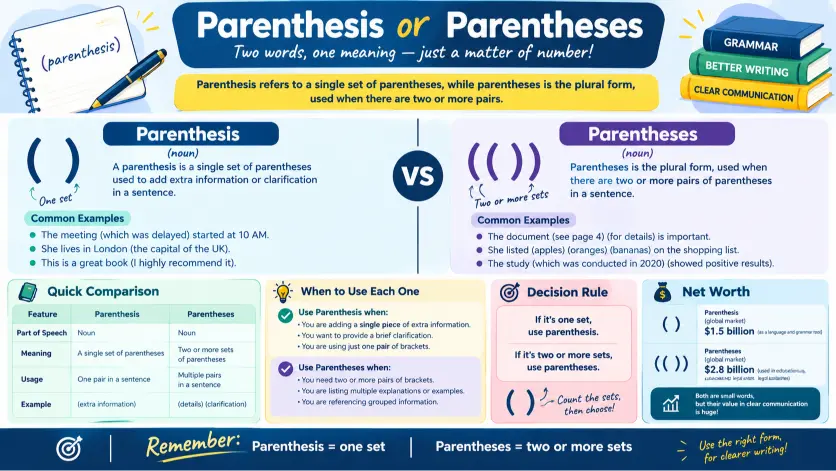
The easiest way to understand parenthesis or parentheses is to remember that parenthesis is singular, while parentheses is plural. For example, when discussing one curved punctuation mark, you can use the word parenthesis. When referring to a pair of curved marks, as in “(important information),” the correct term is parentheses. These terms are especially useful when explaining grammar rules, editing documents, or discussing punctuation with other writers. Learning how they work in context makes the difference easier to recognize and apply.
In this guide, you will explore the meanings of both words, learn the correct singular and plural forms, and discover practical sentence examples that demonstrate their usage. The explanations follow standard English grammar conventions and distinguish between punctuation terminology and everyday writing practices. Whether you are preparing an academic paper, improving your professional communication, or strengthening your English skills, this guide will help you choose the right term with confidence. By the end, you will understand when to use parenthesis and when to use parentheses without second-guessing yourself.
Parenthesis vs Parentheses: What’s the Difference?
The main difference between parenthesis and parentheses is grammatical number. Parenthesis is the singular noun, whereas parentheses is its plural form. Both terms describe supplementary information or the curved punctuation marks used to separate that information from the main sentence.
Although these words look similar, using them incorrectly can create confusion in school assignments, workplace documents, academic papers, and technical instructions. For example, a writer who refers to several pairs of curved marks as “a parenthesis” has used the singular form where the plural is needed.
Definition of Parenthesis
Parenthesis (noun): Parenthesis refers to a single explanatory remark, an inserted piece of information, or one of the curved punctuation marks used to enclose additional material.
For example, consider this sentence:
“Lena, who lives nearby, will attend the meeting.”
The phrase “who lives nearby” provides additional information about Lena. It functions parenthetically because the main sentence remains understandable without it.
Likewise, in the sentence “The word appears inside a parenthesis,” the noun refers to one curved mark, although writers more commonly discuss a pair of parentheses when referring to the complete enclosure.
Definition of Parentheses
Parentheses (plural noun): Parentheses refers to two curved punctuation marks, written as opening and closing brackets: ( ).
These marks enclose supplementary information, explanations, abbreviations, dates, numerical values, or references. For example:
“The meeting begins at 9 a.m. (local time).”
Here, the words “local time” provide clarification without changing the main statement.
Similarly, a writer might include a date in parentheses, while a mathematician might use parentheses to group numbers in an equation.
Parenthesis or Parentheses Comparison Table
| Feature | Parenthesis | Parentheses |
|---|---|---|
| Grammatical number | Singular | Plural |
| Part of speech | Noun | Plural noun |
| Meaning | One explanatory insertion or one curved mark | Two curved marks or multiple insertions |
| Written form | Parenthesis | Parentheses |
| Example | One parenthesis appears in the text. | Put the date in parentheses. |
| Common context | Grammar explanations and singular references | Writing, mathematics, citations, and editing |
Quick Recap
Parenthesis is singular, so use it when referring to one item.
Parentheses is plural, so use it when referring to the paired marks or multiple items.
The punctuation marks themselves are written as ( ).
In everyday writing, the plural form is more common because writers usually use both marks together.
Is Parenthesis vs Parentheses a Grammar, Vocabulary, or Usage Issue?
The distinction between parenthesis and parentheses is primarily a grammatical number issue. Both spellings are correct English words, but each serves a different grammatical purpose.
In addition, the words belong to a broader discussion of punctuation terminology. Understanding their meanings helps writers describe sentence structure accurately and follow standard editing conventions.
Are Parenthesis and Parentheses Interchangeable?
No. Although the words refer to closely related concepts, they aren’t interchangeable in every sentence.
For example, “One parenthesis is missing” uses the singular form because the sentence refers to one mark. By contrast, “The parentheses are missing” refers to the complete pair.
However, the singular term can also refer to a complete parenthetical remark rather than just one punctuation mark. Therefore, context matters when interpreting the word.
Formal and Informal Usage
Both terms are appropriate in formal and informal English. Nevertheless, accurate usage becomes especially important in academic writing, technical documentation, proofreading, and professional communication.
In a workplace editing guide, an instruction might read, “Add the explanation in parentheses.” Conversely, a grammar lesson might explain, “A parenthesis can interrupt the flow of a sentence.”
In casual conversation, people sometimes call these marks brackets. However, terminology varies by region. In American English, parentheses usually refers to the curved marks ( ), while square brackets are written as [ ]. In British English, brackets can commonly refer to curved marks, so the intended meaning should be clear from context.
Academic and Everyday Contexts
In academic writing, parentheses often contain publication dates, brief explanations, citations, or abbreviations. For instance, a research paper might introduce a technical term followed by its abbreviation in parentheses.
Meanwhile, everyday writing uses parentheses to clarify times, add short comments, or include supplementary details.
Therefore, the grammatical distinction remains the same across contexts, even though the purpose of the punctuation may vary.
Practical Usage: When to Use Parenthesis
Use parenthesis when referring to one explanatory insertion or one curved punctuation mark. Although the singular form appears less frequently in ordinary writing, it remains important when discussing individual marks or grammatical concepts.
1. Workplace Example
Suppose an editor reviews a business report containing an unmatched opening mark.
Example: “The editor noticed that one parenthesis was missing from the final paragraph.”
Here, parenthesis is correct because the sentence refers to one missing mark.
Similarly, a style guide might explain that a parenthesis can separate a brief aside from the central message.
Example: “A parenthesis may contain a short clarification that isn’t essential to the main statement.”
2. Academic Example
In a grammar textbook, the singular noun can describe one explanatory insertion.
Example: “The parenthesis adds background information about the historical event.”
In this sentence, the word refers to the inserted explanation rather than necessarily to a single punctuation symbol.
Furthermore, a linguistics instructor might use the singular term when explaining how parenthetical expressions function within a sentence.
3. Technology Example
In programming and software documentation, individual opening and closing marks are important for syntax and grouping.
Example: “The parser identified an unmatched opening parenthesis in the expression.”
This usage is common when diagnosing code errors. In many programming languages, a missing closing mark can prevent an expression from being interpreted correctly.
Usage Recap
Choose parenthesis when discussing one mark or one explanatory insertion. However, determine whether the sentence refers to a punctuation symbol or a complete parenthetical remark before deciding on the most precise wording.
Practical Usage: When to Use Parentheses
Use parentheses when referring to the pair of curved marks or multiple parenthetical elements. Because supplementary information is commonly enclosed between an opening and a closing mark, this plural form appears frequently in everyday writing.
1. Workplace Example
In professional reports, parentheses can clarify dates, abbreviations, or brief details.
Example: “The quarterly review will take place on Thursday (October 22).”
The date provides extra information without interrupting the main statement.
Likewise, a project manager might write, “The team completed the first phase (including testing and documentation) ahead of schedule.”
The enclosed phrase explains what the phase involved.
2. Academic Example
Academic writers often use parentheses to introduce abbreviations or clarify specialized terminology.
Example: “The study examined second language acquisition (SLA) among adult learners.”
Here, the abbreviation appears inside parentheses after the full term.
Similarly, a paper might include a brief citation in parentheses, depending on the required referencing style.
Example: “The results support the proposed explanation (Smith, 2024).”
The exact citation format depends on the academic style being followed.
3. Technology Example
Parentheses play an important role in mathematics, spreadsheets, and computer programming.
Example: “Enter the expression (8 + 4) × 3 to specify which operation should occur first.”
Likewise, a programmer might write a function call with arguments enclosed in parentheses.
Example: “The function accepts two values inside its parentheses.”
Consequently, correct placement can affect both readability and the interpretation of an expression.
Usage Recap
Choose parentheses when referring to a pair of curved marks or multiple enclosed elements. In addition, make sure the opening and closing marks are correctly placed.
When You Should NOT Use Parenthesis or Parentheses
Several common mistakes occur when writers confuse grammatical number, punctuation terminology, and sentence structure. Fortunately, a few practical rules can prevent these errors.
- Don’t use parenthesis when referring to the complete pair of marks. Write “Put the phrase in parentheses” rather than “Put the phrase in parenthesis.”
- Don’t use parentheses when referring to one missing mark. If only one opening symbol is missing, use the singular noun.
- Don’t confuse curved parentheses with square brackets. The marks ( ) are parentheses in American English, whereas [ ] are square brackets.
- Don’t add unnecessary parenthetical information. Too many asides can make a sentence difficult to follow and distract readers from the main point.
- Don’t leave a parenthetical expression unclosed. When using a pair of parentheses, include both the opening and closing marks unless the notation follows a specialized convention.
- Don’t assume every aside requires parentheses. Commas or other punctuation may work better, depending on the sentence and the emphasis intended.
- Don’t place essential information in parentheses without considering clarity. If a detail is necessary to understand the main argument, it may deserve a direct statement instead.
- Don’t confuse grammatical number with the number of words inside the marks. A long explanation can still be one parenthesis, while several separate explanations may be described as parentheses or parenthetical remarks.
Ultimately, select the term that matches the meaning and make sure the punctuation supports the sentence rather than interrupting it unnecessarily.
Common Mistakes and Decision Rules
The following table illustrates common errors and their corrections.
| Correct sentence | Incorrect sentence | Explanation |
|---|---|---|
| One parenthesis is missing. | One parentheses is missing. | One requires the singular noun. |
| Place the date in parentheses. | Place the date in parenthesis. | The complete pair of marks is intended. |
| The parentheses are balanced. | The parenthesis are balanced. | The plural noun agrees with the verb. |
| A parenthesis can contain an aside. | A parentheses can contain an aside. | The singular form describes one insertion. |
| The opening parenthesis is unmatched. | The opening parentheses is unmatched. | One opening mark is being discussed. |
| Both parentheses are necessary. | Both parenthesis are necessary. | Both requires a plural noun. |
| The expression contains two parentheses. | The expression contains two parenthesis. | Two requires the plural form. |
| The parenthesis adds useful context. | The parentheses adds useful context. | The singular subject takes a singular verb. |
A Simple Decision Rule
If you mean one explanatory insertion or one curved punctuation mark, use parenthesis.
If you mean the paired curved marks or multiple parenthetical elements, use parentheses.
For example, “One parenthesis is missing” identifies an individual mark. By contrast, “The parentheses enclose the date” refers to the complete pair.
As an additional check, look at the verb. A singular subject generally takes a singular verb, while the plural noun parentheses generally takes a plural verb.
Parenthesis and Parentheses in Modern Technology and Digital Writing
Modern writing applications, word processors, and code editors often help users insert matching punctuation marks automatically. Nevertheless, automatic correction doesn’t guarantee that the terminology or sentence structure is accurate.
For example, a code editor may highlight an unmatched opening parenthesis because a closing mark is missing. Similarly, a word processor may insert a closing mark when the user types an opening one.
However, these features don’t always explain whether a writer should use the singular or plural noun in a sentence about punctuation.
In spreadsheets, parentheses can also influence how calculations are grouped. For instance, the expression (8 + 4) × 3 produces a different result from 8 + 4 × 3 because the grouped addition is evaluated first.
In digital documentation, clear terminology helps readers distinguish between an individual symbol, a matching pair, and a larger expression. Therefore, writers should understand the rule rather than relying entirely on automated punctuation features.
Etymology: Where Do Parenthesis and Parentheses Come From?
The word parenthesis comes from Greek through Latin and later entered English. Its historical sense is associated with something inserted beside or within a statement.
Over time, the term developed into a grammatical label for supplementary material that interrupts or adds information to a sentence. It can refer to the inserted expression itself or, in certain contexts, an individual curved punctuation mark.
Parentheses is the plural form of parenthesis. Its spelling follows a pattern found in several English words derived from Greek, where singular nouns ending in certain forms take distinctive plural endings.
For example, analysis becomes analyses, while basis becomes bases. Similarly, parenthesis becomes parentheses.
Although these forms may appear irregular to English learners, they reflect historical patterns rather than random spelling changes. Consequently, learning the singular and plural forms together makes them easier to remember.
An Expert Perspective on Parenthetical Writing
A useful editorial principle is to ensure that supplementary information supports the main statement instead of obscuring it.
“Parentheses work best when they clarify a sentence without distracting readers from its central message.”
This is a general writing guideline rather than a quotation attributed to a specific grammar authority.
For example, the sentence “The meeting begins at noon (local time)” uses parentheses effectively because the extra detail is short and useful.
However, a sentence filled with several unrelated asides may become difficult to understand. In that situation, separate sentences or clearer punctuation may improve readability.
Therefore, good punctuation depends on more than grammatical correctness. It also requires judgment about emphasis, sentence length, and the reader’s needs.
Two Practical Case Studies
The following illustrative case studies demonstrate how understanding the distinction can improve writing and technical accuracy. The results are examples of likely corrections, not independently measured research findings.
Case Study 1: Editing a Business Report
A communications team reviews a report that contains the sentence:
“Please include the deadline in parenthesis.”
The editor notices that the instruction refers to a date enclosed by a complete pair of curved marks. Therefore, the sentence is revised to:
“Please include the deadline in parentheses.”
The correction aligns the wording with the intended punctuation and makes the instruction more precise.
Result: The revised instruction clearly indicates that the deadline should be enclosed within a pair of curved marks.
Case Study 2: Correcting a Programming Error
A student writes an expression in a programming exercise and receives an error because an opening parenthesis has no matching closing mark.
The original note reads:
“The code contains unmatched parentheses.”
However, the diagnostic identifies exactly one unmatched opening symbol. The student revises the note to:
“The code contains an unmatched opening parenthesis.”
The corrected sentence accurately describes the problem rather than implying that multiple marks are unmatched.
Result: The revised explanation identifies the specific punctuation error and helps the student locate the problem more efficiently.
These examples show that correct terminology improves both everyday communication and technical explanations.
Error Prevention Checklist
Before submitting a document, review the following checklist to ensure that singular and plural forms are correct.
Always Use Parenthesis When
- Referring to one curved punctuation mark.
- Describing one explanatory insertion in a sentence.
- Identifying a single unmatched opening or closing mark.
- Explaining the grammatical function of one parenthetical expression.
- Using a singular subject that requires a singular verb.
Never Use Parentheses When
- Referring specifically to only one punctuation mark.
- Describing one explanatory insertion as a singular noun.
- Pairing a singular subject with a plural verb simply because the word looks longer.
- Assuming that the plural form is correct whenever the enclosed text contains several words.
Always Use Parentheses When
- Referring to the paired marks ( ).
- Enclosing dates, abbreviations, citations, or short explanations.
- Discussing multiple parenthetical elements.
- Grouping expressions in mathematics or programming.
- Explaining how opening and closing marks work together.
Remember that the word’s grammatical number depends on what it describes, not on how long the enclosed text happens to be.
Related Grammar Confusions You Should Master
Once you understand parenthesis and parentheses, learning other commonly confused forms can improve your writing.
- Analysis vs analyses: Analysis is singular, whereas analyses is plural.
- Basis vs bases: Basis refers to one foundation or principle, while bases refers to multiple foundations.
- Criterion vs criteria: Criterion is singular, whereas criteria is plural.
- Phenomenon vs phenomena: Phenomenon identifies one occurrence, while phenomena identifies multiple occurrences.
- Datum vs data: Datum is historically singular, while data is its plural form, although data is also widely used as a mass noun.
- Affect vs effect: Affect is usually a verb meaning to influence, whereas effect is usually a noun meaning a result.
- Its vs it’s: Its indicates possession, while it’s means “it is” or “it has.”
- Comma vs semicolon: A comma separates elements within a sentence, while a semicolon can connect closely related independent clauses.
- Brackets vs parentheses: Terminology varies by region, so identify the exact punctuation marks when precision matters.
- Quotation marks vs parentheses: Quotation marks identify quoted material, whereas parentheses enclose supplementary information.
These distinctions help writers improve grammatical accuracy, punctuation, and clarity across different types of communication.
Frequently Asked Questions
1. What is the difference between parenthesis and parentheses?
Parenthesis is singular, while parentheses is plural. The singular form can refer to one curved punctuation mark or one inserted explanation. The plural form usually refers to the pair of curved marks, written as ( ), or multiple parenthetical elements.
2. Is parenthesis singular or plural?
Parenthesis is singular. For example, “The opening parenthesis is missing” refers to one punctuation mark. Its plural form is parentheses, which is used when discussing multiple marks or the complete pair.
3. Is parentheses singular or plural?
Parentheses is plural. For example, “The parentheses are correctly placed” refers to the opening and closing marks. In standard usage, the plural noun normally takes a plural verb such as are rather than is.
4. Should I write information in parenthesis or parentheses?
When referring to the usual pair of curved punctuation marks, write “information in parentheses.” For example, “The author placed the publication date in parentheses.” This is the conventional expression in American English.
5. What is one parenthesis called?
One of the curved marks, either ( or ), can be called a parenthesis. The opening mark is an opening parenthesis, while the closing mark is a closing parenthesis.
6. What are parentheses used for in writing?
Parentheses enclose supplementary information, short explanations, abbreviations, dates, and certain citations. They can clarify a statement without making the extra material part of the sentence’s main grammatical structure.
7. Are parentheses and brackets the same thing?
The terminology depends partly on regional convention. In American English, parentheses usually refers to curved marks ( ), while square brackets are written as [ ]. In British English, brackets can refer to curved marks, so context is important.
8. Do parentheses require a closing mark?
Ordinarily, yes. An opening parenthesis should have a matching closing parenthesis. However, specialized mathematical, programming, or editorial notation can follow its own conventions. In normal prose, unmatched marks are generally punctuation errors.
9. How do I remember parenthesis vs parentheses?
Remember that parenthesis is singular and parentheses is plural. When you mean the usual pair of curved marks, choose parentheses. When you mean one individual mark or one explanatory insertion, choose parenthesis.
Conclusion:
The difference between parenthesis and parentheses becomes straightforward once you understand grammatical number. Parenthesis is the singular form, used for one curved punctuation mark or one explanatory insertion. Parentheses is the plural form, commonly used for the paired marks that enclose supplementary information.
Therefore, write “one parenthesis is missing” when referring to an individual mark. Conversely, write “put the date in parentheses” when discussing the complete pair.
In addition, remember that punctuation should support clarity. Although parentheses can provide useful context, excessive asides may distract readers from the main point. Use them thoughtfully, check that opening and closing marks match, and select the correct grammatical form.
Ultimately, understanding this small distinction helps you write more accurately in academic assignments, professional documents, technical explanations, and everyday communication.









