Have you ever paused while writing because you could not decide whether to use while or whilst? You are not alone. Both words can express the same idea, yet their usage often raises questions among students, professionals, and English learners. Some writers prefer one form because it sounds more natural, while others choose the alternative to create a particular tone. Understanding the distinction can help you write with greater confidence, especially when preparing academic assignments, professional emails, articles, or everyday messages.
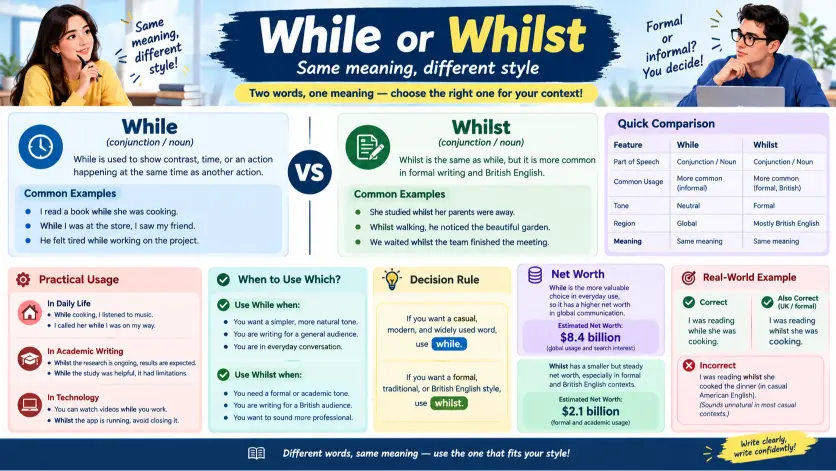
The good news is that while and whilst are both grammatically correct when used appropriately. They commonly introduce an action happening at the same time as another action, although while can also express contrast. The main difference lies in regional preference and writing style. While is widely used in both American and British English, whereas whilst is more common in British English and can sound slightly more formal or literary. Neither word is automatically wrong, and the surrounding sentence helps determine whether the chosen form fits naturally.
In this guide, you will explore the meanings of while or whilst, examine practical sentence examples, and learn how these words differ across English varieties. You will also discover when one form may be more suitable for academic writing, workplace communication, or casual conversation. The explanations follow standard English grammar and established usage patterns, helping you distinguish genuine grammatical rules from matters of personal preference. By the end, you will understand how to select the appropriate word for your audience, maintain a consistent writing style, and avoid common usage mistakes.
While vs Whilst: What’s the Difference?
The main difference between while and whilst concerns regional preference, tone, and frequency rather than meaning. Both words function primarily as conjunctions, connecting clauses that describe simultaneous events, contrasting situations, or circumstances.
For example, “She listened to music while studying” and “She listened to music whilst studying” communicate the same idea. Nevertheless, the first version generally sounds more natural to American readers, whereas the second may sound more traditional or formal to some British readers.
Importantly, whilst isn’t incorrect or outdated in every context. It remains an established part of English, especially in British usage. However, writers usually benefit from choosing the form that best suits their audience.
Definitions and Parts of Speech
While (conjunction and noun): As a conjunction, while introduces a dependent clause expressing time, contrast, or a related circumstance. For example, “While I cooked dinner, my brother set the table.” As a noun, it refers to a period of time, as in “Stay here for a while.”
Whilst (conjunction): Whilst performs the same principal conjunction functions as while. It can indicate simultaneous actions, introduce a contrast, or establish a circumstance. For example, “Whilst the proposal seems promising, further research is necessary.”
Although while has additional established uses as a noun, whilst is chiefly used as a conjunction in contemporary English.
Comparison Table
| Feature | While | Whilst |
|---|---|---|
| Part of speech | Conjunction and noun | Primarily conjunction |
| Main meaning | During the time that, although | During the time that, although |
| American English | Very common | Relatively uncommon |
| British English | Common | More traditional or formal in some contexts |
| Academic writing | Widely accepted | Accepted when used consistently |
| Casual conversation | Natural and common | May sound more formal |
| Example | While I waited, I read. | Whilst I waited, I read. |
Quick Recap
While and whilst can express the same meanings.
While is generally the safer choice for international and American audiences.
Whilst may suit certain British English contexts and a more traditional tone.
Neither word is inherently more grammatically correct than the other.
Is While vs Whilst a Grammar, Vocabulary, or Usage Issue?
The distinction between while and whilst is mainly a matter of usage, regional preference, and writing style. Both are legitimate English words, and both can introduce subordinate clauses. Therefore, using whilst instead of while doesn’t automatically create a grammatical error.
Nevertheless, the choice can influence how natural a sentence sounds to a particular audience. In American English, whilst may appear unusually formal or unfamiliar. In British English, it is more established, although while remains widely used.
Are While and Whilst Interchangeable?
In many sentences, yes. Both words can describe two events occurring at the same time.
For example:
“While the students worked, the teacher prepared the next activity.”
“Whilst the students worked, the teacher prepared the next activity.”
Both sentences express the same relationship between the events. However, the choice may affect the tone rather than the meaning.
Similarly, both forms can introduce a contrast.
“While the first option is inexpensive, the second offers greater flexibility.”
“Whilst the first option is inexpensive, the second offers greater flexibility.”
In these examples, the conjunction means something close to “although” or “whereas.”
Even so, not every use of while has an equally natural equivalent with whilst. Expressions such as “a little while” and “in a while” use while as a noun, so replacing it with whilst would be incorrect.
Formal and Informal Usage
While works comfortably in everyday conversation, business communication, journalism, and academic writing. Because it is widely recognized across English speaking regions, it is often the most practical choice.
Whilst can also appear in formal writing, particularly in British English. However, it shouldn’t be selected simply because a sentence sounds more sophisticated with a longer word.
For instance, “While the results are encouraging, more evidence is required” is clear and professional. Replacing while with whilst doesn’t necessarily improve the sentence.
Consequently, clarity and consistency matter more than perceived formality.
Academic and Casual Contexts
In academic writing, both forms are acceptable when used appropriately. However, universities, journals, and publishers may have their own style preferences. Therefore, writers should follow the relevant style guide rather than assume one form is universally preferred.
In casual messages, while is usually the more natural choice. For example, “I’ll call you while I’m on the bus” sounds conversational and straightforward.
Meanwhile, a British writer might naturally use whilst in a literary passage or a formal narrative. The choice depends on the intended voice, the audience, and the surrounding language.
Practical Usage: When to Use While
Use while when describing simultaneous actions, contrasting two ideas, or establishing the circumstances in which something happens. Because the word is familiar across many varieties of English, it works well in most writing situations.
1. Workplace Examples
In professional communication, while can connect two activities or qualify a statement.
Example: “While the design team reviews the draft, the project manager will update the schedule.”
This sentence shows that two activities will take place during the same period.
Similarly, while can introduce a qualification in a report.
Example: “While the proposal meets our initial requirements, several financial details need further review.”
Here, the conjunction acknowledges a positive point before introducing a limitation. As a result, the sentence sounds balanced and professional.
2. Academic Examples
In academic writing, while often introduces a comparison or describes simultaneous processes.
Example: “While the first experiment measured temperature, the second examined humidity.”
This construction makes the relationship between the experiments clear.
Likewise, a researcher might write, “While the findings support the hypothesis, the sample size limits the conclusions.”
The conjunction helps acknowledge supporting evidence while recognizing a limitation. Therefore, it can be useful when presenting a balanced argument.
3. Technology Examples
In technical documentation, while can explain simultaneous operations or conditions.
Example: “Save your work while the software installs the update.”
This instruction indicates that saving work should occur during the installation process, assuming the software permits it.
Another example is, “While the device connects to the network, the status indicator flashes.”
Here, the conjunction explains what happens during a particular stage of operation.
Usage Recap
Choose while for simultaneous activities, contrast, or context. In addition, use it as a noun when referring to a period of time, as in “Wait for a while.”
Practical Usage: When to Use Whilst
Use whilst when it fits your regional variety of English, desired tone, and sentence structure. Although it shares the main conjunction functions of while, it may sound more traditional or formal to some readers.
1. Workplace Examples
In British professional writing, whilst may appear in reports, correspondence, and policy documents.
Example: “Whilst the initial review is complete, the final approval remains outstanding.”
The sentence acknowledges progress while identifying unfinished work.
Similarly, a British workplace report might state, “Whilst the supplier has confirmed delivery, the installation date remains uncertain.”
However, writers should remember that while would also be correct in both examples. The choice is stylistic rather than a requirement of formal grammar.
2. Academic Examples
Whilst can introduce a contrast in an academic discussion, especially when the writer consistently follows British English conventions.
Example: “Whilst the first theory emphasizes individual behavior, the second focuses on social conditions.”
This construction presents two perspectives in a balanced manner.
Another example is, “Whilst the results suggest a relationship, they do not establish causation.”
Nevertheless, academic writing should prioritize clarity. If whilst feels unnatural or inconsistent with the surrounding prose, while is usually a straightforward alternative.
3. Technology Examples
Whilst can also appear in British technical documentation.
Example: “Whilst the application is updating, avoid disconnecting the device from its power source.”
The sentence describes a temporary condition during an ongoing process.
Another example is, “Whilst the database is being restored, access to certain records may be unavailable.”
Even here, while would communicate the same information. Consequently, technical accuracy depends on the instruction itself, not the choice between these conjunctions.
Usage Recap
Choose whilst when it suits your British English style or intended voice. However, don’t use it merely to make ordinary writing appear more sophisticated.
When You Should NOT Use While or Whilst
Although these conjunctions are often interchangeable, several situations require particular attention.
- Don’t use whilst as a noun meaning a period of time. Write “Stay for a while,” not “Stay for a whilst.”
- Don’t replace every occurrence of while automatically. In expressions such as “a while ago,” the noun while must remain unchanged.
- Don’t assume whilst is always more formal or more correct. Both forms are grammatically acceptable in appropriate conjunction uses.
- Don’t mix regional styles without a reason. If your document consistently follows American English, while is generally the more natural choice.
- Don’t use whilst simply to impress readers. Unnecessary formality can make otherwise clear writing feel stiff.
- Don’t create ambiguity when describing simultaneous events. If the timing matters, rewrite the sentence to make the sequence explicit.
- Don’t use either conjunction when a clearer structure is needed. For example, separate complex instructions into shorter sentences when the relationship between events becomes difficult to follow.
- Don’t overlook punctuation. When a dependent clause beginning with while or whilst comes before the main clause, a comma generally separates the two clauses.
For example, “While the machine was running, the technician monitored its temperature.” However, when the dependent clause follows the main clause, a comma is often unnecessary: “The technician monitored the temperature while the machine was running.”
Common Mistakes and Decision Rules
The following examples illustrate appropriate usage and common errors.
| Correct sentence | Incorrect sentence | Explanation |
|---|---|---|
| While I waited, I read a book. | Whilst I waited, I read a book. | The second sentence is not grammatically incorrect, although it may suit a different regional style. |
| Stay for a while. | Stay for a whilst. | While is a noun in this expression. |
| Whilst the results are promising, further testing is necessary. | Whilst the results is promising, further testing is necessary. | The subject and verb must agree. |
| I listened while she explained the process. | I listened whilst she explained the process. | Both versions are correct conjunction uses. |
| While the first option is cheaper, the second is faster. | While the first option is cheaper the second is faster. | A comma separates the introductory dependent clause from the main clause. |
| I’ll finish the report while you check the figures. | I’ll finish the report during whilst you check the figures. | During and whilst cannot be combined in this way. |
| I haven’t seen him in a while. | I haven’t seen him in a whilst. | The noun expression requires while. |
| While the system restarts, the screen may go blank. | While the system restarts, the screen may goes blank. | The modal verb may takes the base form go. |
A Simple Decision Rule
If you mean “during the time that” or want to introduce a contrast, use while or whilst according to your audience and style.
If you mean a period of time as a noun, use while.
For example, “While I worked, she prepared lunch” describes simultaneous activities. By contrast, “I worked for a while” uses while as a noun.
For most international readers, while is the simplest default. Meanwhile, whilst remains a valid option when it suits the writer’s regional style.
While and Whilst in Modern Technology and Digital Communication
In digital communication, both words appear in emails, online articles, educational materials, software instructions, and automated writing suggestions. Because their meanings overlap, a spelling checker may accept either form without considering whether it suits the intended audience.
For example, a document written for an American company may sound more natural with while throughout. Conversely, a British publication may retain whilst to match its established editorial voice.
Writing assistance tools can identify spelling and grammatical problems, but they may not always recognize subtle differences in regional tone. Therefore, writers should consider the audience and document style when reviewing suggested changes.
In software instructions, clarity remains particularly important. A sentence such as “Save your files while the update runs” communicates a simultaneous action directly. Replacing while with whilst rarely improves the instruction.
Ultimately, consistent terminology and clear sentence structure help readers understand the intended relationship between events.
Etymology: Where Do While and Whilst Come From?
The word while has a long history in English. It developed from Old English forms associated with a period of time and eventually became established as a conjunction introducing temporal relationships and contrasts.
Whilst developed as a variant of while, with the additional ending associated with older English word forms. Over time, it became particularly associated with British usage, although its frequency and tone have varied across periods and regions.
Despite its longer appearance, whilst doesn’t carry an inherently more sophisticated meaning. In most contemporary contexts, it performs the same conjunction functions as while.
The history of these words therefore helps explain why they can be used interchangeably in many sentences. Their modern distinction rests largely on regional convention, frequency, and stylistic preference rather than a fundamental difference in meaning.
An Expert Perspective on While vs Whilst
A useful principle in professional editing is to choose familiar wording unless a particular style or audience calls for something different.
“Effective writing depends on clarity, consistency, and context, not on choosing the longest available word.”
This is a general editorial principle rather than a quotation attributed to a specific linguist.
Applied to while and whilst, the principle suggests that writers should select the form that best serves their readers. For a general international audience, while is often the most accessible choice. For a British literary passage, whilst may contribute to the desired voice.
Neither word automatically makes a sentence more authoritative. Instead, accurate grammar, logical connections, and appropriate tone determine how successfully the sentence communicates its message.
Two Practical Case Studies
The following illustrative case studies demonstrate how choosing between while and whilst can improve consistency. Their outcomes are examples of editorial practice rather than independently measured research findings.
Case Study 1: Editing a Business Report
A company prepares a report for an international audience. Throughout the document, the writer uses American English spelling and familiar business vocabulary. However, one paragraph states:
“Whilst the first phase is complete, several tasks remain.”
The editor changes the sentence to:
“While the first phase is complete, several tasks remain.”
Both sentences are grammatically correct. Nevertheless, the revised version better matches the report’s established style and creates consistency across the document.
Result: The final report uses a consistent regional style and maintains a direct, professional tone.
Case Study 2: Revising a British Academic Essay
A university student writes an essay that consistently follows British English conventions. The draft uses whilst in several comparative passages but switches to while in one paragraph without a clear stylistic reason.
The student reviews the passage and chooses whilst to maintain the intended voice:
“Whilst the first interpretation emphasizes economic factors, the second examines cultural influences.”
Because both forms are acceptable, the revision is a stylistic decision rather than a correction of a grammatical error.
Result: The essay follows a more consistent editorial pattern without changing the argument or the meaning of the sentence.
These examples illustrate an important distinction: editing can improve consistency even when the original wording is technically correct.
Error Prevention Checklist
Before finalizing a sentence containing either conjunction, consider the following points.
Always Use While When
- Writing for a broad international audience and seeking a familiar expression.
- Following American English conventions.
- Referring to a period of time, as in “wait for a while.”
- Writing conversational messages or straightforward instructions.
- Maintaining a consistent style in a document that already uses while.
Never Use Whilst When
- You need a noun meaning a period of time.
- The expression is “a while ago,” “in a while,” or “for a while.”
- You are replacing a noun use of while with whilst.
- The substitution makes an otherwise clear sentence sound unnatural for your intended audience.
Check Both Forms When
- Introducing a contrast between two statements.
- Describing simultaneous events.
- Editing a formal British English document.
- Following a publication’s style guide.
- Reviewing punctuation around introductory dependent clauses.
This checklist reinforces the key principle: grammatical correctness and stylistic suitability are related, but they aren’t identical.
Related Grammar Confusions You Should Master
Understanding while and whilst also helps clarify other commonly confused English expressions.
- Although vs though: Both introduce contrast, although their placement and tone can differ.
- While vs whereas: Both can contrast ideas, but whereas is generally more explicitly comparative.
- During vs while: During is a preposition followed by a noun phrase, whereas while commonly introduces a clause.
- Since vs because: Since can express time or a reason, while because explicitly introduces a cause.
- Although vs despite: Although introduces a clause, whereas despite is followed by a noun phrase or a gerund.
- Among vs between: Between commonly identifies relationships involving distinct entities, while among often describes relationships within a group.
- Fewer vs less: Fewer generally refers to countable items, whereas less commonly refers to quantities or amounts.
- Who vs whom: Who commonly functions as a subject, while whom functions as an object in formal usage.
- That vs which: These words introduce different kinds of relative clauses depending on the construction and applicable style conventions.
- Can vs may: Can often expresses ability, while may commonly expresses permission or possibility.
Learning these distinctions improves grammatical accuracy and helps writers choose language that matches their intended meaning.
Frequently Asked Questions
1. What is the difference between while and whilst?
While and whilst generally have the same meaning when used as conjunctions. Both can describe simultaneous events or introduce contrasts. While is more common in American English, whereas whilst is more traditional or formal sounding in some British contexts.
2. Is whilst grammatically correct in English?
Yes. Whilst is a standard English conjunction. It can introduce temporal relationships and contrasts, just as while does. However, its suitability depends on the intended audience, regional variety, and style of the document.
3. Should I use while or whilst in academic writing?
Both are acceptable in academic writing. Nevertheless, while is widely recognized and generally works well for international audiences. If a university or journal specifies a style preference, follow that guidance consistently.
4. Is whilst more formal than while?
Whilst can sound more formal or traditional to some readers, particularly in British English. However, this impression isn’t universal, and the word isn’t automatically more appropriate for professional writing. Clarity and consistency are more important than perceived formality.
5. Do Americans use whilst?
Americans may recognize and occasionally use whilst, but it is considerably less common in American English than while. Therefore, writers addressing an American audience will usually find while more natural.
6. Do British people say while or whilst?
Both forms are used in Britain. While is common in everyday speech and writing, while whilst may appear in more traditional, literary, or formal contexts. Individual preferences vary, so neither form represents every British speaker.
7. Can I use whilst instead of while in every sentence?
No. Whilst can replace while in many conjunction uses, but it cannot replace the noun in expressions such as “a while,” “for a while,” or “in a while.” In those constructions, while is the correct word.
8. Is there a difference between while and whilst in meaning?
Usually, no meaningful difference exists when the words function as conjunctions. Both can introduce simultaneous events or contrasts. Their main distinction in modern English concerns regional frequency, tone, and editorial preference.
9. Which word is better for professional emails, while or whilst?
While is generally the safest choice for professional emails because it sounds natural to a wide range of readers. However, whilst can be appropriate in British correspondence when it matches the writer’s usual style and the organization’s conventions.
Conclusion:
Choosing between while and whilst is primarily a matter of style, audience, and regional preference. Both words can introduce simultaneous actions and contrasting ideas, so neither is inherently more grammatically correct in those contexts.
While is generally the most practical option for American English, international communication, workplace messages, and everyday writing. Meanwhile, whilst remains an acceptable alternative, particularly in British English and some formal or literary contexts.
However, remember that while also functions as a noun in expressions such as “for a while” and “in a while.” In these cases, whilst cannot replace it.
Ultimately, the best approach is to consider the grammatical function, intended meaning, and readers before choosing a word. By prioritizing clarity and consistency, you can write naturally without worrying unnecessarily about which form sounds more sophisticated.









