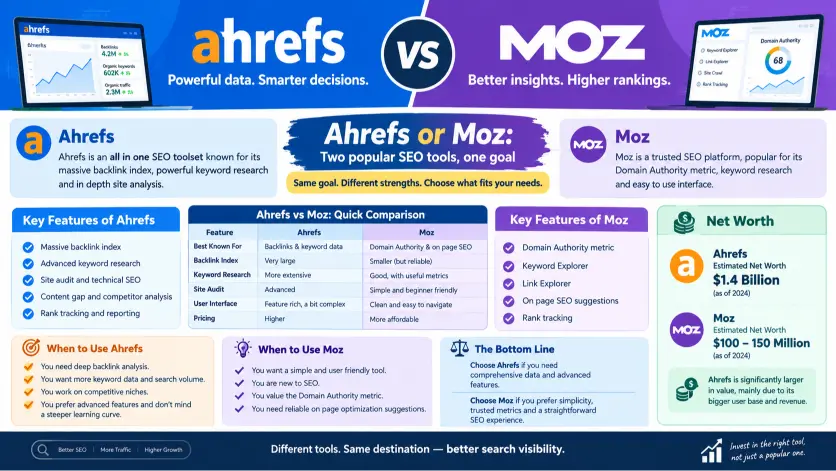
Choosing the right digital marketing tool can make a significant difference in how you research keywords, analyze competitors, and improve your website. However, when comparing Ahrefs or Moz, many website owners and marketers find it difficult to decide which platform best suits their goals. Both tools offer valuable features for understanding search performance, exploring backlinks, and identifying opportunities to improve a website’s visibility. Yet, they differ in their interfaces, data, pricing structures, and specialized capabilities. Understanding these differences can help you avoid paying for features you rarely use and choose a platform that fits your actual needs.
Ahrefs is widely known for its backlink database, competitor analysis, keyword research, and content discovery capabilities. Moz, meanwhile, is recognized for its accessible marketing tools, Domain Authority metric, keyword research features, and link analysis resources. Neither platform is automatically the best choice for every user. The right option depends on your experience, budget, website size, research priorities, and preferred workflow. Comparing their features in context is more useful than relying on brand popularity or isolated performance claims.
In this guide, we will examine Ahrefs and Moz across important areas, including keyword research, backlink analysis, competitor insights, site auditing, usability, and pricing considerations. We will also explain their strengths and limitations so that beginners, bloggers, business owners, and experienced digital marketers can make a more informed decision. By focusing on practical differences rather than promotional claims, this comparison will help you identify which platform aligns most closely with your objectives and long term website growth plans.
Ahrefs vs Moz: What’s the Difference?
Ahrefs and Moz are subscription based software platforms designed to help users understand website performance in search results. Although both offer keyword research, backlink analysis, and site auditing, they differ in their strengths, workflows, metrics, and overall approach to website optimization.
Ahrefs is particularly recognized for its extensive backlink research capabilities, competitor analysis, and tools for exploring search demand. Moz, meanwhile, is well known for Domain Authority, keyword discovery, link analysis, and accessible educational resources.
However, neither platform guarantees higher rankings. Instead, both help users gather information, identify opportunities, and make better informed decisions about their websites.
What Is Ahrefs?
Ahrefs is a digital marketing platform and proper noun used as a brand name. It provides tools for researching keywords, analyzing backlinks, reviewing competing websites, monitoring search visibility, and identifying technical problems.
For example, a website owner can investigate which pages attract links, discover search terms associated with competing sites, and examine opportunities for creating more useful content.
Additionally, Ahrefs provides data that can help content teams assess competing pages and identify gaps in their coverage. Its usefulness depends on the quality of the research, the selected market, and how effectively users interpret the findings.
What Is Moz?
Moz is another digital marketing software brand offering tools for keyword research, link analysis, site auditing, and search performance monitoring. Its product range includes Moz Pro, while its educational resources explain important concepts in website optimization.
One of Moz’s best known metrics is Domain Authority, commonly abbreviated as DA. This score estimates a website’s relative ability to rank based on link related signals. Importantly, DA is a Moz metric, not a score used directly by Google’s ranking systems.
Similarly, Moz helps users identify keyword opportunities, evaluate competing websites, and examine technical issues that may affect their online visibility.
Ahrefs and Moz Comparison Table
| Feature | Ahrefs | Moz |
|---|---|---|
| Main purpose | Search research, backlinks, competitor analysis | Keyword research, link analysis, site optimization |
| Keyword research | Extensive keyword discovery and competitor insights | Keyword suggestions and difficulty estimates |
| Backlink analysis | A major platform strength | Link research and comparison tools |
| Authority metric | Domain Rating, or DR | Domain Authority, or DA |
| Technical auditing | Site auditing and issue discovery | Site auditing and issue discovery |
| Competitor research | Strong emphasis on competing websites and pages | Competitor analysis and keyword comparison |
| Beginner experience | Broad feature set with a learning curve | Accessible tools and educational guidance |
| Best suited to | Detailed backlink and competitor investigations | Users who value DA, keyword research, and guided workflows |
Quick Recap
Ahrefs is especially useful for detailed backlink research and competitor analysis.
Moz offers useful keyword research, link analysis, and its established Domain Authority metric.
Both platforms support website auditing and content planning.
Neither authority score is an official Google ranking score, so use these metrics as comparative indicators rather than guarantees.
Is Ahrefs vs Moz a Feature, Pricing, or Usage Issue?
The comparison between Ahrefs and Moz is a software selection decision rather than a grammar or vocabulary issue. The most useful choice depends on the work you need to complete, the amount you can spend, and the level of detail required in your reports.
Are Ahrefs and Moz Interchangeable?
Partly. Both platforms support keyword discovery, backlink research, competitor analysis, and website auditing. Therefore, they overlap in several important areas.
Nevertheless, their data, interfaces, metrics, and available features differ. A team that relies heavily on backlink investigations may prefer Ahrefs, while another team may appreciate Moz’s authority metric and educational approach.
Furthermore, users shouldn’t assume that matching features produce identical results. Search databases, keyword estimates, link indexes, and scoring methods can vary between providers.
Formal and Informal Business Use
For professional reporting, explain which platform supplied each metric. For example, a report should identify Domain Rating as an Ahrefs metric and Domain Authority as a Moz metric.
In casual discussions, people sometimes compare the two scores as if they were equivalent. However, this can lead to misleading conclusions because each provider uses its own methodology.
Consequently, use consistent metrics when tracking progress over time, and clearly identify the source whenever comparing different websites.
Academic and Practical Evaluation
In a research project, a student might compare backlink estimates from both platforms to examine differences in commercial data sources. Such a comparison should document the date, target websites, and methodology.
In everyday business, a website owner may simply want to identify promising keywords or discover why competitors attract links. In that situation, practical usability and the relevance of the results may matter more than theoretical differences between scoring systems.
Ultimately, choose the platform that answers your questions reliably and fits your workflow.
Practical Usage: When to Choose Ahrefs
Ahrefs is a strong candidate when your primary objective is understanding competing websites, examining backlink profiles, and finding content opportunities. Its research tools are particularly valuable for publishers, consultants, and teams managing several websites.
1. Workplace Example
A content manager wants to understand why a competing publication attracts more visitors to its educational articles. Using Ahrefs, the team investigates competing pages, reviews referring websites, and discovers topics that competitors cover more comprehensively.
For example, the manager identifies several relevant articles that attract links from reputable industry publications. Consequently, the team can plan original research or a more useful guide rather than simply copying existing content.
2. Academic Example
A marketing student is investigating how external links relate to website visibility. Ahrefs can provide backlink information for a selected group of websites, allowing the student to compare referring domains and linking page characteristics.
However, the student must acknowledge that third party databases may not contain every link. Furthermore, a relationship between backlinks and visibility does not establish that links alone caused a ranking change.
3. Technology Example
A technical specialist wants to review a large website for broken links, missing page information, and other discoverable issues. Ahrefs Site Audit can help identify problems that deserve further investigation.
Nevertheless, automated reports should be reviewed alongside actual website behavior. Some reported issues may have limited practical impact, while others may require checking the website’s source code or server configuration.
Usage Recap
Choose Ahrefs when detailed competitor investigations, backlink discovery, and content opportunity research are central to your work. However, evaluate its findings carefully instead of assuming that every reported opportunity will produce measurable growth.
Practical Usage: When to Choose Moz
Moz can be a suitable option for users who want keyword research, backlink information, authority comparisons, and accessible reporting tools. In particular, its Domain Authority metric is familiar to many content professionals and website owners.
1. Workplace Example
A marketing consultant needs to compare several potential publishing partners before recommending where a client might contribute an article.
Using Moz, the consultant reviews Domain Authority alongside relevant link information and website quality. The consultant then checks whether each publication reaches the intended audience and publishes trustworthy, relevant material.
As a result, the final recommendation can consider more than a single numerical score.
2. Academic Example
A student compares authority estimates for a collection of websites in the same industry. Moz provides Domain Authority values that can be recorded and compared at a specific point in time.
To keep the study meaningful, the student documents the measurement date and explains that DA is a third party predictive metric. The analysis also considers other factors, such as content relevance, referring domains, and the purpose of each website.
3. Technology Example
A website manager uses Moz tools to explore keywords and review possible site problems. The findings help the team decide which pages deserve additional research and which technical issues need attention.
However, the team should verify important findings using its own analytics, search performance reports, and technical testing. No single platform provides a complete picture of website health.
Usage Recap
Choose Moz when its keyword tools, link research, Domain Authority metric, and reporting experience match your needs. Nevertheless, assess the complete toolset rather than selecting a platform solely because one metric is familiar.
When You Should NOT Use Ahrefs or Moz
Although both platforms can support informed decisions, neither is necessary for every website or business. Consider these situations before committing to a paid subscription.
- When you need only basic traffic reporting. Your existing analytics platform may already provide the information you need about visits, engagement, and conversions.
- When your website has very limited needs. A small personal website may not require extensive competitor databases or advanced backlink research.
- When you expect guaranteed rankings. Neither Ahrefs nor Moz can promise that a keyword will reach the first page of search results.
- When you treat authority metrics as official ranking scores. Domain Rating and Domain Authority are provider specific estimates, not direct Google ranking measurements.
- When you need exact traffic figures for competitors. Third party estimates are not equivalent to access to another website’s private analytics records.
- When you have no time to interpret reports. Buying sophisticated software without acting on its findings may provide little practical benefit.
- When your primary need is publishing content. Neither tool replaces editorial judgment, subject knowledge, original research, or the ability to answer readers’ questions clearly.
- When you choose entirely by price. A less expensive subscription can still be poor value if it lacks the features your team regularly uses.
Therefore, identify your most important tasks before deciding whether either platform is worth the expense.
Common Mistakes and Decision Rules
A careful evaluation prevents misunderstandings about what these platforms measure and how their results should be interpreted.
| Correct statement | Incorrect statement | Explanation |
|---|---|---|
| Ahrefs provides a Domain Rating metric. | Ahrefs provides Moz’s Domain Authority score. | These are different provider metrics. |
| Moz provides Domain Authority. | Domain Authority is Google’s official ranking score. | DA is a third party estimate. |
| Both tools offer backlink research. | Both tools always report identical backlinks. | Their databases and discovery methods differ. |
| Keyword estimates help guide research. | Keyword estimates guarantee future traffic. | Actual performance depends on many factors. |
| Competitor traffic figures are estimates. | A third party tool reveals exact private analytics. | External estimates cannot replace direct access. |
| Technical reports require interpretation. | Every audit warning must be fixed immediately. | Priority depends on severity and context. |
| Subscription value depends on actual usage. | The most expensive plan is always best. | Different businesses have different requirements. |
A Simple Decision Rule
If you need detailed backlink investigations and competitor research, start by evaluating Ahrefs.
If you value Domain Authority, keyword discovery, and Moz’s reporting approach, evaluate Moz.
Before subscribing, list the tasks you perform every week. Then test whether the relevant features save time, reveal useful opportunities, or improve your decisions.
Ahrefs and Moz in Modern Technology and Research Tools
Both platforms operate within a wider ecosystem of analytics, website auditing, content planning, and reporting software. Therefore, their greatest value often comes from combining their findings with other reliable information.
For example, a keyword research report can suggest topics worth investigating. However, the final decision should also consider search intent, the quality of existing results, audience needs, and whether your website can provide a genuinely useful answer.
Similarly, a backlink report may reveal relevant publications, yet every potential link deserves a quality review. Relevance, editorial standards, audience fit, and natural placement matter more than simply collecting a large number of links.
Automated recommendations can also help organize large amounts of information. Nevertheless, human review remains important because a tool cannot always understand a business’s objectives, expertise, or audience as effectively as its own team.
Consequently, use Ahrefs and Moz as research aids rather than substitutes for thoughtful planning.
Etymology and Origins of Ahrefs and Moz
Ahrefs and Moz are brand names rather than ordinary English vocabulary terms. Their histories reflect the development of software products designed to help website owners understand their online visibility.
Ahrefs takes its name from the technical abbreviation “href,” commonly associated with the HTML attribute that specifies a link destination. This connection fits the platform’s longstanding emphasis on link analysis and website research.
Moz developed from a company focused on helping marketers understand and improve website visibility. Over time, its brand became closely associated with educational resources, keyword research, link analysis, and the Domain Authority metric.
Although the two companies operate in the same broad market, their identities and product histories are distinct. Therefore, understanding their individual strengths is more useful than assuming that similar product categories mean identical capabilities.
An Expert Perspective on Choosing the Right Platform
A useful principle in software evaluation is to judge a product by the quality of the decisions it enables, not simply by the number of features it contains.
“Choose the research tool that helps you identify meaningful opportunities and turn reliable information into practical improvements.”
This is a general professional guideline rather than a quotation attributed to a specific industry expert.
For example, a publisher may benefit most from detailed backlink investigations because earning relevant editorial references is a major priority. Conversely, a small consultancy may prefer a straightforward process for reviewing keywords and comparing website authority.
In either situation, the best platform is the one that supports consistent work without creating unnecessary complexity.
Two Practical Case Studies
The following examples are illustrative scenarios, not independently verified customer results. Their numerical outcomes demonstrate how teams might measure the value of a research workflow.
Case Study 1: A Publisher Investigates Competitor Content
A specialist publisher wants to expand its library of educational articles. The editorial team uses Ahrefs to investigate competing pages, review referring domains, and identify subjects that existing articles address incompletely.
After reviewing the results, the team identifies 18 possible content opportunities. It then narrows the list to five topics that match its expertise and audience needs.
Over the following planning cycle, the team creates five original resources with clearer explanations and more complete coverage. It subsequently monitors impressions, engagement, relevant backlinks, and conversions to evaluate their performance.
Result: The research process turns 18 initial ideas into five prioritized assignments. This provides a concrete planning outcome, although improvements in rankings or traffic would require separate measurement.
Case Study 2: A Consultancy Improves Its Reporting Process
A small consultancy wants a consistent way to compare potential publishing partners. Its team uses Moz to collect Domain Authority values and reviews each publication’s subject relevance, editorial quality, and audience.
Initially, the team considers 30 websites. After applying its evaluation criteria, it selects eight for closer review and identifies four suitable outreach prospects.
The consultancy records the measurement date and keeps authority metrics separate from its final quality assessment.
Result: The process reduces 30 initial candidates to eight shortlisted websites and four outreach prospects. These figures illustrate a more organized workflow, not a verified improvement in search rankings.
Both examples demonstrate that research tools become more useful when teams define a clear objective and measure the resulting work.
Error Prevention Checklist
Before choosing a platform, review the following points.
Always Consider Ahrefs When
- Detailed backlink research is a central requirement.
- You need to investigate competing websites and pages.
- Your team regularly searches for content opportunities.
- Your workflow depends on examining referring domains and link profiles.
- The available research features justify the subscription cost.
Always Consider Moz When
- Domain Authority is useful in your reporting process.
- You want to investigate keywords and website links.
- The available tools fit your team’s experience and workflow.
- You need consistent authority comparisons across selected websites.
- The platform’s features provide sufficient value for your budget.
Never Assume That
- Domain Rating and Domain Authority use identical calculations.
- A high authority score guarantees strong rankings.
- Competitor traffic estimates represent exact analytics figures.
- Every audit warning requires immediate action.
- Purchasing a subscription automatically improves website performance.
Ultimately, the right decision comes from matching the platform to your needs and reviewing its practical value over time.
Related Digital Marketing Comparisons You Should Explore
Several related comparisons can help you understand how research platforms fit into a broader website improvement strategy.
- Domain Rating vs Domain Authority: Understand why the two metrics differ and how to interpret them responsibly.
- Keyword difficulty vs search volume: Learn how competition estimates and search demand influence topic selection.
- Backlinks vs referring domains: Discover the difference between individual links and the websites that provide them.
- Organic traffic vs total traffic: Understand how different visitor sources affect reporting.
- Keyword research vs content research: Distinguish search term discovery from the broader process of understanding audience needs.
- Technical auditing vs content auditing: Separate website functionality issues from problems with clarity, relevance, and completeness.
- Search impressions vs clicks: Learn why appearing in results does not always lead to visits.
- Domain authority vs page authority: Compare website level estimates with metrics focused on individual pages.
- Competitor analysis vs market research: Understand how direct website comparisons differ from studying an entire audience or industry.
- Traffic growth vs conversion growth: Recognize why more visits do not necessarily produce more customers.
These concepts provide a stronger foundation for evaluating research tools and interpreting their findings.
Frequently Asked Questions
1. Which is better, Ahrefs or Moz?
Ahrefs may be the better fit for users who prioritize backlink research and detailed competitor analysis. Moz may suit those who value Domain Authority, keyword research, and its reporting experience. The better option depends on your workflow, budget, and research priorities.
2. Is Ahrefs more accurate than Moz?
Neither platform is universally more accurate for every metric. Each uses its own databases, collection methods, and calculations. Accuracy depends on the information being examined, the target website, and the purpose of the analysis.
3. What is the difference between Ahrefs Domain Rating and Moz Domain Authority?
Domain Rating estimates the strength of a website’s backlink profile using Ahrefs’ methodology. Domain Authority estimates a website’s relative ability to rank using Moz’s methodology. Although both can help compare websites, their calculations and scales are different.
4. Can Ahrefs and Moz improve website rankings?
Neither platform directly guarantees higher rankings. Instead, both help users investigate keywords, backlinks, competing pages, and technical issues. Actual improvements depend on the quality of the work completed and many other factors affecting search performance.
5. Is Moz good for keyword research?
Moz offers keyword research features that help users discover search terms and examine competition estimates. It can be useful for developing content plans, although users should also evaluate audience intent, existing results, and their ability to create a helpful resource.
6. Is Ahrefs worth paying for?
Ahrefs may justify its cost when its research features support regular business activities, such as backlink investigations, competitor analysis, and content planning. However, a website with limited research needs may not benefit enough to justify a paid subscription.
7. Can I use Ahrefs and Moz together?
Yes. Some professionals use both platforms because their databases, metrics, and workflows differ. However, using two subscriptions makes sense only when the additional information improves decisions enough to justify the combined expense.
8. Which tool is better for beginners?
The better choice depends on the beginner’s goals and familiarity with website research. Moz may appeal to users who prefer its educational approach, while Ahrefs can be useful for those eager to explore backlinks and competing pages in detail. Trying the available features is the most reliable way to decide.
9. Do Ahrefs and Moz show exact competitor traffic?
No. Their competitor traffic figures are estimates rather than direct access to another website’s private analytics. Use these figures to identify broad patterns and opportunities, not as exact records of visitors, sales, or conversions.
Conclusion:
Choosing Ahrefs or Moz depends on the research you need to perform, the reports you rely on, and the budget available to your team. Ahrefs is particularly compelling for backlink investigations, competitor research, and content opportunity discovery. Moz offers useful keyword research, link analysis, and the familiar Domain Authority metric.
Nevertheless, neither platform is automatically the best choice for every website. Both provide estimates and indicators that require careful interpretation, and neither can guarantee better search performance.
Before subscribing, identify your most important tasks, compare the relevant features, and determine whether the information will improve your decisions. In addition, remember that useful content, sound technical practices, and a clear understanding of your audience remain essential. Ultimately, the best tool is the one that helps you make better informed decisions consistently and provides value that justifies its cost.









