Have you ever hesitated while writing the words peel or peal? You are not alone. These two words sound identical, but their meanings and uses are entirely different. One usually refers to removing the outer skin of a fruit or vegetable, while the other describes a loud, clear sound, especially one made by bells. Confusing them can change the meaning of a sentence and create unnecessary spelling mistakes. The good news is that learning the difference does not require complicated grammar rules. A few clear definitions and practical examples can make these commonly confused words much easier to remember.
The main difference between peel and peal lies in what each word describes. Peel can function as a verb meaning to remove an outer covering, as in “Peel the orange before eating it.” It can also be a noun referring to the outer skin itself. Peal is a noun or verb associated with a loud, ringing sound, such as a peal of church bells or laughter. Because both words share the same pronunciation, context is the most reliable way to identify the correct spelling.
In this guide, you will explore the definitions of peel and peal, learn how to use each word in everyday sentences, and discover simple memory techniques to avoid future mistakes. The examples follow standard English usage and illustrate how meaning determines spelling. Whether you are a student, a language learner, a teacher, or someone who wants to write more accurately, understanding these homophones can strengthen your vocabulary and improve your confidence. By the end, you will be able to distinguish between peel and peal with ease.
Peel vs Peal: What’s the Difference?
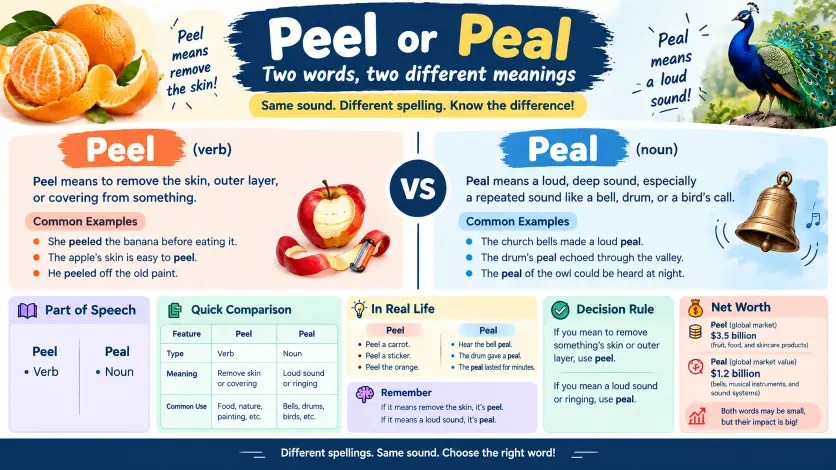
The main difference between peel and peal lies in what each word describes. Peel commonly refers to the outer covering of fruit or another object, and it also functions as a verb meaning to remove that covering. Peal, by contrast, refers to a loud, sustained sound, particularly the ringing of bells or a burst of laughter.
Although both words are pronounced the same way, they aren’t interchangeable. Therefore, understanding the sentence’s meaning is the easiest way to choose the correct spelling.
What Does Peel Mean?
Peel (noun and verb) refers to an outer covering or the action of removing it. As a noun, peel describes the skin or outer layer of fruit and certain vegetables. As a verb, it means to strip away that covering or remove an outer layer from something.
For example, the orange peel remained on the kitchen counter after breakfast. Similarly, the cook asked the assistant to peel the potatoes before boiling them.
Beyond food preparation, peel can describe paint separating from a wall, a sticker coming away from a surface, or a layer of skin being shed. In informal speech, people also use the expression “peel away” to describe a vehicle moving away from a group or location.
What Does Peal Mean?
Peal (noun and verb) refers to a loud, clear, resonant sound. It is especially associated with church bells, large bells, thunder, and ringing laughter.
For example, a peal of bells echoed across the village square. Likewise, a peal of laughter filled the room when the comedian delivered the final joke.
As a verb, peal means to ring out loudly or produce a resonant sound. For instance, the church bells pealed across the town during the celebration.
Unlike peel, peal doesn’t describe removing a covering. Instead, it emphasizes a sound that is powerful, noticeable, or sustained.
Comparison Table
| Feature | Peel | Peal |
|---|---|---|
| Part of speech | Noun and verb | Noun and verb |
| Main meaning | Outer covering or removing a layer | A loud, resonant sound |
| Pronunciation | /piːl/ | /piːl/ |
| Common expression | Orange peel | A peal of bells |
| Typical context | Cooking, surfaces, objects | Bells, thunder, laughter |
| Example | Peel the apple carefully. | The bells pealed at noon. |
Quick Recap
Peel refers to an outer layer or the act of removing one.
Peal describes a loud, resonant sound.
Both words have the same pronunciation but different meanings.
When you mean fruit skin or removing a covering, choose peel. When you mean ringing or a loud burst of sound, choose peal.
Is Peel vs Peal a Grammar, Vocabulary, or Usage Issue?
The difference between peel and peal is primarily a vocabulary and spelling issue. Both are legitimate English words, and each follows ordinary grammatical rules. However, selecting the wrong spelling changes the meaning of a sentence, potentially confusing the reader.
For instance, “The bells began to peal” describes a sound, whereas “The bells began to peel” suggests that their outer covering was coming away. Although the second sentence is grammatically possible in an unusual context, it doesn’t express the intended meaning.
Are Peel and Peal Interchangeable?
No. Peel and peal are homophones, which means they sound alike but have different meanings.
Consider the sentence, “She removed the peel from the lemon.” Here, peel identifies the fruit’s outer covering. Replacing it with peal would be incorrect because the sentence doesn’t refer to a sound.
Similarly, “A peal of laughter erupted from the audience” uses peal to describe a burst of laughter. Substituting peel would create a different and unintended meaning.
Formal and Informal Usage
Both words are acceptable in formal and informal English. Nevertheless, their contexts differ.
In a formal recipe, a chef might instruct readers to peel the carrots before slicing them. In a historical report, a writer might describe the peal of church bells announcing a royal celebration.
During casual conversations, someone might mention orange peel left in a bowl or describe hearing a peal of laughter from another room. Consequently, neither word belongs exclusively to formal or informal communication.
Academic and Everyday Contexts
In academic writing, peel frequently appears in biology, botany, food science, and materials research. Researchers might examine the chemical composition of citrus peel or study why protective coatings peel away from surfaces.
By contrast, peal may appear in literature, sound studies, religious history, and descriptions of acoustic environments. A literary scholar might analyze a peal of bells as a symbol of celebration, warning, or mourning.
In everyday writing, the same distinction applies. Think about the object or sound being described before deciding which spelling to use.
Practical Usage: When to Use Peel
Use peel when discussing an outer covering or the process of removing a layer. This word appears frequently in cooking, household tasks, gardening, biology, and descriptions of physical surfaces.
1. Workplace Examples
In a restaurant kitchen, peel commonly describes food preparation.
Example: “The kitchen supervisor asked the staff to peel the apples before preparing the dessert.”
Similarly, a maintenance worker might use the word when describing a damaged surface.
Example: “The technician reported that the protective coating had started to peel away from the metal.”
In both situations, the word refers to removing or losing an outer layer rather than producing a sound.
2. Academic Examples
In biology, researchers may examine the structure of fruit coverings.
Example: “The students compared the thickness of orange peel and lemon peel during the laboratory exercise.”
Likewise, materials scientists may investigate the separation of coatings from different surfaces.
Example: “The experiment measured how quickly the paint began to peel under humid conditions.”
These examples demonstrate that peel can describe both a biological covering and the separation of a material layer.
3. Technology Examples
In manufacturing and digital product development, peel can describe the removal of protective films or labels.
Example: “The installation guide instructed users to peel the protective film from the display before switching on the device.”
Similarly, engineers may measure peel strength to evaluate how well an adhesive joins two materials.
Example: “The technician tested the peel strength of the adhesive label before approving the packaging.”
Therefore, the word is useful in technical instructions where removing or separating a layer is the central action.
Usage Recap
Choose peel when referring to skin, coverings, protective films, coatings, or the act of removing a layer. Remember that it functions as both a noun and a verb.
Practical Usage: When to Use Peal
Use peal when describing a loud, clear, or resonant sound. The word frequently appears in writing about bells, laughter, thunder, celebrations, and dramatic acoustic effects.
1. Workplace Examples
In event planning, peal can describe the sound of bells during a ceremony.
Example: “A peal of bells welcomed the guests as the ceremony began.”
Similarly, a writer reporting on a public celebration might use the word to describe a memorable sound.
Example: “A peal of laughter rose from the audience during the opening performance.”
Both examples focus on a noticeable sound that draws attention.
2. Academic Examples
In literature, peal can communicate atmosphere and symbolism.
Example: “The poet used a peal of bells to suggest celebration and renewed hope.”
In sound studies, researchers may examine the characteristics of bell tones in different environments.
Example: “The study recorded the peal of the bells to assess how sound traveled through the historic courtyard.”
These examples show how peal can describe both a literary image and an audible event.
3. Technology Examples
In sound engineering, peal may describe the resonant ringing of bells recorded for a digital audio project.
Example: “The audio engineer captured a peal of bells for the documentary’s opening scene.”
Likewise, a sound designer might recreate the ringing of bells in a digital environment.
Example: “The designer layered several recordings to produce a realistic peal of church bells.”
Although sound engineers may use more precise technical terminology when measuring frequency or resonance, peal remains a useful descriptive word.
Usage Recap
Choose peal when describing loud ringing, resonant bells, or a burst of laughter. As a noun, it identifies the sound; as a verb, it describes producing that sound.
When You Should NOT Use Peel or Peal
Although the distinction is straightforward, several common situations can cause confusion. Therefore, review these examples before choosing either word.
- When describing bell sounds, don’t use peel. Write “The bells began to peal,” not “The bells began to peel,” unless you genuinely mean that a covering is separating from the bells.
- When describing fruit skin, don’t use peal. Write “Remove the orange peel” because the sentence refers to the fruit’s outer layer.
- When describing laughter, choose peal. The expression “a peal of laughter” describes a loud or sustained burst of laughter.
- When describing paint separating from a wall, choose peel. For example, “The paint began to peel near the window.”
- When writing a cooking instruction, don’t substitute peal for peel. A recipe should say “Peel the potatoes before boiling them.”
- When describing a loud ringing sound, don’t choose peel merely because it sounds correct. The pronunciation doesn’t determine the spelling.
- When discussing adhesive performance, use peel in established technical expressions. For example, “peel strength” describes resistance to separation under a peeling force.
- When describing a resonant bell sound in literature, choose peal. For example, “A peal of bells announced the arrival of the procession.”
Ultimately, ask yourself whether the sentence concerns a covering or a sound. That simple distinction resolves most mistakes.
Common Mistakes and Decision Rules
The following table illustrates frequent errors and explains how to correct them.
| Correct sentence | Incorrect sentence | Explanation |
|---|---|---|
| Remove the peel from the orange. | Remove the peal from the orange. | Peel means the fruit’s outer covering. |
| The bells began to peal. | The bells began to peel. | Peal describes ringing loudly. |
| A peal of laughter filled the hall. | A peel of laughter filled the hall. | Peal describes a burst of sound. |
| The paint started to peel. | The paint started to peal. | Peel describes a layer separating from a surface. |
| She peeled the potatoes before cooking. | She pealed the potatoes before cooking. | Peeled is the correct past tense of peel. |
| The church bells pealed at noon. | The church bells peeled at noon. | Pealed is the correct past tense of peal. |
| The label began to peel away. | The label began to peal away. | Peel describes separation from a surface. |
| A peal of thunder echoed overhead. | A peel of thunder echoed overhead. | Peal describes a loud sound. |
A Simple Decision Rule
If you mean an outer layer or the action of removing it, use peel.
If you mean a loud, resonant sound, use peal.
For example, peel an apple before eating it, but listen to the peal of church bells during a celebration. Once the intended meaning is clear, the spelling becomes easy to identify.
Peel and Peal in Modern Technology and Digital Communication
Modern technology uses both words in different contexts. However, spelling suggestions and automatic proofreading systems may accept either word because both are legitimate English vocabulary.
For example, a spelling checker might accept “a peel of bells” without recognizing that the intended expression is “a peal of bells.” Similarly, it may accept “peal the orange” without understanding that the writer means to remove the fruit’s skin.
Therefore, proofreading should consider meaning rather than spelling alone.
In food processing, peel appears in instructions, product descriptions, and discussions of fruit coverings. In engineering, it can describe the separation of protective films or the measurement of adhesive strength.
Meanwhile, peal may appear in audio descriptions, digital sound libraries, historical recordings, and literary commentary. A recording application might label a file as a peal of bells to describe its contents.
Consequently, contextual review is essential whenever two correctly spelled words share the same pronunciation.
Etymology: Where Do Peel and Peal Come From?
Although peel and peal sound identical in modern English, their histories developed along different paths.
Peel entered English through historical forms associated with stripping or removing a covering. Its established meanings now include the outer skin of fruit, the removal of a layer, and the separation of paint or other materials from a surface.
Peal developed from older English forms associated with ringing or sounding. Over time, the word became strongly connected with the loud, resonant ringing of bells and similar sounds. It also acquired figurative uses, including a peal of laughter.
These historical associations help explain their modern meanings. Peel concerns an outer layer or its removal, whereas peal concerns sound.
Because their pronunciations converged, the words became homophones. Their spelling, however, preserves the distinction between the two meanings.
An Expert Perspective on Choosing the Correct Word
A useful principle in language instruction is to identify the meaning of a word before selecting its spelling.
“Context is the clearest guide when two words share a pronunciation but express different ideas.”
This is a general educational principle rather than a quotation attributed to a specific linguist.
For example, a recipe provides a clear context for peel because it often describes removing fruit skin or vegetable coverings. By contrast, a description of church bells points toward peal because the subject is a ringing sound.
Moreover, identifying the word’s grammatical role can provide an additional clue. If the sentence describes removing a layer, peel is usually appropriate. If it describes a sound ringing out, peal is the likely choice.
Together, context and meaning offer a reliable way to distinguish homophones in everyday writing.
Two Practical Case Studies
The following illustrative case studies show how correct word choice improves clarity. They are educational examples rather than reports of independently measured research.
Case Study 1: Correcting a Recipe
A food writer prepares instructions for a citrus dessert. The original sentence reads:
“Peal the oranges carefully before adding the zest.”
Although the intended action is understandable, the spelling is incorrect. The editor revises the instruction to:
“Peel the oranges carefully before adding the zest.”
The corrected sentence uses the appropriate verb and aligns with standard cooking terminology. As a result, the instruction reads naturally and avoids distracting readers with a spelling mistake.
Result: The recipe communicates the preparation step accurately and uses the correct word for removing the fruit’s outer layer.
Case Study 2: Editing a Historical Description
A writer describes a village celebration and includes the sentence:
“A peel of bells rang throughout the square.”
Because the sentence concerns the sound of ringing bells, the editor changes it to:
“A peal of bells rang throughout the square.”
The revision uses the established expression and preserves the intended atmosphere of the scene.
Result: The description becomes more precise, and readers can understand that the sentence refers to a resonant sound rather than an outer covering.
These examples demonstrate why careful word choice matters even when a sentence seems understandable at first glance.
Error Prevention Checklist
Before publishing a sentence containing peel or peal, review the following reminders.
Always Use Peel When
- Referring to the skin of fruit or vegetables.
- Describing the removal of a covering.
- Discussing paint or coatings separating from a surface.
- Writing instructions about removing a protective film.
- Using technical expressions such as “peel strength.”
Never Use Peal When
- Referring to fruit skin or vegetable coverings.
- Describing the removal of a sticker or protective layer.
- Explaining how paint separates from a wall.
- Giving cooking instructions that involve removing a covering.
- Referring to adhesive separation when the established term is “peel.”
Remember Peal When
- Describing church bells ringing loudly.
- Writing about a peal of laughter.
- Describing the resonant ringing of bells.
- Discussing a peal of thunder in literary language.
- Using the verb “pealed” to describe a loud, ringing sound.
This quick checklist can prevent many spelling mistakes. Nevertheless, the most reliable method remains understanding what the sentence actually means.
Related Grammar Confusions You Should Master
Learning the difference between peel and peal can help you recognize other commonly confused English words.
- Hear vs here: Hear relates to listening, while here identifies a place.
- Sea vs see: Sea refers to a large body of salt water, whereas see means to perceive something or look at it.
- Right vs write: Right can mean correct or refer to a direction, while write means to form words.
- Flour vs flower: Flour is used in cooking and baking, while a flower is the reproductive structure of many plants.
- Pair vs pear: Pair refers to two things considered together, while pear is a type of fruit.
- Brake vs break: Brake refers to a device used to slow or stop movement, while break can mean to damage, separate, or take a pause.
- Sole vs soul: Sole can mean the underside of a foot or the only one, whereas soul relates to a person’s spiritual or emotional essence.
- Knight vs night: Knight refers to a historical warrior or honorary title, while night is the dark period between evening and morning.
- Weather vs whether: Weather describes atmospheric conditions, whereas whether introduces alternatives or uncertainty.
- Principal vs principle: Principal can describe a school leader or something most important, while principle refers to a rule or belief.
Like peel and peal, these pairs become easier to distinguish when you focus on meaning and sentence context rather than pronunciation alone.
Frequently Asked Questions
1. What is the difference between peel and peal?
Peel refers to an outer covering or the act of removing one, while peal describes a loud, resonant sound. For example, an orange has a peel, whereas church bells produce a peal. Although the words sound alike, their meanings differ.
2. Is it peel or peal of bells?
The correct expression is “peal of bells.” Peal describes the loud, resonant ringing of bells. Peel refers to an outer covering or the action of removing a layer, so it doesn’t express the intended meaning.
3. Is it orange peel or orange peal?
The correct expression is “orange peel.” It refers to the fruit’s outer skin, which can be removed, grated, or used to flavor food. Orange peal would incorrectly suggest a sound rather than a fruit covering.
4. Is peal a noun or a verb?
Peal can function as both a noun and a verb. As a noun, it describes a loud, resonant sound, such as a peal of bells. As a verb, it means to ring out loudly, as in “The bells pealed across the village.”
5. Is peel a noun or a verb?
Peel can also function as both a noun and a verb. As a noun, it refers to an outer covering, such as lemon peel. As a verb, it means to remove a layer, as in “Peel the potatoes before cooking.”
6. What does a peal of laughter mean?
A peal of laughter describes a loud or sustained burst of laughter. The expression emphasizes the sound’s intensity and often creates an image of several people laughing together or one person’s laughter ringing out clearly.
7. Why do peel and peal sound the same?
Peel and peal are homophones because their pronunciations are identical in standard English. Their spellings and meanings differ, however. Consequently, readers must rely on context to identify whether a sentence refers to a covering or a sound.
8. Is it peeled or pealed?
Both forms are correct, but they belong to different verbs. Peeled is the past tense of peel, meaning to remove a covering. Pealed is the past tense of peal, meaning to ring loudly. For example, “She peeled the apple” and “The bells pealed at noon.”
9. How can I remember peel vs peal?
Associate peel with an apple or orange whose outer skin can be removed. Associate peal with the ringing sound of church bells. These familiar examples provide a simple memory aid for choosing the correct spelling.
Conclusion:
The difference between peel and peal becomes simple once you identify the intended meaning. Peel refers to an outer covering or the action of removing it, while peal describes a loud, resonant sound, particularly the ringing of bells.
Therefore, choose peel when discussing fruit skin, protective films, paint separation, or food preparation. Meanwhile, use peal when describing bells, laughter, or other ringing sounds.
Although both words share the same pronunciation, their meanings aren’t interchangeable. By considering context, grammatical function, and the intended message, you can choose the correct spelling with confidence in academic assignments, workplace documents, technical instructions, and everyday conversations.









