Have you ever wondered whether something should be described as internal or external? These two terms appear frequently in education, business, technology, healthcare, and everyday communication. Although they may seem straightforward, choosing between them can sometimes be confusing because their meanings depend on the situation. Understanding the distinction helps you explain where something originates, where it is located, or whether it belongs within a particular system or comes from outside it. A small difference in wording can make instructions, reports, and professional communication much clearer.
The simplest way to understand internal or external is to consider whether something exists or operates within a defined boundary or beyond it. Internal generally refers to something inside an organization, system, structure, or individual. For example, an internal company meeting involves people or matters within the organization. External describes something coming from outside or relating to the surrounding environment, such as an external consultant hired to provide independent advice. However, the precise meaning can vary across fields, so context is essential when deciding which term fits best.
In this guide, you will explore the definitions of internal and external, examine practical examples, and learn how to use both terms accurately in different situations. The explanations draw on standard English usage and familiar scenarios from workplaces, schools, technology, and daily life. You will also discover common mistakes, useful comparisons, and simple memory techniques that make the distinction easier to remember. Whether you are a student, a professional, or someone improving their English vocabulary, this guide will help you communicate ideas more precisely and confidently.
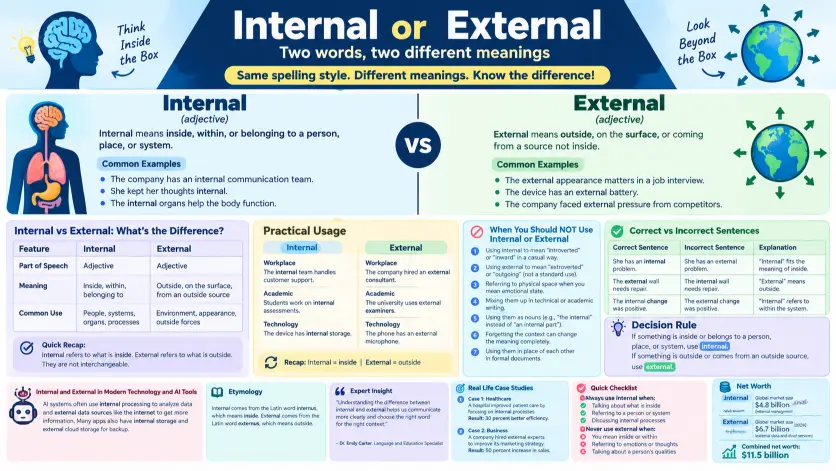
Internal vs External: What’s the Difference?
The main difference between internal and external is the location, origin, or scope of something relative to a defined boundary. Both words are adjectives, although they can also appear in established expressions and technical terminology. Therefore, their exact meanings depend on the subject being discussed.
For example, an internal employee works within an organization, whereas an external consultant usually provides services from outside it. Similarly, an internal link connects pages within the same website, while an external link directs readers to another website.
Definition of Internal
Internal (adjective): Internal describes something situated within a particular structure, organization, system, or boundary. It can also refer to processes, relationships, conditions, or information that exist within a defined entity.
For instance, an internal meeting takes place among people within an organization. Likewise, internal communication refers to information exchanged among members of a company, institution, or group.
In medicine, internal can describe structures or processes inside the body. In technology, it may refer to a component located inside a device or a process operating within a computer system.
Definition of External
External (adjective): External describes something situated outside a particular structure, organization, system, or boundary. It can also refer to outside influences, relationships, resources, or information originating beyond the entity being discussed.
For example, an external auditor examines an organization’s financial records independently of its internal accounting team. Similarly, an external hard drive provides storage outside a computer’s main internal storage system.
In business, external factors can include competitors, regulations, and economic conditions. In education, external assessment may involve an evaluator who is independent of the student’s usual institution or teacher.
Internal vs External Comparison Table
| Feature | Internal | External |
|---|---|---|
| Part of speech | Adjective | Adjective |
| Core meaning | Within a boundary | Outside a boundary |
| Origin | Inside the relevant entity | Beyond the relevant entity |
| Business example | Internal department | External consultant |
| Communication | Staff announcements | Public announcements |
| Technology | Internal storage | External storage |
| Website example | Link to another page on the same site | Link to another website |
| Common expression | Internal review | External assessment |
Quick Recap
Internal refers to something within a defined boundary.
External describes something outside that boundary or originating beyond it.
Both terms are adjectives, and their interpretation depends on context.
To choose correctly, identify the entity or boundary being discussed first.
Is Internal vs External a Grammar, Vocabulary, or Usage Issue?
The distinction between internal and external is primarily a vocabulary and usage issue rather than a grammatical problem. Both words are standard English adjectives, and both can be used correctly in formal or informal communication. However, choosing the wrong term can reverse the intended meaning.
For example, describing an outside contractor as an internal employee may create confusion about responsibilities, access permissions, or employment status. Likewise, calling a link external when it leads to another page on the same website may mislead readers.
Are Internal and External Interchangeable?
No. Although both words describe relationships to a boundary, they generally express opposite meanings.
Consider the sentence, “The company conducted an internal investigation.” This means the investigation was carried out within the organization’s own structure or under its internal authority.
By contrast, “The company commissioned an external investigation” suggests that an outside party was involved.
Nevertheless, the distinction isn’t always determined by physical location. An external consultant might work inside a company’s building while remaining external to its workforce. Consequently, organizational relationships can matter more than physical distance.
Formal and Informal Usage
Both words appear naturally in formal and informal English. In professional communication, internal may describe staff policies, departments, procedures, and company information. External commonly describes suppliers, consultants, clients, and outside influences.
In casual conversation, someone might mention an internal disagreement or an external influence on a decision. Although the terminology is relatively formal in some contexts, neither word is restricted to academic or professional writing.
Academic and Everyday Contexts
In academic writing, internal and external frequently describe variables, evidence, assessments, and factors affecting a research question. For example, researchers might distinguish internal validity from external validity when evaluating a study.
In everyday communication, the same distinction can describe relationships and physical objects. An internal door connects rooms within a building, while an external door provides access between a building’s interior and the outside.
Therefore, understanding the relevant context is essential because the same pair of words can have specialized meanings across different subjects.
Practical Usage: When to Use Internal
Use internal when referring to something within an organization, system, structure, or defined boundary. In addition, choose it when discussing processes, resources, communications, or relationships that belong to the entity itself.
1. Workplace Examples
In a business environment, internal commonly describes company procedures and communication.
Example: “The manager scheduled an internal meeting to discuss the department’s quarterly performance.”
Here, the meeting concerns people or matters within the organization.
Similarly, a company might conduct an internal review before introducing a new policy.
Example: “The finance department completed an internal review of its expense reporting procedures.”
These examples show how the word establishes a relationship with the organization itself.
2. Academic Examples
In research, internal can describe evidence, factors, or characteristics within the subject being studied.
Example: “The researcher examined internal factors that influenced student motivation.”
Likewise, a psychology paper might discuss internal motivation, referring to reasons for acting that arise from within an individual rather than from external rewards.
In research methodology, internal validity concerns whether a study supports a credible conclusion about a relationship between variables. Therefore, the term has a more specialized meaning than simply being located inside something.
3. Technology Examples
In computing, internal commonly describes components or processes that operate within a device or system.
Example: “The laptop uses internal storage to hold its operating system and applications.”
Similarly, a software application might maintain an internal database for information used by its own processes.
Example: “The program stores temporary settings in an internal configuration file.”
The precise meaning depends on the system architecture, so technical writers should define the relevant boundary when necessary.
Usage Recap
Use internal for matters belonging within a defined system or organization. However, remember that the boundary may be organizational, conceptual, biological, or physical rather than simply a wall or building.
Practical Usage: When to Use External
Choose external when discussing something outside a defined organization, system, or structure. Likewise, use it when describing outside resources, influences, assessments, or components that interact with the main entity.
1. Workplace Examples
In professional settings, external often describes people or organizations that operate independently of the employer.
Example: “The business hired an external consultant to evaluate its customer service process.”
The consultant may work closely with employees, but the individual remains outside the company’s regular organizational structure.
Similarly, an organization may seek external funding to support a new project.
Example: “The research team secured external funding from an independent foundation.”
In both examples, the word identifies a source beyond the organization itself.
2. Academic Examples
In education, external can describe assessment conducted by an evaluator outside a student’s immediate institution or teaching team.
Example: “An external examiner reviewed the university’s final examination process.”
In research, external validity refers to the extent to which findings may apply to other populations, settings, or circumstances beyond those studied.
Example: “The researchers discussed whether their results had external validity across different age groups.”
These examples illustrate how external can describe both organizational independence and broader applicability.
3. Technology Examples
In computing, external commonly refers to devices or resources outside a computer’s primary physical enclosure or a particular software system.
Example: “The technician connected an external monitor to the laptop.”
Similarly, a website may link to a separate organization’s website.
Example: “The article includes an external reference to the publisher’s official documentation.”
However, technical context matters. A device can be physically external while still being closely integrated with the computer’s operating environment.
Usage Recap
Use external for people, resources, influences, or components beyond the relevant boundary. To avoid ambiguity, explain whether that boundary is physical, organizational, digital, or conceptual.
When You Should NOT Use Internal or External
Although the basic distinction is straightforward, several situations can cause confusion. Therefore, consider the intended relationship before choosing either term.
- Don’t use internal to describe an independent outside contractor solely because the person works on company premises. Organizational status and physical location are different concepts.
- Don’t use external for another page on the same website when describing website links. In ordinary website terminology, a link to another page on the same site is internal.
- Don’t assume internal always means private or confidential. An internal document may be approved for broad distribution within an organization without being legally confidential.
- Don’t assume external always means publicly accessible. Information received from an outside supplier may still be confidential or restricted.
- Don’t describe an internal review as independent without checking who conducts it. Independence depends on the reviewer’s relationship to the organization and the applicable rules.
- Don’t assume an external factor is always harmful. Outside influences can provide funding, expertise, innovation, or opportunities.
- Don’t confuse internal storage with external backup. A backup can exist on a separate device, remote server, or another storage environment, depending on the system design.
- Don’t use either term without a clear boundary when the context is ambiguous. Explain whether you’re referring to a company, a building, a website, a body, or a computer system.
Ultimately, a correct choice requires a clear understanding of what counts as inside and outside in the specific situation.
Common Mistakes and Decision Rules
The following examples illustrate how to distinguish internal and external in everyday writing.
| Correct sentence | Incorrect sentence | Explanation |
|---|---|---|
| The company held an internal meeting. | The company held an external meeting with its own department only. | An internal meeting involves matters within the organization. |
| The business hired an external consultant. | The business called its independent outside consultant an internal employee. | An outside consultant isn’t automatically an employee. |
| The page contains an internal link to another page on the same website. | The page contains an external link to another page on the same website. | Same site pages are generally connected by internal links. |
| The computer uses an external monitor. | The monitor is described as internal when it sits outside the laptop. | The monitor is physically separate from the laptop. |
| The study examined internal validity. | The study examined external validity when testing whether its findings were credible within the study itself. | Internal and external validity address different questions. |
| The company requested an external audit. | The company described an independent outside audit as internal. | An outside audit is external to the organization. |
| The policy governs internal communications. | The policy governs external communications when it only applies to staff messages. | The intended audience determines the appropriate term. |
| The team received external funding. | The team described a grant from an outside foundation as internal funding. | The funding originated beyond the team or institution. |
A Simple Decision Rule
If you mean something within a defined organization, system, or structure, use internal.
If you mean something outside that boundary or originating beyond it, use external.
For example, a company can have an internal finance team and hire an external accountant. Similarly, a computer can contain internal storage and connect to an external drive.
Nevertheless, always define the relevant boundary first. That step prevents many common mistakes.
Internal and External in Modern Technology and Digital Systems
Modern technology uses internal and external to distinguish resources, connections, and processes according to their relationship with a particular system.
For example, internal storage refers to storage integrated into a device, whereas external storage usually refers to a separate device connected through an appropriate interface. However, cloud storage introduces a more complicated distinction because the files may appear directly within a device’s interface while physically residing on remote infrastructure.
Likewise, websites use internal links to connect pages within the same website and external links to direct users to other websites. These distinctions help visitors navigate information and help site owners organize content.
Software documentation also uses internal and external to describe functions, dependencies, services, and interfaces. An internal function may be intended only for use within a program, while an external service may be provided by a separate system.
Consequently, technical writers should explain the relevant system boundary whenever the terminology could have more than one interpretation.
Etymology: Where Do Internal and External Come From?
The words internal and external share Latin roots associated with the ideas of inside and outside.
Internal derives from Latin internus, meaning inward or belonging to the inside. Over time, English adopted the term to describe matters occurring within a body, organization, system, or other defined structure.
External derives from Latin externus, meaning outward or belonging to the outside. In English, it developed into a general term for objects, influences, relationships, and conditions originating beyond a particular boundary.
Their historical origins explain why the words function as natural opposites in many contexts. Nevertheless, specialized fields sometimes use them in more precise ways.
For example, internal validity and external validity are established research terms with specific methodological meanings. Similarly, internal and external medicine may describe different areas of clinical practice depending on the healthcare system and terminology being used.
Therefore, understanding the root distinction provides a useful starting point, while context determines the precise interpretation.
An Expert Perspective on Internal vs External
A useful principle in technical writing and professional communication is to define the boundary before classifying something as internal or external.
“Before deciding whether something is internal or external, identify the system, organization, or boundary to which it belongs.”
This is a general explanatory principle rather than a quotation attributed to a specific expert.
Consider a contractor working inside a company office. Physically, the contractor is inside the building. Organizationally, however, the contractor may remain external to the company’s workforce.
Similarly, a cloud application may appear within a company’s internal workflow while relying on services hosted by an outside provider. In this case, the answer depends on whether the discussion concerns the user interface, the company’s organizational structure, or the underlying technical infrastructure.
Consequently, precise writing should identify the relevant relationship instead of relying on physical location alone.
Two Practical Case Studies
The following illustrative case studies demonstrate how correct terminology can improve communication and decision making. They are teaching examples, not independently measured research findings.
Case Study 1: Clarifying a Company Policy
A business prepares a policy explaining which communications are intended for employees and which are directed toward customers.
The initial draft uses internal and external inconsistently, leaving staff unsure whether certain announcements can be shared outside the organization.
The communications manager revises the policy to define internal communications as messages intended for employees and approved organizational groups. External communications are defined as messages intended for customers, suppliers, media representatives, or the public.
The policy also explains that confidential information may require additional restrictions regardless of its intended audience.
Result: The revised wording creates clearer categories for company announcements and reduces ambiguity about who should receive each type of message.
Case Study 2: Improving a Website’s Navigation
A publisher reviews an educational website and discovers that editors use internal and external inconsistently when describing links.
Some links leading to other pages on the same website are labeled external, while links to independent websites are incorrectly labeled internal.
The editorial team adopts a consistent rule: links connecting pages within the same website are internal, while links leading to different websites are external. Editors then review the affected descriptions and navigation instructions.
Result: The revised terminology provides a more consistent explanation of website navigation and helps readers understand where each link leads.
These examples show that the distinction matters most when people need to interpret responsibilities, relationships, or destinations accurately.
Error Prevention Checklist
Use the following checklist whenever you need to choose between internal and external.
Always Use Internal When
- Referring to a process or relationship within a defined organization.
- Describing communication intended for employees or organizational members.
- Identifying a link to another page within the same website.
- Discussing components integrated into a device or system.
- Describing research concepts such as internal validity.
Never Use External When
- Referring to an ordinary link between pages on the same website.
- Describing an internal process that remains within the defined system.
- Identifying a built in component as a separate external device.
- Discussing a company’s own department as though it were automatically an outside organization.
- Using the word without checking the relevant boundary.
Always Check the Context When
- A contractor works inside a company’s premises.
- A cloud service is integrated into an internal workflow.
- An outside organization handles confidential information.
- A research term has a specialized methodological definition.
- Physical location differs from organizational membership.
This checklist can prevent many terminology errors. Nevertheless, specialized workplace, legal, scientific, and technical settings may require more precise definitions.
Related Grammar Confusions You Should Master
Understanding internal and external also provides a useful opportunity to review other commonly confused English words.
- Internal vs intrinsic: Internal means within a boundary, while intrinsic describes a quality that belongs to something by its nature.
- External vs extrinsic: External means outside a boundary, while extrinsic describes something arising from an outside influence or source.
- Affect vs effect: Affect is usually a verb meaning to influence, whereas effect is usually a noun meaning a result.
- Principal vs principle: Principal can mean a person in charge or something most important, while principle refers to a rule or belief.
- Complement vs compliment: A complement completes or enhances something, whereas a compliment expresses praise.
- Their vs there: Their indicates possession, while there refers to a place or appears in certain grammatical constructions.
- Stationary vs stationery: Stationary means not moving, whereas stationery refers to writing materials.
- Advice vs advise: Advice is a noun meaning guidance, while advise is a verb meaning to offer guidance.
- Loose vs lose: Loose means not firmly attached, while lose means to misplace something or fail to retain it.
- Explicit vs implicit: Explicit means clearly stated, while implicit means suggested or understood without being directly expressed.
Learning these distinctions helps writers communicate more precisely. Moreover, recognizing the relationship between a word’s meaning and its context makes vocabulary choices easier to remember.
Frequently Asked Questions
1. What is the difference between internal and external?
Internal means within a defined organization, structure, or system. External means outside that boundary or originating beyond it. For example, an internal employee belongs to an organization, while an external consultant generally works independently of its regular workforce.
2. Is internal the opposite of external?
Yes. In many ordinary contexts, internal and external are opposites. Internal describes something within a boundary, while external describes something outside it. However, specialized terminology may give each word a more specific meaning.
3. What is the difference between internal and external communication?
Internal communication occurs among people within an organization, such as employees and departments. External communication is directed toward people or groups outside it, including customers, suppliers, partners, and the public.
4. What is the difference between internal and external links?
An internal link connects one page to another page within the same website. An external link directs users to a different website. These terms describe the destination’s relationship to the website containing the original link.
5. What is the difference between internal and external storage?
Internal storage is integrated into a device or system, whereas external storage generally uses a separate device connected through a supported interface. The distinction concerns the storage arrangement rather than whether the files can be accessed by the same computer.
6. What is the difference between internal and external factors?
Internal factors originate within the individual, organization, or system being examined. External factors arise beyond it. For example, employee skills may be internal factors affecting a business, while market conditions may be external factors.
7. What is the difference between internal and external validity?
Internal validity concerns whether a study supports a credible conclusion about the relationship between its variables. External validity concerns how well its findings may apply to other populations, settings, or circumstances.
8. What is an internal employee versus an external consultant?
An internal employee belongs to an organization’s workforce. An external consultant generally provides expertise or services from outside that workforce. However, a consultant may work on company premises without becoming an internal employee.
9. Can internal and external be used in formal writing?
Yes. Both terms are appropriate in formal, academic, professional, and casual communication. Their suitability depends on the meaning and context, not on whether the writing is formal or informal.
Conclusion: , Which Term Is Correct?
Choosing between internal and external becomes straightforward once the relevant boundary is clear. Internal describes something within an organization, structure, or system, whereas external refers to something outside that boundary or originating beyond it.
For example, a company may have an internal finance department and hire an external auditor. Similarly, a website can contain internal links to its own pages and external links to other websites.
Nevertheless, context remains important. A person can work physically inside a building while remaining organizationally external, and a technical service can operate within a workflow while relying on outside infrastructure.
Ultimately, identify the entity being discussed, determine where the relevant boundary lies, and choose the term that accurately describes the relationship. This simple method improves clarity in workplace communication, academic writing, technology, research, and everyday English.









