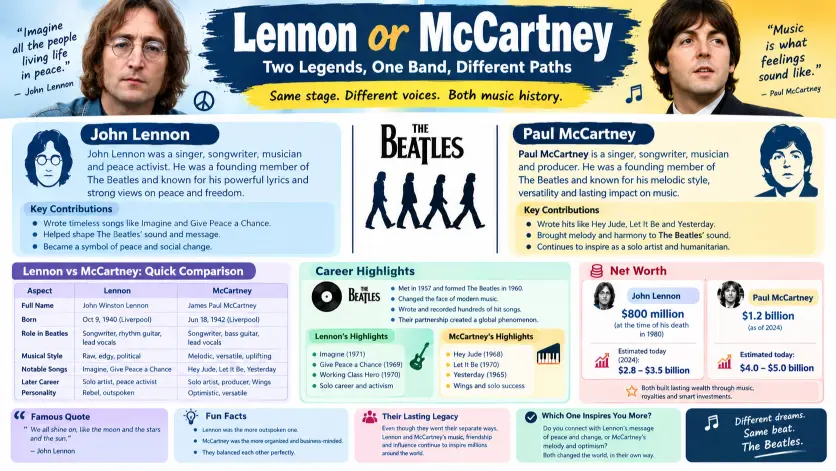
Few musical partnerships have shaped popular music as profoundly as John Lennon and Paul McCartney. As the creative forces behind many of the Beatles’ most memorable songs, both musicians helped transform songwriting, recording, and modern pop culture. Yet their contrasting personalities, musical instincts, and approaches to lyrics have inspired a lasting debate: Lennon or McCartney? For longtime Beatles fans and new listeners alike, comparing these two legends offers a fascinating way to understand how different creative strengths can contribute to the same extraordinary band.
John Lennon often brought sharp observations, emotional honesty, unconventional ideas, and a distinctive edge to his songwriting. Paul McCartney became widely recognized for his melodic inventiveness, musical versatility, and ability to craft memorable arrangements. However, their contributions were not limited to separate styles. They frequently collaborated, challenged each other creatively, and helped refine songs that became classics. Understanding their partnership requires looking beyond popular stereotypes and considering their individual work, shared compositions, performances, and influence on later generations of musicians.
In this guide, we will compare Lennon and McCartney across songwriting, vocal performance, musical experimentation, memorable hits, and lasting cultural influence. We will also explore their most celebrated compositions and explain why choosing a single winner is more complicated than it first appears. Drawing on established music history and the duo’s documented creative achievements, this comparison aims to give readers a balanced perspective rather than simply favoring one artist. Whether you admire Lennon’s expressive intensity or McCartney’s melodic brilliance, you will gain a clearer understanding of what made each musician distinctive and why their partnership remains so influential.
Lennon vs McCartney: What’s the Difference?
John Lennon and Paul McCartney were English musicians, singers, and songwriters whose partnership helped transform popular music. Although both contributed vocals, instruments, and compositions to the Beatles, their creative instincts often differed. Lennon frequently explored personal struggles, provocative ideas, and experimental sounds. McCartney, meanwhile, often emphasized melody, musical structure, emotional accessibility, and diverse arrangements.
Nevertheless, these descriptions represent broad tendencies rather than absolute rules. Both musicians wrote intimate ballads, energetic rock songs, imaginative lyrics, and experimental recordings. Their collaboration also evolved throughout the band’s career, making it difficult to assign every song exclusively to one artistic personality.
Who Was John Lennon?
John Lennon (1940 to 1980) was a singer, guitarist, songwriter, and founding member of the Beatles. As a musician, he became associated with sharp lyrical observations, expressive vocal performances, and a willingness to challenge conventional expectations.
Lennon’s songwriting frequently examined identity, relationships, disillusionment, peace, and social issues. Songs such as “Help!”, “Strawberry Fields Forever,” and “Across the Universe” illustrate different aspects of his musical personality.
Moreover, Lennon pursued a solo career that included politically conscious work and experimental collaborations. His solo recordings demonstrated that his interests extended beyond conventional pop songwriting into avant garde music, personal reflection, and activism.
Who Was Paul McCartney?
Paul McCartney, born in 1942, is a singer, bassist, pianist, guitarist, and songwriter. His musical identity is particularly associated with memorable melodies, carefully constructed arrangements, vocal harmonies, and a broad interest in musical styles.
Songs such as “Yesterday,” “Eleanor Rigby,” and “Hey Jude” demonstrate his ability to create distinctive musical experiences through relatively simple melodic ideas and sophisticated arrangements.
Furthermore, McCartney’s post Beatles career included the band Wings, solo albums, orchestral projects, and collaborations across genres. His work illustrates a continuing interest in musical experimentation alongside accessible songwriting.
Comparison Table
| Feature | John Lennon | Paul McCartney |
|---|---|---|
| Main role | Singer, guitarist, songwriter | Singer, bassist, multi instrumentalist, songwriter |
| Common songwriting strengths | Introspection, wordplay, provocative themes | Melody, arrangement, musical versatility |
| Vocal character | Often raw, direct, expressive | Often melodic, flexible, harmonically rich |
| Common lyrical interests | Identity, conflict, personal reflection | Relationships, storytelling, everyday experiences |
| Beatles examples | “Help!”, “Strawberry Fields Forever” | “Yesterday,” “Hey Jude” |
| Solo career | Experimental music, political themes, personal reflection | Wings, solo albums, varied musical projects |
| Collaboration | Frequently challenged ideas and developed songs with McCartney | Frequently refined melodies and arrangements with Lennon |
Quick Recap
Lennon often brought a provocative, introspective perspective to the Beatles.
McCartney frequently contributed memorable melodies and intricate musical arrangements.
However, both artists crossed these boundaries throughout their careers.
Their creative partnership, rather than competition alone, helped make the Beatles exceptionally influential.
Is Lennon vs McCartney a Grammar, Vocabulary, or Usage Issue?
The comparison between Lennon and McCartney is not a grammar issue. Instead, it is a question of musical history, artistic interpretation, and cultural influence. The two names identify different people, and using one in place of the other can create factual errors.
For example, attributing a solo recording by Lennon to McCartney misidentifies the artist. Similarly, crediting a song primarily written by McCartney to Lennon can distort the historical record.
Are Lennon and McCartney Interchangeable?
No. John Lennon and Paul McCartney were separate individuals with distinct careers, personalities, and musical contributions.
Nevertheless, their work overlapped substantially. Both performed lead vocals, played multiple instruments, and contributed to the Beatles’ songwriting. In addition, many songs developed through discussion, revision, and musical experimentation between them.
Their partnership is often described through the songwriting credit “Lennon McCartney.” This shared credit became one of popular music’s best known songwriting partnerships, although individual contributions varied from song to song.
Formal and Informal Usage
In formal writing, use full names when introducing the musicians for the first time. For example, “John Lennon and Paul McCartney developed a productive songwriting partnership.”
Subsequently, surnames alone are generally sufficient when the context remains clear. In informal discussion, listeners might simply say “Lennon” or “McCartney” when debating musical preferences.
However, avoid presenting personal opinions as established historical facts. Saying that one artist was objectively the better songwriter requires a defined standard, such as chart success, critical reception, melodic complexity, or lyrical influence.
Academic and Casual Contexts
Academic discussions usually distinguish documented songwriting credits from interpretations of artistic style. Scholars may examine manuscript evidence, recording sessions, interviews, and musical structures when assessing authorship.
Casual conversations often focus on favorite songs, distinctive voices, or personal reactions. Although these opinions are perfectly reasonable, they don’t necessarily establish who contributed the most to a particular recording.
Therefore, understanding the purpose of the comparison helps readers separate historical evidence from subjective judgment.
Practical Usage: When to Discuss John Lennon
John Lennon is the appropriate subject when discussing his songwriting, vocal performances, solo recordings, public statements, or personal history.
1. Workplace Example
In a music publication, an editor might assign a feature examining Lennon’s influence on modern songwriting.
Example: “The writer analyzed how Lennon’s direct lyrics influenced later generations of rock musicians.”
This sentence correctly identifies the musician whose work is being discussed. In addition, it provides a clear subject for historical analysis.
2. Academic Example
A university paper might examine Lennon’s use of surreal imagery and personal reflection.
Example: “The researcher compared Lennon’s lyrics in ‘Strawberry Fields Forever’ with the song’s unusual studio production.”
Such a discussion connects a particular composition with its documented creative context. Nevertheless, the researcher should distinguish interpretation from confirmed facts about the recording process.
3. Technology Example
A music streaming service might organize recordings according to artist, album, release date, and songwriting credit.
Example: “The music database lists John Lennon as the performer of the selected solo recording.”
Accurate metadata helps listeners locate the correct version and prevents confusion between Beatles recordings, solo releases, and tribute performances.
Usage Recap
Discuss Lennon when the subject concerns his individual work, documented contributions, or artistic perspective. However, remember that some Beatles recordings involved extensive collaboration with McCartney and other band members.
Practical Usage: When to Discuss Paul McCartney
Paul McCartney is the correct subject when discussing his individual compositions, performances, instrumental skills, solo releases, or broader musical career.
1. Workplace Example
A record label might commission an article about McCartney’s influence on popular melody.
Example: “The editorial team examined McCartney’s approach to memorable choruses and vocal harmonies.”
This statement identifies a recognizable feature of his musical reputation without claiming that every composition follows the same pattern.
2. Academic Example
A music student might analyze the structure of “Yesterday.”
Example: “The student explored McCartney’s melodic phrasing and the arrangement of the song’s string accompaniment.”
This approach focuses on musical characteristics that can be examined through listening and score analysis. It also avoids reducing the composition to a simple contest between two songwriters.
3. Technology Example
A digital music archive might classify McCartney’s solo recordings separately from Beatles releases.
Example: “The catalog distinguishes McCartney’s solo discography from recordings released under the Beatles’ name.”
Accurate classification makes research easier and allows listeners to follow the development of an artist’s work over several decades.
Usage Recap
Discuss McCartney when examining his compositions, performances, musical arrangements, or solo career. At the same time, recognize that Lennon and McCartney often influenced each other’s work.
When You Should NOT Confuse Lennon and McCartney
Several common mistakes can weaken a comparison between these musicians. Fortunately, careful attention to historical context can prevent most of them.
- Don’t attribute every Lennon McCartney composition equally to both writers. The shared credit does not mean every song was written jointly in equal proportions.
- Don’t assume Lennon wrote only serious songs. His catalog also includes playful wordplay, humorous observations, and energetic rock performances.
- Don’t assume McCartney wrote only cheerful pop songs. His work includes darker narratives, emotional ballads, and experimental compositions.
- Don’t treat their musical styles as completely separate. Both explored multiple genres, and their individual approaches sometimes overlapped.
- Don’t confuse Beatles compositions with solo releases. A song released under one musician’s solo name belongs to a different recording context than a Beatles track.
- Don’t judge songwriting ability solely by popularity. Chart performance reflects many factors beyond composition, including promotion, timing, audience preferences, and recording production.
- Don’t overlook other Beatles members. George Harrison and Ringo Starr also contributed important musical ideas and performances to the band’s development.
- Don’t confuse personal preference with historical evidence. Enjoying one artist more than the other is a valid opinion, but it does not establish objective superiority.
Ultimately, a useful comparison recognizes individual differences while respecting the collaborative environment that helped both musicians flourish.
Common Mistakes and Decision Rules
The following examples show how to discuss Lennon and McCartney accurately in everyday writing and music analysis.
| Correct sentence | Incorrect sentence | Explanation |
|---|---|---|
| John Lennon released solo recordings after the Beatles. | Paul McCartney released John Lennon’s solo recordings under his own name. | Their solo careers were distinct. |
| McCartney is strongly associated with “Yesterday.” | Lennon is universally credited as the principal writer of “Yesterday.” | McCartney is recognized as the song’s principal writer. |
| Lennon and McCartney shared the songwriting credit on many Beatles songs. | Every shared credit proves they contributed equally to each song. | Credit does not establish an equal division of work. |
| Lennon recorded “Imagine” as a solo artist. | McCartney recorded “Imagine” as his signature solo song. | “Imagine” is a Lennon solo recording. |
| McCartney played bass in the Beatles. | Lennon was the band’s principal bass guitarist. | McCartney was the band’s principal bassist. |
| George Harrison wrote “Something.” | Lennon and McCartney wrote every major Beatles song. | Harrison contributed important compositions. |
| Lennon and McCartney collaborated extensively. | Their musical styles never overlapped. | Their approaches sometimes intersected. |
| McCartney formed Wings after the Beatles. | Lennon founded Wings with McCartney. | Wings was formed by McCartney with Linda McCartney and other musicians. |
A Simple Decision Rule
If you mean the artist associated with a particular song, performance, or documented contribution, identify that individual by name.
If you mean the songwriting partnership or the Beatles’ shared creative history, discuss Lennon and McCartney together.
For example, a discussion of “Imagine” should identify Lennon as its performer and principal songwriter. By contrast, a discussion of the Beatles’ songwriting partnership should acknowledge the shared credit while allowing for different levels of individual contribution.
Lennon and McCartney in Modern Technology and Digital Music
Digital music platforms, online archives, and music identification applications have made it easier to explore Lennon and McCartney’s catalogs. Nevertheless, accurate metadata remains essential.
For example, a streaming platform may display a Beatles recording alongside an artist’s solo work. Without careful attention to the performer and release information, listeners may confuse a Beatles composition with a later solo recording.
Music databases also distinguish performers, composers, lyricists, producers, and contributors. These categories matter because songwriting credits do not necessarily identify every person who performed on a recording or shaped its final arrangement.
Furthermore, digital remasters, alternate takes, demos, and live recordings may reveal different aspects of a song’s development. Comparing these versions can help listeners investigate the musical decisions associated with Lennon, McCartney, and their collaborators.
Therefore, reliable metadata and primary historical sources provide a stronger foundation for evaluating their creative contributions than brief online summaries alone.
Etymology and Origins of the Lennon McCartney Partnership
John Lennon’s surname comes from his family heritage, while McCartney is a Scottish surname associated with the Gaelic name Mac Artáin. Their names identify individuals rather than contrasting English vocabulary terms.
The famous Lennon McCartney songwriting credit developed during the Beatles’ early years. The partnership began when Lennon and McCartney were young musicians in Liverpool, England. Through shared interests, songwriting sessions, performances, and extensive rehearsal, they developed complementary approaches to popular music.
Their songwriting relationship became central to the Beatles’ identity. Although the pair increasingly pursued separate creative directions as the group matured, the shared credit continued to identify many of their compositions.
Importantly, the partnership was not a fixed formula. Some songs began primarily with one writer, while others emerged through collaboration, arrangement changes, and suggestions from bandmates. Consequently, individual authorship should be assessed composition by composition.
An Expert Perspective on Lennon vs McCartney
A useful principle in music criticism is to distinguish artistic preference from evidence based evaluation.
“Great songwriting can be judged through melody, lyrical expression, musical structure, originality, and emotional impact, rather than through popularity alone.”
This is a general critical principle, not a quotation attributed to a particular musicologist.
From this perspective, Lennon and McCartney can be appreciated through different strengths. Lennon’s directness, introspection, and willingness to challenge convention appeal to listeners who value emotional intensity and experimentation. McCartney’s melodic imagination, harmonic sensitivity, and arrangement skills appeal to those who value musical construction and versatility.
However, neither description tells the entire story. Lennon’s catalog contains melodic achievements, while McCartney’s work includes provocative ideas and experimental passages. A fair evaluation therefore considers the specific song, recording, and historical context.
Two Practical Case Studies
The following case studies illustrate how evidence based comparisons can improve music education and historical writing. The results are illustrative rather than independently measured research findings.
Case Study 1: Correcting a Music History Assignment
A student prepares an assignment comparing the Beatles’ songwriting partnership. The first draft states that every song credited to Lennon McCartney was written equally by both artists.
The teacher asks the student to distinguish the official songwriting credit from the creative history of individual compositions. The student then examines song specific accounts and revises the discussion to acknowledge that some compositions were driven primarily by Lennon, others by McCartney, and some by substantial collaboration.
Result: The revised assignment presents a more nuanced historical argument and avoids treating a shared credit as proof of equal contribution on every song.
Case Study 2: Improving a Music Streaming Guide
A music publisher prepares a listening guide featuring Beatles recordings and solo releases. During editing, the team discovers that several entries mix Beatles tracks with solo recordings without clearly identifying the performer.
The editor reorganizes the entries into Beatles recordings, Lennon’s solo work, and McCartney’s solo work. Songwriting credits and release information are also checked for consistency.
Result: The revised guide gives readers a clearer listening path and reduces ambiguity about which artist or group released each recording.
These examples demonstrate why careful attribution matters. Even when two musicians share a famous partnership, their individual histories deserve accurate treatment.
Error Prevention Checklist
Use this checklist when writing about Lennon and McCartney.
Always Use Lennon When
- Discussing John Lennon’s solo recording of “Imagine.”
- Examining his documented songwriting contributions and vocal performances.
- Exploring his experimental recordings and political activism.
- Identifying his individual career after the Beatles.
- Discussing his personal history using reliable biographical evidence.
Always Use McCartney When
- Discussing his solo recordings and work with Wings.
- Examining his bass playing and multi instrumental abilities.
- Analyzing his principal songwriting contribution to “Yesterday.”
- Exploring his melodic approach and orchestral arrangements.
- Identifying his individual projects after the Beatles.
Never Use Either Name Carelessly When
- Discussing a shared songwriting credit without checking individual contributions.
- Attributing a song to an artist based solely on its general style.
- Treating a subjective ranking as an established historical fact.
- Ignoring the roles of Harrison, Starr, producers, and other collaborators.
- Confusing a cover version with the original recording.
This checklist provides a practical starting point for accurate music writing. Nevertheless, detailed historical claims should always be supported by trustworthy documentation.
Related Music Comparisons You Should Explore
Understanding Lennon and McCartney becomes even more rewarding when their partnership is considered alongside other musical comparisons.
- John Lennon vs Paul McCartney: Differences in songwriting, vocal delivery, and creative philosophy.
- Beatles vs Rolling Stones: Contrasting approaches to British rock and popular music.
- George Harrison vs John Lennon: Distinctive songwriting contributions within the Beatles.
- Paul McCartney vs George Harrison: Differences in melodic composition and musical development.
- Lennon solo vs Beatles Lennon: How Lennon’s songwriting changed outside the band.
- McCartney solo vs Beatles McCartney: The development of his arrangements and musical experimentation.
- Songwriter vs composer: The distinction between creating lyrics, melodies, and broader musical structures.
- Original recording vs cover version: How performance and arrangement influence a song’s identity.
- Melody vs harmony: Two essential elements of musical composition.
- Lyrics vs musical arrangement: How words and instrumentation work together to create meaning.
These comparisons offer a broader understanding of popular music. Moreover, they encourage listeners to evaluate compositions through musical evidence rather than relying exclusively on familiar reputations.
Frequently Asked Questions
1. Who was the better songwriter, Lennon or McCartney?
There is no universally accepted winner. Lennon is often praised for introspective lyrics and unconventional ideas, while McCartney is celebrated for melody and musical versatility. The answer depends on the criteria used, the songs examined, and the listener’s preferences.
2. Did Lennon or McCartney write more Beatles songs?
Both wrote a substantial number of Beatles songs, and McCartney’s overall songwriting output across his career is extensive. However, a precise comparison depends on whether the count includes jointly credited songs, individual compositions, unfinished material, and songs released outside the Beatles.
3. Who wrote “Yesterday,” Lennon or McCartney?
Paul McCartney is recognized as the song’s principal writer. Although the composition carried the Lennon McCartney credit, historical accounts generally identify it as primarily McCartney’s work.
4. Who wrote “Imagine,” Lennon or McCartney?
John Lennon wrote and performed “Imagine” as a solo artist. Released in 1971, the song became one of his most recognized recordings and is associated with themes of peace and human possibility.
5. Were Lennon and McCartney friends?
Lennon and McCartney developed a close friendship as teenagers and became songwriting partners in the Beatles. Their relationship experienced tensions over time, particularly as their creative priorities and personal lives changed, yet their early partnership remained a defining part of both careers.
6. Did Lennon and McCartney write songs together?
Yes. They collaborated extensively, particularly during the Beatles’ early years. Their methods varied, however. Sometimes one musician brought a nearly complete composition to the other, while in other cases they developed lyrics, melodies, or arrangements together.
7. Who was the better singer, Lennon or McCartney?
The answer is subjective. Lennon was known for an expressive, sometimes rough vocal delivery, whereas McCartney demonstrated considerable range, flexibility, and control. Their different voices contributed to the variety of the Beatles’ recordings.
8. Did Lennon or McCartney play bass in the Beatles?
Paul McCartney was the band’s principal bass guitarist, although he also played guitar, piano, drums, and other instruments. Lennon primarily played rhythm guitar and also performed on other instruments when recordings called for them.
9. Why are Lennon and McCartney compared so often?
Their partnership helped define the Beatles’ songwriting and influenced generations of musicians. Because their approaches had recognizable differences, listeners often compare their lyrics, melodies, performances, and creative decisions to understand how their collaboration worked.
Conclusion:
The question of Lennon or McCartney has no single answer because both musicians made extraordinary contributions to popular music. Lennon brought distinctive lyrical perspectives, emotional intensity, and experimental ambition. McCartney contributed remarkable melodic ideas, musical versatility, and sophisticated arrangements.
Nevertheless, their greatest historical achievement cannot be understood by comparing individual strengths alone. Their partnership helped the Beatles evolve from a successful rock group into one of the most influential musical acts of the twentieth century.
When evaluating their work, consider individual compositions, documented songwriting contributions, recording techniques, and the wider creative environment. In addition, distinguish personal taste from historical evidence.
Ultimately, choosing a favorite is a matter of musical preference. Understanding both artists, however, offers a richer appreciation of their creativity, collaboration, and enduring influence.









