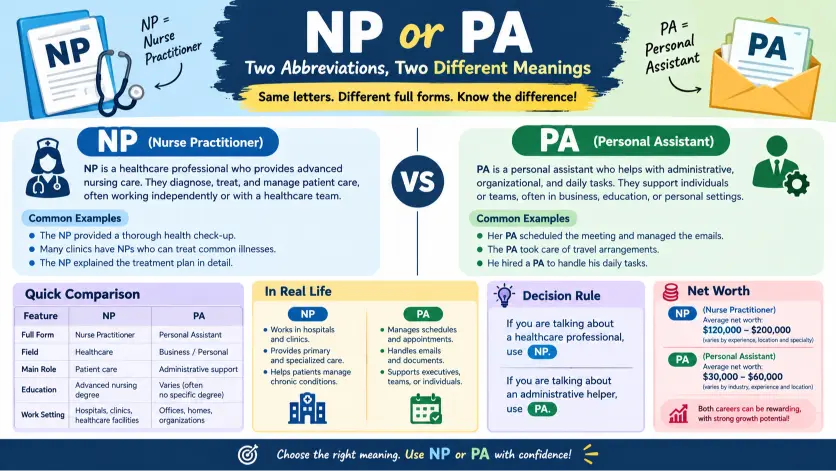
Choosing a healthcare career can be exciting, but it can also raise important questions about education, professional responsibilities, and future opportunities. If you are comparing NP or PA, you may wonder which role offers better career prospects, greater independence, or more flexibility in patient care. Although nurse practitioners and physician associates can perform similar clinical duties, their educational pathways, professional foundations, and scopes of practice differ in meaningful ways. Understanding these distinctions can help you make a more informed decision, whether you are planning your first healthcare qualification or considering a career change.
A nurse practitioner (NP) is an advanced practice registered nurse who builds on a nursing background and completes graduate level education and clinical training. A physician associate (PA), also known as a physician assistant in the United States, is trained through a medical model that emphasizes diagnosing illnesses, developing treatment plans, and managing patient care across different specialties. Both professionals may examine patients, order tests, prescribe medications when authorized, and collaborate with other healthcare providers. However, their authority and responsibilities depend on the applicable laws, licensing requirements, and practice setting.
In this guide, you will explore the differences between NPs and PAs, including educational requirements, certification, salaries, job opportunities, specialty options, and professional autonomy. The comparison will also explain how state regulations and employer policies can affect their day to day responsibilities. Since compensation and scope of practice vary by location and experience, it is important to evaluate current official licensing guidance and reliable employment data before making a decision. By the end, you will have a clearer understanding of both professions and how each may align with your interests, qualifications, and long term career goals.
NP vs PA: What’s the Difference?
The main difference between an NP and a PA lies in their educational pathways, clinical training models, and professional approach to patient care. Both can evaluate symptoms, order diagnostic tests, prescribe medications when authorized, and help manage chronic conditions. However, an NP enters advanced practice through nursing, whereas a PA follows a medical model of education and training.
In the United States, an NP is an advanced practice registered nurse who builds upon nursing education and clinical experience. By contrast, a PA completes specialized medical education that prepares them to diagnose and treat patients across various specialties.
Neither title automatically guarantees better care. Instead, the most appropriate professional depends on the patient’s needs, the clinician’s experience, the healthcare setting, and applicable state laws.
Definitions and Parts of Speech
NP, noun abbreviation: NP stands for Nurse Practitioner. An NP is a licensed healthcare professional who has completed advanced nursing education and the clinical preparation required for the role. Depending on qualifications and jurisdiction, NPs may diagnose conditions, develop treatment plans, prescribe medications, and manage ongoing care.
PA, noun abbreviation: PA stands for Physician Assistant or Physician Associate, depending on the terminology used by the relevant professional body or jurisdiction. A PA is a healthcare professional educated through a medical model to assess patients, diagnose illnesses, recommend treatments, and provide preventive care.
Both abbreviations function as nouns in ordinary English. Their meanings are professional titles rather than interchangeable descriptions of the same qualification.
NP vs PA Comparison Table
| Feature | NP | PA |
|---|---|---|
| Full form | Nurse Practitioner | Physician Assistant or Physician Associate |
| Educational foundation | Nursing | Medical model |
| Typical entry pathway | Nursing qualification followed by advanced nursing education | Undergraduate preparation followed by a PA program |
| Clinical training | Advanced nursing practice and supervised clinical experiences | General medical education and supervised clinical rotations |
| Specialization | Often organized around population focus and specialty | Often organized around specialty and clinical practice |
| Diagnosis | Within authorized scope | Within authorized scope |
| Prescribing | Depends on qualifications and local law | Depends on qualifications and local law |
| Practice authority | Varies by jurisdiction | Varies by jurisdiction |
| Work settings | Clinics, hospitals, primary care, specialty services | Clinics, hospitals, primary care, specialty services |
Quick Recap
An NP enters advanced healthcare practice through nursing.
A PA receives medical model training designed for clinical diagnosis and treatment.
Both can provide substantial patient care within their authorized scope.
Their exact responsibilities depend on qualifications, experience, workplace policies, and local regulations.
Therefore, patients should compare individual clinicians rather than relying on the title alone.
Is NP vs PA a Grammar, Vocabulary, or Usage Issue?
The difference between NP and PA is primarily a matter of professional terminology, education, and healthcare practice. It isn’t a grammar problem in the traditional sense. Nevertheless, using the abbreviations incorrectly can create misunderstandings in medical forms, employment applications, patient instructions, and professional communication.
Are NP and PA Interchangeable?
No. Although their clinical responsibilities can overlap, an NP and a PA hold different professional qualifications.
For example, an NP’s educational foundation is nursing, which emphasizes nursing practice, patient assessment, health promotion, and management of health conditions. Meanwhile, PA education follows a medical model that prepares graduates to evaluate patients, recognize disease, and develop treatment plans.
Consequently, both clinicians might treat the same condition, but their training pathways and professional frameworks differ.
Formal and Informal Usage
In formal healthcare documents, spell out each abbreviation on first use when the audience may not understand it. For example, write “Nurse Practitioner (NP)” and “Physician Assistant (PA)” before using the shortened forms.
In everyday conversation, patients commonly ask whether they should see an NP or a PA. This wording is appropriate when discussing appointment options, provider credentials, or differences in clinical responsibilities.
However, remember that terminology can vary by country and professional organization. In the United States, Physician Assistant remains widely used, while some organizations also use Physician Associate.
Academic and Casual Usage
In academic writing, distinguish the professions clearly when discussing healthcare workforce composition, clinical outcomes, education, or prescribing authority.
For instance, a research paper comparing NP and PA training should explain each group’s educational background and define the population being studied. Otherwise, readers might incorrectly assume the two professional categories are identical.
In casual conversation, the abbreviations are usually sufficient. Nevertheless, if someone is unfamiliar with healthcare terminology, explain the full titles rather than assuming that the initials are universally understood.
Practical Usage: When to Use NP
Use NP when referring specifically to a Nurse Practitioner. This abbreviation is appropriate in clinical records, professional biographies, appointment systems, healthcare research, and conversations about advanced nursing practice.
1. Workplace Example
A clinic administrator might write:
“The NP will review the patient’s blood pressure readings during the follow up appointment.”
Here, NP identifies the clinician responsible for the visit. In a workplace directory, the title can also help patients identify the professional’s credentials.
For example, a staff profile might state that a Nurse Practitioner specializes in family health, adult care, or another recognized practice area.
2. Academic Example
A nursing researcher could write:
“The study examined how NPs support patients with long term health conditions.”
In this sentence, the abbreviation identifies Nurse Practitioners as a specific professional group. Therefore, it should not be used to represent PAs or other clinicians.
When reporting research findings, writers should also distinguish between different NP populations, specialties, and practice settings whenever those details affect the results.
3. Technology Example
Electronic health record systems often display professional credentials beside appointment details.
For example:
“Assigned provider: NP.”
This label indicates that the appointment is assigned to a Nurse Practitioner. However, patients should review the clinician’s full profile if they need information about specialty, prescribing authority, or clinical responsibilities.
Usage Recap
Choose NP when the professional is a Nurse Practitioner. In addition, use the complete title in formal documents whenever clarity requires it. Never assume that every clinician with an advanced healthcare qualification is an NP.
Practical Usage: When to Use PA
Use PA when referring to a Physician Assistant or Physician Associate, according to the terminology recognized by the relevant organization or jurisdiction.
The abbreviation commonly appears in hospital directories, clinic schedules, professional credentials, research reports, and healthcare workforce discussions.
1. Workplace Example
A hospital might state:
“The PA evaluated the patient and discussed the treatment options with the supervising clinical team.”
Here, PA identifies the professional who performed the evaluation. The precise relationship between the PA and other clinicians depends on applicable law, workplace policy, and the setting in which care is delivered.
2. Academic Example
A medical education researcher might write:
“PA students completed clinical rotations in several healthcare specialties.”
This sentence describes students enrolled in Physician Assistant education. The abbreviation should not be replaced with NP because the two professions have different educational pathways.
Similarly, workforce research should identify the professional category accurately to avoid confusing educational outcomes or employment statistics.
3. Technology Example
An appointment scheduling application might display:
“Available provider: PA.”
This indicates that a Physician Assistant or Physician Associate has an available appointment. Nevertheless, patients should examine the clinician’s specialty and experience before deciding whether the appointment meets their needs.
For example, someone seeking a dermatology consultation should check whether the PA works in dermatology rather than assuming that every PA practices in that field.
Usage Recap
Use PA when referring to the relevant Physician Assistant or Physician Associate role. Additionally, explain the full title when communicating with audiences who may be unfamiliar with the abbreviation.
When You Should NOT Use NP or PA
Although the abbreviations are common in healthcare, several situations require more precise wording.
- Do not use NP as a generic term for every healthcare professional. An NP is specifically a Nurse Practitioner, not a general label for a clinician.
- Do not use PA to identify a Nurse Practitioner. The abbreviation refers to a different professional category in this context.
- Do not assume the titles mean the same thing. Shared responsibilities do not eliminate differences in training and professional credentials.
- Do not assume every NP has identical practice authority. Prescribing rights and independent practice rules vary by jurisdiction and individual authorization.
- Do not assume every PA has identical legal responsibilities. Regulations, institutional policies, and professional qualifications influence what a PA can do.
- Do not use the abbreviation without explanation in unfamiliar settings. NP and PA can have other meanings outside healthcare, so provide context when necessary.
- Do not use the title alone to judge clinical quality. A clinician’s experience, specialty training, communication skills, and suitability for the patient’s needs also matter.
- Do not assume that an appointment label fully explains a clinician’s qualifications. Check the professional profile or ask the clinic when a credential or scope of practice is unclear.
By avoiding these errors, patients and writers can communicate more accurately about healthcare roles.
Common Mistakes and Decision Rules
The following table illustrates how to use the abbreviations correctly in common situations.
| Correct sentence | Incorrect sentence | Explanation |
|---|---|---|
| The NP completed advanced nursing education. | The PA completed advanced nursing education. | The sentence describes the NP pathway. |
| The PA completed a Physician Assistant program. | The NP completed a Physician Assistant program. | The sentence refers to PA education. |
| The clinic employs three NPs. | The clinic employs three PAs. | The second sentence changes the professional group. |
| The PA evaluated the patient’s symptoms. | The NP evaluated the patient’s symptoms. | The incorrect version changes the identified clinician. |
| The NP discussed nursing based care. | The PA discussed nursing based care. | The appropriate title depends on who performed the work. |
| The PA works in emergency medicine. | The NP works in emergency medicine. | The titles are not interchangeable, even when both roles exist in emergency care. |
Importantly, some sentences in the incorrect column could be true in other circumstances. The error occurs when the abbreviation doesn’t match the professional actually being described.
A Simple Decision Rule
If you mean a Nurse Practitioner, use NP.
If you mean a Physician Assistant or Physician Associate, use PA.
Unlike word pairs that describe actions and objects, NP and PA identify distinct professional roles. Therefore, the correct choice depends on the person’s actual credentials, not merely the duties performed during a particular appointment.
NP and PA in Modern Technology and Digital Healthcare
Digital healthcare systems increasingly display professional titles in appointment portals, electronic records, telehealth applications, and patient messaging platforms.
For example, a virtual clinic may allow patients to select an NP or PA when booking a consultation. Although both clinicians may offer similar services, the available appointments can differ according to specialty, location, licensing requirements, and organizational policies.
Additionally, automated scheduling systems may shorten professional titles to fit small screens. Therefore, healthcare organizations should ensure that their interfaces define abbreviations clearly and provide access to clinician profiles.
Clinical documentation also requires accurate terminology. If a record attributes an assessment to the wrong professional category, the mistake may complicate administrative review or create confusion about credentials.
As a result, digital systems should preserve accurate professional designations and display relevant qualifications. Patients should also verify that the selected provider offers the service they need.
Etymology: Where Do NP and PA Come From?
Unlike ordinary vocabulary words, NP and PA are abbreviations derived from professional titles.
Nurse Practitioner combines “nurse,” a term associated with caring for people who are ill or require support, with “practitioner,” meaning someone who actively works in a profession or field. Together, the words identify a nursing professional with advanced preparation and an expanded clinical role.
Physician Assistant combines “physician,” referring to a medical doctor, with “assistant,” describing a role that provides professional support. The title reflects the historical development of the profession within medical care teams.
The alternative title Physician Associate is also used in some professional settings. Terminology and regulatory arrangements vary across countries, so the title should be interpreted according to local usage.
Consequently, the abbreviations preserve important information about professional identity and educational background.
An Expert Perspective on NP and PA Roles
A useful principle for understanding healthcare credentials is that similar responsibilities don’t necessarily indicate identical qualifications.
As a practical guideline:
“Compare the professional’s training, authorized responsibilities, and experience rather than relying on the title alone.”
This is a general educational statement, not a quotation attributed to a named medical authority.
For example, an NP and a PA may both provide primary care, evaluate symptoms, and help manage chronic illnesses. Nevertheless, their educational preparation and regulatory frameworks can differ.
Therefore, patients should consider the specific clinical service they need, the provider’s qualifications, and the rules governing practice in their location. When necessary, asking the clinic to explain the available credentials can help resolve uncertainty.
Two Practical Case Studies
The following illustrative case studies demonstrate how understanding professional titles can improve communication. They are educational scenarios rather than independently verified clinical research findings.
Case Study 1: Choosing a Primary Care Appointment
A patient visits an online clinic portal and sees two appointment options, one with an NP and another with a PA. Initially, the patient assumes that the titles refer to the same qualification.
After reviewing the provider profiles, the patient learns that both clinicians offer primary care, although their educational backgrounds differ. The patient then compares appointment availability, experience, and the services offered.
Result: The patient makes a more informed appointment choice based on the actual providers and their qualifications rather than assuming that the abbreviations are interchangeable.
Case Study 2: Correcting a Healthcare Workforce Report
A hospital administrator prepares a workforce report describing the number of Nurse Practitioners and Physician Assistants employed by the organization. During review, the administrator notices that several PA positions have been incorrectly grouped under NP.
The report is revised to separate the two professional categories. The administrator then checks the job titles against the organization’s staff records.
Result: The corrected report distinguishes the professional groups accurately, improving clarity for readers and reducing the risk of misleading workforce comparisons.
Error Prevention Checklist
Before using either abbreviation, review these practical points.
Always Use NP When
- Referring to a Nurse Practitioner.
- Describing advanced nursing practice.
- Identifying an NP in a clinical directory.
- Discussing research specifically about Nurse Practitioners.
- Recording a professional title that has been verified as NP.
Never Use PA When
- The person is identified as a Nurse Practitioner.
- A document specifically requires the Nurse Practitioner title.
- You are describing the educational pathway of an NP.
- The abbreviation would misrepresent the person’s professional credentials.
- You have not verified that PA is the appropriate title in the relevant context.
Always Use PA When
- Referring to a Physician Assistant or Physician Associate under the terminology used by the organization.
- Describing an educational program for that professional group.
- Identifying a PA in an appointment system or clinical report.
- Discussing workforce data specific to PAs.
- Recording a verified PA credential.
Ultimately, accuracy depends on matching the abbreviation to the actual professional title and the context in which it appears.
Related Healthcare Terms You Should Understand
Learning the difference between NP and PA also helps clarify other commonly used healthcare abbreviations.
- MD vs DO: Both are physician degrees in the United States, although their educational traditions differ.
- RN vs NP: An RN is a Registered Nurse, while an NP is a Nurse Practitioner with additional advanced practice preparation.
- PA vs MD: A PA is a Physician Assistant or Physician Associate, whereas an MD holds a Doctor of Medicine degree.
- NP vs RN: These titles describe different levels and types of nursing qualifications and responsibilities.
- PCP vs specialist: A primary care provider manages general health needs, while a specialist focuses on a particular field of medicine.
- CNA vs RN: A Certified Nursing Assistant and a Registered Nurse have different education requirements and scopes of responsibility.
- DNP vs NP: DNP means Doctor of Nursing Practice, an academic degree, while NP identifies a professional role.
- PA vs APRN: PA identifies a Physician Assistant or Physician Associate, whereas APRN means Advanced Practice Registered Nurse.
- DO vs PA: A Doctor of Osteopathic Medicine is a physician, while a PA is a separately trained healthcare professional.
- NP vs physician: NPs and physicians have distinct educational and licensing pathways, although their clinical responsibilities may overlap in some settings.
These distinctions are particularly useful when reviewing medical biographies, comparing clinical services, reading workforce reports, or choosing an appointment.
Frequently Asked Questions
1. What is the difference between an NP and a PA?
An NP is a Nurse Practitioner whose professional foundation is nursing, while a PA is a Physician Assistant or Physician Associate educated through a medical model. Both can diagnose and treat patients within their authorized scope, although their training and practice regulations differ.
2. Is an NP higher than a PA?
Neither title is universally higher than the other. They represent different professional pathways. The appropriate clinician depends on the patient’s needs, the provider’s qualifications, clinical experience, and the legal scope of practice in the relevant jurisdiction.
3. Can an NP and a PA prescribe medication?
Both NPs and PAs may prescribe medications when authorized by applicable law and their professional credentials. However, prescribing authority, restrictions, and supervision requirements differ by jurisdiction. Patients should check local regulations or ask their healthcare provider for clarification.
4. Is an NP a doctor?
An NP is not automatically a physician. Nurse Practitioners complete advanced nursing education, and some hold doctoral degrees, such as a Doctor of Nursing Practice. However, holding an NP credential doesn’t itself make someone a medical doctor.
5. Is a PA the same as a physician assistant?
Yes. In the United States, PA traditionally stands for Physician Assistant, although Physician Associate is also used by some professional organizations. The appropriate title depends on the applicable professional terminology and jurisdiction.
6. Do NPs or PAs have more training?
The answer depends on how training is measured, including educational background, clinical experience, specialty preparation, and the type of care involved. Their educational pathways differ, so a general ranking may be misleading. Compare the individual qualifications relevant to the patient’s needs.
7. Can an NP or PA work in a hospital?
Yes. Both NPs and PAs work in hospitals, outpatient clinics, emergency departments, and specialty services. Their actual responsibilities depend on their qualifications, employer policies, specialty, and applicable regulations.
8. Should I see an NP or a PA for primary care?
Either may be an appropriate choice for primary care. Consider appointment availability, experience, communication style, the services offered, and whether the professional is qualified to address your needs. If you have a complex condition, ask whether additional specialist care is advisable.
9. What do NP and PA stand for in healthcare?
NP stands for Nurse Practitioner. PA stands for Physician Assistant or Physician Associate, depending on the terminology used by the organization or jurisdiction. Both abbreviations identify healthcare professions, but they don’t represent the same qualification.
Conclusion:
Understanding NP or PA begins with recognizing that these abbreviations identify different healthcare professions. NP stands for Nurse Practitioner, a clinician whose professional foundation is nursing. PA refers to a Physician Assistant or Physician Associate, a clinician educated through a medical model.
Although their duties can overlap, their educational pathways, professional frameworks, and legal responsibilities aren’t identical. Consequently, choosing between them shouldn’t depend on the title alone.
Instead, consider the care you need, the provider’s experience, relevant specialty qualifications, and local practice regulations. Moreover, verify credentials whenever a clinic directory or appointment system uses unfamiliar abbreviations.
Ultimately, accurate terminology helps patients understand their options and allows healthcare organizations to communicate professional roles clearly. Once you know what each title represents, distinguishing NP from PA becomes straightforward.









