Choosing a camera can feel overwhelming when you are deciding between a DSLR and a mirrorless model. Both camera types can capture stunning photographs, record high quality videos, and support interchangeable lenses. However, their internal designs, autofocus systems, size, and shooting experiences differ in important ways. If you are planning to buy your first camera or upgrade your existing equipment, understanding these differences can help you avoid spending money on features you do not need. The right choice depends on your photography goals, budget, and preferred shooting style.
When comparing DSLR or mirrorless cameras, the biggest distinction is how each system displays the image before you take a photograph. A DSLR uses a mirror mechanism to direct light toward an optical viewfinder, while a mirrorless camera sends light directly to its image sensor and typically displays the preview electronically. This design difference influences camera size, electronic features, autofocus performance, and video capabilities. Mirrorless cameras have become increasingly popular because of their advanced features and compact designs, although DSLRs can still offer excellent image quality, comfortable handling, and access to extensive lens collections.
In this guide, you will explore the advantages and disadvantages of both camera systems, including image quality, autofocus, battery life, lens compatibility, video recording, and overall cost. You will also learn which option may suit beginners, professional photographers, travelers, and content creators. The comparison focuses on practical features and established camera technology rather than marketing claims alone. By understanding what each system does well, you can make a more informed purchasing decision and choose a camera that fits your needs today while supporting your creative goals in the future.
DSLR vs Mirrorless: What’s the Difference?
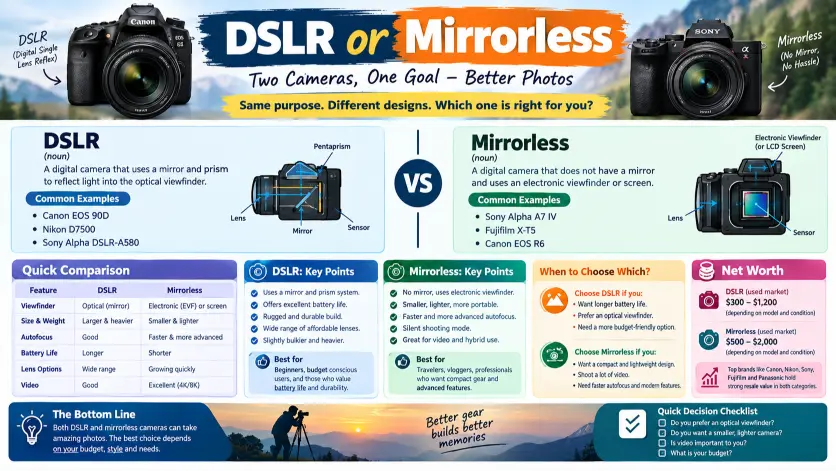
The main difference between a DSLR and a mirrorless camera is how each device displays and captures an image. Although both can produce excellent photographs, their internal designs affect size, autofocus, battery life, viewfinder experience, and video capabilities.
A DSLR, short for digital single lens reflex, uses a mirror mechanism to direct light from the lens into an optical viewfinder. When the photographer presses the shutter button, the mirror moves out of the way so light can reach the image sensor.
By comparison, a mirrorless camera has no reflex mirror. Instead, light reaches the image sensor directly, allowing the camera to display a digital preview on its screen or electronic viewfinder.
Definitions and Parts of Speech
DSLR (noun): An abbreviation for digital single lens reflex, referring to a digital camera that uses a reflex mirror and generally an optical viewfinder.
Mirrorless (adjective): A term describing a camera system that operates without the reflex mirror found in a DSLR. The complete expression, mirrorless camera, functions as a noun phrase.
For example, a wildlife photographer might choose a DSLR for its optical viewfinder and established lens collection. Meanwhile, a travel photographer might prefer a mirrorless camera because many models offer compact bodies, advanced autofocus, and strong video features.
DSLR vs Mirrorless Comparison Table
| Feature | DSLR Camera | Mirrorless Camera |
|---|---|---|
| Internal mirror | Uses a reflex mirror | No reflex mirror |
| Viewfinder | Usually optical | Electronic, if included |
| Image preview | Optical view through the lens | Digital preview on screen or electronic viewfinder |
| Size and weight | Often larger and heavier | Often smaller and lighter |
| Autofocus | Depends on the model and shooting mode | Often includes advanced subject tracking |
| Video recording | Varies by model | Many models offer advanced video features |
| Battery life | Often longer when using the optical viewfinder | Electronic displays generally consume more power |
| Lens selection | Large selection, especially for established systems | Expanding selection of native lenses |
| Silent shooting | Depends on shutter design and settings | Many models offer electronic shutter modes |
| Best suited for | Optical viewing and established systems | Hybrid photography, video, and modern autofocus |
Quick Recap
A DSLR uses a mirror to direct light into an optical viewfinder.
A mirrorless camera sends light directly to its image sensor.
Both systems can deliver professional quality photographs.
However, the best choice depends on budget, handling preferences, lens availability, and intended use.
Is DSLR vs Mirrorless a Grammar, Vocabulary, or Usage Issue?
Unlike pairs of commonly confused words, DSLR and mirrorless are not competing spellings of the same word. Instead, they describe two different camera designs. Therefore, choosing between them is a technical and practical decision rather than a grammar problem.
Are DSLR and Mirrorless Cameras Interchangeable?
Both types can perform many of the same photographic tasks, including portraits, landscapes, sports photography, and event coverage. Nevertheless, their designs and available features differ.
For instance, a modern mirrorless camera may offer subject recognition that tracks an animal’s eyes during movement. Similarly, a DSLR may provide an optical viewfinder that some photographers prefer because it shows the scene directly rather than displaying a digital image.
Consequently, neither category is automatically superior in every situation. Individual models, lenses, settings, and photographer preferences all influence the final result.
Formal and Informal Usage
In formal photography reviews, equipment guides, and technical reports, DSLR and mirrorless are standard terms. Writers commonly introduce the complete phrase “digital single lens reflex camera” before using its abbreviation.
In everyday conversation, photographers often say “DSLR” or simply “mirrorless.” Although the second expression is technically an adjective used as shorthand for a mirrorless camera, its meaning is widely understood.
For clarity, beginners should write “mirrorless camera” when first introducing the term.
Academic and Casual Contexts
In academic photography courses, technical explanations may cover the reflex mirror, image sensor, shutter mechanism, and viewfinder design. These details help students understand how the equipment works.
In casual discussions, however, photographers are more likely to compare price, portability, image quality, and ease of use.
For example, a student researching photographic technology might examine the differences between optical and electronic viewfinders. Meanwhile, a hobbyist shopping for a travel camera might focus primarily on weight and lens options.
Practical Usage: When to Choose a DSLR
A DSLR can remain a sensible choice for photographers who already own compatible lenses, prefer optical viewing, or want an affordable used camera system. Although manufacturers have increasingly concentrated on mirrorless development, many DSLR bodies and lenses continue to serve photographers effectively.
1. Workplace Photography
In professional event photography, a DSLR may suit photographers who are familiar with its controls and already possess a collection of compatible lenses.
For example, a wedding photographer with several DSLR bodies and professional lenses may continue using that equipment rather than replacing an entire system immediately.
Furthermore, a reliable camera that meets a client’s requirements can remain valuable even when newer technology becomes available.
2. Academic Photography
Photography students can learn exposure, aperture, shutter speed, ISO, and depth of field using a DSLR.
For instance, an instructor may demonstrate how the mirror moves when a photograph is captured. This mechanical arrangement provides a useful introduction to the relationship between the lens, viewfinder, and image sensor.
Nevertheless, these concepts can also be learned using a mirrorless camera.
3. Technology and Equipment Compatibility
A photographer who owns older lenses may find that a DSLR offers convenient native compatibility with those accessories.
For example, someone with a collection of compatible lenses might prefer to continue using an existing camera body while investing in lighting equipment or photography education.
However, lens compatibility depends on the manufacturer, mount, and individual model. Some older lenses can also work on mirrorless bodies through suitable adapters.
Usage Recap
Choose a DSLR when its optical viewfinder, familiar handling, available lenses, or used market pricing matches your needs. However, evaluate the specific model rather than assuming that every DSLR offers better battery life or autofocus than every mirrorless alternative.
Practical Usage: When to Choose a Mirrorless Camera
Mirrorless cameras appeal to photographers who want modern autofocus, electronic previews, advanced video options, and increasingly broad lens selections. Moreover, many models combine high resolution with relatively compact bodies.
1. Workplace Photography
For commercial photographers who produce both still images and videos, a mirrorless camera can simplify a hybrid workflow.
For example, a content creator might photograph a product, record a promotional video, and review exposure using the same camera.
Additionally, subject tracking can help photographers keep moving subjects in focus, although performance varies across models and recording settings.
2. Academic Photography
Mirrorless cameras can help students understand exposure through a live electronic preview.
For instance, when a student adjusts shutter speed or exposure compensation, the viewfinder may display an approximation of how the final image will appear.
This feature can make experimentation easier. Nevertheless, the preview may not perfectly represent the final photograph under every lighting condition.
3. Technology and Video Production
Many mirrorless cameras provide advanced video features, including high resolution recording, in body image stabilization on selected models, and sophisticated autofocus tracking.
For example, a travel filmmaker might use a mirrorless camera to record interviews, moving scenes, and still photographs during the same trip.
However, buyers should compare recording limits, heat management, stabilization, microphone connections, and autofocus performance before choosing a model.
Usage Recap
Choose a mirrorless camera when its autofocus, electronic viewfinder, portability, or video capabilities meet your requirements. Still, compare actual specifications because camera size, battery endurance, and performance differ considerably between models.
When You Should NOT Choose a DSLR or Mirrorless Camera
Neither design suits every photographer equally. Therefore, consider these situations before spending money on new equipment.
- Don’t buy a new DSLR without checking long term system support. If you need future lens releases or the newest autofocus developments, investigate the manufacturer’s current product direction first.
- Don’t dismiss a DSLR you already own. If your current camera produces the results you need, replacement may offer little practical benefit.
- Don’t assume every mirrorless camera is lightweight. Professional bodies and large telephoto lenses can create a heavy setup.
- Don’t purchase mirrorless equipment solely because it is newer. A costly upgrade won’t automatically improve composition, lighting, or photographic technique.
- Don’t choose a camera without checking lens compatibility. Existing lenses, adapters, autofocus support, and mount restrictions can affect your total investment.
- Don’t overlook battery requirements. Electronic viewfinders and displays use power, so mirrorless users may benefit from carrying spare batteries.
- Don’t assume a DSLR always has superior battery life. Optical viewing often conserves power, but actual endurance depends on the model, battery, and shooting conditions.
- Don’t compare image quality using the camera category alone. Sensor size, resolution, lens quality, dynamic range, lighting, and technique all influence the finished image.
Ultimately, selecting a camera requires evaluating the complete system rather than following a general preference for one design.
Common DSLR and Mirrorless Buying Mistakes
Many camera comparisons become confusing because buyers treat broad categories as guarantees of performance. Instead, compare specific features and practical requirements.
| Correct understanding | Incorrect assumption | Explanation |
|---|---|---|
| Both systems can produce excellent photographs. | Mirrorless always delivers better image quality. | Image quality depends on the sensor, lens, exposure, and processing. |
| Some DSLRs have excellent autofocus. | Every mirrorless camera focuses faster. | Performance depends on the model and shooting conditions. |
| Many mirrorless models offer electronic previews. | Electronic previews always match the final image perfectly. | Display brightness, exposure settings, and lighting can affect the preview. |
| DSLRs may offer good value on the used market. | All DSLRs are inexpensive. | Professional and collectible models can remain costly. |
| Lens compatibility varies by system. | Every old lens works perfectly with an adapter. | Autofocus, stabilization, and other functions may be limited. |
| Some mirrorless bodies are compact. | All mirrorless setups are smaller. | Large lenses and professional bodies can increase overall weight. |
| Battery life varies by model. | Every DSLR lasts longer than every mirrorless camera. | Usage patterns and battery capacity affect endurance. |
| Both designs can support professional work. | DSLRs are unsuitable for professional photography. | Professional suitability depends on requirements and equipment capabilities. |
A Simple Decision Rule
If you mean a camera with a reflex mirror and usually an optical viewfinder, choose a DSLR.
If you mean a camera designed without a reflex mirror, choose a mirrorless camera.
For purchasing decisions, use a second rule: select the camera that best fits your photography needs, budget, and existing equipment. The design alone does not determine whether a camera is right for you.
DSLR and Mirrorless Cameras in Modern Technology
Camera technology continues to evolve, especially in autofocus, image processing, video recording, and subject recognition. Consequently, modern mirrorless systems often attract photographers who need advanced tracking and hybrid video performance.
Many models can recognize people, animals, or vehicles and adjust focus as subjects move through a scene. Additionally, electronic viewfinders can display exposure information, histograms, and other shooting aids.
Nevertheless, DSLRs remain useful for many photography tasks. Their optical viewfinders provide a direct optical view, and established lens systems may offer excellent value for photographers who already own compatible equipment.
Both categories can also use modern editing applications, wireless transfers, and computer based image management. Therefore, a camera’s overall workflow depends on its connectivity, software support, and file formats as well as its internal design.
Before buying, compare the exact features that matter to your work instead of relying on general claims about newer technology.
Etymology: Where Do DSLR and Mirrorless Come From?
The term DSLR comes from digital single lens reflex. Each part describes an aspect of the camera: digital refers to electronic image capture, single lens indicates a shared lens for viewing and photography, and reflex refers to the mirror mechanism that redirects light toward the viewfinder.
The word mirrorless is formed from “mirror” and the suffix “less,” meaning without. In photography, it describes a camera design that omits the reflex mirror assembly used in a DSLR.
Historically, DSLR cameras became widely used in professional and enthusiast photography as digital sensors replaced film in established single lens reflex designs. Mirrorless cameras later developed into a major category as electronic viewfinders, sensors, processing, and autofocus systems advanced.
Today, both terms describe established camera types. Their differences reflect engineering design rather than a simple division between good and bad equipment.
An Expert Perspective on Choosing a Camera
A useful principle in photography education is to match equipment to the task rather than selecting a product based on popularity.
As a practical buying guideline:
“Choose the camera that supports your photographic goals, not simply the camera with the newest specifications.”
This is an editorial recommendation rather than a quotation attributed to a specific photography expert.
For example, a sports photographer may prioritize continuous autofocus, burst speed, and buffer performance. Conversely, a landscape photographer may care more about dynamic range, resolution, lens quality, and tripod handling.
Similarly, a video creator may value recording formats, stabilization, audio connections, and heat management. By evaluating these requirements first, buyers can avoid paying for features they rarely use.
Two Practical Case Studies
The following examples illustrate how different photographic needs can lead to different camera choices. They are hypothetical scenarios, not independently verified customer studies.
Case Study 1: A Wedding Photographer With Existing Equipment
Consider a wedding photographer who owns two DSLR bodies and several compatible professional lenses.
Replacing the entire system would involve more than buying a new camera. The photographer would also need to consider replacement lenses, batteries, accessories, training, and potential workflow changes.
Instead, the photographer reviews the current equipment and determines that it still meets the required image quality and reliability standards.
Result: Keeping the existing DSLR system avoids an immediate equipment replacement expense while allowing the photographer to continue serving clients. A future upgrade can be planned around specific performance needs rather than the age of the technology.
Case Study 2: A Travel Creator Recording Photos and Videos
Now consider a travel creator who photographs landscapes, records interviews, and produces short videos while moving between destinations.
The creator compares several mirrorless models based on total kit weight, autofocus tracking, stabilization, recording features, battery capacity, and lens availability.
After testing the shortlisted options, the creator selects a model that balances portability and video performance.
Result: A carefully selected mirrorless setup supports both still photography and video recording within one system. The practical benefit comes from matching the equipment to the workflow, rather than from assuming every mirrorless camera outperforms every DSLR.
Camera Buying Checklist
Before selecting either camera type, review these points.
Choose a DSLR When
- You prefer an optical viewfinder.
- Your existing lenses are compatible with a DSLR body.
- A suitable used camera offers the features you need.
- You value familiar controls and handling.
- The camera meets your requirements for still photography.
Choose a Mirrorless Camera When
- You want an electronic viewfinder or live digital exposure preview.
- Advanced subject tracking is important to your work.
- You regularly record video as well as photographs.
- You want access to the features available in a particular mirrorless system.
- A compatible body and lens combination meets your portability needs.
Check Before Purchasing Either Type
- Total price, including lenses and accessories.
- Sensor size and resolution.
- Autofocus performance in your intended shooting conditions.
- Battery life and replacement battery cost.
- Lens selection and future compatibility.
- Video recording specifications, if required.
- Ergonomics, weight, and ease of use.
- Repair options and availability of replacement parts.
This checklist makes the buying process more objective. In addition, testing a camera in person can reveal handling preferences that specification sheets cannot communicate.
Related Photography Concepts You Should Understand
Understanding these related terms will make camera comparisons more useful.
- DSLR vs film camera: A DSLR captures digital images, whereas a traditional film camera records photographs on photographic film.
- Full frame vs crop sensor: These terms describe sensor formats that influence field of view, equipment size, and other photographic characteristics.
- Optical vs electronic viewfinder: An optical viewfinder presents a direct optical view, while an electronic viewfinder displays a digital image.
- Prime vs zoom lens: A prime lens has a fixed focal length, whereas a zoom lens covers a range of focal lengths.
- Aperture vs shutter speed: Aperture controls the lens opening, while shutter speed determines how long light reaches the sensor during exposure.
- ISO vs exposure compensation: ISO describes the sensor system’s light sensitivity setting, while exposure compensation adjusts the camera’s automatic exposure target.
- Autofocus vs manual focus: Autofocus uses the camera’s focusing system, while manual focus requires the photographer to adjust focus directly.
- RAW vs JPEG: RAW files preserve more original image data for processing, while JPEG files are processed and compressed.
- Optical stabilization vs in body stabilization: Lens stabilization operates within a lens, while in body stabilization moves the camera sensor to compensate for certain movements.
- Megapixels vs image quality: Megapixels indicate image resolution, but overall quality also depends on sensor performance, optics, lighting, and processing.
These distinctions help photographers evaluate cameras according to measurable capabilities rather than marketing claims.
Frequently Asked Questions
1. What is the difference between DSLR and mirrorless cameras?
A DSLR uses a reflex mirror to direct light into an optical viewfinder, while a mirrorless camera has no reflex mirror and relies on its image sensor to provide a digital preview. Both types can produce excellent photographs, but their handling, autofocus, and video features vary.
2. Is a DSLR better than a mirrorless camera for beginners?
Neither type is automatically better for beginners. A DSLR may provide affordable access to established equipment, while a mirrorless model may offer convenient exposure previews and modern autofocus. The best option depends on budget, comfort, intended subjects, and available lenses.
3. Which camera has better image quality, DSLR or mirrorless?
Neither category automatically produces better image quality. Sensor size, resolution, dynamic range, lens performance, exposure, and lighting matter more than the presence or absence of a mirror. A high quality DSLR can outperform an entry level mirrorless model in particular situations, and the reverse can also be true.
4. Are mirrorless cameras smaller and lighter than DSLRs?
Many mirrorless bodies are smaller and lighter because they omit the reflex mirror assembly. However, professional mirrorless cameras and large lenses can be substantial. Therefore, compare the weight of the complete camera and lens combination rather than the body alone.
5. Do DSLR cameras have better battery life than mirrorless cameras?
DSLRs often provide longer battery endurance when photographers use their optical viewfinders because they don’t need to power an electronic viewfinder continuously. Nevertheless, actual performance depends on battery capacity, screen use, temperature, recording settings, and the specific camera model.
6. Is mirrorless better than DSLR for video recording?
Many modern mirrorless cameras offer advanced video specifications, autofocus tracking, and convenient electronic previews. However, video performance varies by model, and some DSLRs also record high quality footage. Compare resolution, frame rates, recording limits, stabilization, audio inputs, and heat management.
7. Are DSLR cameras becoming obsolete?
DSLR cameras aren’t automatically obsolete simply because mirrorless systems have become increasingly prominent. Existing DSLRs can remain useful for professional assignments, education, and hobby photography. However, buyers should consider current manufacturer support, future lens development, repairs, and the availability of compatible equipment.
8. Can I use DSLR lenses on a mirrorless camera?
Sometimes. Many manufacturers offer adapters that allow selected DSLR lenses to work with compatible mirrorless bodies. However, autofocus, image stabilization, aperture control, and other functions may vary according to the lens, adapter, and camera combination. Always check compatibility before purchasing.
9. Should I buy a DSLR or mirrorless camera for wildlife photography?
Either type can work well for wildlife photography. Important factors include autofocus tracking, continuous shooting speed, buffer capacity, lens reach, low light performance, and handling. A modern mirrorless model may offer useful subject recognition, while a DSLR with a suitable telephoto lens can still produce excellent results.
Conclusion:
Choosing between DSLR or mirrorless cameras depends on your photographic goals, budget, and preferred shooting experience. A DSLR may be a sensible option if you value an optical viewfinder, already own compatible lenses, or find a suitable used system at an attractive price.
By contrast, a mirrorless camera may better suit photographers who prioritize electronic previews, advanced subject tracking, video capabilities, or a compact body. Nevertheless, neither design guarantees superior image quality, and individual models differ substantially.
Before making a purchase, compare the sensor, autofocus, lens system, battery performance, handling, and total cost. Whenever possible, test the camera with the type of lens you’ll use most often.
Ultimately, the best camera is the one that reliably helps you capture the images you want. Understanding the difference between these two systems allows you to make a confident, practical decision without spending money on features you don’t need.









