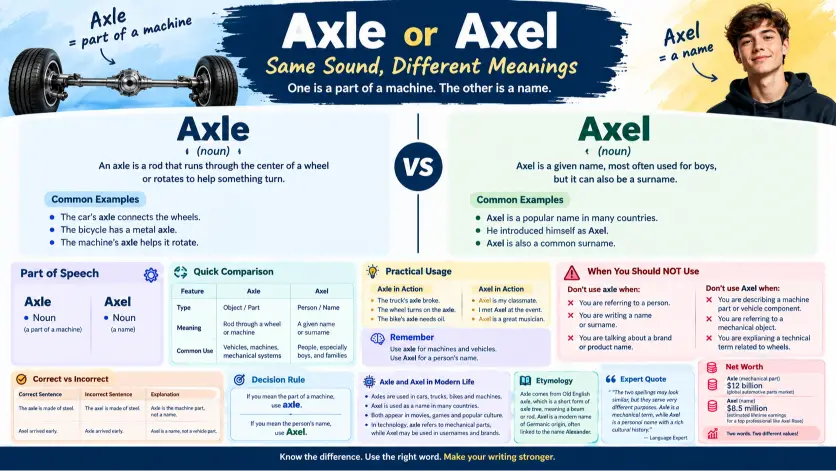
Have you ever wondered whether the correct spelling is axle or axel? These two words look remarkably similar, so it is easy to mix them up when writing about cars, mechanical parts, or personal names. However, they serve different purposes. An axle is an important mechanical component associated with the wheels of a vehicle, while Axel is commonly used as a personal name. Understanding this distinction helps you avoid spelling errors and communicate more clearly, especially when discussing automotive technology, vehicle repairs, or engineering.
The easiest way to distinguish axle or axel is to consider the context. In automotive and mechanical writing, axle is the standard spelling for the component that supports or connects wheels and may transmit driving torque, depending on the vehicle design. For example, a mechanic might inspect a damaged axle after a vehicle experiences a problem. In contrast, Axel is a recognized given name, so it appears in personal introductions, biographies, and other contexts involving individuals. Although the words look and sound similar in English, their meanings make the correct choice clear.
In this guide, you will learn the definitions of axle and Axel, examine practical sentence examples, and discover common mistakes that can lead to confusion. You will also explore how the words are used in automotive discussions, technical documents, and everyday communication. Whether you are a student, a vehicle owner, a writer, or someone learning English, these explanations will help you recognize the correct spelling with confidence. By the end, you will understand when to write axle for a mechanical component and when Axel is appropriate as a personal name.
Axle vs Axel: What’s the Difference?
The main difference between axle and axel is their meaning and context. Although both words share the same pronunciation, they belong to different subject areas. An axle is a mechanical component, whereas an axel is a named figure skating jump.
For instance, a mechanic might inspect a damaged axle before returning a vehicle to the road. Meanwhile, a figure skater might practice an axel to improve a competitive routine. Consequently, understanding the context is the easiest way to choose the correct spelling.
Definition of Axle
Axle (noun): An axle is a shaft or structural component that supports wheels, connects rotating parts, or helps transmit mechanical power. Depending on the design, it may remain stationary while wheels rotate around it, or it may rotate with the wheels.
Axles are common in cars, trucks, bicycles, trailers, agricultural equipment, and industrial machinery. Their precise function depends on the mechanical system in which they operate.
Examples include:
“The mechanic replaced the damaged axle.”
“The trailer’s rear axle supports much of its load.”
“The engineer examined the axle assembly before testing the machine.”
In each sentence, axle refers to a physical mechanical component.
Definition of Axel
Axel (noun): An axel is a figure skating jump that begins with a forward takeoff from an outside edge and includes rotation in the air before the skater lands backward on the opposite foot.
The jump is named after Norwegian figure skater Axel Paulsen, who performed it in the nineteenth century. Because the takeoff begins while the skater is moving forward, an axel requires an additional half rotation compared with many other jumps having the same number of named rotations.
For example:
“She landed a clean single axel during practice.”
“The skater is working toward a consistent double axel.”
“The triple axel is a challenging jump in competitive figure skating.”
In these examples, axel refers exclusively to the skating element.
Axle vs Axel Comparison Table
| Feature | Axle | Axel |
|---|---|---|
| Part of speech | Noun | Noun |
| Main meaning | Mechanical shaft or wheel supporting component | Figure skating jump |
| Common field | Automotive engineering and machinery | Figure skating and sports |
| Typical phrase | Rear axle | Triple axel |
| Physical role | Supports wheels or transmits mechanical force | Describes an athletic movement |
| Example | The axle needs replacement. | She landed a double axel. |
| Common context | Repairs, engineering, vehicles | Training, competitions, skating |
Quick Recap
Axle is the correct spelling for the mechanical component found in vehicles and machinery.
Axel is the correct spelling for a figure skating jump.
Both words sound alike, but their meanings are entirely different.
Therefore, choose the spelling according to whether you’re discussing mechanical equipment or skating.
Is Axle vs Axel a Grammar, Vocabulary, or Usage Issue?
The difference between axle and axel is primarily a vocabulary and spelling issue. Both words are legitimate English nouns, and neither spelling is inherently incorrect. However, using one in place of the other can make a sentence inaccurate because the intended subject changes.
Are Axle and Axel Interchangeable?
No. These words aren’t interchangeable in standard English.
Consider the sentence, “The mechanic inspected the axle.” Here, the word identifies a component of a mechanical system. Replacing axle with axel would introduce an incorrect spelling for the intended meaning.
Likewise, “The skater landed a triple axel” correctly identifies a particular skating jump. Substituting axle would create a spelling error in the sports context.
Thus, pronunciation alone cannot determine which word belongs in a sentence.
Formal and Informal Usage
Both words are suitable for formal and informal communication when used correctly.
In a formal engineering report, axle might appear in descriptions of wheel assemblies, load distribution, or vehicle maintenance. Similarly, a sports article might discuss an athlete’s successful axel or progress toward a triple axel.
In everyday conversation, someone could ask whether a car needs a new axle or comment on a skater’s impressive jump. Therefore, neither term is restricted to a particular level of formality.
Academic and Casual Contexts
In academic writing, axle commonly appears in mechanical engineering, automotive technology, transportation studies, and physics. Researchers may examine axle loads, shaft stresses, or the performance of different wheel assemblies.
By comparison, axel appears in sports science, figure skating instruction, biomechanics, and competitive skating analysis. Coaches may discuss takeoff technique, rotation, balance, and landing mechanics.
In casual writing, the same distinction applies. The subject determines the spelling, regardless of whether the sentence appears in a textbook, newspaper, maintenance manual, or conversation.
Practical Usage: When to Use Axle
Use axle when referring to a mechanical component that supports wheels, connects rotating components, or helps transfer mechanical force. Although axle designs vary, the word consistently belongs to the world of machinery and transportation.
1. Workplace Examples
In an automotive repair shop, a technician might inspect an axle after a driver reports unusual vibration or hears a knocking sound.
Example: “The technician discovered damage to the rear axle during the vehicle inspection.”
Similarly, a logistics company might examine axle loads to ensure that a truck complies with applicable weight limits.
Example: “The transport manager checked the axle loads before approving the shipment.”
In both cases, axle identifies a physical part or a component associated with vehicle loading.
2. Academic Examples
In mechanical engineering, students may study axle design to understand how loads affect vehicle components.
Example: “The engineering team calculated the forces acting on the axle under different operating conditions.”
Likewise, a transportation research paper might examine the relationship between axle loading and road surface damage.
Example: “The researchers investigated how heavy axle loads influence pavement deterioration.”
These examples demonstrate how the word appears in technical and scientific discussions.
3. Technology Examples
Modern vehicles use different axle arrangements depending on their design and intended purpose. Engineers may evaluate solid axles, independent suspension systems, and drive axle assemblies when developing new vehicles.
Example: “The manufacturer redesigned the drive axle to improve power delivery.”
In vehicle diagnostic software, technicians might review sensor readings or service information associated with an axle assembly.
Example: “The diagnostic report identified a problem affecting the vehicle’s axle system.”
Although the technology may be sophisticated, the spelling remains axle whenever the mechanical component is meant.
Usage Recap
Choose axle when discussing cars, trucks, trailers, bicycles, machinery, or engineering components. In addition, remember that related expressions include drive axle, rear axle, front axle, and axle load.
Practical Usage: When to Use Axel
Use axel when describing the figure skating jump named after Axel Paulsen. The term appears in skating lessons, competition commentary, training plans, and discussions of jump difficulty.
1. Workplace Examples
In professional skating, coaches evaluate jump technique, consistency, and landing control.
Example: “The coach adjusted the training schedule to help the athlete improve the double axel.”
Similarly, a sports commentator might explain a competitor’s performance during a competition.
Example: “The skater completed a clean axel and earned positive feedback from the judges.”
In both sentences, axel identifies the skating movement rather than an equipment component.
2. Academic Examples
Sports science researchers may examine the biomechanics of an axel, including takeoff speed, body position, angular momentum, and landing stability.
Example: “The researchers analyzed the skater’s rotation during the double axel.”
Likewise, an exercise science student might compare the physical demands of different figure skating jumps.
Example: “The study evaluated balance and rotational control during axel training.”
Consequently, axel is appropriate when the subject involves this specific athletic skill.
3. Technology Examples
Video analysis software helps coaches review jump technique frame by frame. Motion capture systems can also measure body movement during training.
Example: “The coach used slow motion video to evaluate the athlete’s axel takeoff.”
Similarly, digital competition records may identify which jumps a skater attempts during a program.
Example: “The performance report recorded a successful triple axel.”
In each case, technology supports the analysis, but the skating term remains axel.
Usage Recap
Choose axel when discussing figure skating jumps, coaching, competitions, or jump analysis. Common expressions include single axel, double axel, and triple axel.
When You Should NOT Use Axle or Axel
Because these words are homophones, writers sometimes select the wrong spelling without noticing the change in meaning. However, a few practical distinctions can prevent most errors.
- Don’t use axel for a vehicle component. Write “The truck’s axle needs repair,” not “The truck’s axel needs repair.”
- Don’t use axle for a skating jump. Write “She landed a double axel,” not “She landed a double axle.”
- Don’t confuse an axle with an entire wheel assembly. An axle is a particular component, although its exact relationship to the wheels depends on the design.
- Don’t assume every axle rotates. Some axles remain stationary while the wheels rotate around them. Others rotate as part of a drive system.
- Don’t describe every skating jump as an axel. The axel has a specific forward takeoff and rotational pattern. Other jumps, such as the toe loop and salchow, have different takeoff mechanics.
- Don’t spell technical vehicle terms according to pronunciation alone. Expressions such as axle shaft and axle load require the spelling axle.
- Don’t substitute axle in sports commentary. Even if a triple axel sounds like a mechanical term, it refers to a recognized figure skating jump.
- Don’t assume a spelling checker will identify the mistake. Both spellings are valid words, so proofreading must account for the sentence’s meaning.
Ultimately, the safest approach is to identify the subject first. If the sentence concerns machinery, choose axle. If it concerns the named skating jump, choose axel.
Common Mistakes and Decision Rules
The following table illustrates how these spellings should appear in everyday and professional sentences.
| Correct sentence | Incorrect sentence | Explanation |
|---|---|---|
| The mechanic inspected the axle. | The mechanic inspected the axel. | Axle is the mechanical component. |
| She landed a triple axel. | She landed a triple axle. | Axel names the skating jump. |
| The rear axle supports the vehicle. | The rear axel supports the vehicle. | The sentence refers to vehicle hardware. |
| He is practicing a double axel. | He is practicing a double axle. | The subject is figure skating. |
| The engineer measured axle stress. | The engineer measured axel stress. | Axle is the appropriate engineering term. |
| The skater attempted an axel. | The skater attempted an axle. | Axel identifies the athletic movement. |
| The truck’s drive axle transfers power. | The truck’s drive axel transfers power. | Drive axle is the established mechanical expression. |
| The athlete completed a clean single axel. | The athlete completed a clean single axle. | Single axel is the correct skating expression. |
A Simple Decision Rule
If you mean a mechanical component, use axle.
If you mean the figure skating jump, use axel.
For example, a mechanic might replace a damaged axle, while a skater might practice a triple axel. Once you identify the subject, the correct spelling becomes straightforward.
Axle and Axel in Modern Technology
Modern technology uses both words in distinct areas. In vehicle design, computer aided engineering software allows engineers to model axle geometry, estimate loads, and evaluate component strength. Meanwhile, automotive diagnostic equipment can help technicians identify problems involving an axle assembly.
In figure skating, video replay, motion tracking, and performance analysis software help coaches examine an axel’s takeoff, rotation, and landing. These tools can reveal technical details that may be difficult to observe during a live performance.
However, digital tools don’t eliminate the need for accurate vocabulary. A spellchecker might accept both words without understanding whether the sentence refers to machinery or sport. Similarly, a writing assistant may need sufficient context to distinguish the intended meaning.
Therefore, technical writers, journalists, coaches, and students should verify the terminology against the subject being discussed. Correct spelling improves clarity, especially in instructions, reports, and educational materials.
Etymology: Where Do Axle and Axel Come From?
The histories of axle and axel help explain why these words belong to different contexts.
Axle developed from older Germanic forms associated with an axis or the central shaft of a wheel. The word became established in English as transportation and mechanical systems evolved. Today, it describes components used in vehicles, carts, trailers, and machinery.
Axel, in the skating sense, is named after Norwegian figure skater Axel Paulsen. He is credited with introducing the jump that bears his name in the nineteenth century. The jump subsequently became an important element of competitive figure skating.
Although the spellings differ by only one letter, their histories point toward separate concepts. Axle belongs to mechanical terminology, while axel identifies a particular athletic movement.
Both words are therefore correct in their respective contexts. Neither spelling is simply a mistaken variation of the other.
An Expert Perspective on Choosing the Correct Word
A useful principle in technical writing is to select a term according to its established meaning within a specific field.
As a general editorial guideline:
“Accurate terminology begins with understanding the subject, not merely recognizing the sound of a word.”
This is an explanatory editorial statement rather than a quotation attributed to a named expert.
For example, an automotive technician should use axle when documenting a damaged component. By contrast, a figure skating coach should use axel when describing a jump’s takeoff and landing.
This distinction is especially important in professional documents, where a spelling error may make an instruction confusing or reduce the credibility of the writer. Therefore, context should guide word choice whenever two terms share the same pronunciation.
Two Practical Case Studies
The following illustrative case studies show how correcting axle and axel improves clarity. They are constructed examples for educational purposes rather than independently verified reports.
Case Study 1: Correcting an Automotive Service Report
An automotive workshop prepares a report after inspecting a customer’s vehicle. The initial draft states:
“The technician found a crack in the rear axel.”
Because the report refers to a mechanical component, the spelling should be axle. The corrected sentence reads:
“The technician found a crack in the rear axle.”
The revised wording uses standard automotive terminology. Furthermore, it allows the service report to identify the affected component clearly.
Result: One spelling correction makes the mechanical reference accurate and suitable for a professional maintenance record.
Case Study 2: Improving a Figure Skating Performance Review
A sports journalist reviews a competitor’s performance and writes:
“The athlete landed a difficult triple axle.”
Since the sentence describes a figure skating jump, the correct spelling is axel. The revised version reads:
“The athlete landed a difficult triple axel.”
This change aligns the report with established skating terminology. Consequently, readers familiar with the sport can understand the jump being discussed without encountering a distracting spelling mistake.
Result: The corrected sentence accurately identifies the athletic element and improves the report’s technical precision.
Error Prevention Checklist
Before submitting a report, assignment, or article, use this checklist to verify your spelling.
Always Use Axle When
- Referring to a vehicle’s front or rear axle.
- Discussing a mechanical shaft associated with wheels.
- Describing a drive axle or axle assembly.
- Writing about axle loads in transportation engineering.
- Explaining mechanical repairs involving an axle.
Never Use Axel When
- Referring to a vehicle’s wheel supporting or power transmitting component.
- Writing technical descriptions of axle geometry or stress.
- Describing a trailer’s load distribution across its axles.
- Documenting automotive inspections involving damaged axles.
- Explaining the operation of a mechanical axle assembly.
Remember Axel When
- Describing a single, double, or triple skating jump.
- Writing about figure skating competitions.
- Discussing a skater’s jump technique.
- Reviewing skating practice or coaching sessions.
- Explaining the biomechanics of a forward takeoff jump.
This checklist makes proofreading more efficient because it links each spelling to a familiar context.
Related Grammar Confusions You Should Master
Learning other commonly confused words can also improve spelling accuracy and vocabulary.
- Axle vs axis: An axle is a mechanical component, while an axis is an imaginary or physical line around which something rotates or is organized.
- Brake vs break: A brake slows movement, whereas break means to damage something or interrupt an activity.
- Principal vs principle: Principal can mean a school leader or something most important, while principle refers to a rule or belief.
- Stationary vs stationery: Stationary means not moving, while stationery refers to writing materials.
- Affect vs effect: Affect is usually a verb meaning to influence, whereas effect is usually a noun meaning a result.
- Complement vs compliment: A complement completes or enhances something, while a compliment expresses praise.
- Loose vs lose: Loose means not firmly attached, whereas lose means to misplace something or fail to keep it.
- Weather vs whether: Weather refers to atmospheric conditions, while whether introduces alternatives or uncertainty.
- Advice vs advise: Advice is a noun meaning guidance, while advise is a verb meaning to offer guidance.
- Peak vs pique: Peak refers to a highest point, while pique can mean to provoke interest or cause irritation.
Like axle and axel, these pairs become easier to understand when you focus on meaning rather than sound alone.
Frequently Asked Questions
1. What is the difference between axle and axel?
Axle is a mechanical component associated with wheels, vehicles, and machinery. Axel is a figure skating jump that begins with a forward takeoff. Although the words sound alike, their meanings and spelling conventions differ.
2. Is it spelled axle or axel on a car?
The correct spelling is axle. A car may have front axles, rear axles, or drive axles, depending on its design. Axel refers to the skating jump and isn’t the correct spelling for an automotive component.
3. Is a triple axle or triple axel correct?
Triple axel is correct. It describes a figure skating jump involving three and a half rotations in the air, including the additional half rotation associated with the forward takeoff. Triple axle is incorrect in this sporting context.
4. Why are axle and axel pronounced the same?
Both words are homophones in standard English pronunciation. Their identical sounds can cause confusion, especially when someone encounters the words in conversation rather than in writing. Their meanings and contexts, however, remain different.
5. What does an axle do in a vehicle?
An axle supports wheels, helps maintain their alignment, or transmits mechanical power, depending on its design. In some systems, the axle rotates with the wheels. In others, the wheels rotate around a stationary shaft.
6. What is an axel in figure skating?
An axel is a figure skating jump that begins with a forward takeoff from an outside edge and finishes with a backward landing on the opposite foot. It can be performed in single, double, and triple forms.
7. Is axle a noun or a verb?
Axle is a noun. It names a mechanical component rather than an action. For example, “The mechanic inspected the axle” uses the word to identify a specific part of a vehicle.
8. Is axel only used in figure skating?
In standard English, axel is best known as the name of the figure skating jump. It can also appear as a personal name. However, when discussing a vehicle component, the correct spelling is axle.
9. How can I remember whether to use axle or axel?
Associate axle with automobiles and mechanical assemblies. Associate axel with athletic jumps on ice. If the sentence concerns a vehicle or machine, use axle. If it concerns figure skating, use axel.
Conclusion:
Choosing between axle and axel depends on what you’re describing. Axle refers to a mechanical component used in vehicles, transportation equipment, and machinery. Axel, by contrast, names a figure skating jump performed with a forward takeoff.
Although the words have the same pronunciation, their meanings aren’t interchangeable. Therefore, use axle in engineering reports, automotive repair instructions, and discussions of mechanical systems. Meanwhile, choose axel when writing about skating lessons, competitive performances, or jump technique.
Ultimately, the easiest way to remember the difference is to connect each spelling with its subject. If you’re discussing machinery, choose axle. If you’re discussing figure skating, choose axel. By following this simple rule, you can avoid common spelling mistakes and communicate your meaning clearly.









