Choosing the right bedding can make a noticeable difference in how comfortable your bedroom feels. However, when shopping for a new bed covering, you may find yourself wondering whether a duvet or comforter is the better option. Although both provide warmth and help create a cozy sleeping environment, they differ in construction, appearance, maintenance, and everyday convenience. These differences can affect everything from your laundry routine to how easily you update your bedroom’s style. Understanding the basics before making a purchase can help you avoid unnecessary expenses and choose bedding that suits your needs.
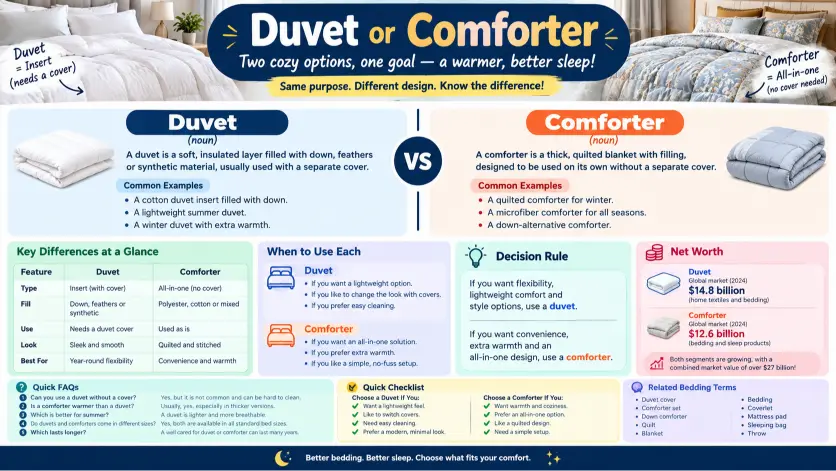
The main difference between a duvet and a comforter is their design. A duvet is an insert filled with materials such as down, feathers, or synthetic fibers, usually protected by a removable cover. A comforter is typically a single, quilted bed covering with its filling stitched inside, so it does not usually require a separate cover. Duvets offer flexibility because you can change their covers, while comforters provide a ready-to-use option with fewer separate pieces. However, warmth and quality depend on the filling, construction, and materials rather than the name alone.
In this guide, you will learn how duvets and comforters compare in warmth, comfort, price, cleaning, durability, and style. You will also discover the advantages and disadvantages of each option, along with practical tips for choosing bedding based on your climate, budget, and personal preferences. These comparisons use established bedding terminology and everyday examples to make the differences easier to understand. Whether you are furnishing a new bedroom, replacing an old bed covering, or shopping for a more comfortable night’s sleep, this guide will help you make an informed decision with confidence.
Duvet vs Comforter: What’s the Difference?
Although duvets and comforters serve the same basic purpose, their designs affect how they feel and how much care they require. A duvet generally uses two separate components: a filled insert and a protective outer cover. By contrast, a comforter combines its decorative outer fabric and insulating filling into one finished piece.
Consequently, choosing between them involves more than appearance. You should also consider washing requirements, warmth, fabric preferences, and the convenience of changing your bedding.
What Is a Duvet?
A duvet is a noun referring to a soft, insulated bedding insert designed to cover the sleeper. It usually contains down, feathers, wool, cotton, polyester, or another insulating material. In most cases, it sits inside a removable duvet cover.
Because the cover can be removed independently, a duvet allows you to change your bedroom’s appearance without replacing the entire insert. Furthermore, the cover protects the filling from body oils, dust, and everyday dirt.
For example, someone might keep a warm duvet insert throughout winter while switching between neutral and colorful covers. This arrangement provides flexibility without requiring several bulky blankets.
What Is a Comforter?
A comforter is a noun describing a thick, padded bed covering with an outer fabric and insulating filling sewn or quilted together. Unlike a typical duvet, it doesn’t require a separate cover to function as a finished bedding item.
Comforters commonly contain polyester, cotton, down, or blended filling. Their decorative surfaces often feature printed patterns, stitched designs, or coordinated colors.
For instance, a homeowner might purchase a comforter set containing a comforter, pillow shams, and matching accessories. Because the decorative design is already incorporated, the bed can look coordinated with relatively little effort.
Duvet vs Comforter Comparison Table
| Feature | Duvet | Comforter |
|---|---|---|
| Construction | Separate insert and cover | Outer fabric and filling joined together |
| Outer covering | Usually removable | Generally attached |
| Appearance | Determined largely by the cover | Determined by the comforter’s fabric and design |
| Washing | Cover is usually washed separately | Entire item may require washing |
| Style changes | Covers can be exchanged | Often requires another comforter |
| Storage | Insert and cover can be stored separately | Entire item is stored together |
| Warmth | Depends on filling and construction | Depends on filling and construction |
| Initial purchase | Insert and cover may be separate purchases | Often purchased as one item |
| Common accessories | Duvet cover and insert | Pillow shams or coordinating bedding |
Quick Recap
A duvet usually consists of an insert and a removable cover.
A comforter combines its filling and outer fabric into one finished item.
Duvets offer convenient changes in color and pattern, while comforters simplify everyday bed making.
Ultimately, warmth depends more on filling, thickness, and construction than on the name alone.
Is Duvet vs Comforter a Vocabulary, Design, or Usage Issue?
The difference between a duvet and a comforter is primarily a matter of bedding design and terminology rather than grammar. Both words are correct English nouns, but they describe products with different typical constructions.
However, the distinction isn’t absolute across every retailer or region. Product descriptions sometimes use the terms loosely, and some bedding products combine characteristics of both designs. Therefore, examining the actual construction is more reliable than relying on the product name alone.
Are Duvets and Comforters Interchangeable?
In everyday conversation, people sometimes use duvet and comforter to describe almost any thick bed covering. Nevertheless, the terms generally refer to different arrangements.
A duvet normally has a separate insert and removable cover. A comforter usually has its filling enclosed within its finished outer fabric.
For example, a person who wants to replace the decorative cover without purchasing new filling may prefer a duvet. Conversely, someone who wants one ready to place on the bed might choose a comforter.
Although either option can provide warmth, they aren’t always interchangeable in practice. Their dimensions, construction, and care requirements may differ.
Formal and Informal Usage
In retail descriptions, bedding guides, and product specifications, the distinction helps shoppers understand exactly what they’re purchasing. A listing for a duvet insert generally refers to the insulated inner component, whereas a duvet cover describes the washable outer shell.
In casual conversation, however, a person might call a thick bed covering a duvet even when it resembles a comforter. Such usage is understandable, although it can create confusion when buying replacement covers or inserts.
Therefore, when communicating with a retailer, specify whether you need the insert, the cover, or a complete bedding set.
Regional Differences
Terminology also varies by location. In the United Kingdom and several other countries, duvet is a common term for the filled bed covering used inside a removable cover. In the United States, comforter is widely used for a complete quilted bed covering, while duvet often refers to the insert and cover arrangement.
Nevertheless, these patterns aren’t universal. Retailers may sell similar products under different labels, so buyers should always check the item description.
Practical Usage: When to Choose a Duvet
A duvet is particularly useful for people who want adaptable bedding, a removable outer cover, and flexibility in bedroom decoration. Since the cover can be washed or replaced separately, the arrangement can simplify routine maintenance.
1. Workplace and Accommodation Examples
Hotels, guesthouses, and short term rental properties often need bedding that looks fresh and coordinated. A duvet system can help housekeeping staff change outer covers between guests without replacing the insulated insert each time, provided the property’s hygiene procedures and laundering standards are followed.
For example, a guesthouse manager might select white duvet covers because they create a consistent appearance across multiple rooms.
Similarly, a property manager furnishing several bedrooms can purchase identical inserts and use different covers to distinguish individual spaces.
2. Academic and Research Examples
In textile studies, a duvet provides an example of layered bedding construction. Researchers can compare how different fillings, outer fabrics, and cover materials influence insulation, moisture management, and perceived comfort.
For instance, a student examining household textiles might compare a down filled duvet with a polyester filled alternative.
However, warmth cannot be judged by filling type alone. Fill power, filling quantity, fabric permeability, and construction all influence performance.
3. Technology and Smart Bedding Examples
Duvet products may be designed for use with heated mattress systems, temperature regulating fabrics, or bedding accessories. Nevertheless, compatibility depends on the specific manufacturer’s instructions.
For example, someone using a temperature controlled bed system should check whether the duvet’s thickness and materials are appropriate for the device.
Likewise, a shopper comparing online product specifications can examine filling weight, fabric composition, washing instructions, and thermal ratings rather than relying on promotional descriptions.
Usage Recap
Choose a duvet when you value interchangeable covers, adaptable styling, and a separate insulated insert. Additionally, check the insert’s dimensions and care instructions before purchasing a cover.
Practical Usage: When to Choose a Comforter
A comforter works well for people who prefer a finished bedding item that can be placed directly on the bed. Since the outer fabric and filling are joined together, there’s no need to purchase a separate cover for ordinary use.
1. Workplace and Accommodation Examples
For dormitories, rental apartments, and temporary accommodation, comforters can provide a straightforward bedding solution.
For example, a property owner furnishing a student room might choose a polyester filled comforter with a durable outer fabric. This option can be convenient when the entire item is designed for machine washing.
However, the washing machine’s capacity and the manufacturer’s instructions still matter. Larger comforters may require a commercial machine or professional cleaning.
2. Academic and Research Examples
Comforters can be examined in textile design courses to understand quilting, filling distribution, stitching patterns, and insulation.
For example, a student might compare a box stitched comforter with one featuring channel stitching. The goal would be to examine how construction influences the movement and distribution of filling.
Even so, stitching alone doesn’t determine quality. Fabric durability, filling composition, workmanship, and intended use also deserve consideration.
3. Technology and Modern Bedding Examples
Modern comforters may use synthetic insulation, lightweight fabrics, or materials designed to improve moisture management. Some products are also marketed as temperature regulating or suitable for particular seasons.
For example, a shopper could compare the specifications of two comforters to determine which one offers suitable warmth for a climate controlled bedroom.
Nevertheless, claims about cooling or heating should be evaluated carefully. Actual performance depends on the materials, construction, surrounding temperature, and individual sleeping preferences.
Usage Recap
Choose a comforter when you want a complete bed covering with a finished appearance. Before buying, confirm whether the item is washable, whether its size suits your mattress, and whether its filling provides suitable warmth.
When You Should NOT Choose a Duvet or Comforter
Neither option is automatically the best choice for every sleeper. Instead, the right decision depends on practical needs, climate, maintenance preferences, and the available budget.
- Don’t choose a duvet without checking the cover requirements. If you expect a complete bedding item in one purchase, remember that an insert and cover may be sold separately.
- Don’t buy a comforter without checking its washing requirements. A large, thick item might not fit comfortably in your household washing machine.
- Don’t assume every duvet is warmer than every comforter. Insulation depends on filling, construction, thickness, and the amount of air retained.
- Don’t choose a duvet system if you dislike changing covers. Putting a cover over an insert can take time, especially when the insert is large.
- Don’t choose a comforter solely because it looks attractive. Check its weight, fabric, filling, and care requirements as well.
- Don’t overlook allergies or material sensitivities. If you have known sensitivities, examine the filling and outer fabric carefully. Synthetic filling may be preferable for some people, although individual reactions vary.
- Don’t assume every cover fits every insert. Compare the manufacturer’s dimensions and account for differences in sizing conventions.
- Don’t ignore your sleeping environment. A thick winter covering may feel uncomfortable in a warm room, regardless of whether it’s called a duvet or comforter.
Ultimately, the most suitable bedding is the one that meets your comfort needs and fits your maintenance routine.
Common Mistakes and Decision Rules
When shopping for bedding, a few misunderstandings can lead to unnecessary purchases. Fortunately, checking the product’s construction and intended use usually resolves the confusion.
| Correct statement | Incorrect statement | Explanation |
|---|---|---|
| A duvet usually has a removable cover. | Every duvet has its outer fabric permanently attached. | A typical duvet system separates the insert and cover. |
| A comforter is generally a complete bed covering. | A comforter always requires a separate duvet cover. | Most comforters are designed for use without one. |
| A duvet cover protects the insert. | A duvet cover is the insulated insert itself. | The cover is the outer layer, not the filling. |
| Some comforters can be machine washed. | Every comforter can safely be machine washed. | Cleaning requirements depend on the product. |
| Warmth depends on construction and filling. | Every duvet is warmer than every comforter. | Product specifications determine insulation performance. |
| A duvet cover can change the bed’s appearance. | Changing a duvet cover always requires a new insert. | The same insert can often be reused with another suitable cover. |
| Bedding dimensions should be checked before purchase. | All queen size covers fit every queen size insert perfectly. | Actual measurements and sizing standards can vary. |
| Both products can contain synthetic filling. | All duvets contain natural down. | Duvets can use several natural or synthetic materials. |
A Simple Decision Rule
If you want a separate insert with an interchangeable cover, choose a duvet system.
If you want a single, finished bed covering, choose a comforter.
For example, a person who enjoys changing bedroom colors seasonally may appreciate a duvet. By contrast, someone who prefers a coordinated bedding set with minimal setup may find a comforter more convenient.
Duvets and Comforters in Modern Technology and Smart Homes
Bedding has evolved alongside improvements in textile manufacturing, online shopping, and home comfort technology. Today, buyers can compare product measurements, material compositions, care labels, and temperature related features before making a purchase.
For example, some manufacturers offer breathable fabrics, recycled polyester filling, or materials designed to manage moisture. Others develop bedding intended to work alongside adjustable beds or temperature control systems.
However, a duvet isn’t automatically compatible with every smart bedding product. Thick insulation may affect how some systems distribute heat, so manufacturer guidance should always take priority.
Likewise, online shopping tools can help compare dimensions and materials, but shoppers should verify the specifications directly. Product names alone don’t guarantee consistent construction, quality, or thermal performance.
Consequently, informed purchasing requires a combination of product research and an understanding of individual sleeping preferences.
Etymology: Where Do Duvet and Comforter Come From?
The word duvet comes from French, where it referred to down or soft feathers. Its connection with insulating bedding reflects the traditional use of soft filling to retain warmth during sleep.
By contrast, comforter comes from the English word comfort, which relates to providing relief, reassurance, or physical ease. The term developed into a name for a padded bed covering intended to provide warmth and comfort.
These histories help explain why the words carry slightly different associations. Duvet commonly emphasizes the filled bedding insert and its cover system, whereas comforter often identifies a complete padded covering.
Nevertheless, modern product terminology has evolved, and regional usage can overlap. Therefore, the construction of the actual item remains more important than its historical name.
An Expert Perspective on Choosing Bedding
A useful principle in bedding selection is to assess construction, insulation, and care requirements before considering appearance alone.
As a practical purchasing guideline:
“Choose bedding by its materials, warmth, construction, and maintenance needs rather than its label alone.”
This is a general editorial guideline, not a quotation attributed to a named bedding specialist.
For instance, two products with similar appearances may have different filling weights or washing requirements. Consequently, examining the product specifications provides a more reliable basis for comparison.
Furthermore, personal comfort matters. Some sleepers prefer the flexibility of a duvet system, while others appreciate the simplicity of a comforter. Neither preference is universally superior.
Two Practical Case Studies
The following illustrative case studies demonstrate how different bedding needs can influence a purchasing decision. They are examples for educational purposes, not independently verified research findings.
Case Study 1: A Guesthouse Refreshes Its Bedrooms
A small guesthouse wants to create a consistent appearance across eight bedrooms. Previously, each bed had a different decorative covering, making it difficult to maintain a coordinated style.
The owner chooses duvet inserts of consistent dimensions and purchases two sets of washable covers for each room. One set can be used while the other is being laundered, subject to the property’s cleaning procedures.
As a result, the guesthouse can maintain a consistent color scheme while changing covers when necessary. The owner also avoids buying a new insulated insert whenever the decorative style changes.
Practical result: The duvet system offers greater flexibility in appearance and simplifies the replacement of outer covers.
Case Study 2: A Student Furnishes a Small Apartment
A university student needs bedding that is affordable, simple to arrange, and suitable for a compact apartment. The student compares a duvet set with a machine washable comforter.
After reviewing the total cost, washing instructions, and storage requirements, the student selects a comforter that fits the existing mattress and can be cleaned using available laundry facilities.
The finished item requires no separate cover purchase and can be placed directly on the bed.
Practical result: The comforter meets the student’s preference for straightforward setup and a complete bedding solution without adding a separate component.
Error Prevention Checklist
Before buying bedding, use the following checklist to ensure that your choice matches your requirements.
Always Choose a Duvet When
- You want to replace the outer cover without replacing the insert.
- You enjoy changing bedroom colors or patterns.
- You prefer washing the cover separately.
- You want to choose an insert and cover independently.
- You have adequate storage for spare covers.
Avoid Choosing a Duvet When
- You don’t want to purchase or manage a separate cover.
- You dislike fitting covers around a large insert.
- The combined cost exceeds your available budget.
- You haven’t checked insert and cover dimensions.
Always Consider a Comforter When
- You prefer one complete bed covering.
- You want a coordinated design without buying a separate cover.
- The selected product suits your washing facilities.
- You want a straightforward bedding arrangement.
Avoid Choosing a Comforter When
- You want to change the outer fabric frequently without replacing the entire covering.
- The item requires cleaning services you can’t conveniently access.
- Its filling or thickness is unsuitable for your sleeping environment.
- Its dimensions don’t match your bed properly.
This checklist can narrow the available options considerably. In addition, comparing the total purchase price with ongoing cleaning and replacement costs can help you make a more practical decision.
Related Bedding Terms You Should Understand
Understanding related bedding terminology can prevent confusion when comparing products.
- Duvet insert vs duvet cover: The insert contains the filling, while the cover surrounds and protects it.
- Comforter vs quilt: A comforter generally has thicker insulation, whereas a quilt often consists of layered fabric with decorative stitching.
- Duvet vs blanket: A duvet is typically a filled covering, while a blanket is usually a single layer or woven textile.
- Bedspread vs comforter: A bedspread is generally intended to cover more of the bed and may prioritize appearance over substantial insulation.
- Down vs down alternative: Down is a natural insulating material from birds, while down alternative usually refers to synthetic filling designed to provide similar softness or warmth.
- Fill power vs fill weight: Fill power measures the loft of down under a standardized test, while fill weight indicates the quantity of filling used.
- Thread count vs fabric quality: Thread count measures threads per unit area in certain woven fabrics, but it doesn’t independently determine durability or comfort.
- Twin vs full bedding sizes: These labels describe different mattress dimensions, so the correct size should be checked before purchasing a covering.
- Breathable vs insulating bedding: Breathability relates to airflow and moisture movement, whereas insulation relates to retaining warmth.
- Machine washable vs dry clean only: These labels indicate different care requirements and should be followed to help preserve the bedding.
Knowing these distinctions makes it easier to compare products accurately and avoid unnecessary purchases.
Frequently Asked Questions
1. What is the difference between a duvet and a comforter?
A duvet usually consists of an insulated insert placed inside a removable cover. A comforter combines its outer fabric and filling into one finished bed covering. Both provide warmth, but their construction, maintenance, and styling options differ.
2. Is a duvet warmer than a comforter?
Not necessarily. Warmth depends on the type and amount of filling, fabric construction, loft, and other product characteristics. A thick comforter can provide more insulation than a lightweight duvet, so compare specifications rather than relying on the product name.
3. Which is better, a duvet or a comforter?
A duvet is often better for people who want interchangeable covers and flexible styling. A comforter may suit those who prefer one complete item that can be placed directly on the bed. The best option depends on budget, care requirements, and personal preference.
4. Do you need a duvet cover for a comforter?
No, a comforter generally doesn’t require a duvet cover because its outer fabric and filling are already joined together. However, some people use an appropriately sized cover to protect a comforter or change its appearance, provided the dimensions and care instructions are suitable.
5. Can you wash a duvet in a washing machine?
Some duvet inserts can be machine washed, but others require professional cleaning or special care. Check the manufacturer’s label for washing temperature, machine capacity, drying instructions, and restrictions before cleaning the item.
6. Is a duvet cover the same as a comforter?
No. A duvet cover is the removable outer layer that surrounds a duvet insert. A comforter is generally a complete padded covering containing its own filling. Although both contribute to the appearance of a bed, they serve different construction roles.
7. Which is cheaper, a duvet or a comforter?
The initial cost depends on the materials, dimensions, filling, brand, and product quality. A comforter may cost less initially because it is a single item, while a duvet system may require separate purchases. However, interchangeable covers can offer flexibility over time.
8. What is better for summer, a duvet or a comforter?
Neither category is automatically better for summer. A lightweight duvet insert or a thin comforter made from breathable materials may suit warmer conditions. Consider filling weight, fabric, room temperature, and personal sleeping preferences when choosing.
9. Can you use a duvet without a cover?
Some duvet inserts can technically be used without a cover, depending on their design and care instructions. However, a cover protects the insert from everyday dirt and makes routine laundering more convenient. Without one, the insert itself may require more frequent cleaning.
Conclusion:
Choosing between a duvet or comforter depends on how you want your bedding to function. A duvet offers a separate insert and removable cover, making it convenient for people who enjoy changing colors, washing covers independently, and customizing their bedroom style. In contrast, a comforter provides a complete padded covering that can be placed directly on the bed.
However, neither option is automatically warmer, more durable, or more affordable. Those qualities depend on filling, fabric, construction, care requirements, and product quality.
Therefore, consider your climate, sleeping preferences, washing facilities, available storage, and total budget before making a decision. If flexibility is your priority, a duvet system may be the better fit. If simplicity matters most, a comforter may be more convenient.
Ultimately, the right bedding is the one that delivers suitable warmth, practical maintenance, and lasting comfort for your everyday routine.









