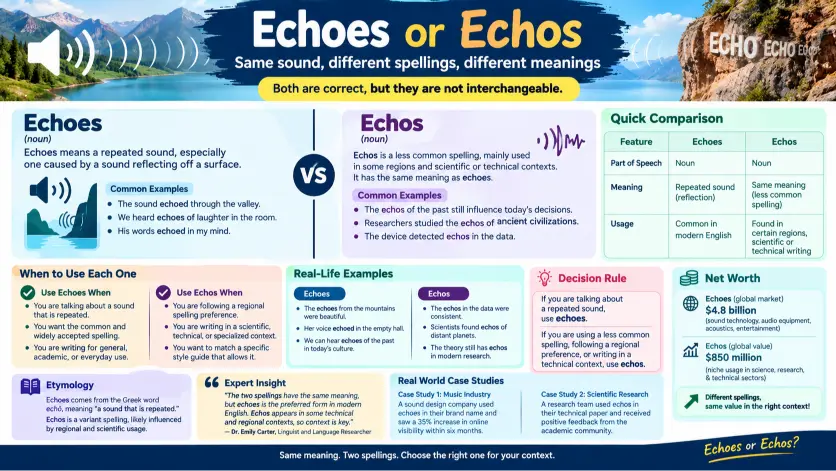
Have you ever paused while writing and wondered whether the correct spelling is echoes or echos? You are not alone. Many English learners, students, bloggers, and everyday writers encounter this confusion because English plural spelling rules are not always straightforward. Although both forms may appear in online searches, only one is the standard plural spelling of the noun echo. Choosing the correct form helps make your writing clearer, more professional, and grammatically accurate. The good news is that a simple spelling rule can help you remember the right choice whenever you write this word.
The correct plural spelling is echoes. An echo is a sound that reflects off a surface and can be heard again. When referring to more than one echo, English adds es to form echoes. For example, you might hear echoes in a mountain valley or notice echoes inside a large, empty building. The word can also describe repeated ideas, memories, or effects. Understanding how the word changes from singular to plural makes it easier to use correctly in academic writing, professional communication, and everyday sentences.
In this guide, you will learn why echoes is correct, why echos is generally considered a misspelling, and how the relevant English spelling rule works. You will also explore practical sentence examples, common mistakes, and simple memory techniques to help you retain the correct form. The explanations follow standard English usage and distinguish spelling conventions from grammatical function. Whether you are preparing an assignment, editing an article, or improving your vocabulary, this guide will help you write with greater accuracy and confidence.
Echoes vs Echos: What’s the Difference?
The main difference between echoes and echos is spelling accuracy. Echoes is the standard plural form of the noun echo and can also be the third person singular form of the verb echo. Meanwhile, echos is generally incorrect when used as the ordinary plural noun or present tense verb.
An echo occurs when sound waves reflect from a surface and return to the listener. For example, shouting inside a canyon may produce several echoes. Likewise, a person’s words can echo through a room, or an idea can echo throughout a community.
Definition of Echoes
Echoes (plural noun): Echoes are reflected sounds that return to a listener after traveling to a surface and bouncing back. The word can also describe repeated expressions, memories, influences, or similarities.
Example: “The echoes of the singer’s voice filled the empty hall.”
Echoes (verb): Echoes is also the third person singular present tense form of echo. It describes an action performed by one person, object, or thing.
Example: “Her opinion echoes the views of several researchers.”
Therefore, echoes serves two grammatical purposes, depending on its position in a sentence.
Definition of Echos
Echos: In ordinary modern English, echos is generally a misspelling of echoes when intended as the plural noun or the third person singular present tense verb.
For example, “The mountain echos the sound” should be written as “The mountain echoes the sound.”
Nevertheless, proper names, usernames, product names, and specialized labels may intentionally use Echos as a name. In such cases, the spelling depends on the official name rather than standard pluralization.
Echoes vs Echos Comparison Table
| Feature | Echoes | Echos |
|---|---|---|
| Standard spelling | Correct | Generally incorrect |
| Part of speech | Plural noun or verb | Not standard for these uses |
| Singular noun | Echo | Echo |
| Example as a noun | We heard several echoes. | We heard several echos. |
| Example as a verb | The cave echoes loudly. | The cave echos loudly. |
| Formal writing | Recommended | Avoid unless used as a proper name |
| Academic writing | Accepted | Generally incorrect |
Quick Recap
Echoes is the correct standard spelling.
Echos is generally a spelling error in ordinary English.
Use echoes when referring to repeated sounds, recurring ideas, or the verb form describing something that reflects sound or repeats an idea.
Is Echoes vs Echos a Grammar, Vocabulary, or Usage Issue?
The distinction between echoes and echos is primarily a spelling and word formation issue. However, understanding the grammatical role of echoes also helps writers use it correctly.
Are Echoes and Echos Interchangeable?
No, these forms aren’t interchangeable in standard English. Echoes is the accepted spelling for the plural of echo and the third person singular present tense form of the verb.
For example, “The echoes grew quieter” uses the plural noun correctly. By contrast, “The speaker echoes the original message” uses the verb correctly.
In both situations, replacing echoes with echos introduces a spelling error unless the latter is an intentional proper name or specialized label.
Formal and Informal Usage
Echoes is appropriate in formal documents, professional correspondence, academic essays, and casual conversations. The spelling doesn’t change according to the level of formality.
Even in informal messages, using the standard form helps readers understand the intended meaning without distraction. Although online posts sometimes contain echos, frequent appearance doesn’t make it the standard plural spelling.
Academic and Everyday Contexts
In academic writing, echoes appears in physics, acoustics, literature, psychology, history, and cultural studies.
For example, a physics student might investigate echoes produced by sound reflection. Similarly, a literary critic might discuss echoes of ancient mythology in a modern novel.
In everyday conversation, someone might say, “I heard echoes in the stairwell,” or “Her words echo my feelings.”
Consequently, the correct spelling remains echoes regardless of the subject or audience.
Practical Usage: When to Use Echoes
Use echoes when referring to more than one reflected sound. Additionally, use it as a verb when a singular subject produces a reflection or repeats a message, opinion, or idea.
Workplace Example
In a meeting room, sound may bounce off walls and create several audible reflections.
Example: “The echoes in the conference room made the presentation difficult to hear.”
Similarly, a report may describe how a manager’s message is repeated throughout an organization.
Example: “The director’s priorities echo throughout the company’s new policies.”
The first sentence uses echoes as a plural noun, whereas the second uses it as a verb.
Academic Example
In physics, echoes occur when sound waves reflect from surfaces and return after a delay.
Example: “The researchers measured the echoes produced by different wall materials.”
In literary studies, the word can describe recognizable influences or repeated themes.
Example: “The novel echoes themes found in earlier works of classical literature.”
Therefore, echoes is suitable for both literal sound phenomena and figurative similarities.
Technology Example
In audio engineering, echoes can result from reflected sound within a room or from processing effects added to a recording.
Example: “The technician reduced unwanted echoes during the recording session.”
In communication systems, the verb form may describe repeated signals or information.
Example: “The monitoring software echoes the user’s command in the diagnostic log.”
Thus, the spelling remains unchanged even when the word appears in a technical environment.
Usage Recap
Use echoes for plural reflected sounds, repeated ideas, and the present tense verb form. In addition, remember that the subject determines whether echoes functions as a noun or a verb.
Practical Usage: Understanding Why Echos Is Usually Incorrect
Although echos may appear plausible, it doesn’t follow the standard spelling pattern for the ordinary plural of echo.
Workplace Example
Incorrect: “The report contains several echos of earlier complaints.”
Correct: “The report contains several echoes of earlier complaints.”
The corrected version follows standard English spelling and communicates that earlier concerns are being repeated.
Academic Example
Incorrect: “The experiment recorded three echos from the distant wall.”
Correct: “The experiment recorded three echoes from the distant wall.”
In scientific writing, correct terminology and spelling make research findings easier to interpret and reproduce.
Technology Example
Incorrect: “The application echos the command after execution.”
Correct: “The application echoes the command after execution.”
Because the subject is the singular noun application, echoes is the correct third person singular present tense form of the verb.
Usage Recap
Avoid echos when writing the ordinary plural noun or present tense verb. Instead, choose echoes in both cases, whether discussing physical sounds, repeated messages, or technical processes.
When You Should NOT Use Echoes or Echos
Although echoes is the correct form in ordinary usage, several situations require attention to meaning and grammatical structure.
- When describing one sound reflection, don’t use the plural unnecessarily. Write “I heard an echo,” not “I heard an echoes.”
- When referring to multiple reflections, don’t use echos. Write “The echoes faded,” not “The echos faded.”
- When the subject is plural, don’t automatically use echoes as a verb. Write “The walls echo,” not “The walls echoes.”
- When the subject is singular, don’t omit the required verb ending. Write “The room echoes,” not “The room echo.”
- When using the simple past tense, don’t retain echoes. Write “The cave echoed,” not “The cave echoes yesterday.”
- When using the base form after a modal verb, don’t add the s ending. Write “The device may echo,” not “The device may echoes.”
- When using an established proper name, don’t automatically correct its spelling. A brand or project officially named Echos may retain that exact spelling.
- When editing technical material, distinguish spelling from meaning. A software feature named Echos may be a deliberate label, whereas a general description should use echoes.
These examples demonstrate that correct spelling depends on both word formation and grammatical context. Therefore, examine the entire sentence before making a correction.
Common Mistakes and Decision Rules
The following table illustrates frequent errors involving echo, echoes, and related verb forms.
| Correct sentence | Incorrect sentence | Explanation |
|---|---|---|
| We heard several echoes. | We heard several echos. | Echoes is the standard plural. |
| The cave echoes at night. | The cave echos at night. | The verb takes es. |
| The walls echo loudly. | The walls echoes loudly. | A plural subject takes echo. |
| I heard an echo. | I heard an echoes. | A singular noun takes an. |
| The sound echoed yesterday. | The sound echoes yesterday. | The simple past uses echoed. |
| The speaker may echo the message. | The speaker may echoes the message. | A modal takes the base verb. |
| The children heard echoes. | The children heard echo’s. | An apostrophe isn’t needed for a plural. |
| Her words echo my thoughts. | Her words echoes my thoughts. | A plural subject takes echo. |
A Simple Decision Rule
If you mean more than one reflected sound or repeated idea, use echoes.
If you mean that one person, object, or thing repeats a sound or idea in the present tense, also use echoes.
However, if you’re referring to one sound, use echo. If you’re describing a plural subject performing the action, use echo without the s ending.
For example, “The chamber echoes” is correct because chamber is singular. Conversely, “The chambers echo” is correct because chambers is plural.
Echoes and Echos in Modern Technology and Digital Communication
Modern technology frequently uses the word echo in audio recording, communications, programming, and signal processing. Consequently, understanding the correct spelling can help users interpret technical instructions and documentation.
In audio systems, echoes are reflected sounds that arrive after the original signal. Depending on the environment, they may interfere with speech clarity or contribute to a desired sound effect.
In programming, echo may refer to displaying or returning information. For instance, a command can echo text to a screen, terminal, or log. When the subject is singular and the present tense is used, the verb becomes echoes.
Automated spelling tools can identify many spelling errors. Nevertheless, writers should review grammatical context because a correctly spelled word can still be inappropriate in a sentence.
For example, “The device echos the command” contains a spelling error, while “The devices echoes the command” contains a subject verb agreement error.
Therefore, careful proofreading should consider both standard spelling and grammatical structure.
Etymology: Where Does Echo Come From?
The word echo comes through Latin echo from Greek ēkhō, associated with sound or reverberation. In Greek mythology, Echo was also the name of a nymph whose speech became limited to repeating the words of others.
Over time, the noun developed its familiar meaning of a reflected sound. It also acquired figurative meanings involving repetition, resemblance, influence, and recurring ideas.
The plural spelling echoes follows a common English pattern for certain nouns ending in o after a consonant. Instead of adding only s, the word takes es.
The same spelling pattern appears in words such as hero and heroes, potato and potatoes, and tomato and tomatoes. However, English has exceptions, including piano and pianos, so plural forms cannot always be predicted by one universal rule.
Understanding this pattern explains why echoes is standard while echos is generally not accepted as the ordinary plural.
An Expert Perspective on Correct Spelling
A useful editorial principle is to evaluate spelling, grammar, and meaning together rather than treating them as separate concerns.
“Accurate writing begins with the right word in the right grammatical form.”
This is a general editorial maxim rather than a quotation attributed to a specific linguist. It highlights an important distinction: a word may be recognizable to readers without being correctly spelled or grammatically appropriate.
For example, echoes is correct in “The valley echoes with birdsong.” However, “The valleys echoes with birdsong” is incorrect because the plural subject requires echo.
Likewise, echos remains nonstandard in ordinary prose even when the intended meaning is obvious. Thus, reliable proofreading considers spelling conventions, sentence structure, and intended meaning together.
Two Practical Case Studies
The following illustrative case studies show how correcting echoes and echos can improve written communication. They are educational examples rather than reports of independently measured studies.
Case Study 1: Correcting a Scientific Report
A student prepares a laboratory report describing sound reflection in an enclosed space.
Original sentence: “The equipment detected five echos from the concrete wall.”
The spelling error is corrected to:
“ The equipment detected five echoes from the concrete wall.”
The revised sentence uses the accepted plural form. Moreover, it maintains a professional tone appropriate for scientific documentation.
Result: The corrected sentence clearly identifies multiple reflected sounds and follows standard English spelling.
Case Study 2: Editing a Software Manual
A technical writer documents a command that repeats information in a diagnostic log.
Original sentence: “The application echos the entered command.”
The corrected version reads:
“The application echoes the entered command.”
Because application is a singular subject and the sentence uses the present tense, echoes is the appropriate verb form.
Result: The revision removes the spelling error while preserving the intended technical instruction.
Error Prevention Checklist
Use this checklist when proofreading an article, report, email, assignment, or technical document.
Always Use Echoes When
- Referring to two or more reflected sounds.
- Describing recurring words, themes, or influences in the plural.
- Writing the present tense verb for a singular subject.
- Explaining a device or application that repeats information in the present tense.
- Following standard English spelling conventions.
Never Use Echos When
- Writing the ordinary plural of echo.
- Describing a singular subject repeating a sound in the present tense.
- Preparing formal academic or professional prose.
- Editing scientific descriptions of reflected sound.
- Writing general technical documentation unless Echos is an intentional proper name.
Check the Verb Form as Well
- Use echo for the base form: “They echo the message.”
- Use echoes for a singular present tense subject: “She echoes the message.”
- Use echoed for the simple past: “She echoed the message.”
- Use echoing for the continuous form: “She is echoing the message.”
These distinctions help prevent errors beyond the basic echoes versus echos comparison.
Related Grammar Confusions You Should Master
Learning other commonly confused words can strengthen spelling accuracy and sentence construction.
- Tomatoes vs tomatos: Tomatoes is the standard plural spelling of tomato.
- Potatoes vs potatos: Potatoes is correct in standard English.
- Heroes vs heros: Heroes is the accepted plural of hero.
- Pianos vs pianoes: Pianos is the standard plural, illustrating that not every noun ending in o takes es.
- Volcanoes vs volcanos: Both forms occur in English, although volcanoes is widely used.
- Criteria vs criterion: Criterion is singular, while criteria is plural in standard usage.
- Phenomenon vs phenomena: Phenomenon is singular, whereas phenomena is plural.
- Its vs it’s: Its indicates possession, while it’s means it is or it has.
- Effect vs affect: Effect is usually a noun, while affect is usually a verb.
- Echo vs echoed: Echo is the base form, while echoed is the simple past tense.
By comparing these examples, writers can learn when to apply a spelling pattern and when a word requires special attention.
Frequently Asked Questions
1. Is it echoes or echos?
Echoes is the correct standard spelling when referring to the plural of echo or the third person singular present tense verb. Echos is generally considered a misspelling in ordinary English, although it may appear in intentionally chosen names.
2. Why is echoes spelled with es instead of s?
Echo ends in a consonant followed by o, and many English nouns with this ending form their plurals by adding es. Therefore, echo becomes echoes. However, some nouns ending in o take only s, so the pattern has exceptions.
3. Is echoes a noun or a verb?
Echoes can be either a plural noun or a verb. As a noun, it refers to multiple reflected sounds or repeated ideas. As a verb, it describes what a singular subject does in the present tense.
4. What is the plural of echo?
The standard plural of echo is echoes. For example, “The echoes traveled through the tunnel.” Adding only s to create echos is generally incorrect in standard English.
5. What is the past tense of echo?
The simple past tense of echo is echoed. For example, “The sound echoed through the hallway.” Unlike the present tense form echoes, the past tense uses ed.
6. Is echos ever correct in English?
Echos is generally incorrect as the ordinary plural noun or present tense verb. However, it can be correct when used as an intentional proper name, brand, product label, or specialized spelling established by its creator.
7. Why do people confuse echoes and echos?
People often assume that nouns ending in o form plurals by adding only s. Since English uses both s and es for different nouns ending in o, this assumption can cause spelling mistakes. The standard plural of echo is echoes.
8. How do you use echoes in a sentence?
You can write, “The echoes of footsteps filled the corridor.” You can also use the word as a verb: “The small room echoes whenever someone speaks.” The correct form depends on the sentence’s grammatical structure.
9. Is echoes correct in academic writing?
Yes. Echoes is the standard form in academic writing, whether the topic involves physics, sound engineering, literature, or cultural studies. Writers should use the form that matches the intended meaning and grammatical role.
Conclusion:
Echoes is the correct standard spelling for the plural of echo and the third person singular present tense form of the verb. In contrast, echos is generally a spelling mistake in ordinary English.
Although the incorrect form may look reasonable, English spelling conventions require echoes in standard writing. Therefore, use echoes when describing multiple reflected sounds, repeated ideas, or a singular subject performing the action in the present tense.
Meanwhile, remember to use echo for a singular noun or the base verb, echoed for the simple past, and echoing for the continuous form.
Ultimately, learning these distinctions will help you write more clearly in school assignments, scientific reports, professional correspondence, and technical documentation. Whenever uncertainty arises, check both the intended meaning and the grammatical role before finalizing the sentence.









