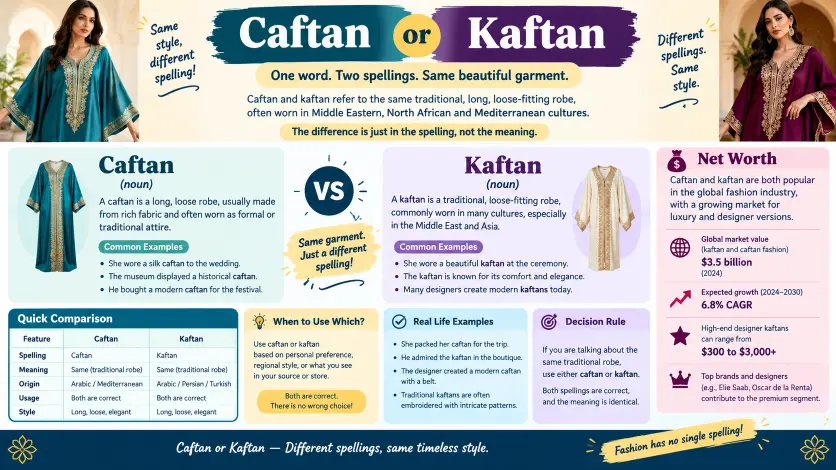
Have you ever searched for an elegant, flowing outfit and wondered whether its name should be spelled caftan or kaftan? You may have encountered both spellings in fashion magazines, online stores, clothing descriptions, and style guides. Although the words look different, they generally refer to the same type of loose fitting garment. This similarity often leaves shoppers, writers, and English learners wondering which spelling is correct. Understanding the relationship between these terms can make your writing clearer and help you find the clothing styles you want without unnecessary confusion.
The difference between caftan or kaftan is primarily a matter of spelling and language tradition rather than two entirely separate garments. Both terms describe a long, loose garment, often featuring wide sleeves and a relaxed silhouette. The word kaftan is commonly associated with historical clothing traditions across parts of the Middle East, Central Asia, and other regions, while caftan is a widely used alternative spelling in English and international fashion contexts. However, garment designs vary across cultures, so the two terms do not always describe identical styles in every setting.
In this guide, you will learn the meanings of caftan and kaftan, discover why both spellings exist, and explore their use in modern fashion and everyday English. You will also find practical examples, spelling tips, and advice for choosing the most appropriate term when writing product descriptions or shopping online. By examining established language usage and the garment’s cultural background, this comparison will help you understand both forms accurately. Whether you are a fashion enthusiast, a clothing retailer, a student, or simply curious about English spelling, you will have a clearer understanding of when and how to use each word.
Caftan vs Kaftan: What’s the Difference?
The main difference between caftan and kaftan is spelling rather than meaning. Both words are nouns that describe a loose, robe like garment associated with different clothing traditions across the Middle East, North Africa, Central Asia, and other regions. Today, both spellings also appear in fashion collections, resort wear, and contemporary clothing descriptions.
However, usage can vary according to country, cultural tradition, and commercial preference. For example, caftan is common in English language fashion writing, particularly in some Western publications, while kaftan is also widely recognized and used internationally.
Therefore, choosing between these forms requires an understanding of your audience and the context in which the garment is discussed.
Definitions and Parts of Speech
Caftan (noun): A caftan is a long, loose fitting garment, generally resembling a robe or tunic. Depending on its design, it may feature long sleeves, an open front, a belt, embroidery, or luxurious fabric. The spelling caftan frequently appears in fashion descriptions and retail terminology.
Kaftan (noun): A kaftan is the same general type of flowing garment, although the word may carry particular cultural associations depending on the region and garment being described. It can refer to traditional attire, ceremonial clothing, or modern designs made for everyday wear and special occasions.
Although both words refer to similar clothing, the precise construction and cultural significance of a particular garment depend on its origin and design.
Comparison Table
| Feature | Caftan | Kaftan |
|---|---|---|
| Part of speech | Noun | Noun |
| General meaning | Loose, flowing robe | Loose, flowing robe |
| Spelling status | Accepted variant | Accepted variant |
| Pronunciation | Commonly pronounced kaf tan | Commonly pronounced kaf tan |
| Fashion context | Resort wear, evening wear, designer clothing | Traditional clothing, resort wear, contemporary fashion |
| Cultural association | Varies by garment and region | Varies by garment and region |
| Main distinction | Alternative spelling | Alternative spelling |
Quick Recap
Caftan and kaftan refer to the same general category of garment.
Both spellings are accepted in English.
Neither form is universally more correct than the other.
Regional preference, cultural context, and house style can influence the choice.
Is Caftan vs Kaftan a Grammar, Vocabulary, or Usage Issue?
The difference between caftan and kaftan is primarily a spelling and vocabulary usage issue rather than a grammatical one. Both are nouns, and both can be used correctly in ordinary English sentences. Nevertheless, writers should select a spelling that suits their audience and remain consistent throughout their content.
Are Caftan and Kaftan Interchangeable?
In general English usage, the terms are interchangeable when they refer to the same type of garment. For instance, a clothing description could call a flowing summer robe a caftan or a kaftan without changing the basic meaning.
However, the terms aren’t necessarily interchangeable in every cultural or historical discussion. A particular museum, designer, community, or historical source may use one spelling to identify a specific garment or tradition. In such cases, preserving the original terminology is important.
Consequently, writers should distinguish between general clothing descriptions and references to culturally specific garments.
Formal and Informal Usage
Both spellings can appear in formal and informal communication. For example, a fashion retailer might describe a lightweight beach caftan, while a cultural publication might discuss a traditional kaftan.
In professional writing, consistency matters more than choosing one spelling as universally superior. Therefore, a brand should follow its established product naming conventions, while a magazine should follow its editorial style guide.
In casual conversation, either spelling is generally understandable. However, readers may recognize one form more readily than the other depending on their location and exposure to different fashion traditions.
Academic and Everyday Contexts
In academic writing, the appropriate spelling depends on the subject, historical source, and cultural setting. A researcher examining historical garments should preserve the terminology used in the sources and explain any relevant spelling variations.
Meanwhile, everyday writing usually allows greater flexibility. A person discussing vacation clothing might use either spelling, provided the intended garment is clear.
For museum labels, historical exhibitions, and cultural studies, greater precision may be necessary. A garment’s origin, construction, and traditional purpose can be more important than the spelling alone.
Practical Usage: When to Use Caftan
Use caftan when it matches your preferred spelling, your publication’s conventions, or the terminology used by a fashion brand. The word is especially familiar in many English language descriptions of resort clothing, elegant robes, and contemporary designer collections.
1. Workplace Examples
In fashion retail, caftan can appear in product descriptions, catalogues, merchandising documents, and promotional materials.
Example: “The summer collection includes a silk caftan with embroidered cuffs and a relaxed silhouette.”
Similarly, a stylist might write:
“The client selected a printed caftan for the resort photography session.”
In both cases, the spelling identifies the garment rather than describing a separate clothing category.
2. Academic Examples
In fashion history, caftan may appear in discussions of garment construction, changing styles, or the international movement of clothing traditions.
Example: “The exhibition examines the evolution of the caftan through textiles, tailoring, and decorative techniques.”
Likewise, a student might write:
“The designer adapted the traditional robe into a contemporary caftan for the runway.”
Nevertheless, historical accuracy requires attention to the specific garment and source rather than relying on spelling alone.
3. Technology Examples
Online stores and fashion applications frequently use caftan in product titles, search filters, and digital catalogues.
Example: “The shopping platform categorizes the embroidered caftan under women’s resort clothing.”
A fashion designer might also use digital pattern making software to develop a new caftan design.
Example: “The design team created a digital pattern for a lightweight cotton caftan.”
In these situations, consistent naming helps customers locate the intended product.
Usage Recap
Choose caftan when it matches your brand’s established spelling or your preferred English language style. Above all, maintain consistency across product listings, articles, and descriptions.
Practical Usage: When to Use Kaftan
Use kaftan when it matches the spelling preferred by your audience, source material, retailer, or cultural context. This spelling is widely recognized in international fashion and is frequently used for both traditional garments and modern interpretations.
1. Workplace Examples
In clothing retail, kaftan may appear in descriptions of casual garments, luxury robes, and traditional inspired collections.
Example: “The boutique introduced a linen kaftan designed for warm weather.”
Similarly, a fashion buyer might write:
“The new collection features a kaftan with intricate embroidery and a decorative neckline.”
Both examples use kaftan as a noun identifying a garment.
2. Academic Examples
In cultural studies, kaftan may be used when discussing traditional clothing and its development across different societies.
Example: “The researcher examined the role of the kaftan in historical dress and ceremonial presentation.”
Likewise, a textile student might write:
“The museum’s collection includes a richly decorated kaftan made with woven fabric.”
However, researchers should identify the garment’s particular origin where relevant. A shared spelling doesn’t mean that every garment called a kaftan has the same history or cultural meaning.
3. Technology Examples
Digital fashion platforms often use kaftan in product filters, image descriptions, and garment recommendations.
Example: “The online catalogue displays cotton kaftans alongside other lightweight summer garments.”
Furthermore, a clothing designer might create a digital mockup before producing a kaftan in physical fabric.
Example: “The designer adjusted the digital kaftan pattern to improve its drape and sleeve proportions.”
These examples show how the word functions in contemporary product development and online retail.
Usage Recap
Choose kaftan when it reflects your audience’s preference, the source’s terminology, or the product’s official name. In addition, retain the spelling consistently throughout the same publication.
When You Should NOT Use Caftan or Kaftan
Although both spellings are acceptable, several situations call for extra care. In particular, writers should avoid treating every loose robe as the same garment or assuming that spelling determines cultural origin.
- Don’t call every long robe a caftan or kaftan. Some garments have distinct names, construction methods, and cultural meanings.
- Don’t change a product’s official spelling without a reason. If a retailer lists an item as a kaftan, preserve that spelling when referring to the specific product.
- Don’t alternate spellings randomly within one article. Although both forms are accepted, unnecessary switching can confuse readers and weaken editorial consistency.
- Don’t assume caftan belongs exclusively to one country. Usage varies across publishers, markets, and clothing traditions.
- Don’t assume kaftan describes only traditional clothing. Modern designers also use the term for contemporary dresses, cover ups, and relaxed garments.
- Don’t ignore historical context. When discussing a particular historical garment, use the spelling found in reliable sources and clarify the relevant tradition.
- Don’t treat the two spellings as different garment categories by default. The spelling alone doesn’t establish a difference in material, cut, function, or cultural significance.
- Don’t force one spelling into every market. International retailers may adapt terminology to match regional search habits and established customer expectations.
Ultimately, the correct decision depends on the intended reference. For general use, either spelling is suitable; for specific products and cultural discussions, precision should guide the choice.
Common Mistakes and Decision Rules
The following examples illustrate how to use both spellings correctly and how to avoid misleading distinctions.
| Correct sentence | Incorrect sentence | Explanation |
|---|---|---|
| She purchased a silk caftan for her holiday. | She purchased a silk caftan, which is always different from a kaftan. | The spellings don’t automatically identify different garment categories. |
| The boutique sells embroidered kaftans. | The boutique sells embroidered kaftans, but the spelling is universally wrong. | Kaftan is an accepted English spelling. |
| The museum displayed a historical kaftan. | The museum displayed a historical kaftan without checking its origin. | Cultural and historical context may require more detail. |
| The retailer uses caftan in its catalogue. | The retailer switches between caftan and kaftan in every listing without a reason. | Consistent terminology improves clarity. |
| The designer created a modern kaftan. | The designer created a modern kaftan, so it cannot be traditional in inspiration. | Modern designs can draw inspiration from traditional garments. |
| The article explains both spellings. | The article claims that only one spelling is correct everywhere. | Regional and editorial preferences vary. |
A Simple Decision Rule
If you are describing a loose, flowing garment, either caftan or kaftan may be correct.
If you are referring to a specific product, cultural tradition, or publication, use the spelling established by that source.
For example, a general fashion article can use caftan consistently, while a retailer should preserve the official name of a product listed as a kaftan. Therefore, context and consistency are more useful than trying to establish a universal winner.
Caftan and Kaftan in Modern Technology and Digital Fashion
Modern fashion technology has made both spellings more visible. Online boutiques, digital catalogues, clothing design applications, and shopping platforms use these terms to describe products and organize search results.
However, differences in spelling can affect how customers find an item. A shopper searching for caftan may encounter products listed under kaftan, or the reverse. Therefore, retailers may benefit from recognizing both variants in their product descriptions and internal search systems.
For example, a store might use kaftan as the official product title while including caftan as an alternative spelling in its descriptive text. This approach can help customers discover the intended item without changing its official name.
Likewise, digital pattern making software can support the development of either garment regardless of the spelling used in its product record. The actual design depends on measurements, fabric, construction, and desired fit.
Ultimately, technology doesn’t change the basic meaning of either word. Instead, it makes consistency, clear descriptions, and accessible product naming increasingly important.
Etymology: Where Do Caftan and Kaftan Come From?
The words caftan and kaftan belong to a long history of garment terminology that travelled across languages and regions.
English acquired these terms through forms associated with French and other languages, while the wider word history is connected to Persian khaftan and related forms used for robes or tunic like garments. The precise route and historical development involve multiple linguistic traditions.
Over time, the words became established in English as names for loose, robe like clothing. Their spelling variations reflect differences in transliteration, language influence, and editorial convention.
Moreover, the garment itself has a complex history. Similar robe forms have appeared in different societies, with variations in fabric, cut, decoration, social significance, and intended use.
Consequently, the modern spellings should not be treated as definitive evidence of a garment’s precise origin. To understand a particular example, readers should examine its historical period, construction, and cultural context.
An Expert Perspective on Choosing the Correct Spelling
A useful editorial principle is to distinguish spelling variation from differences in meaning. When two accepted forms refer to the same object, writers should avoid presenting their spelling preferences as universal grammatical rules.
As a practical language guideline:
“Use the established spelling for your audience, preserve the source’s terminology, and prioritize cultural accuracy over assumptions about spelling.”
This is a general editorial recommendation rather than a quotation attributed to a specific linguist.
For example, a fashion writer may consistently use caftan throughout an article. Meanwhile, a museum catalogue may retain kaftan because that form appears in the relevant collection records.
Both approaches can be appropriate. The important point is to explain genuine distinctions when they exist and avoid inventing differences that the spelling alone cannot support.
Two Practical Case Studies
The following illustrative case studies demonstrate how consistent spelling can improve fashion communication. They are hypothetical examples rather than reports of independently measured results.
Case Study 1: A Fashion Retailer
Imagine an online boutique that lists similar garments under both caftan and kaftan without a consistent naming policy. As a result, customers may find products under one search term but overlook related listings under the other.
The retailer reviews its catalogue and selects kaftan as its preferred product title. It then uses that spelling consistently in product headings while acknowledging caftan as an alternative term in relevant descriptions.
Result: The catalogue becomes more consistent, and customers have a clearer way to identify the garments. Supporting both recognized spellings in search may also make the product range easier to discover, although the actual effect would require measurement.
Case Study 2: A Fashion History Exhibition
Consider a museum preparing an exhibition about traditional robes from several regions. Initially, its draft labels use caftan and kaftan interchangeably without explaining the specific garments.
The curatorial team reviews its collection records, identifies the origin of each item, and adopts the terminology best supported by the historical documentation. Where necessary, the labels explain alternative English spellings.
Result: Visitors receive more precise information, while the exhibition avoids suggesting that spelling alone establishes cultural origin or garment construction.
These examples demonstrate that consistent naming and accurate context can improve communication without declaring one accepted spelling universally superior.
Error Prevention Checklist
Before publishing an article, product listing, or educational description, review these practical points.
Always Use Caftan When
- It matches the publication’s chosen spelling.
- The retailer or designer uses caftan as the official product name.
- Your existing article consistently follows that convention.
- Your audience recognizes this spelling and the context doesn’t require another established form.
Never Use Kaftan When
- You would be changing an official product name without justification.
- A source specific to the garment uses caftan and accurate quotation or identification is required.
- You are assuming that kaftan is a different type of garment solely because its spelling differs.
Additional Checks
- Confirm the garment’s cultural or historical context where relevant.
- Keep spelling consistent within each article or catalogue.
- Check the publisher’s preferred terminology.
- Avoid describing either form as universally incorrect.
- Explain genuine differences in design or tradition separately from spelling.
By following these steps, writers can produce clearer descriptions while respecting the diversity of clothing traditions.
Related Grammar Confusions You Should Master
Learning about spelling variants can also help you understand other commonly confused words and forms.
- Color vs colour: Both are correct spellings, with color standard in American English and colour standard in British English.
- Favorite vs favourite: These variants differ mainly by regional spelling convention.
- Pajamas vs pyjamas: Both refer to sleepwear, although regional preferences vary.
- Gray vs grey: Both spellings are accepted, with preferences influenced by region and editorial style.
- Traveler vs traveller: The difference reflects regional spelling conventions rather than a change in meaning.
- Catalog vs catalogue: Both forms are accepted, although usage varies by region and publication.
- Check vs cheque: These words can have different meanings in different contexts, especially in financial writing.
- Practice vs practise: In British English, practice is generally the noun and practise the verb, while American English usually uses practice for both.
- License vs licence: British English generally distinguishes the verb license from the noun licence, whereas American English uses license for both.
- Program vs programme: Program is standard in American English and common in computing internationally, while programme remains common in some British English contexts.
These examples demonstrate that spelling differences can arise from regional conventions, grammatical distinctions, or changes in meaning. Therefore, identify the reason for a variation before deciding whether two forms are interchangeable.
Frequently Asked Questions
1. What is the difference between caftan and kaftan?
Caftan and kaftan are accepted spelling variants for a similar type of loose, flowing robe. In general English usage, they have the same basic meaning. However, specific publications, cultural traditions, or product names may prefer one spelling.
2. Is caftan or kaftan the correct spelling?
Both caftan and kaftan are correct. The preferred spelling depends on regional usage, editorial convention, and context. For a particular product or historical garment, follow the terminology used by the retailer, designer, or reliable source.
3. Are caftan and kaftan the same garment?
Generally, both terms describe a loose, robe like garment. Nevertheless, the words can be used in discussions of garments with different origins, designs, and cultural significance. Therefore, examine the particular garment rather than assuming that every item has identical features.
4. How do you pronounce caftan and kaftan?
Both words are commonly pronounced similarly, often as “KAF tan.” Pronunciation can vary slightly by speaker and language background. Because their sounds are so similar, the spelling distinction is usually more noticeable in writing than in speech.
5. Which spelling is more common in fashion?
Both spellings appear in fashion writing and retail. The preferred form varies by market, publisher, and brand. Therefore, it’s more useful to check the terminology used by your intended audience than to assume that one spelling is universally dominant.
6. Is a caftan different from a kaftan in style?
Not necessarily. The spelling alone doesn’t establish a difference in fabric, cut, sleeve length, decoration, or cultural origin. Specific garments can differ substantially, but those distinctions should be explained through their construction and history rather than spelling alone.
7. Should I use caftan or kaftan in a product description?
Use the spelling found in the official product name or your brand’s style guide. Additionally, consider acknowledging the alternative spelling where it helps customers understand the item. Consistency across headings, descriptions, and product records improves clarity.
8. What is the plural of caftan or kaftan?
The regular plurals are caftans and kaftans. For example, “The boutique sells embroidered caftans” and “The exhibition displays traditional kaftans” are both grammatically correct.
9. Are caftan and kaftan formal or informal words?
Both are suitable for formal and informal contexts. They can appear in academic writing, museum descriptions, fashion journalism, product catalogues, and everyday conversation. The appropriate spelling depends on context and editorial preference rather than formality.
Conclusion:
When deciding between caftan and kaftan, remember that both are accepted English spellings for a similar type of loose, flowing garment. Neither form is universally incorrect, and the difference usually concerns spelling preference rather than grammar.
For everyday fashion writing, choose the form that suits your audience and use it consistently. For product listings, preserve the official name whenever possible. Meanwhile, for historical or cultural discussions, follow reliable sources and identify the particular garment accurately.
Ultimately, clear communication depends on more than choosing between two spellings. By considering context, respecting cultural terminology, and maintaining consistent usage, you can describe traditional robes and contemporary fashion garments with confidence.









