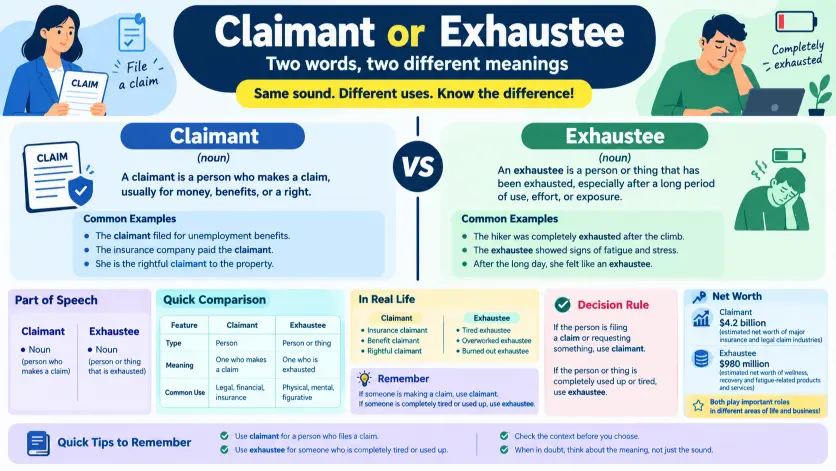
Have you come across the terms claimant or exhaustee on an unemployment benefits form and wondered what they mean? Although both terms relate to unemployment insurance, they describe different situations. A claimant is generally someone who files a claim for benefits, while an exhaustee is typically someone who has used up the unemployment benefits available under a particular program or claim. Understanding this distinction can help you interpret official notices, complete applications more accurately, and avoid confusion when checking your benefit status.
The difference between a claimant and an exhaustee becomes especially important when dealing with unemployment insurance programs, eligibility requirements, and benefit extensions. A person may qualify as a claimant without having exhausted their benefits. By contrast, an exhaustee has generally reached the limit of available benefits under the relevant program, although eligibility for other assistance may depend on applicable rules. Exact definitions can vary by jurisdiction and program, so the wording used by your state unemployment agency or the relevant benefits authority should always guide your interpretation.
In this guide, you will learn what each term means, how claimant and exhaustee statuses differ, and where these terms commonly appear in unemployment documentation. You will also explore practical examples, common misunderstandings, and important questions about benefit eligibility. The explanations are based on the general terminology used in unemployment insurance, with an emphasis on distinguishing a person who files a claim from someone who has exhausted available benefits. Whether you are completing a form, reviewing an official notice, or simply learning the terminology, this guide will help you understand the distinction more confidently.
Claimant vs Exhaustee: What’s the Difference?
The main difference between claimant and exhaustee is the person’s status in a benefits process. A claimant submits a request for benefits or asserts a legal right to something. An exhaustee, particularly in unemployment insurance, is someone who has exhausted the benefits available under a specific program or claim.
Although both terms frequently appear in unemployment documentation, they aren’t interchangeable. A person may be a claimant while receiving benefits, waiting for a decision, or appealing a denial. By contrast, an exhaustee has reached the limit of benefits available under the relevant program, although eligibility for other assistance may still exist.
Definition of Claimant
Claimant (noun): A claimant is an individual who formally requests benefits, compensation, payment, or recognition of a legal right.
In unemployment insurance, a claimant typically files an application with the relevant agency after losing employment or experiencing another qualifying employment situation. The agency then reviews the application to determine whether the individual meets the applicable requirements.
For example, someone who loses a job and applies for unemployment compensation becomes a claimant. However, filing an application doesn’t automatically guarantee approval. The agency may need to verify employment history, earnings, availability for work, and other eligibility conditions.
The term also appears in insurance, legal proceedings, disability programs, and compensation claims. In each setting, its central meaning remains the same: the person is asserting a claim or requesting a benefit.
Definition of Exhaustee
Exhaustee (noun): An exhaustee is a person who has used all benefits available under a particular program or benefit entitlement.
In unemployment insurance, the term often describes someone who has received the maximum amount payable under a regular unemployment claim. Depending on the program’s rules, the person might no longer qualify for payments under that claim.
Nevertheless, exhausting one benefit entitlement doesn’t necessarily mean that the person can never receive further assistance. Eligibility may depend on additional programs, new employment, a subsequent qualifying claim, or special rules established by the relevant jurisdiction.
For example, an individual who receives all the unemployment payments available under an approved claim may be classified as an exhaustee for that program.
Comparison Table
| Feature | Claimant | Exhaustee |
|---|---|---|
| Part of speech | Noun | Noun |
| Main meaning | Person who files a claim | Person who has used all available benefits |
| Typical context | Applications and eligibility reviews | Benefit limits and program records |
| Unemployment example | Applies for compensation | Has exhausted the applicable entitlement |
| Does the term guarantee payment? | No | No |
| Can further assistance be possible? | Yes, subject to eligibility | Yes, subject to other program rules |
| Common documentation | Initial claim or appeal | Exhaustion status or benefit history |
Quick Recap
A claimant is someone who requests benefits or asserts a right to compensation.
An exhaustee has used the benefits available under a specified entitlement.
A claimant may receive benefits, await a decision, or challenge a determination.
An exhaustee may need to explore other programs, depending on the applicable rules.
Is Claimant vs Exhaustee a Grammar, Vocabulary, or Usage Issue?
The distinction between claimant and exhaustee is primarily a vocabulary and administrative terminology issue. Both words are nouns, and each has a specific meaning in benefit systems. Therefore, the main challenge isn’t grammatical correctness but understanding the status represented by each term.
Are Claimant and Exhaustee Interchangeable?
No, claimant and exhaustee aren’t interchangeable in standard administrative usage.
For instance, consider this sentence: “The claimant submitted an application for unemployment benefits.” The word claimant identifies someone requesting assistance.
By comparison, the statement “The exhaustee has received all benefits available under the applicable claim” identifies someone whose entitlement has been used up.
A person may initially be a claimant and later become an exhaustee if the relevant benefit entitlement is fully used. However, the exact classification depends on the program’s terminology and rules.
Formal and Informal Usage
Both terms are formal and commonly associated with official records, legal documents, administrative decisions, and benefit applications.
In everyday conversation, people are more likely to say “someone applying for unemployment benefits” than “a claimant.” Likewise, they may say “someone who has run out of unemployment benefits” rather than “an exhaustee.”
Nevertheless, when completing an official form, the wording provided by the administering agency should take priority over an informal interpretation.
Academic and Administrative Contexts
In academic discussions of public policy, labor economics, and social welfare, claimant may refer to individuals seeking assistance from an established program. Exhaustee may describe a subgroup whose benefit entitlement has reached its limit.
However, researchers and students should define both terms carefully because program rules differ across jurisdictions. An exhaustee under one program might qualify for assistance under another, while a claimant might not yet have received any payment.
Consequently, understanding the administrative context is essential for interpreting statistics, eligibility categories, and official decisions correctly.
Practical Usage: When to Use Claimant
Use claimant when referring to someone who has filed a request for benefits, compensation, insurance proceeds, or another recognized entitlement. Additionally, choose this word when discussing the application, review, or appeal process.
1. Workplace Example
An employee loses a job and applies for unemployment compensation.
Example: “The claimant submitted employment records to support the unemployment application.”
Here, claimant describes the person seeking assistance. The sentence doesn’t imply that the application has already been approved or that payments have begun.
Similarly, an employer responding to an agency inquiry might provide information concerning a claimant’s previous wages or separation from employment.
2. Academic Example
In a labor economics report, researchers may examine how people apply for public benefits after job loss.
Example: “The study compared the employment outcomes of claimants across several industries.”
In this context, claimant identifies individuals who have submitted claims. However, researchers should specify the program and population because different studies may define claimants according to different administrative criteria.
3. Technology Example
Online benefit portals allow applicants to submit forms, upload documents, and monitor application progress.
Example: “The digital portal allows each claimant to check the status of a pending application.”
The term refers to the person interacting with the benefits system. Although the application may be submitted electronically, the individual’s classification depends on the relevant program’s rules.
Usage Recap
Choose claimant when someone requests benefits or asserts a right to compensation. Moreover, remember that claimant status alone doesn’t establish eligibility, approval, or payment.
Practical Usage: When to Use Exhaustee
Use exhaustee when an individual has used all benefits available under the relevant entitlement and the administering program recognizes that status. The term is especially important when discussing unemployment insurance and the limits of benefit payments.
1. Workplace Example
A former employee has received all payments available under a particular unemployment claim.
Example: “The agency recorded the individual as an exhaustee after the available benefits were fully paid.”
This description focuses on the completed entitlement rather than the initial application. However, the exact classification must follow the agency’s official definition.
2. Academic Example
A public policy researcher studies how benefit limits affect people experiencing extended unemployment.
Example: “The report examined the employment outcomes of exhaustees whose regular unemployment benefits had ended.”
Here, exhaustees represent people who have used their available benefits under the specified program. The researcher should still explain the relevant jurisdiction, benefit category, and study period.
3. Technology Example
A benefits management system may track payment totals and identify when an entitlement reaches its maximum.
Example: “The software flags an exhaustee record when the applicable benefit entitlement has been fully used.”
In practice, the system must rely on accurate payment data and the program’s official classification rules. Otherwise, a record might incorrectly suggest that someone has exhausted benefits when an adjustment, correction, or additional entitlement remains possible.
Usage Recap
Choose exhaustee when the relevant benefits have been exhausted under the applicable program. Nevertheless, don’t assume that the person is permanently ineligible for every form of assistance.
When You Should NOT Use Claimant or Exhaustee
Several common misunderstandings can lead to inaccurate applications, reports, or explanations. Therefore, consider these scenarios before choosing either term.
- Don’t use claimant to mean an approved recipient. Someone may file a claim without meeting the requirements for payment.
- Don’t use exhaustee for every unemployed person. A person may be unemployed without having applied for benefits or exhausted an entitlement.
- Don’t assume every claimant receives money. An application may be denied, withdrawn, or still under review.
- Don’t use exhaustee merely because payments have stopped. Payments might have been suspended, delayed, or interrupted for another reason.
- Don’t assume an exhaustee can never receive further assistance. Other programs or subsequent entitlements may be available if their conditions are met.
- Don’t treat claimant and exhaustee as competing categories in every situation. A person may be a claimant in a broader administrative sense while also being classified as an exhaustee under a particular benefit program.
- Don’t assume the same definition applies everywhere. Government agencies may use specialized definitions for particular programs, reporting systems, or eligibility categories.
- Don’t rely on a label alone to determine eligibility. Always consult the official notice, applicable regulations, or administering agency when making decisions about benefits.
These distinctions matter because administrative terms can affect how people understand application status, payment limits, and available options.
Common Mistakes and Decision Rules
The following examples show how to distinguish the terms in everyday and administrative writing.
| Correct sentence | Incorrect sentence | Explanation |
|---|---|---|
| The claimant filed for unemployment benefits. | The exhaustee filed for unemployment benefits. | The first sentence identifies someone submitting a claim, without implying that benefits have been exhausted. |
| The exhaustee used all benefits available under the claim. | The claimant used all benefits available under the claim. | The second sentence may be grammatically possible, but it doesn’t specifically identify exhaustion status. |
| The claimant is waiting for an eligibility decision. | The exhaustee is waiting for an eligibility decision. | Exhaustee is inappropriate if the intended meaning is simply a pending initial application. |
| The agency identified the individual as an exhaustee. | The agency identified the individual as a claimant. | The second sentence omits the specific exhaustion status when that classification is the point being discussed. |
| The claimant appealed the denial. | The exhaustee appealed the denial. | Claimant is appropriate when emphasizing the person’s claim or appeal, unless the context specifically requires the exhaustion label. |
| The exhaustee may investigate other available programs. | The exhaustee is automatically eligible for other programs. | Exhaustion doesn’t automatically establish eligibility for additional assistance. |
Decision Rule
If you mean the person who files a claim or requests benefits, use claimant.
If you mean the person whose available benefits have been exhausted, use exhaustee.
For example, a person may first submit an unemployment application as a claimant. Later, after receiving all payments available under that entitlement, the same individual may qualify as an exhaustee under the relevant program’s rules.
Claimant and Exhaustee in Modern Technology and Digital Benefit Systems
Online portals, electronic case management systems, and automated eligibility checks have made benefit terminology increasingly visible to applicants.
For example, a portal may label an individual as a claimant while an application is being reviewed. Meanwhile, an administrative database may identify an exhaustee when recorded payments reach the applicable entitlement limit.
However, digital labels don’t always explain the full circumstances behind a decision. A payment interruption, an exhausted entitlement, and an unresolved application are different situations, even if they all result in a person receiving no payment at a particular moment.
Therefore, applicants should read the accompanying explanation rather than interpreting a status label in isolation. If a portal uses unfamiliar terminology, the program’s official glossary or help desk can clarify its meaning.
Additionally, organizations developing benefit management software should distinguish between application status, payment status, and exhaustion status. Keeping these categories separate improves record accuracy and makes administrative decisions easier to explain.
Etymology: Where Do Claimant and Exhaustee Come From?
The history of these words helps explain their modern administrative meanings.
Claimant derives from claim, which entered English through Old French and ultimately traces back to Latin clamare, meaning to call out or proclaim. The suffix “ant” identifies a person associated with an action. Consequently, claimant refers to someone who makes a claim.
Exhaustee comes from exhaust, a word rooted in Latin exhaurire, meaning to draw out or empty. The ending “ee” commonly identifies a person who experiences an action or is the recipient of it, as in employee or appointee. In benefits terminology, exhaustee therefore describes someone whose available entitlement has been used up.
Although both terms identify people, their word formation highlights different relationships. A claimant initiates or asserts a claim, whereas an exhaustee is associated with the completion of an available benefit entitlement.
An Expert Perspective on Accurate Benefit Terminology
A useful principle in administrative writing is to distinguish the action a person takes from the status that follows.
“Describe the person’s actual benefit status, rather than assuming it from a single application or payment record.”
This is a general editorial guideline, not a quotation attributed to a named authority. It emphasizes accuracy when explaining public assistance, insurance, or employment related benefits.
For instance, an application record may show that someone requested compensation, but it doesn’t necessarily prove that the request was approved. Similarly, a record showing no recent payment doesn’t establish that the person exhausted the entitlement.
Consequently, writers should identify the relevant program and explain the evidence supporting a classification. This practice improves clarity for applicants, researchers, caseworkers, and readers of administrative reports.
Two Practical Case Studies
The following illustrative case studies demonstrate how these terms can be used correctly. They are hypothetical examples, not verified agency decisions or independently measured research findings.
Case Study 1: Understanding an Initial Unemployment Application
An individual loses a job and submits an application for unemployment compensation. While the agency verifies earnings and reviews eligibility, the application record identifies the individual as a claimant.
An inexperienced writer describes the person as an exhaustee simply because payments haven’t started. However, that description is unsupported because the application is still under review.
The writer corrects the report to state: “The claimant is awaiting an eligibility determination.”
Result: The revised wording accurately distinguishes a pending application from an exhausted benefit entitlement. It also avoids suggesting that the individual has already received all available payments.
Case Study 2: Interpreting a Completed Benefit Entitlement
Another individual receives the full amount available under a particular unemployment claim. The agency’s records confirm that no further payments remain under that entitlement.
A benefits summary describes the person as an exhaustee under the applicable program. However, the individual assumes that this label means no public assistance can ever be available again.
The explanation is revised to state: “The individual has exhausted benefits under this claim and may review other programs for which they could qualify.”
Result: The revised wording explains the exhausted entitlement without making unsupported claims about eligibility for other assistance.
Error Prevention Checklist
Before using either term in an application guide, report, or explanation, review the following points.
Always Use Claimant When
- Describing someone who has filed a benefit claim.
- Explaining a pending application or eligibility review.
- Referring to a person challenging an administrative decision.
- Discussing a request for compensation or another recognized entitlement.
- Describing an applicant without assuming the outcome.
Never Use Exhaustee When
- The person has only submitted an application.
- The application remains under review and exhaustion hasn’t occurred.
- Payments have stopped for an unverified reason.
- You lack evidence that the relevant entitlement has been fully used.
- You intend to say that someone is permanently ineligible for all benefits.
Additional Verification Steps
- Check the administering agency’s official definition.
- Identify the specific program or benefit entitlement.
- Distinguish application status from payment status.
- Verify whether the available entitlement has actually been exhausted.
- Avoid promising additional benefits without confirming eligibility requirements.
By following these steps, writers and applicants can interpret official terminology more reliably.
Related Grammar Confusions You Should Master
Learning the distinction between claimant and exhaustee also provides an opportunity to review other commonly confused terms.
- Applicant vs recipient: An applicant requests assistance, whereas a recipient receives it.
- Eligible vs ineligible: Eligible means that the relevant requirements are met, while ineligible means they aren’t.
- Approved vs pending: Approved indicates a favorable decision, whereas pending means a decision hasn’t been finalized.
- Benefit vs entitlement: A benefit is assistance or a payment, while entitlement refers to a recognized right to receive it under applicable rules.
- Appeal vs application: An application requests an initial determination, whereas an appeal challenges a decision.
- Gross vs net: Gross refers to an amount before specified deductions, while net refers to the amount remaining afterward.
- Suspended vs terminated: Suspended generally means temporarily halted, whereas terminated means ended, subject to the relevant rules.
- Claim vs complaint: A claim asserts a right or requests compensation, while a complaint expresses dissatisfaction or alleges a problem.
- Insured vs uninsured: Insured means covered by an insurance arrangement, whereas uninsured means lacking that coverage.
- Temporary vs permanent: Temporary describes something intended or expected to last for a limited period, whereas permanent suggests an enduring condition.
Understanding these distinctions helps readers interpret official documents without confusing applications, decisions, payments, and eligibility.
Frequently Asked Questions
1. What is the difference between a claimant and an exhaustee?
A claimant is someone who files a claim for benefits or asserts a right to compensation. An exhaustee is someone who has used all benefits available under a specified entitlement. The precise definition of exhaustee depends on the relevant program.
2. What does claimant mean in unemployment benefits?
In unemployment insurance, claimant generally refers to a person who submits a claim for unemployment compensation. The individual may be waiting for a decision, receiving benefits, or challenging a determination. Filing a claim doesn’t guarantee approval.
3. What does exhaustee mean in unemployment insurance?
An exhaustee generally refers to a person who has received all benefits available under a particular unemployment entitlement. Depending on the program, the person may need to explore other assistance options or satisfy additional requirements before receiving further payments.
4. Can a claimant become an exhaustee?
Yes. A person may begin as a claimant and later become an exhaustee after using all benefits available under the applicable entitlement. However, the exact classification depends on the program’s definitions and administrative rules.
5. Does being an exhaustee mean someone is no longer eligible for benefits?
Not necessarily. Exhaustion generally concerns a specific entitlement. A person might qualify for another program or a future claim if the applicable requirements are met. The individual should confirm eligibility with the relevant agency.
6. Is an exhaustee the same as an unemployed person?
No. An unemployed person is someone without employment under the relevant definition. An exhaustee is someone who has used all available benefits under a particular entitlement. Not every unemployed individual has filed a claim or exhausted benefits.
7. Can a claimant be denied unemployment benefits?
Yes. A claimant may be denied if the application doesn’t satisfy the applicable eligibility requirements. Depending on local rules, the person may have the right to request reconsideration or appeal the determination.
8. Why does an unemployment form ask whether someone is an exhaustee?
The question may help the administering agency determine whether the person has used all benefits available under a particular program. The answer may affect how the agency evaluates the individual’s status or directs them toward other possible options.
9. How can I determine whether I am a claimant or an exhaustee?
Review the official benefit notice, application status, and payment history. If you have filed a claim, claimant may describe your role. If the agency confirms that your available entitlement has been fully used, exhaustee may apply under that program. When uncertain, contact the administering agency for clarification.
Conclusion:
Choosing between claimant and exhaustee depends on the person’s actual status in the benefit process. A claimant is someone who requests compensation or asserts a right to assistance. An exhaustee, by contrast, has used all benefits available under a particular entitlement.
Although both terms frequently appear in unemployment insurance documentation, they aren’t interchangeable. Therefore, use claimant when discussing an application, request, or appeal. Meanwhile, use exhaustee when the applicable benefit entitlement has been exhausted and the program recognizes that status.
Most importantly, don’t assume that filing an application guarantees payment or that exhausting one entitlement permanently prevents further assistance. Instead, review the official records, confirm the program’s terminology, and distinguish application status from benefit exhaustion. By following these principles, you can interpret administrative documents more accurately and communicate benefit related information with confidence.









