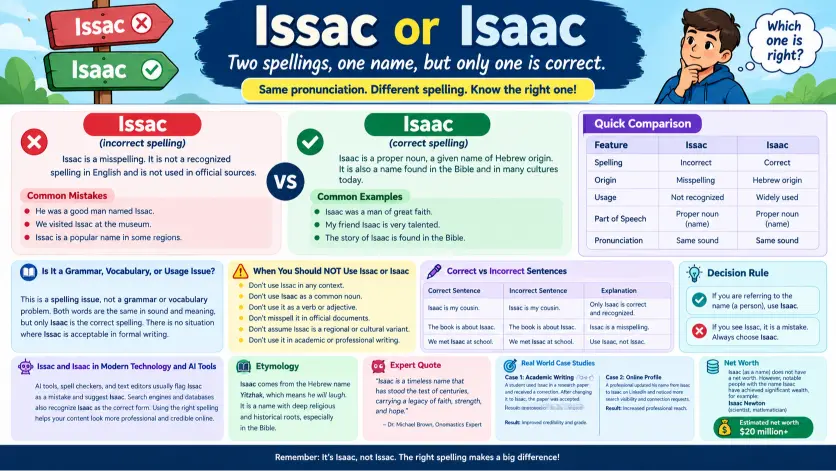
Have you ever wondered whether the correct spelling is Issac or Isaac? These two versions look almost identical, so it is easy to mix them up when writing a name on a school assignment, official document, birthday card, or online profile. However, there is an important distinction to understand. Isaac is the standard and widely accepted spelling of the name, while Issac is generally considered a misspelling or a less common variant. Knowing which form to use can help you avoid confusion and make your writing more accurate.
The name Isaac has a long history and is traditionally associated with the Hebrew name Yitzhak, commonly interpreted as “he will laugh” or “he laughs.” It is also well known from the Bible, where Isaac is the son of Abraham and Sarah. These historical and cultural connections have helped establish Isaac as a familiar name across many countries and languages. Although Issac may appear in personal records or informal writing, the traditional spelling remains Isaac.
In this guide, you will learn the difference between Issac and Isaac, explore the name’s origin and meaning, and discover examples showing how to spell it correctly. The discussion draws on established naming conventions, linguistic background, and standard written usage to explain why the two forms are not equally common. Whether you are choosing a baby name, checking someone’s spelling, or improving your English writing, this practical comparison will help you identify the preferred form and use it confidently in the right context.
Issac vs Isaac: What’s the Difference?
The main difference between Issac and Isaac is spelling. Isaac is the established English spelling of a biblical name, whereas Issac is a less common variant that is usually treated as a spelling error when the traditional name is intended.
Both forms can appear as personal names. Nevertheless, their usage differs considerably because Isaac has a long history in religious texts, literature, and everyday naming traditions. By comparison, Issac is much less established in standard English references.
Definition of Isaac
Isaac (proper noun): Isaac is a masculine given name of Hebrew origin. It is traditionally associated with the Hebrew name Yitzhak, meaning “he laughs” or “he will laugh.” In the Bible, Isaac is the son of Abraham and Sarah and the father of Jacob and Esau.
Today, Isaac is used across many countries, cultures, and language communities. It appears in religious writing, historical records, academic publications, and contemporary birth registrations.
Example: “Isaac received an award for his outstanding academic performance.”
Definition of Issac
Issac (proper noun when used as a name): Issac is an uncommon spelling that resembles Isaac but reverses the placement of the second and third letters. In many contexts, it appears because someone has mistyped the traditional name.
However, a person may legitimately have Issac as their registered first name. Therefore, it is important to distinguish a spelling mistake from an individual’s official name.
Example: “Issac submitted his application before the deadline.”
If the person’s legal name is Issac, the spelling should be respected rather than automatically corrected.
Comparison Table
| Feature | Isaac | Issac |
|---|---|---|
| Classification | Established given name | Uncommon personal spelling |
| Origin | Hebrew | Usually a variant spelling of Isaac |
| Traditional meaning | He laughs or he will laugh | Associated with Isaac when intended as a variant |
| Common usage | Religious, historical, and everyday naming | Individual names and spelling errors |
| Standard spelling | Yes | Generally nonstandard |
| Part of speech | Proper noun | Proper noun when used as a name |
| Example | Isaac visited the library. | Issac visited the library. |
Quick Recap
Isaac is the traditional and widely recognized spelling.
Issac is uncommon and may be a typographical error.
Both forms can function as personal names.
When referring to the biblical figure or the traditional name, use Isaac.
When writing about a specific person, follow the spelling in their official records.
Is Issac vs Isaac a Grammar, Vocabulary, or Usage Issue?
The distinction between Issac and Isaac is primarily a spelling and naming issue, rather than a grammatical one. Both forms can function as proper nouns, and neither changes the structure of a sentence. However, the choice matters because names identify individuals and carry personal, cultural, and historical significance.
Are Issac and Isaac Interchangeable?
Generally, no. When referring to the traditional name, Isaac is the accepted spelling. Replacing it with Issac in a historical essay, religious discussion, or general reference may introduce an error.
For example:
Correct: “Isaac was the son of Abraham and Sarah.”
Usually incorrect in this context: “Issac was the son of Abraham and Sarah.”
The second sentence contains a spelling mistake if it refers to the biblical figure.
Nevertheless, the situation changes when Issac is someone’s actual registered name. In that case, it is not appropriate to alter the spelling simply because another form is more common.
Formal and Informal Usage
In formal communication, accuracy is especially important. Therefore, use Isaac when referring to the traditional name in a report, application, academic paper, or historical account.
In informal conversation, people may overlook a minor spelling error. Even so, the established spelling remains Isaac.
For example, a casual message might contain “Hey Issac, are you coming today?” If the recipient’s name is Isaac, correcting the spelling would make the message more accurate and personal.
Academic and Everyday Contexts
Academic writing generally follows established naming conventions. Consequently, textbooks, historical discussions, and religious studies ordinarily use Isaac when discussing the biblical patriarch.
In everyday situations, the appropriate spelling depends on the person being addressed. A student named Isaac should have that spelling on assignments and certificates, while someone officially named Issac should retain their own spelling.
Thus, the important distinction is between a traditional name and an individual’s documented name.
Practical Usage: When to Use Isaac
Use Isaac when referring to the traditional Hebrew name, the biblical patriarch, or a person whose name is spelled this way. Additionally, this spelling is appropriate in historical, educational, religious, and professional contexts.
1. Workplace Examples
In professional communication, names should match the spelling provided by the individual or recorded in the relevant system.
Example: “Isaac will lead the presentation during Monday’s meeting.”
Similarly, an administrative employee might write:
“Please send the completed contract to Isaac before the end of the day.”
In both examples, Isaac is appropriate if that is the person’s correct name.
2. Academic Examples
In educational writing, Isaac is the established spelling of the biblical figure.
Example: “Isaac is an important figure in the traditions of Judaism, Christianity, and Islam.”
Likewise, a history teacher might write:
“Students examined the biblical account of Isaac and his family.”
The spelling should remain consistent throughout the assignment, particularly when discussing historical or religious material.
3. Technology Examples
Digital systems frequently store personal names in databases, email accounts, contact lists, and identification records.
Example: “The student information system lists Isaac as the applicant’s first name.”
Similarly, an online registration form might display:
“Welcome, Isaac. Your account has been created successfully.”
Because digital records can be used across multiple services, an incorrect spelling may lead to duplicate profiles or difficulties matching records.
Usage Recap
Choose Isaac for the traditional name and whenever a person’s documented spelling is Isaac. Above all, preserve the same spelling across professional correspondence, academic work, and digital records.
Practical Usage: When to Use Issac
Although Issac is not the standard spelling of the traditional name, it can still be correct when it is an individual’s actual name. Therefore, context matters more than assumptions about spelling.
1. Workplace Examples
Suppose an employee’s official name is Issac. In that situation, colleagues should use the spelling supplied by the employee.
Example: “Issac will coordinate the team’s weekly schedule.”
Similarly, an office administrator might write:
“Please update Issac’s contact information in the employee directory.”
These sentences are appropriate if the employee’s name is genuinely spelled Issac.
2. Academic Examples
In a school or university, the spelling on official records should be preserved.
Example: “Issac Ahmed received his certificate at the graduation ceremony.”
If the student’s registered name is Issac Ahmed, changing it to Isaac Ahmed could create inconsistencies between the certificate and the institution’s records.
However, when discussing the biblical figure, use Isaac instead.
3. Technology Examples
Online platforms often require names to match account records or identity documents.
Example: “The database stores Issac as the user’s registered first name.”
Similarly, a software developer might test a registration form using different names.
Example: “The form correctly displayed Issac without automatically changing the spelling.”
In this case, preserving the entered name helps prevent unwanted changes to personal information.
Usage Recap
Use Issac when it is the person’s actual spelling. Otherwise, choose Isaac for the traditional name and correct accidental misspellings when appropriate.
When You Should NOT Use Issac or Isaac
Although the difference seems small, several situations require particular attention.
- When writing about the biblical patriarch, don’t use Issac. The established spelling is Isaac.
- When completing official documents, don’t guess a person’s name. Check the relevant identification or registration record first.
- When correcting a spelling mistake, don’t assume every occurrence of Issac is wrong. It may be someone’s genuine registered name.
- When writing an academic paper, don’t alternate between both spellings for the same historical figure. Consistency helps maintain accuracy.
- When creating a professional email, don’t copy a misspelled name from an unreliable source without checking it. Confirm the spelling whenever possible.
- When managing a contact database, don’t automatically replace Issac with Isaac. Verify the record before making a change.
- When discussing the name’s Hebrew origin, don’t present Issac as the standard historical spelling. Isaac is the conventional English form.
- When addressing a person, don’t correct their name without evidence. Personal names may have unusual but legitimate spellings.
Ultimately, the safest approach is to identify whether the sentence refers to the traditional name or to a particular individual.
Common Mistakes and Decision Rules
Because the two spellings differ by only two adjacent letters, the error can easily go unnoticed. However, proofreading the complete sentence can help identify the intended form.
| Correct sentence | Incorrect sentence | Explanation |
|---|---|---|
| Isaac was a biblical patriarch. | Issac was a biblical patriarch. | Isaac is the established spelling of the biblical name. |
| Isaac will attend the conference. | Issac will attend the conference. | The first spelling is correct if the attendee’s name is Isaac. |
| Issac received his certificate. | Isaac received his certificate. | Issac is correct if that is the student’s registered name. |
| The story of Isaac appears in the Bible. | The story of Issac appears in the Bible. | Isaac is the conventional spelling in biblical references. |
| Isaac’s application was approved. | Issac’s application was approved. | Use the documented spelling of the applicant’s name. |
| Issac’s account matches his identification. | Isaac’s account matches his identification. | Issac is appropriate if it matches the person’s official records. |
Notice that the third and sixth examples are not mistakes when Issac is genuinely the person’s name. Therefore, context determines whether a spelling should be corrected.
A Simple Decision Rule
If you mean the traditional Hebrew name or the biblical patriarch, use Isaac.
If you mean a specific person, use the spelling shown in that person’s reliable records or preferred name.
This rule avoids the common error of treating every unusual spelling as incorrect. It also preserves accuracy in both historical writing and personal communication.
Issac and Isaac in Modern Technology and Digital Tools
Digital technology has made accurate spelling increasingly important. For example, names appear in email addresses, student portals, customer databases, workplace messaging systems, and online applications.
Although spellcheckers may identify Issac as a possible error, they cannot always determine whether the spelling belongs to a real person. As a result, automatic correction can sometimes create more problems than it solves.
For example, a contact management system might convert Issac into Isaac without confirming the change. Consequently, the displayed name could no longer match the individual’s identification documents or other records.
Likewise, search engines may return different results depending on the spelling entered. Someone looking for information about the biblical patriarch should search for Isaac, whereas a person looking for a specific individual named Issac may need the less common spelling.
Therefore, context sensitive proofreading and careful record management are essential. Correct spelling improves search accuracy, reduces confusion, and helps preserve personal identity.
Etymology: Where Does the Name Isaac Come From?
Isaac originates from the Hebrew name Yitzhak, which is traditionally associated with laughter. Its meaning is commonly rendered in English as “he laughs” or “he will laugh.”
According to the biblical narrative in Genesis, Abraham and Sarah received the news that they would have a son despite their advanced age. The name Isaac is connected with the laughter associated with that announcement.
Over time, the name became established in English through biblical translation and religious tradition. It subsequently spread across many regions and language communities.
The spelling Isaac is now widely recognized in English speaking countries and in international naming contexts. Meanwhile, Issac is often encountered as a typographical variation or an individual’s chosen or registered spelling.
Understanding this history explains why Isaac remains the conventional form in religious and historical writing.
An Expert Perspective on Correct Name Spelling
A useful editorial principle is that proper names require both conventional accuracy and respect for individual identity.
As a general writing guideline:
“Follow established spelling conventions for historical names, but preserve a person’s documented name whenever identity is the subject.”
This is an editorial principle rather than a quotation attributed to a particular linguist.
For example, a textbook should use Isaac when discussing the biblical patriarch. By contrast, a school administrator should use Issac if that spelling appears on the student’s verified records.
Consequently, the correct decision depends on the purpose of the text. Historical accuracy calls for the traditional form, whereas personal identification calls for the individual’s actual name.
Two Practical Case Studies
The following illustrative examples demonstrate how spelling choices affect accuracy in everyday situations. They are hypothetical teaching cases rather than reports of independently measured research.
Case Study 1: Correcting a School Assignment
A student writes an essay about the biblical patriarch and repeatedly uses the spelling Issac.
The teacher reviews the paper and recognizes that the student intends to discuss Isaac, the son of Abraham and Sarah. The teacher then corrects the spelling throughout the essay while preserving the student’s original argument.
Result: The essay follows conventional spelling and presents the historical name consistently. The correction also helps the student recognize the difference between a typographical error and an established name.
Case Study 2: Updating an Employee Database
A human resources employee receives a request to update a staff directory. The employee’s identification document spells the first name Issac, but an older spreadsheet lists Isaac.
Rather than automatically selecting the more familiar form, the administrator checks the official record and updates the directory to match it.
Result: The employee’s name becomes consistent with the verified documentation, reducing the risk of mismatched records in internal systems.
These examples demonstrate an important distinction: standard spelling conventions are useful, but personal names should not be changed without verification.
Error Prevention Checklist
Use this checklist before publishing content or updating records that contain either spelling.
Always Use Isaac When
- Referring to the biblical patriarch.
- Writing about the traditional Hebrew name in a historical or religious context.
- Preparing educational materials about biblical figures.
- Correcting an obvious typographical error when the intended name is known to be Isaac.
- Using the conventional spelling in general explanations of the name’s origin and meaning.
Never Use Issac When
- Referring to the biblical patriarch whose established English name is Isaac.
- Reproducing a historical name in an academic essay without checking the accepted spelling.
- Assuming the less common form is appropriate simply because it looks similar.
- Creating inconsistent spellings for the same person in a document when the correct form is known.
- Replacing the conventional spelling in a general definition without a specific reason.
Verify Before Correcting When
- The spelling appears on an official identity document.
- A student or employee has supplied their name directly.
- A database contains conflicting versions of the same name.
- An online profile uses an uncommon spelling.
- A document refers to a real person rather than the traditional name.
By following these steps, writers can improve accuracy without making assumptions about personal identity.
Related Grammar Confusions You Should Master
Learning other commonly confused words can further improve spelling and vocabulary skills.
- Jon vs John: Jon and John are both personal names, but they may refer to different people. Always verify the intended name.
- Sara vs Sarah: Both spellings are used as given names. The correct choice depends on the individual.
- Steven vs Stephen: Both are established personal names with different spellings and naming histories.
- Katherine vs Catherine: Both are recognized given names. Personal preference and official records determine the appropriate spelling.
- Sean vs Shawn: These names may sound similar in some varieties of English, but they have distinct spellings.
- Brian vs Bryan: Both are used as personal names, so context and identity determine the correct form.
- Michael vs Micheal: Michael is the established conventional spelling, while Micheal may be a personal variant or a typographical error.
- Definately vs definitely: Definitely is the standard spelling, while definately is a common misspelling.
- Separate vs seperate: Separate is correct, whereas seperate is a common spelling mistake.
- Receive vs recieve: Receive is the standard spelling. Remembering the spelling pattern can help prevent errors.
Unlike many ordinary spelling mistakes, differences between personal names sometimes reflect genuine naming choices. Therefore, always consider the context before making corrections.
Frequently Asked Questions
1. Is it Issac or Isaac, which spelling is correct?
Isaac is the conventional spelling of the traditional Hebrew name and the biblical patriarch. Issac is less common and is often a spelling mistake. However, Issac can be correct when it is someone’s actual registered name.
2. What does the name Isaac mean?
Isaac is a Hebrew name traditionally interpreted as “he laughs” or “he will laugh.” Its meaning is associated with the biblical account of Abraham and Sarah, in which laughter is connected with the announcement of their son’s birth.
3. Is Issac a real name?
Issac can be a real personal name when an individual has that spelling on official records or uses it as their chosen name. Nevertheless, Isaac remains the established English spelling of the traditional Hebrew name.
4. Why do people spell Isaac as Issac?
People may write Issac because they accidentally reverse the placement of letters when typing or remembering the name. In other cases, the spelling may be a genuine personal variation. Therefore, the context determines whether it is an error.
5. Is Isaac the correct biblical spelling?
Yes. Isaac is the conventional English spelling of the biblical patriarch who appears in the Book of Genesis. Consequently, academic, historical, and religious writing should use Isaac when referring to this figure.
6. Are Isaac and Issac pronounced the same?
They are commonly pronounced the same in English, which contributes to the spelling confusion. Since pronunciation generally does not distinguish the two forms, writers must rely on conventional spelling and the identity of the person being discussed.
7. How do you spell Isaac correctly in a formal letter?
Spell the name Isaac when that is the recipient’s actual name. However, if the recipient is officially named Issac, use that spelling instead. Checking an email signature or another reliable record can prevent an embarrassing mistake.
8. What is the difference between Issac and Isaac in a school record?
Isaac is the conventional spelling of the traditional name, while Issac is less common. Nevertheless, school records must reflect the student’s verified name. If the official record says Issac, administrators should not change it without proper confirmation.
9. Is Issac a misspelling of Isaac?
In general writing, Issac is usually treated as a misspelling when the intended name is Isaac. However, it should not automatically be considered incorrect when it belongs to a real individual whose name is officially spelled that way.
Conclusion:
The correct choice between Issac or Isaac depends on whether you are referring to the traditional name or to a particular person. Isaac is the established English spelling of the Hebrew name associated with laughter, and it is the conventional spelling of the biblical patriarch.
By contrast, Issac is less common and frequently appears as a typographical error. Nevertheless, it can be correct when it is someone’s genuine registered or preferred name.
Therefore, use Isaac in general explanations, historical discussions, religious texts, and academic assignments about the biblical figure. When writing about an individual, verify the spelling rather than assuming that the more familiar form is always correct.
Ultimately, accurate naming requires both attention to conventional spelling and respect for personal identity. By applying this simple distinction, you can avoid unnecessary mistakes in professional documents, educational materials, online communication, and everyday writing.









