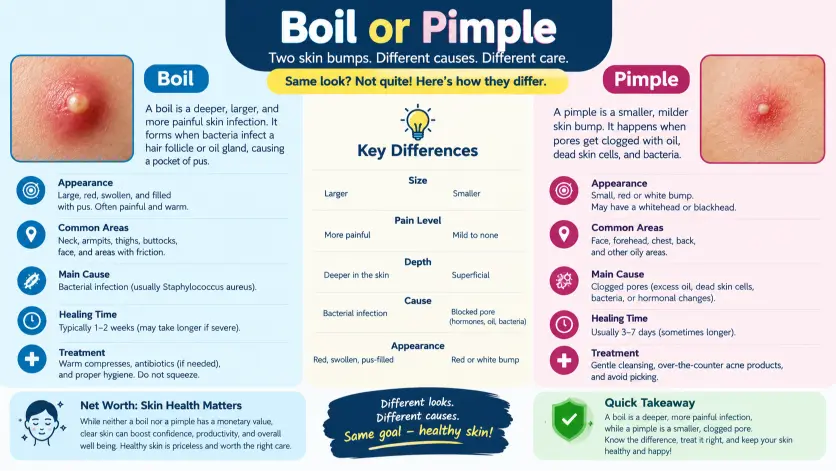
A sudden red, swollen, painful bump can be confusing, especially when it looks similar to an ordinary acne spot. You may wonder whether you are dealing with a boil or pimple, and that distinction matters because the two conditions can have different causes and may require different approaches to care. While both can appear as raised, inflamed bumps on the skin, their development, appearance, and typical symptoms are not always the same.
Understanding these differences can help you avoid common mistakes, such as squeezing a painful lump or using acne products on a skin infection. A pimple commonly develops when pores become clogged with oil and dead skin cells, while a boil is usually linked to a bacterial infection involving a hair follicle or surrounding tissue. Knowing what you are looking at is therefore an important first step toward appropriate care.
This guide explains how to distinguish a boil or pimple by looking at size, tenderness, location, redness, pus, and how the bump develops over time. It also covers common causes, safe treatment options, prevention tips, and warning signs that may require medical attention. The information is intended for general education and should not replace advice from a qualified healthcare professional.
Boil or Pimple: What Is the Difference?
At first glance, a raised red bump can be difficult to identify. Both conditions may become swollen, tender, and filled with fluid. However, their underlying causes are different.
A pimple is commonly associated with acne. Acne develops when hair follicles become blocked by oil and dead skin cells. Inflammation can then produce different types of blemishes, including whiteheads, blackheads, pustules, nodules, and cysts. The American Academy of Dermatology describes pimples as one of the common manifestations of acne.
A boil, medically known as a furuncle, usually develops when bacteria infect and inflame one or more hair follicles. The result is often a painful, pus filled lump beneath the skin. Boils commonly become progressively larger and more tender before they drain.
| Feature | Boil | Pimple |
|---|---|---|
| Main cause | Usually bacterial infection | Clogged and inflamed pore |
| Typical depth | Often deeper beneath the skin | Usually closer to the surface |
| Pain | Often noticeably painful | Can be tender or painful |
| Appearance | Red, swollen, pus filled lump | Red bump, whitehead, blackhead, or pustule |
| Common locations | Face, neck, armpits, thighs, buttocks | Face, chest, shoulders, and back |
| Growth pattern | May enlarge rapidly | Often develops within an acne breakout |
| Infection | Usually involves infection | Acne itself is not the same as a boil |
| Treatment approach | Warm compresses and medical drainage when necessary | Acne focused skin care and medication |
The simplest distinction is the cause. A pimple generally belongs to the acne family, whereas a boil is usually an infected follicle.
Size can provide a clue, but it isn’t enough to make a diagnosis. A large, painful acne nodule can resemble a boil, while a small boil may look like an ordinary pimple.
Quick Recap
A pimple usually results from a clogged and inflamed pore.
A boil generally develops from a bacterial infection involving a hair follicle.
Boils tend to be deeper, warmer, and more painful.
Large or persistent bumps may require professional evaluation because appearance alone can be misleading.
Is Boil or Pimple a Grammar, Vocabulary, or Usage Issue?
The phrase is primarily a vocabulary and usage question rather than a grammar problem.
The words boil and pimple refer to different skin conditions. Therefore, they aren’t normally interchangeable. Saying that every pus filled bump is a pimple can lead to confusion, particularly when a deeper infection is present.
In casual conversation, people often use broad terms such as spot, bump, zit, or pimple. These expressions can be understandable without being medically precise. However, healthcare discussions require more careful terminology.
For academic or professional writing, the distinction becomes even more important. A medical explanation should identify whether a lesion appears consistent with acne, folliculitis, a boil, an abscess, or another skin condition.
There is also a practical reason to use accurate language. Treatment varies according to the underlying condition. Acne may respond to ingredients such as benzoyl peroxide, salicylic acid, or retinoids, depending on the type and severity. Boils may require warm compresses, drainage, or antibiotics in selected circumstances.
Consequently, vocabulary isn’t merely cosmetic here. It can influence how someone interprets the seriousness of a skin problem.
Understanding a Boil
A boil is a localized skin infection that usually begins in a hair follicle. Bacteria can enter through a tiny break in the skin or through a follicle. As the immune system responds, inflammation and pus can develop.
Early on, a boil may resemble a small red bump. Over the following days, however, it can become increasingly swollen and painful. Some develop a yellow or white center as pus accumulates.
Boils are especially common in areas exposed to sweat, friction, or hair growth. The face, neck, armpits, thighs, and buttocks are among the locations frequently affected.
Workplace Example
Imagine someone notices a painful lump near the upper thigh after several days of sweating and friction. Calling it a pimple may seem harmless, but if the area becomes increasingly warm, swollen, and tender, a boil or abscess may be a more appropriate possibility.
Accurate terminology can help the person recognize that repeated squeezing isn’t a good strategy.
Academic Example
In a health education paper, describing a boil simply as a pimple would reduce medical precision. A stronger sentence would identify it as a potentially infected hair follicle that has developed into a painful, pus filled lesion.
Technology Example
Digital symptom checkers and health information systems often depend on precise descriptions. Entering terms such as painful lump, pus, warmth, rapid growth, and redness can provide more useful information than simply entering pimple.
Technology can organize information, but it cannot replace a physical examination when the diagnosis is uncertain.
Usage Recap
Use boil when describing a painful, infected follicular lump.
Pay attention to rapid enlargement, warmth, tenderness, and pus.
Avoid squeezing or piercing a suspected boil because doing so can spread infection.
Understanding a Pimple
A pimple is a familiar term for an acne blemish. Acne occurs when follicles become blocked and inflamed. Different acne lesions can look quite different, so not every pimple has the same appearance.
A pustule, for example, can contain yellowish or white fluid. Papules are generally raised and inflamed without visible pus. Deeper nodules and cysts can be painful and may increase the likelihood of permanent scarring.
Pimples most often appear on areas where oil glands are active, including the face, chest, shoulders, and back.
Workplace Example
Suppose an employee develops several small red and white bumps across the forehead. If similar blemishes have appeared repeatedly, especially around oily areas, acne is more plausible than a single isolated boil.
Academic Example
In a dermatology assignment, pimple should be presented as a common descriptive term rather than a precise diagnosis for every skin bump. More specific terms such as pustule, papule, nodule, or cyst can describe particular acne lesions.
Technology Example
Skin tracking applications may categorize facial lesions according to characteristics such as redness, size, location, and recurrence. Such tools can support observation, but they shouldn’t be treated as definitive diagnostic systems.
Usage Recap
Use pimple when discussing a typical acne blemish.
Repeated breakouts often point toward acne rather than an isolated boil.
Deep, painful acne lesions deserve attention because some can scar.
When You Should NOT Use Boil or Pimple
There are several situations where casually labeling a skin lesion can be misleading.
1. When the lump is rapidly enlarging
A rapidly growing painful lump may represent an abscess or another infection rather than ordinary acne.
2. When redness is spreading
Expanding redness around a painful lump can signal a spreading skin infection and deserves medical attention.
3. When fever or chills occur
A fever, chills, or feeling unusually unwell alongside a painful skin lesion should not be dismissed as a normal pimple.
4. When the lesion is on the face
A facial boil deserves particular caution, especially when swelling is significant or vision is affected.
5. When the same lesions keep returning
Recurring boils may require professional assessment to determine why they continue developing.
6. When a lump remains for more than two weeks
A persistent lump should be assessed rather than repeatedly treated as acne or an ordinary spot.
7. When there are several connected painful lumps
Multiple connected boils can form a carbuncle, which represents a deeper and more extensive infection.
8. When the diagnosis is simply uncertain
Not every red bump is acne or a boil. Folliculitis, cysts, insect reactions, and other skin conditions can produce similar appearances.
Common Mistakes and Decision Rules
| Correct sentence | Incorrect sentence | Explanation |
|---|---|---|
| The painful lump may be a boil. | Every painful lump is a pimple. | Pain alone does not establish acne. |
| This recurring breakout looks consistent with acne. | Every breakout is a boil. | Repeated acne lesions have a different pattern. |
| A boil should not be squeezed. | Squeeze the boil to remove the infection. | Manipulation can spread infection. |
| A pustule is a type of acne lesion. | Every pus filled bump is a boil. | Pustules can occur with acne. |
| A dermatologist can evaluate deep acne. | Deep acne should always be treated like an infection. | Acne nodules and cysts require a different approach. |
| A growing warm lump deserves attention. | A growing lump is just a large pimple. | Rapid growth can indicate an abscess or infection. |
Decision Rule Box
If you mean an acne related blemish, use pimple.
If you mean a painful bacterial infection involving a hair follicle, use boil.
When the appearance doesn’t clearly fit either description, avoid guessing and consider professional evaluation.
Boil or Pimple in Modern Technology and Clinical Tools
Modern health platforms increasingly rely on structured descriptions of symptoms. A person may enter information about lesion size, pain, location, color, drainage, duration, and recurrence.
These details can be useful because visual similarity doesn’t always indicate identical causes. A folliculitis lesion, for example, can resemble a pimple while being associated with infection around a hair follicle.
Clinical guidelines also emphasize that acne treatment should be matched to disease severity and lesion type. Current dermatology guidance supports several topical approaches, including benzoyl peroxide and retinoids, while more severe cases may require additional treatment.
The important principle is simple: digital tools can organize symptoms, but diagnosis still depends on clinical judgment.
Etymology and Medical Background
The everyday word pimple has long been associated with a small raised spot on the skin. Its modern use is strongly connected with acne and similar blemishes.
Boil has a different linguistic history. The word developed from terminology associated with swelling and inflammation, eventually becoming the familiar English term for a painful skin lump containing pus.
The medical term furuncle is more specific. It describes a deeper infection involving a hair follicle. When several connected boils develop together, the condition may be called a carbuncle.
As medical vocabulary became more standardized, distinctions between everyday descriptions and clinical terminology became increasingly important.
Expert Style Perspective
A useful clinical principle is that appearance should be interpreted together with depth, pain, progression, location, and surrounding inflammation.
That principle explains why simply asking whether something looks like a pimple isn’t always enough.
Two Evidence Based Case Studies
Case Study 1: Moderate to Severe Acne
A randomized clinical study evaluated 503 participants with moderate to severe inflammatory acne over 12 weeks. Participants receiving adapalene combined with benzoyl peroxide achieved substantially greater lesion reductions than participants receiving the inactive comparison treatment.
At week 12, inflammatory lesions declined by 68.7 percent in the stronger combination group compared with 39.2 percent in the comparison group. Noninflammatory lesions declined by 68.3 percent compared with 37.4 percent.
The practical lesson is that persistent acne can respond to evidence based treatment, but the appropriate approach depends on severity and individual circumstances.
Case Study 2: Adolescent Acne
Another clinical analysis followed 2,453 adolescents aged 12 to 17 years who received a fixed combination of adapalene and benzoyl peroxide. After 12 weeks, 30.9 percent of participants receiving the combination were classified as clear or almost clear.
Total lesion counts fell by 56 percent, inflammatory lesions by 63 percent, and noninflammatory lesions by 54.5 percent.
This example reinforces an important distinction. Acne treatment is designed around the biology of acne, while a true boil involves an infectious process and should not automatically be approached with acne medication.
Error Prevention Checklist
Always use pimple when
- The lesion appears as part of a recurring acne breakout.
- There are blackheads or whiteheads nearby.
- Several similar blemishes occur in typical acne prone areas.
- The lesion fits a recognized acne pattern.
- You are discussing acne generally rather than a confirmed infection.
Never use boil when
- You are simply describing an ordinary blackhead.
- You have no evidence suggesting a deeper infected follicle.
- The lesion is one of many typical acne blemishes.
- You are using the term merely because the spot contains a small amount of fluid.
Always use caution when
- A lump becomes rapidly larger.
- Pain becomes severe.
- The surrounding skin becomes increasingly warm or swollen.
- Redness spreads outward.
- Fever or chills develop.
- A lesion keeps returning.
- A lump remains for an unusually long period.
Medical guidance recommends avoiding attempts to puncture or squeeze boils because manipulation can spread infection.
Related Grammar Confusions You Should Master
Although this topic is primarily about health vocabulary, several related comparison patterns can help readers distinguish similar terms more accurately.
- Acne vs pimple: condition compared with individual blemish
- Boil vs abscess: related but not identical clinical descriptions
- Pustule vs papule: two different acne lesion types
- Cyst vs nodule: deeper inflammatory lesions with different characteristics
- Folliculitis vs acne: similar appearance with different underlying processes
- Rash vs irritation: broad description compared with a particular skin response
- Infection vs inflammation: related concepts that shouldn’t be treated as synonyms
- Symptom vs diagnosis: an observed experience compared with a clinical conclusion
- Blemish vs lesion: everyday language compared with broader medical terminology
- Treatment vs prevention: managing an existing problem compared with reducing future risk
Learning these distinctions improves both everyday communication and health related writing.
Frequently Asked Questions
What is the difference between a boil and a pimple?
A pimple is generally an acne related blemish caused by follicular blockage and inflammation. A boil is usually a deeper bacterial infection involving a hair follicle. Boils are often more painful and may enlarge as pus accumulates.
How can you tell if a bump is a boil or a pimple?
Look at the overall pattern rather than one feature. A single rapidly enlarging, warm, painful lump may suggest a boil, while recurring smaller blemishes in acne prone areas may suggest acne. Appearance alone cannot always establish the diagnosis.
Can a pimple turn into a boil?
A typical pimple does not simply transform into a boil. However, skin can develop different conditions in the same area, and an infected follicle may produce a lesion that resembles acne.
Should you pop a boil or a pimple?
Neither should routinely be squeezed. Popping acne can increase inflammation, dark marks, and scarring, while squeezing a boil can spread infection.
Is a painful pimple always a boil?
No. Deep inflammatory acne can be extremely painful and may resemble a boil. Acne nodules and cysts can occur beneath the surface and require different management.
What does a boil look like when it starts?
A boil may initially appear as a small red or purplish tender bump. It can then become larger, more swollen, and more painful as pus develops.
When should you see a doctor for a boil?
Professional evaluation is appropriate when a boil is on the face, grows quickly, becomes extremely painful, causes fever, keeps returning, becomes larger despite self care, or fails to heal within about two weeks.
Can acne cause large painful lumps?
Yes. Acne can produce nodules and cysts that extend deeply into the skin. These lesions may be painful and have a greater risk of scarring, so dermatological treatment can be helpful.
Are boils contagious?
The bacteria associated with boils can spread between people, particularly through close contact or contaminated personal items. Good hand hygiene and avoiding shared towels can help reduce transmission.
Final Takeaway
The distinction between a boil and a pimple comes down mainly to cause, depth, progression, and clinical context. A pimple generally belongs to the acne spectrum, while a boil is usually an infected hair follicle that produces a deeper, painful collection of pus.
If a bump is small, familiar, and part of a recurring acne pattern, it may be a pimple. However, a rapidly enlarging, hot, painful lump with significant swelling deserves more caution.
Most importantly, don’t rely on squeezing as a diagnostic or treatment method. Acne and boils can both become worse after manipulation. When pain, spreading redness, fever, recurrence, facial involvement, or persistent swelling appears, professional assessment is the safer choice.









