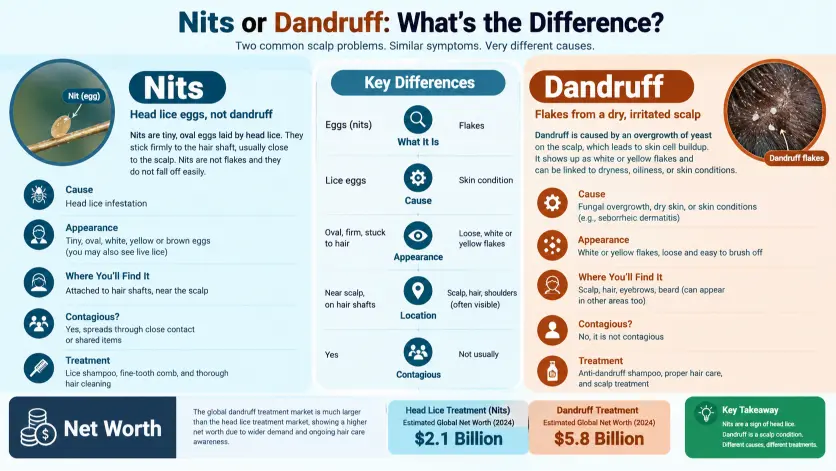
Have you ever noticed tiny white or pale particles in your hair and wondered whether they are nits or dandruff? At first glance, the two can look surprisingly similar, but they are not the same thing. Dandruff consists of flakes of dead skin that usually come away from the scalp easily, while nits are lice eggs that attach firmly to individual strands of hair. Knowing the difference matters because the appropriate response for each condition is different. A simple mistake can lead to unnecessary treatments or delay the right solution.
Identifying the difference starts with paying attention to where the particles are located, how they look, and how easily they move. Dandruff commonly appears as loose white or yellowish flakes on the scalp and clothing, whereas nits tend to remain attached close to the hair shaft. Itching can occur with both, which is why relying on symptoms alone may not always provide a clear answer.
This guide explains nits or dandruff in a straightforward, evidence informed way, helping you recognize the most important visual and practical differences. You will learn how nits and dandruff typically appear, how to check your hair properly, what symptoms may accompany each condition, and when professional advice may be appropriate. Whether you are checking your own scalp or helping someone else, understanding these distinctions can make the next step much clearer.
Difference between Nits or Dandruff:
At first glance, nits and dandruff can be difficult to distinguish. Nevertheless, they have completely different meanings, causes, appearances, and management requirements. Understanding those differences makes identification much easier.
A nit is a noun that refers to the egg of a head louse. Female head lice attach their eggs to individual strands of hair using a strong adhesive substance. Consequently, a genuine nit usually remains firmly attached instead of falling away like ordinary scalp flakes.
Dandruff is also a noun. It describes visible flakes produced when skin sheds from the scalp. Depending on the individual, those flakes may be tiny and powdery or larger and more noticeable. Furthermore, dandruff can be accompanied by scalp itching.
The most useful distinction is attachment. A nit typically stays fixed to a particular hair shaft, whereas dandruff usually moves freely among the hair or falls onto clothing.
| Feature | Nits | Dandruff |
|---|---|---|
| Meaning | Lice eggs | Loose scalp skin flakes |
| Cause | Head lice infestation | Scalp flaking and related skin processes |
| Attachment | Firmly attached to hair | Usually loose |
| Movement | Difficult to remove from the hair shaft | Usually falls or brushes away |
| Typical location | Close to the scalp, especially around the ears and neck | Scalp, hair, eyebrows, and shoulders can show flakes |
| Associated organism | Head louse | Not caused by lice |
| Contagious | Associated with a contagious lice infestation | Not contagious |
In simple terms, nits are attached with eggs, while dandruff is loose scalp material.
Furthermore, location can provide another useful clue. Nits are frequently found closed to the scalp because developing eggs require warmth. Dandruff, on the other hand, may be distributed throughout the hair and can fall onto the shoulders.
However, appearance alone should not be considered conclusive. Hair products, dry skin, dirt, scabs, and other particles can sometimes resemble lice eggs. Therefore, examining attachment and movement provides more useful information than relying solely on color.
Another important point involves active infestation. Finding a crawling louse provides stronger evidence of current head lice than simply discovering an isolated white particle. Consequently, suspected nits should be considered alongside the other signs.
Is Nits vs Dandruff a Grammar, Vocabulary, or Usage Issue?
From a language perspective, nits and dandruff are vocabulary terms rather than alternative grammatical forms. They describe different things, so they cannot normally replace each other.
The word nits is the plural form of nit. Therefore, it refers to more than one lice egg. For example, a person might say, “The examination found several nits near the scalp.”
By contrast, dandruff is generally treated as an uncountable noun. Thus, natural expressions include “I have dandruff” or “There is dandruff on the scalp.” Saying “three dandruffs” would normally sound incorrect in ordinary English.
In formal writing, medical communication, and educational material, accuracy becomes particularly important. For instance, calling lice eggs dandruff can create confusion about the underlying problem.
Likewise, casual conversation may use broader descriptions such as “white flakes” or “something in the hair.” Although such wording can be understandable, it does not identify the material precisely.
Therefore, the terms are neither interchangeable nor competing spelling variants. Instead, they represent separate concepts that require different vocabulary.
Formal and Academic Usage
In academic writing, nit should be used when discussing the egg stage of head lice. Meanwhile, dandruff should be used when discussing scalp flaking.
For example, a biology lesson could explain the life cycle of head lice and mention nits as the egg stage. A dermatology discussion, however, could describe dandruff as a common scalp condition involving visible flakes.
Casual Usage
In everyday speech, people sometimes use “dandruff” as a general description for anything white found in hair. Nevertheless, that shortcut can be misleading.
Consequently, when the distinction matters, descriptive language is preferable. Mention whether the material moves, brushes away, or remains attached to a particular strand.
Nits: Meaning, Appearance, and Practical Usage
Nits are the eggs produced by head lice. Generally, they are tiny and oval shaped, and they become attached to individual hair shafts. Because of their strong attachment, they can be difficult to remove with ordinary brushing.
Usually, suspected nits are found close to the scalp. Areas around the ears and the back of the neck deserve particular attention because these locations can provide suitable conditions for lice development.
Moreover, not every nit found in the hair proves that an active infestation is currently present. Empty egg casings can remain attached after a louse has emerged. Therefore, identifying a live louse or nymph is more useful when determining whether an infestation is active.
Color can vary, so it should not be the only identification feature. Similarly, size can be misleading because other particles may look comparable when viewed without magnification.
Workplace Example
Suppose an employee notices several tiny objects attached to individual hairs. Instead of immediately describing them as dandruff, the person could explain that the particles remain firmly attached and do not brush away easily.
That description provides more useful information for someone assessing the situation.
Academic Example
A student studying parasitic organisms might write, “Nits are the eggs of head lice and are attached to individual hair shafts.”
This wording is accurate because it identifies both the object and its relationship to the host.
Technology Example
Digital health questionnaires may ask whether a particle can be removed easily, whether it is attached to the hair, and whether crawling insects are visible. Such questions help separate different possibilities.
Usage Recap
Use nits when you specifically mean lice eggs. Furthermore, use the term when discussing the life cycle, identification, or presence of head lice eggs.
Dandruff: Meaning, Appearance, and Practical Usage
Dandruff refers to visible scalp flaking. It is common and may occur alongside itching or irritation. However, dandruff is not itself a lice infestation.
Unlike nits, dandruff flakes are generally loose. Consequently, they may fall from the scalp during brushing, washing, scratching, or ordinary movement.
Dandruff can vary considerably in appearance. Some individuals experience very fine white flakes, while others notice larger pieces of scaling. Therefore, visual size does not provide a perfect identification method.
Furthermore, dandruff is not simply a consequence of poor hygiene. Scalp oil, skin turnover, sensitivity, and other factors can contribute to the condition.
Workplace Example
Imagine someone notices white flakes on a dark jacket during a workday. Although the flakes may be noticeable, their presence does not automatically indicate head lice.
Therefore, it would be inappropriate to assume that the person has an infestation without additional evidence.
Academic Example
A health education assignment could explain that dandruff involves visible scalp flaking and may be associated with itching.
That description separates dandruff from lice eggs and makes the terminology clearer.
Technology Example
A digital symptom questionnaire may ask about scalp dryness, flaking, itching, redness, product use, and duration. Those details can help organize possible explanations for scalp symptoms.
Usage Recap
Use dandruff when referring to scalp flaking rather than lice eggs. In addition, avoid using the word as a general label for every white substance found in hair.
How to Tell Nits and Dandruff Apart
The most practical first step is to examine whether the material is attached to the hair.
If a particle moves easily when the hair is brushed, it may be dandruff or another loose substance. Conversely, if something remains firmly fixed to an individual hair, a nit becomes more plausible.
Nevertheless, attachment is not an absolute diagnostic test. Hair spray, styling products, dirt, scabs, and other debris can cling to hair.
Next, consider the location. Suspected nits close to the scalp deserve closer examination, especially around the ears and the back of the neck.
Then, consider whether anything is moving. Dandruff itself does not crawl. Head lice, however, are living insects capable of moving through the hair.
Itching can also provide a clue, but it is not definitive. Both dandruff and head lice can cause an itchy scalp. Therefore, itching alone cannot establish the cause.
Finally, consider the overall pattern. Several firmly attached structures combined with evidence of crawling lice are more concerning for an infestation than a few loose flakes that fall away during brushing.
When You Should NOT Use Nits or Dandruff
Using these terms incorrectly can cause unnecessary confusion. Therefore, keep the following situations in mind.
- Do not call every white particle a nit. White material can have many explanations.
- Do not call firmly attached lice eggs dandruff. Dandruff normally consists of loose flakes.
- Do not diagnose head lice from itching alone. Numerous scalp conditions can cause itching.
- Do not diagnose dandruff simply because white flakes are present. Other conditions can produce visible scaling.
- Do not assume that every attached particle represents a live infestation. Empty egg casings may remain after the insect has emerged.
- Do not use personal cleanliness as evidence. Head lice can affect people regardless of hygiene habits.
- Do not rely exclusively on color. Both genuine nits and harmless debris can have pale appearances.
- Do not begin unnecessary treatment solely because you are uncertain. Correct identification is important before selecting an appropriate approach.
Common Mistakes and Decision Rules
The following examples demonstrate how wording can change meaning.
| Correct sentence | Incorrect sentence | Explanation |
|---|---|---|
| The flakes may be dandruff. | The flakes are definitely nits. | Loose flakes can have several causes. |
| The eggs are attached to the hair shaft. | The eggs brush away like dandruff. | Nits generally remain firmly attached. |
| A live louse was found. | Dandruff was found crawling. | Dandruff does not crawl. |
| The scalp has visible dandruff. | The scalp has dandruff eggs. | Dandruff is not an egg producing organism. |
| The suspected nits are close to the scalp. | Any white particle proves an infestation. | Location can provide useful evidence, but confirmation still matters. |
Decision Rule
If you mean the lice egg, use nits.
If you mean the loose scalp flakes, use dandruff.
Therefore, when the identity of a particle is uncertain, describe its observable characteristics rather than making an immediate assumption.
Nits and Dandruff in Modern Technology and Digital Health Tools
Today, digital health resources often rely on detailed symptom descriptions. Consequently, users may be asked about attachment, location, itching, movement, duration, and visible insects.
These details matter because a photograph or brief description may not always distinguish similar looking particles.
Furthermore, lighting and image quality can change how hair debris appears. Dark hair can make ordinary flakes particularly noticeable, while bright lighting may exaggerate small particles.
Therefore, visual information should be considered alongside physical characteristics. When suspected lice are involved, finding a crawling insect provides particularly useful evidence.
Likewise, persistent scalp flaking may require professional evaluation when ordinary care does not resolve the problem. A healthcare professional can inspect the scalp directly and determine whether another condition may be responsible.
Etymology and Word History
The word nit has a long history in English and specifically refers to the egg of a louse. Over time, its meaning has remained closely associated with parasitic insects and their eggs.
The word dandruff, meanwhile, developed as a term associated with flakes or scales from the scalp. In contemporary English, it refers specifically to a common scalp related condition.
Consequently, the two words have distinct histories and meanings. Their difference is not simply a matter of spelling or regional preference.
That distinction also explains why replacing one word with the other can change the meaning of a sentence.
An Expert Perspective
Dermatology guidance emphasizes that dandruff is common and should not automatically be associated with poor personal hygiene. This point is important because social assumptions can sometimes lead to embarrassment or unnecessary concern.
As a result, accurate vocabulary has practical value. Saying “there are loose scalp flakes” is different from saying “there are lice eggs attached to the hair.”
Therefore, observation should come before judgment. A careful description of what is actually visible can lead to clearer communication and more appropriate next steps.
Two Practical Case Studies
Case Study One: Firmly Attached Particles
Consider a hypothetical child whose caregiver notices several pale structures around the back of the neck. Initially, the caregiver assumes the material is dandruff.
However, closer inspection shows that the structures are firmly attached to individual hairs. They remain in place when the hair is gently brushed. Further examination identifies a crawling louse nearby.
The practical result is a stronger indication of head lice rather than ordinary scalp flaking. Consequently, the family can seek appropriate confirmation and follow recommended treatment guidance.
The central lesson is that attachment and the presence of a live insect provide more useful information than color alone.
Case Study Two: Loose Flakes
Now consider a hypothetical adult who notices recurring white flakes across the scalp and shoulders. The particles fall away during brushing and washing, and no crawling insects or firmly attached egg structures are observed.
In this situation, the pattern is more consistent with dandruff than with an active lice infestation.
The practical result is that unnecessary lice treatment can be avoided while suitable scalp care can be considered.
These examples are educational scenarios rather than individual medical diagnoses. Nevertheless, they demonstrate why careful observation is valuable when two scalp related problems appear similar.
Error Prevention Checklist
Always use nits when:
☐ Mean lice eggs.
☐ The structures are attached to individual hair shafts.
☐ While discussing the egg stage of head lice.
☐ When describing suspected eggs near the scalp.
☐ Distinguishing eggs from adult lice or young lice.
Never use dandruff when:
☐ When specifically mean lice eggs.
☐ Describing a structure firmly attached to a hair shaft.
☐ Discussing the life cycle of head lice.
☐ Referring to an egg produced by a louse.
Always use dandruff when:
☐ When mean loose scalp flakes.
☐ Discussing ordinary scalp flaking.
☐ The material easily falls away from the hair.
☐ Describing a common scalp condition involving visible flakes.
Ultimately, precise terminology makes the discussion clearer and helps prevent unnecessary assumptions.
Related Grammar Confusions You Should Master
Although nits and dandruff represent a vocabulary distinction, several related terms can also cause confusion.
- Louse vs lice: One refers to a single insect, while the other refers to more than one.
- Nit vs nits: The first is singular, whereas the second is plural.
- Scalp vs skin: These terms overlap in everyday conversation but do not have identical meanings.
- Flake vs scale: Both can describe visible skin material, although their clinical use may differ.
- Egg vs nit: Egg is a broad biological term, while nit specifically refers to a louse egg.
- Infestation vs infection: These terms describe different biological processes and should not be treated as synonyms.
- Symptom vs condition: A symptom is an observable or experienced sign, whereas a condition describes the underlying problem.
- Itching vs irritation: These experiences can occur together but do not mean exactly the same thing.
- Dry scalp vs dandruff: These terms are often confused even though they can describe different scalp concerns.
- Lice vs dandruff: One involves a parasitic insect, while the other concerns scalp flaking.
Frequently Asked Questions
What is the easiest way to tell nits from dandruff?
The easiest starting point is attachment. Nits generally remain firmly attached to individual hairs, whereas dandruff usually consists of loose flakes that can move or fall away. However, other hair debris can resemble nits, so attachment should be considered alongside other signs.
Can dandruff look like nits?
Yes. Dandruff can sometimes resemble small pale particles in the hair. Additionally, styling products, dirt, dry skin, and other debris may look similar. Therefore, color alone cannot reliably establish whether a particle is a nit.
Do nits brush out like dandruff?
Generally, no. Nits are attached to individual hair shafts and can be difficult to remove through ordinary brushing. Dandruff, by comparison, is usually loose and may fall away during brushing or washing.
Where are nits usually found?
Nits are commonly found close to the scalp, particularly around the ears and the back of the neck. Their proximity to the scalp is important because developing eggs require suitable warmth.
Does dandruff mean poor hygiene?
No. Dandruff is not simply a result of poor personal hygiene. Various scalp and skin factors can contribute to visible flaking. Therefore, having dandruff should not be interpreted as evidence that someone is unclean.
Can someone have dandruff and head lice at the same time?
Yes. Dandruff and head lice are separate issues, so one does not prevent the other. Consequently, someone can experience scalp flaking while also having a lice infestation.
Does an itchy scalp always mean head lice?
No. Itching can occur with dandruff, dry skin, irritation, allergic reactions, and several other scalp concerns. Therefore, itching alone cannot confirm head lice.
Do nits always mean that live lice are present?
Not necessarily. Empty egg casings can remain attached after a louse has emerged. Furthermore, older material farther from the scalp may not indicate a current infestation. Finding a live crawling louse provides stronger evidence of active infestation.
When should you ask a healthcare professional about scalp flakes?
Professional advice can be useful when the cause remains uncertain, symptoms persist, significant irritation develops, sores appear, or suspected lice cannot be confidently identified. An examination can help determine the appropriate next step.
Conclusion:
Ultimately, understanding the difference between nits and dandruff is much easier when you focus on what each term actually describes. Nits are lice eggs that remain attached to individual hair shafts, whereas dandruff consists of loose flakes from the scalp.
Therefore, do not rely exclusively on color, size, or itching. Instead, consider attachment, location, movement, and the possible presence of crawling lice. Moreover, remember that not every pale particle is a nit, and not every itchy scalp has head lice. Similarly, visible flakes do not automatically prove dandruff because other scalp conditions can produce comparable appearances.
The simplest distinction remains useful: nits are attached lice eggs, while dandruff is loose scalp flaking. Consequently, careful observation and accurate terminology can prevent unnecessary concern and inappropriate treatment. When the appearance remains uncertain, professional evaluation can provide greater confidence.









