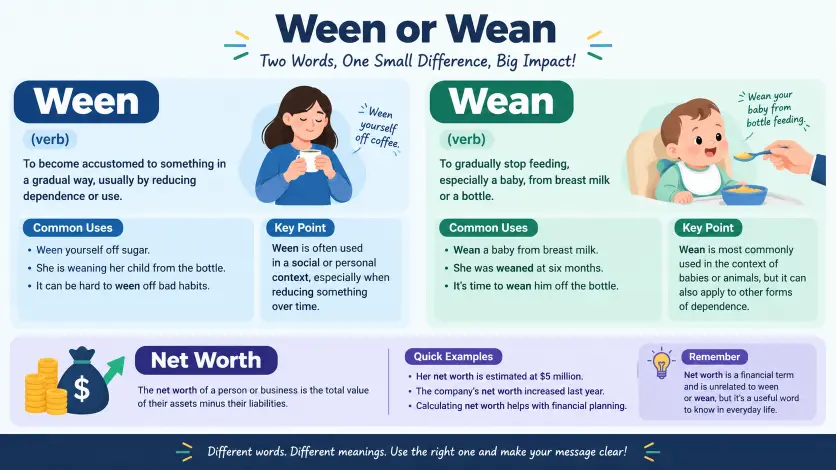
The English language is full of words that look or sound surprisingly similar, and ween or wean is a good example. At first glance, the two spellings may seem interchangeable, but they do not carry the same meaning or usage. Choosing the wrong form can make an otherwise clear sentence confusing, especially in formal writing, education, parenting discussions, or everyday communication. Understanding the distinction is therefore more useful than simply memorizing a spelling.
Wean is the established English word most readers are looking for when referring to gradually stopping a baby from breastfeeding or helping someone become accustomed to managing without something. Ween, on the other hand, is an uncommon and largely obsolete word that can mean to think, suppose, or imagine. Because modern English rarely uses it, confusion between these forms is understandable.
In this guide, we will examine ween or wean through their meanings, grammatical roles, pronunciation, origins, and practical examples. The goal is to make the difference easy to remember while showing how each form appears in real English. By looking at established dictionary usage and standard language conventions, you can confidently choose the correct word for your sentence.
Ween or Wean: What’s the Difference?
The main difference between these two verbs is their meaning.
Ween is a verb traditionally used to mean think, suppose, believe, or imagine. Today, it is uncommon and generally appears in older literature, poetry, historical writing, or deliberately old fashioned speech.
Wean, on the other hand, is a familiar modern verb. It originally referred to gradually moving a young child or animal away from milk. Over time, its meaning expanded to describe reducing dependence on almost anything.
| Word | Part of Speech | Meaning | Typical Context | Modern Usage |
|---|---|---|---|---|
| Ween | Verb | To think, suppose, or believe | Historical and literary writing | Rare |
| Wean | Verb | To gradually reduce dependence | Parenting, health, habits, technology, everyday writing | Common |
Consequently, the two words cannot normally replace one another.
If a writer means think or suppose, the historical verb ween may fit a literary context.
If the intended meaning is gradually reduce dependence, the correct modern word is wean.
Simple way to remember the difference
Think of ween as an old expression connected with belief.
Think of wean as a process connected with gradual separation.
For example:
I ween the tale is true.
Here, ween means something like I suppose.
By comparison:
The parents decided to wean their child from milk.
Here, wean describes a gradual transition.
Is Ween or Wean a Grammar, Vocabulary, or Usage Issue?
Although the confusion often appears as a spelling mistake, the deeper issue involves vocabulary and usage.
The words don’t represent different spellings of the same concept. Instead, they developed separate meanings and have different places in English.
Are ween and wean interchangeable?
No.
Replacing one with the other can produce an entirely different meaning. Consider these two examples:
I ween the journey will be difficult.
The historical verb expresses an assumption.
Now consider:
The doctor advised the patient to wean himself from the medication gradually.
Here, wean describes reducing dependence.
Therefore, substitution isn’t appropriate.
Formal versus informal usage
Interestingly, ween isn’t simply a more formal version of think. Instead, it is an archaic or literary expression.
A writer might deliberately choose it when recreating an older style. Nevertheless, using it in an ordinary business email could make the sentence sound unnatural.
Meanwhile, wean is perfectly acceptable in professional, academic, medical, parenting, and general communication.
Academic versus casual usage
Academic writers can use wean when discussing dependency, behavioral change, child development, nutrition, technology, or treatment.
For example:
The intervention was designed to gradually wean participants from excessive reliance on external assistance.
By contrast, an academic writer would rarely choose ween unless the subject involved historical language or literary analysis.
Therefore, register plays an important role in determining whether ween sounds appropriate.
How to Use Ween Correctly
Although ween is rarely encountered in everyday communication, it remains a legitimate English word.
Its traditional meaning is associated with believing, thinking, expecting, or supposing. Modern readers are more likely to encounter it in poetry, classic literature, historical narratives, or intentionally archaic dialogue.
For example:
I ween that the old king knew the truth.
The meaning is approximately:
I believe that the old king knew the truth.
Workplace example
Imagine a historical drama involving a character who works as an adviser:
I ween the council shall accept our proposal.
The sentence works because the character’s language is intentionally old fashioned.
However, a contemporary employee would normally write:
I believe the council will accept our proposal.
Thus, ween isn’t usually the strongest choice for modern workplace communication.
Academic example
A literature professor might write:
The narrator appears to ween that fate has already determined his future.
Such usage can be suitable when discussing an older text or deliberately preserving a historical tone.
However, modern explanatory writing would usually say:
The narrator appears to believe that fate has already determined his future.
Technology example
A historical fiction writer could use the word in a sentence involving an unusual invention:
I ween this device shall change the kingdom forever.
The expression sounds intentionally archaic.
By contrast, a technology report would normally use believe, expect, predict, or estimate.
Usage recap
Use ween mainly when historical or literary style calls for it.
Avoid using it simply because you want a sophisticated alternative to think.
For most contemporary readers, familiar verbs such as believe, suppose, and think provide greater clarity.
How to Use Wean Correctly
Unlike ween, wean remains an active and useful part of modern English.
Its most familiar meaning concerns infant feeding. During weaning, a baby gradually transitions away from breast milk or another primary source of nourishment toward other suitable foods and drinks.
However, the word has a much broader figurative application.
Someone can be weaned from:
- a habit
- a substance
- a particular routine
- a service
- a device
- a software system
- excessive assistance
- a long standing dependency
Workplace example
The company is trying to wean employees from outdated paper procedures.
The sentence means that employees are gradually being encouraged to move toward another method.
Academic example
The program helped students wean themselves from excessive dependence on translation tools.
Here, the verb describes a gradual behavioral change.
Technology example
The organization plans to wean customers from its older software platform.
This wording suggests a controlled transition rather than an immediate shutdown.
Parenting example
Parents often introduce new foods as they gradually wean their children.
Here, the traditional meaning is being used.
Usage recap
Choose wean when the sentence describes gradual withdrawal or reduced dependence.
The term works in literal situations involving nourishment as well as figurative situations involving habits, technology, substances, and systems.
When You Should Not Use Ween or Wean
Knowing when a word doesn’t belong can be just as useful as knowing where it does belong.
1. Don’t use ween for infant feeding
The correct sentence is:
The parents began to wean their baby.
Not:
The parents began to ween their baby.
The process of moving away from milk is called weaning.
2. Don’t use wean when you mean think
If you are expressing an ordinary opinion, use think, believe, or another suitable verb.
Instead of:
I wean this is correct.
Use:
I think this is correct.
3. Don’t treat ween as a modern spelling variant
The similarity between the two words doesn’t mean that they are interchangeable versions of one word.
4. Don’t use wean for a sudden action
The word generally suggests a gradual process.
If something stops immediately, verbs such as remove, stop, end, or eliminate may be more precise.
5. Don’t use ween casually in business communication
A sentence such as:
I ween our sales figures will improve.
may sound unnecessarily archaic.
A clearer contemporary version would be:
I believe our sales figures will improve.
6. Don’t assume weaning always means complete removal
Weaning usually emphasizes a transition. A person may become less dependent without immediately becoming completely independent.
7. Don’t select the spelling by sound alone
Pronunciation isn’t a reliable guide here. Instead, determine the intended meaning first.
8. Don’t choose rare vocabulary merely to sound impressive
Clear language is generally more effective than unnecessarily unusual wording.
Common Mistakes and Decision Rules
The following examples demonstrate how a small spelling difference can create a significant semantic problem.
| Correct Sentence | Incorrect Sentence | Explanation |
|---|---|---|
| The mother began to wean the baby. | The mother began to ween the baby. | The sentence describes gradual withdrawal from milk. |
| The patient was gradually weaned from the treatment. | The patient was gradually weened from the treatment. | The standard spelling is weaned. |
| I believe the plan will work. | I wean the plan will work. | Modern English normally uses believe or think. |
| The poem uses the verb ween. | The poem uses the verb wean. | The historical word means think or suppose. |
| The company hopes to wean customers from its older system. | The company hopes to ween customers from its older system. | The sentence describes reduced dependence. |
Decision Rule
If you mean gradual withdrawal or reduced dependence, use WEAN.
If you mean think or suppose, WEEN may appear in historical or literary language.
For modern everyday writing, however, think, believe, and suppose will usually communicate the intended idea more naturally.
Ween and Wean in Modern Technology and Digital Tools
Modern technology has created many new situations in which wean can be used naturally.
People may attempt to reduce their dependence on smartphones, social platforms, notification systems, subscription services, or particular software products.
For example:
The school is helping students wean themselves from excessive smartphone use.
The sentence doesn’t suggest that students will stop using technology altogether. Instead, it indicates a gradual reduction.
Similarly:
The company is attempting to wean employees from its outdated software.
Again, the idea involves transition.
By comparison, ween has almost no practical role in ordinary technology writing. If a technical author needs to communicate an assumption, words such as expect, assume, believe, or estimate are generally clearer.
Therefore, contemporary technology discussions strongly favor wean when dependence is involved.
The Etymology of Ween and Wean
The resemblance between ween and wean can make their histories seem connected. However, they developed along different linguistic paths.
Ween has Old English roots associated with thinking, expecting, believing, or imagining. Its survival in English became increasingly restricted, which explains its strongly literary flavor today.
Wean has Germanic origins associated with becoming accustomed to something different. Over centuries, its primary association with infant nourishment became established. Later, English speakers extended the word metaphorically to other forms of dependency.
As a result, the modern meanings are quite distinct.
The history also explains why ween can sound familiar to readers who encounter older English texts even though it isn’t common in contemporary conversation.
Expert style insight
“The most reliable distinction is meaning: ween concerns belief, while wean describes gradual movement away from dependence.”
This principle offers a simple way to separate the two expressions without relying on spelling alone.
Two Practical Case Studies
Case Study One: Infant Feeding
Imagine an article discussing the transition from milk to other nourishment.
The original sentence reads:
Parents can begin to ween their infant gradually.
A careful editor would identify the problem immediately. The writer is discussing a reduction in dependence on milk, so wean is required.
The corrected version is:
Parents can begin to wean their infant gradually.
The change involves only one letter, yet it restores the intended meaning.
Consequently, vocabulary accuracy is particularly important in parenting, healthcare, educational, and informational content.
Case Study Two: Historical Literature
Now imagine a student reading an old poem containing this sentence:
I ween the traveler shall return.
A modern reader might assume that ween is a spelling error.
However, historical context changes the interpretation. Here, ween means something close to believe or suppose.
Replacing it with wean would create a completely different meaning.
Therefore, historical vocabulary should always be interpreted within its literary context.
Error Prevention Checklist
A quick review can prevent nearly every common mistake involving these words.
Always use wean when
☑ Describing a child’s transition away from milk
☑ Discussing gradual reduction of a substance
☑ Talking about changing a long standing habit
☑ Describing reduced dependence on technology
☑ Explaining movement away from an older system
☑ Discussing a gradual behavioral transition
☑ Referring to reduced reliance on assistance
Never use wean when
☑ You simply mean think
☑ You mean suppose
☑ You are expressing an opinion
☑ You are describing a belief
☑ You are translating the historical meaning of ween
For the rare historical verb, context is essential. For the common modern verb, dependence and gradual withdrawal are the key ideas.
Related Grammar Confusions You Should Master
English contains numerous word pairs that look or sound alike but carry different meanings. Learning these distinctions can make writing considerably more precise.
Affect or Effect
Affect commonly functions as a verb meaning influence, while effect commonly functions as a noun meaning result.
Lay or Lie
These verbs differ according to grammatical function and whether an object receives the action.
Advice or Advise
Advice is a noun, whereas advise is a verb.
Your or You’re
Your indicates possession, while you’re is a contraction meaning you are.
Their, There, or They’re
These three forms have distinct functions involving possession, location, and contraction.
Its or It’s
Its indicates possession, while it’s usually means it is or it has.
Then or Than
Then commonly relates to time or sequence, whereas than is primarily used in comparisons.
Complement or Compliment
A complement completes or enhances something, while a compliment expresses praise.
Further or Farther
These forms overlap in some contexts, although traditional usage often distinguishes figurative distance from measurable physical distance.
Practice or Practise
These spellings differ according to grammatical role and regional English conventions.
Together, these examples reinforce an important lesson: similar looking words should be selected according to meaning and function rather than appearance.
Frequently Asked Questions
What is the difference between ween and wean?
Ween traditionally means to think, suppose, or believe and is now uncommon. Wean means to gradually reduce dependence, especially when moving away from milk, a substance, habit, service, or system.
Is ween a real English word?
Yes. Ween is a genuine English verb with historical roots. Nevertheless, it is uncommon in modern everyday writing and is mostly encountered in literary, poetic, historical, or deliberately archaic contexts.
Is wean the correct word for stopping breastfeeding?
Yes, although wean generally refers to a gradual transition rather than an abrupt ending. The process is commonly called weaning.
Can wean be used for habits?
Yes. The verb has an established figurative meaning involving gradual reduction of dependence.
For example:
She is trying to wean herself from excessive social media use.
The expression indicates a gradual behavioral transition.
What does “I ween” mean?
“I ween” is an old fashioned expression meaning approximately “I think,” “I suppose,” or “I believe.”
It may appear in older literary works or deliberately historical dialogue.
Is ween commonly used today?
No. Contemporary speakers generally use think, believe, suppose, assume, or imagine instead.
How can I remember wean versus ween?
Associate wean with gradual withdrawal and reduced dependence. Associate ween with an old fashioned expression involving belief or thought.
Is “weened” correct?
No, when referring to the standard past form of wean, the correct spelling is weaned.
For example:
The child was gradually weaned from milk.
Which word should I use in professional writing?
Use wean when you are describing gradual reduction of dependence. If you mean think or believe, choose a modern alternative such as believe, think, or suppose rather than the uncommon ween.
Conclusion: Ween or Wean Explained Clearly
The difference between ween or wean becomes simple once the meaning of each word is understood.
Ween is a rare, historical verb connected with thinking, supposing, or believing. It can still be useful when discussing older literature or creating deliberately archaic language. However, it isn’t normally suitable for everyday modern communication.
Wean, in contrast, remains a common and versatile verb. Its original association with infant feeding has expanded into broader meanings involving habits, substances, technology, services, routines, and other forms of dependence.
Therefore, when writing a contemporary sentence, ask one simple question: Am I describing belief, or am I describing gradual withdrawal?
If the idea involves gradual withdrawal, choose wean.
If an older text uses ween, understand it as a historical expression associated with thought or belief. Once that distinction becomes familiar, this commonly confused pair becomes much easier to handle accurately.









