When you come across the terms adjustor or adjuster, it is easy to wonder whether they are simply different spellings of the same word or whether there is an important distinction between them. Both forms are connected to the verb adjust, and both can refer to someone who evaluates, changes, or handles adjustments. However, their usage and popularity can vary depending on context, profession, and regional English. Choosing the right form matters when you are writing a professional email, preparing a document, or describing a specific occupation.
The confusion becomes especially common in insurance, finance, engineering, and other professional settings where precise terminology is important. Adjuster is generally the more widely recognized form, particularly in American English, while adjustor also appears in dictionaries and professional usage. Understanding how these terms developed and where they are normally used can help you avoid awkward or inconsistent wording.
In this guide, we will compare adjustor or adjuster in a clear and practical way. You will learn their meanings, spelling patterns, pronunciation, common contexts, and real world examples. Whether you are a student, professional, writer, or simply trying to improve your English vocabulary, this explanation will help you confidently choose the term that best fits your sentence.
Adjustor vs Adjuster: What’s the Difference?
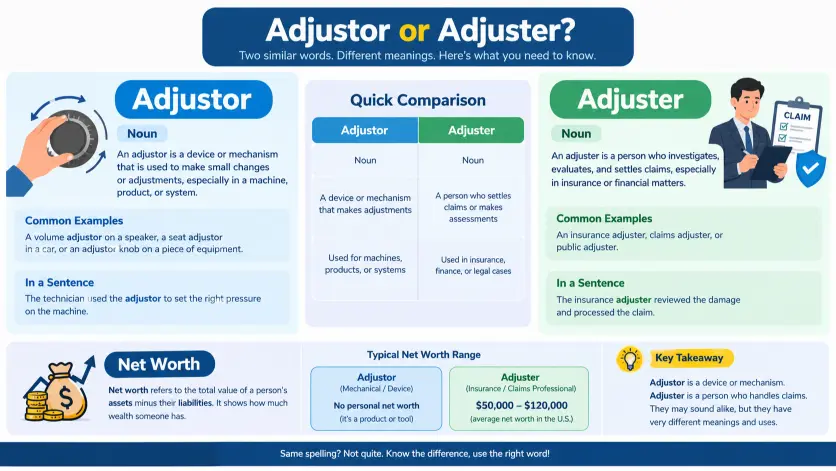
First, it helps to understand that adjuster and adjustor are both nouns. Each word can describe someone who adjusts, evaluates, reviews, or settles something. Nevertheless, the two forms aren’t equally common in every setting.
An adjuster is generally a person whose job involves examining circumstances and determining an appropriate resolution. In insurance, for example, an adjuster investigates a claim, reviews supporting evidence, assesses damage, and helps determine how much compensation may be appropriate.
An adjustor has essentially the same basic meaning. However, this spelling is less common in contemporary usage. It can still appear in dictionaries, professional documents, legal material, and specialized contexts. Consequently, calling it incorrect would be misleading.
| Feature | Adjuster | Adjustor |
|---|---|---|
| Part of speech | Noun | Noun |
| Basic meaning | A person who adjusts or evaluates something | A person who adjusts or evaluates something |
| Common insurance usage | Very common | Less common |
| Modern frequency | Higher | Lower |
| Professional preference | Usually preferred | Acceptable in some contexts |
| Meaning difference | Generally none | Generally none |
| Regional variation | Especially common in American English | Used as an alternative form |
| Recommended general choice | Yes | Usually secondary |
Therefore, adjuster is normally the safer choice for contemporary professional writing.
Meanwhile, adjustor remains a legitimate spelling rather than a simple spelling mistake.
Ultimately, the distinction is mainly about frequency and convention.
Is Adjustor vs Adjuster a Grammar, Vocabulary, or Usage Issue?
At first glance, the question may appear to be a grammar problem. However, it is primarily a vocabulary and usage issue because both forms function as nouns and generally communicate the same idea.
For example, someone who investigates an insurance claim can be called an adjuster. In some publications, that same professional may be described as an adjustor. Therefore, the grammatical structure of the sentence doesn’t usually change simply because the spelling changes.
Nevertheless, frequency matters. Modern professional English tends to favor adjuster, particularly within the insurance industry. Consequently, writers who want the most familiar and widely recognized form will usually select adjuster.
Interchangeable or Not?
In many situations, the terms are interchangeable. If someone writes, “The insurance adjuster inspected the property,” the meaning is clear. Likewise, “The insurance adjustor inspected the property” communicates essentially the same information.
However, interchangeable doesn’t always mean equally suitable. A word can be technically acceptable while still being less natural for a particular audience.
Formal vs Casual Usage
Both forms can occur in formal writing. Still, adjuster tends to sound more familiar to contemporary readers. Meanwhile, adjustor may appear more specialized, traditional, or simply less frequent.
In casual communication, most readers are likely to recognize adjuster immediately. Therefore, it is usually the smoother option when clarity and familiarity are priorities.
Academic vs Casual Usage
Academic writing should generally favor terminology that is widely established within the relevant field. Thus, if an academic paper discusses insurance claims, adjuster will normally be the more straightforward choice.
However, if a source document specifically uses adjustor, preserving that spelling may be appropriate when quoting, analyzing, or discussing the source.
How to Use Adjuster Correctly
Because adjuster is the more common form, it deserves special attention. The word can describe a professional who evaluates a situation and determines an appropriate adjustment or settlement.
In insurance, an adjuster may inspect damaged property, interview people involved in an incident, examine photographs, review reports, and assess documentation. Consequently, the role involves much more than simply looking at damage.
Workplace Example
For instance, consider this sentence:
“The claims adjuster requested additional photographs before completing the assessment.”
Here, adjuster identifies the professional responsible for reviewing the claim.
Similarly, a company might say:
“Our adjuster will contact you after reviewing the submitted documents.”
Thus, the term fits naturally into professional correspondence.
Academic Example
In an academic discussion of insurance practices, a writer might state:
“An insurance adjuster evaluates evidence before recommending an appropriate claim settlement.”
As a result, the word works comfortably within formal explanatory prose.
Technology Example
Modern claims departments increasingly use digital platforms to organize photographs, documents, inspection records, and communication. Nevertheless, a human professional may still be described as an adjuster when reviewing those materials and making judgments.
For example:
“The claims adjuster reviewed the digital inspection report before approving the next stage of processing.”
Usage Recap
Overall, adjuster is the preferred everyday choice.
Furthermore, it is especially natural in insurance, business, legal, and professional communication.
Therefore, when you need the safest modern spelling, choose adjuster.
How to Use Adjustor Correctly
Although adjustor is less common, it isn’t automatically wrong. Instead, it functions as an alternative noun referring to someone who adjusts, evaluates, or settles something.
Its lower frequency is the main reason writers sometimes assume that it must be a misspelling. However, that conclusion goes too far. A less common variant can remain valid while gradually becoming less preferred.
Workplace Example
A company document might state:
“The adjustor reviewed the submitted records before issuing a determination.”
The sentence is understandable, and the intended professional role is clear.
However, many contemporary organizations would likely choose adjuster instead.
Academic Example
A historical study or specialized discussion might use the spelling adjustor, especially if the term reflects the terminology found in older material.
For example:
“The adjustor examined the evidence available at the time of the dispute.”
In such a context, the unusual spelling may reflect a source tradition rather than an error.
Technology Example
A digital claims platform might contain records referring to an “adjustor review.” Although understandable, a current product team would generally be more likely to label the function “adjuster review” because that wording is more familiar.
Therefore, context matters when evaluating the form.
Usage Recap
Adjustor is a valid alternative spelling.
Nevertheless, it appears less frequently than adjuster.
Therefore, use it when a particular organization, source, jurisdiction, or established terminology calls for it.
When You Should NOT Use Adjustor or Adjuster
Although both words can be useful, neither belongs in every sentence involving change or correction. Instead, the intended meaning should determine the vocabulary.
1. When You Mean Someone Who Repairs Something
If you’re describing a person who repairs machinery, adjuster may not be the best choice. A technician, mechanic, or repair specialist could be more precise.
2. When You Mean a Simple Change
For an ordinary modification, use adjustment or change rather than forcing a person based noun into the sentence.
For example, “We made an adjustment to the schedule” is clearer than describing someone as an adjuster.
3. When You Mean a Financial Reviewer in Another Role
Not every financial professional is an adjuster. An accountant, auditor, assessor, or analyst may perform a different function.
Therefore, selecting adjuster merely because money or records are involved can create confusion.
4. When You Mean a Software Setting
A program may have an adjustment feature, control, slider, or setting. Calling it an adjuster may sound unnatural unless the product documentation specifically uses that term.
5. When a Company Has an Official Job Title
If an employer officially uses a particular title, reproduce that title accurately. Consequently, changing adjustor to adjuster without checking the organization’s terminology could create an unnecessary inconsistency.
6. When Quoting Historical Material
If an older source uses adjustor, don’t automatically modernize it when exact wording matters. Instead, preserve the original form when accuracy is important.
7. When Referring to a Different Professional
A claims adjuster has a specific occupational role. Therefore, don’t use the term broadly for every person who evaluates something.
8. When Precision Matters More Than Familiarity
Sometimes another word provides a clearer description. Consequently, choose the exact occupational term rather than relying on adjuster simply because it sounds familiar.
Common Mistakes and Decision Rules
The most frequent mistake is assuming that adjustor is always incorrect. Another common error is treating adjuster as a general replacement for every professional who evaluates or modifies something.
| Correct sentence | Incorrect sentence | Explanation |
|---|---|---|
| The insurance adjuster inspected the damage. | The insurance adjustment inspected the damage. | A person is being described, so adjuster is appropriate. |
| The adjustor reviewed the historical claim. | The adjustor is always wrong. | Adjustor can be a valid alternative spelling. |
| The claims adjuster requested more evidence. | The claims adjuster requested more adjustment. | The professional is the adjuster, while the process is an adjustment. |
| The company contacted an adjuster. | The company contacted an adjusting. | A person is required in this sentence. |
| The adjuster assessed the property. | The adjustment assessed the property. | An adjustment isn’t a person. |
Decision Rule Box
If you mean the person or professional who evaluates or settles something, use adjuster in most modern contexts.
If you encounter adjustor in an established source or professional context, recognize it as a valid alternative form rather than automatically treating it as an error.
Adjustor or Adjuster in Modern Technology
Modern technology has changed how claims and assessments are handled. Digital photographs, electronic forms, automated document processing, remote inspections, and centralized databases can now support professionals throughout the evaluation process.
Nevertheless, the occupational title remains important. A person responsible for reviewing evidence and making professional judgments can still be called an adjuster.
Meanwhile, software may support an adjuster’s work without becoming an adjuster itself. For example, a digital platform might organize claim information, compare records, flag inconsistencies, or calculate estimated values.
Therefore, it’s useful to distinguish between the professional and the technology supporting that professional. The tool may assist with an assessment, whereas the adjuster remains responsible for the professional evaluation when human judgment is required.
Where Do Adjuster and Adjustor Come From?
Both forms are connected to the verb adjust, which entered English through French and ultimately traces back to Latin roots associated with bringing something into proper order or alignment.
The ending in adjuster follows a familiar English pattern in which a person who performs an action is identified with an ending such as “er.” For example, English has many occupational nouns formed in a similar way.
The form adjustor uses the ending “or,” another noun forming pattern found in English. Consequently, its existence isn’t surprising from a linguistic perspective.
Over time, usage frequency can determine which variant becomes dominant. In contemporary professional English, adjuster has gained stronger recognition, especially in insurance terminology.
A useful expert style observation is:
“When two spellings share the same meaning, frequency and professional convention often determine which form feels natural to modern readers.”
This principle explains why adjuster can be the preferred option without making adjustor inherently incorrect.
Two Real World Usage Case Studies
Case Study One: Insurance Claims
Consider a homeowner whose property has suffered significant storm damage. The insurer assigns a professional to inspect photographs, examine repair estimates, review the policy, and determine the appropriate claim assessment.
In contemporary American insurance communication, that professional is overwhelmingly likely to be called an adjuster.
Consequently, a sentence such as “The adjuster inspected the roof” sounds immediately natural to most readers.
If the same sentence uses adjustor, the meaning remains understandable. However, some readers may perceive the spelling as unusual because adjuster is more firmly established in everyday industry language.
Case Study Two: Historical Documentation
Now consider a researcher examining an older insurance document. The original material repeatedly uses adjustor.
In this situation, changing every occurrence to adjuster could distort the historical character of the source. Therefore, the researcher may preserve adjustor when accurately reporting the terminology used in that document.
The result demonstrates an important principle: correctness can depend not only on dictionary validity but also on context, chronology, and source fidelity.
Error Prevention Checklist
Always use Adjuster when:
☑ You are writing for a broad modern audience.
☑ You are discussing a contemporary insurance professional.
☑ You want the most familiar spelling.
☑ You are creating general business communication.
☑ You want to minimize possible reader hesitation.
Never use Adjustor when:
☑ You are assuming it is mandatory simply because it appears in an older source.
☑ You are using it to describe a software setting without checking terminology.
☑ You mean adjustment rather than the person performing the work.
☑ You are referring to an unrelated professional role.
☑ You are changing an organization’s official title without verification.
Related Grammar Confusions You Should Master
Understanding adjuster and adjustor becomes easier when you recognize similar vocabulary questions. Consequently, these related distinctions are worth mastering:
- Adviser or advisor
- Adviser or consultant
- Assessor or evaluator
- Appraiser or assessor
- Insure or ensure
- Affect or effect
- Practice or practise
- License or licence
- Inquiry or enquiry
- Judgment or judgement
These pairs demonstrate an important lesson. Some differences involve regional spelling, while others involve meaning, grammatical function, professional convention, or historical development.
Therefore, don’t assume that two similar looking words must have either identical usage or completely different meanings. Context remains the deciding factor.
Frequently Asked Questions
What is the difference between adjustor and adjuster?
The two words generally refer to someone who adjusts, evaluates, or settles something. However, adjuster is considerably more common in modern professional English, especially within insurance. Adjustor remains a valid alternative spelling in certain contexts.
Is adjustor a correct word?
Yes, adjustor can be a correct word. Nevertheless, it is less common than adjuster. Therefore, writers seeking the most familiar contemporary form will usually prefer adjuster.
Is adjuster or adjustor correct for insurance?
Both forms can refer to an insurance professional. However, adjuster is the standard and much more widely recognized choice in modern insurance communication.
Should I write insurance adjuster or insurance adjustor?
Generally, write insurance adjuster. This form is more familiar to contemporary readers and is strongly established within insurance terminology.
Is adjustor a misspelling of adjuster?
No. Adjustor isn’t necessarily a misspelling. Instead, it is an alternative form with the same general meaning. However, because adjuster is more common, some readers may assume adjustor is an error.
Which spelling is more common, adjuster or adjustor?
Adjuster is more common in contemporary English, particularly in American insurance contexts. Therefore, it is usually the better choice for general professional writing.
Can adjuster and adjustor be used interchangeably?
In many contexts, yes. Both can identify someone who performs an adjustment or evaluation. However, adjuster is generally preferred because it is more familiar and widely established.
Is adjuster a noun or a verb?
Adjuster is a noun. It identifies a person or professional who adjusts, evaluates, or settles something. The related verb is adjust.
Why does insurance use the word adjuster?
Insurance uses adjuster because claims professionals evaluate circumstances, inspect evidence, assess losses, and help determine appropriate settlements. The occupational title has become firmly established within the industry.
Conclusion:
Ultimately, adjuster is the best choice for most modern professional writing. It is especially appropriate when discussing insurance claims, property damage, settlements, and related occupational responsibilities.
Meanwhile, adjustor is not automatically wrong. Rather, it is a less common variant that can appear in historical, specialized, or organization specific contexts.
Therefore, when you’re unsure which spelling to select, choose adjuster unless a particular source, organization, jurisdiction, or established terminology specifically uses adjustor.
Most importantly, remember that the distinction isn’t primarily about grammar. Instead, it involves usage, frequency, professional convention, and context. Once that principle is understood, choosing the appropriate form becomes considerably easier.









