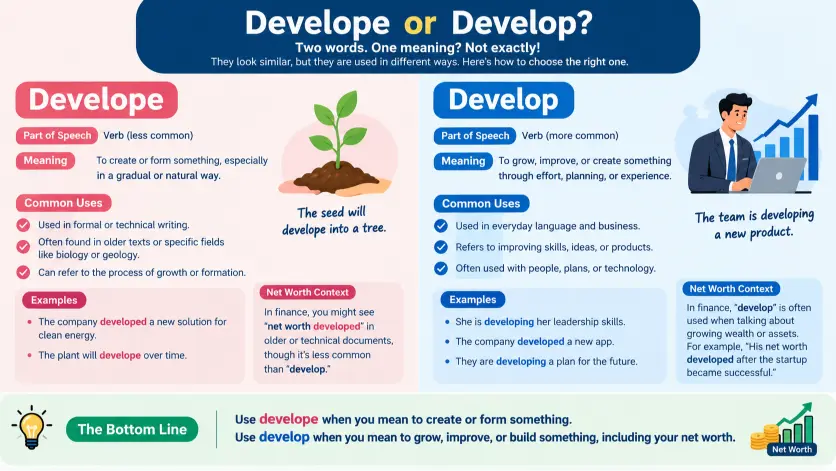
Confusing develope or develop is an easy mistake to make, especially when writing quickly or relying on how a word sounds. Although the two forms look almost identical, only one is the standard spelling in modern English. Knowing the correct form matters because a single extra letter can make otherwise polished writing appear careless or incorrect. Whether you are a student, professional, blogger, or everyday English user, understanding this distinction can help you communicate with greater confidence and accuracy.
The correct spelling is develop, which can mean to grow, improve, create, or bring something into existence. Develope is not the standard modern English spelling of this verb. The confusion often happens because many English verbs have endings that may visually suggest an additional letter. However, established spelling conventions determine which form is correct, and reputable dictionaries consistently recognize develop as the standard word.
In this guide, we will explore develope or develop in detail, including their meanings, correct usage, common mistakes, and practical examples. You will also learn a simple way to remember the correct spelling and understand why develop should be used in academic, professional, and everyday writing.
Develope or Develop: What Is the Correct Spelling?
When deciding between develope or develop, the answer is straightforward: develop is the standard English spelling, while develope is incorrect in modern standard English.
The confusion usually happens because many English verbs contain a final silent e, such as create, complete, and improve. Consequently, writers sometimes assume that develop follows the same pattern. However, the word ends with p, not pe, so adding an extra e produces an incorrect form.
The verb develop has several closely related meanings. It can describe gradual growth, the creation of something new, the improvement of an existing ability, or the progression of a situation.
For example:
The company plans to develop a new training program.
Here, develop means to create or produce something.
Likewise:
Children develop new skills as they gain experience.
In this sentence, develop refers to growth or progress.
Therefore, whenever you need the standard verb, choose develop. The spelling develope should not appear in formal, academic, professional, or carefully edited writing.
Develope or Develop: What’s the Difference?
The essential distinction is spelling and correctness. Develop is a standard English verb, whereas develope is a misspelling.
| Feature | Develop | Develope |
|---|---|---|
| Word status | Correct standard English | Incorrect spelling |
| Part of speech | Verb | Not a standard English word |
| Meaning | Grow, create, improve, or progress | No accepted standard meaning |
| Common context | Academic, workplace, technology, everyday writing | Usually a spelling mistake |
| Correct example | We need to develop a better plan. | We need to develope a better plan. |
| Recommended use | Yes | No |
The difference is therefore not a matter of British versus American English.
Instead, develop is accepted across major varieties of standard English. Whether you’re writing for a university, workplace, publication, or international audience, develop remains the appropriate spelling.
Mini Recap
Develop is the correct English verb.
Develope is a spelling error.
The two forms are not interchangeable.
Use develop whenever you mean to grow, create, improve, or advance something.
Is Develope or Develop a Grammar, Vocabulary, or Usage Issue?
Primarily, this is a spelling and usage issue, rather than a grammatical distinction between two legitimate words.
Grammar determines how a word functions within a sentence. In contrast, spelling determines how that word is correctly written. Since develope isn’t recognized as the standard spelling of the verb, the problem occurs before questions of grammatical function arise.
Furthermore, develop works naturally in many grammatical structures.
For example:
We develop new strategies every year.
She developed strong communication skills.
They are developing a training system.
The project will develop over several months.
Notice that the base form remains develop. Its grammatical forms include develops, developed, and developing.
The word is equally appropriate in formal and casual communication. You might see it in a university essay, a business proposal, a software specification, or an informal conversation.
For instance, an academic writer could say:
Researchers developed a method for measuring plant growth.
Meanwhile, a colleague might say:
We need to develop a better way to organize these files.
Thus, there is no situation in standard English where develope becomes an acceptable alternative simply because the setting is casual or informal.
How to Use Develop Correctly
Develop is an extremely flexible verb, which explains why it appears frequently in everyday communication and professional writing.
Its first major meaning is to grow or change gradually.
The neighborhood has developed rapidly over the past decade.
It can also mean to create or build something.
The engineers developed a new testing procedure.
Additionally, it can describe the improvement of a skill or quality.
She developed excellent leadership abilities during the project.
Because the verb covers several meanings, context determines the precise interpretation.
Workplace Example
Our department needs to develop a more efficient reporting process.
Here, develop means create or improve.
Academic Example
Students develop critical thinking skills through research and discussion.
In this context, the verb refers to gradual intellectual growth.
Technology Example
The company plans to develop a mobile application for customers.
Here, develop means design and create a technological product.
Usage Recap
Use develop when discussing growth, creation, improvement, progression, or production.
The word works naturally in professional, academic, technical, and conversational settings.
Most importantly, never add an unnecessary final e.
How Develop Changes in Different Sentences
Understanding related forms makes the spelling easier to remember.
The base form is develop.
The third person singular form is develops.
The past tense and past participle are developed.
The present participle is developing.
Consider these examples:
The organization develops educational materials.
The organization developed educational materials last year.
The organization is developing educational materials now.
The organization has developed several useful resources.
Therefore, the spelling changes according to grammatical form, but none of these forms becomes develope.
A useful memory technique is to connect develop with the noun development. Both words begin with develop.
develop
developed
developing
development
That pattern can make the correct spelling much easier to recall.
When You Should NOT Use Develope or Develop
Although develop is correct, it isn’t suitable for every sentence. Meaning matters just as much as spelling.
1. When You Mean a Finished Product
If your intended meaning is simply that something already exists, develop may not be the most precise choice.
Instead of:
The company will develop a finished application.
you might say:
The company will launch the finished application.
The issue here isn’t spelling. It is word choice.
2. When You Mean Simple Physical Movement
Develop does not normally mean move from one place to another.
Instead of:
The vehicle developed toward the entrance.
use a verb such as moved, traveled, or approached, depending on the intended meaning.
3. When You Mean Immediate Creation
Develop often suggests planning, progression, refinement, or growth. Consequently, create, make, or produce may be more precise when something is produced immediately.
4. When You Mean Discover
Develop and discover aren’t synonyms.
Scientists developed a new treatment.
means they created or refined it.
Scientists discovered a new phenomenon.
means they found something previously unknown.
5. When You Mean Purchase
Develop does not mean buy.
We need to develop new equipment.
means create or improve equipment.
We need to purchase new equipment.
means acquire it.
6. When You Mean Repair
Develop isn’t a replacement for repair.
The technician repaired the damaged device.
is different from:
The technician developed a new device.
7. When You Are Describing a Spelling Choice
Never treat develope as an alternative spelling of develop. Standard dictionaries and edited English use develop.
8. When You Are Writing Formal Material
A spelling error can undermine otherwise strong communication. Therefore, use develop in reports, applications, essays, documentation, presentations, and professional correspondence.
Common Mistakes and Decision Rules
| Correct sentence | Incorrect sentence | Explanation |
|---|---|---|
| We need to develop a strategy. | We need to develope a strategy. | Develop is the correct spelling. |
| She developed a useful skill. | She developeed a useful skill. | The past form is developed. |
| They are developing software. | They are developping software. | The correct form is developing. |
| The company develops products. | The company developes products. | The third person form is develops. |
| He wants to develop his writing. | He wants to develope his writing. | The base verb is develop. |
Decision Rule Box
If you mean growth, creation, improvement, or progression, use develop.
If you are considering develope as the spelling of that verb, do not use it.
A simple spelling check can prevent the error. Whenever you feel tempted to add a final e, remember the related noun development. The connection makes the correct form easier to recognize.
Develope or Develop in Modern Technology and Smart Tools
The word develop appears constantly in technical communication.
Software teams develop applications, organizations develop platforms, engineers develop devices, and researchers develop new methods. Because technology writing often uses the verb repeatedly, spelling accuracy becomes particularly important.
For example:
Developers are developing a secure payment system.
Here, developing is the correct present participle.
Another example is:
The team developed a faster data processing method.
The past form developed is also standard.
In product documentation, the word can describe both creation and improvement.
The company continues to develop its cloud platform.
Consequently, people working with software, engineering, research, education, and digital products should be especially familiar with the correct spelling.
The Origin and History of Develop
Develop has an interesting linguistic history.
The English verb developed through French and ultimately traces back to Latin roots associated with unfolding or revealing. The historical sense connects naturally with one of the modern meanings of the word: bringing something from an earlier state into a more advanced or visible form.
Over time, develop acquired broader meanings. Today, it can refer to physical growth, intellectual progress, business expansion, construction, planning, technological creation, and the gradual appearance of a situation.
That broad semantic range explains why develop is such a useful English verb.
An expert style observation captures the practical principle well:
“Good spelling preserves meaning before the reader has to interpret it.”
The point is simple. Correct spelling removes unnecessary friction, allowing readers to concentrate on the actual message.
Two Practical Case Studies
Case Study 1: Academic Writing
Consider a university student preparing a research report about communication skills.
The student repeatedly writes:
Students develope stronger communication abilities through group work.
Although the intended meaning is completely understandable, the spelling error appears several times. During editing, each occurrence is changed to:
Students develop stronger communication abilities through group work.
Suppose the document contains eight instances of the mistake. Correcting those eight occurrences removes a visible pattern of error and produces a substantially more polished final submission.
The lesson is straightforward: repeated spelling mistakes become more noticeable in formal writing, even when the underlying ideas are strong.
Case Study 2: Professional Documentation
Imagine a product team preparing internal documentation.
One sentence reads:
The platform will develope additional reporting features.
An editor changes it to:
The platform will develop additional reporting features.
Suppose the document is then reviewed by twelve employees across product, engineering, sales, and management teams. The corrected version prevents the same spelling error from being copied into related documents and presentations.
The broader lesson is that a small spelling correction can prevent an error from spreading across an entire communication system.
Error Prevention Checklist
Always use Develop when
You mean to grow or progress.
You mean to create something.
You mean to improve an ability.
You mean to build a product or system.
You mean to formulate a plan or strategy.
You mean that a situation is gradually changing.
You are writing academic or professional material.
Never use Develope when
You are trying to spell the standard verb.
You are writing an essay.
You are preparing workplace documentation.
You are describing software creation.
You are discussing personal skill growth.
You are editing formal communication.
You are writing content for a broad audience.
The easiest rule remains the strongest one: develop is correct, while develope is not.
Related Grammar Confusions You Should Master
Once you understand develop, several other spelling and vocabulary distinctions become easier to study.
- Developed or developt: Learn the correct past tense formation.
- Developing or developping: Understand why the spelling uses one p before ing.
- Advice or advise: Distinguish the noun from the verb.
- Practice or practise: Recognize the spelling difference between major English varieties.
- Affect or effect: Identify whether the word functions primarily as a verb or noun.
- Loose or lose: Avoid adding or removing letters that change the word entirely.
- Separate or seperate: Remember the correct vowel sequence.
- Occur or occurence: Apply the correct spelling when forming related nouns.
- Principal or principle: Separate a person or main item from a general rule.
- Then or than: Distinguish time and comparison.
Studying these pairs together builds stronger spelling awareness because many errors come from pronunciation, visual similarity, or assumptions about word formation.
Frequently Asked Questions
What is the correct spelling, develope or develop?
The correct spelling is develop. Develope is a misspelling and isn’t accepted as the standard form of the English verb.
Is develope a real English word?
Develope is not the standard modern English spelling of the verb meaning to grow, create, improve, or progress. In ordinary edited English, use develop instead.
Why do people spell develop as develope?
People often add the final e because many English verbs contain a silent e at the end. Words such as create and improve may influence this spelling assumption. However, develop does not follow that pattern.
How do you use develop in a sentence?
You can use develop when discussing growth, creation, improvement, or progression. For example: “The team plans to develop a new training program.”
What is the past tense of develop?
The past tense is developed. For example: “The researchers developed a new method.”
Is developed spelled with an extra e?
No. The correct spelling is developed. It comes directly from develop plus the regular past tense ending.
Is developing spelled with one or two p letters?
The standard spelling is developing, with one p. The word does not become developping.
Is develop used in academic writing?
Yes. Develop is common in academic writing when discussing theories, skills, methods, arguments, ideas, systems, or research findings.
What is the difference between develop and create?
Develop can mean create, but it often suggests a process of planning, growth, refinement, or improvement. Create can emphasize bringing something into existence without necessarily highlighting a gradual process.
How can I remember the correct spelling of develop?
Connect develop with development. Both begin with the same sequence of letters: develop. Remembering that relationship makes it easier to reject the incorrect form develope.
Conclusion: Develope or Develop?
When choosing between develope or develop, the correct answer is clear: develop is the standard English spelling.
It functions as a versatile verb describing growth, creation, improvement, and progression. Furthermore, it works naturally in academic writing, professional communication, technology, research, and everyday conversation.
The incorrect form develope usually appears because writers expect the word to behave like verbs ending with a silent e. However, that assumption doesn’t apply here.
Therefore, whenever you’re writing a sentence that requires this verb, choose develop. Once the spelling becomes familiar, the distinction becomes almost effortless. Correct spelling isn’t merely about appearance. Instead, it improves clarity, strengthens professional presentation, and helps readers focus on the ideas you’re communicating.









