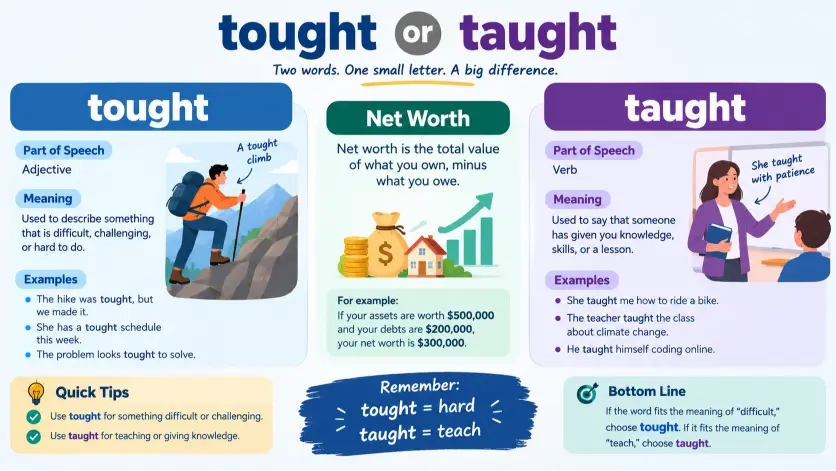
Have you ever written “tought” and wondered whether it was actually the correct spelling? You are not alone. Many English learners and even native speakers confuse tought or taught because both forms look similar and seem related to the verb “teach.” However, only one is a standard English word. Understanding the difference can help you avoid embarrassing spelling mistakes in school assignments, professional writing, emails, and everyday communication.
The correct spelling is taught, which is the past tense and past participle of the verb “teach.” For example, “My teacher taught me how to solve the problem.” The spelling “tought” is generally considered incorrect in standard modern English. This confusion often happens because English pronunciation does not always provide a reliable guide to spelling, especially with irregular verbs.
In this guide, we will examine tought or taught in detail, including their meanings, correct usage, grammar, pronunciation, and practical examples. The explanation is based on standard English usage and established grammatical rules, making it useful for students, writers, professionals, and anyone who wants to improve their English accuracy. By the end, you will know exactly when to use “taught” and why “tought” should be avoided.
Tought or Taught: What’s the Difference?
The confusion between tought or taught usually comes from pronunciation and memory rather than meaning. Both forms may appear similar when spoken quickly; however, only one belongs to standard English vocabulary.
Taught is a verb form. More specifically, it is the past tense and past participle of teach. Therefore, when someone gave instruction in the past, taught is normally the correct choice.
For example:
My teacher taught me how to write clearly.
Here, taught describes an action that happened previously.
By contrast, tought is not a standard English word. Consequently, it should not appear in formal writing, academic assignments, professional documents, or carefully edited online content.
| Form | Part of speech | Meaning | Standard English | Example |
|---|---|---|---|---|
| Taught | Verb | Gave instruction or knowledge | Yes | She taught mathematics. |
| Tought | Not a standard word | No established standard meaning | No | This spelling is incorrect. |
| Teach | Verb | Give instruction | Yes | They teach English. |
| Teaching | Verb or noun | Giving instruction | Yes | Teaching requires patience. |
Therefore, the central distinction is straightforward. Taught is the accepted form, whereas tought is a misspelling.
In addition, taught can describe instruction involving knowledge, behavior, skills, methods, or practical experience.
For instance, a parent may have taught a child to ride a bicycle. Likewise, a lecturer may have taught a complicated theory. Similarly, a supervisor may have taught a new employee how to operate workplace software.
Mini Recap
Taught is the correct past form of teach.
Tought is an incorrect spelling in standard English.
The two forms are not interchangeable.
Whenever you describe instruction that already happened, taught is normally the appropriate word.
Is Tought or Taught a Grammar, Vocabulary, or Usage Issue?
At first glance, the question appears to involve grammar. Nevertheless, the main problem is actually a combination of spelling, vocabulary, and verb usage.
The word teach follows an irregular verb pattern. Consequently, its past form isn’t created by simply adding a common past tense ending. Instead, teach becomes taught.
Consider the basic pattern:
Teach → taught → taught
The first form is the present form. The second is the past tense. The third is the past participle.
For example:
I teach English every Saturday.
I taught English last year.
I have taught English for several years.
Therefore, understanding the verb family makes the spelling easier to remember.
Are Taught and Tought Interchangeable?
No. They aren’t interchangeable in standard English.
Taught has a clear grammatical role and established meaning. Meanwhile, tought does not function as an accepted alternative spelling.
Consequently, replacing taught with tought can make a sentence look careless even when the intended meaning is obvious.
Formal Versus Casual Usage
Taught is suitable in virtually every variety of standard English. For example, it can appear in conversation, journalism, academic writing, business communication, and educational material.
Tought, however, should not be treated as an acceptable casual alternative. Although informal communication sometimes tolerates spelling shortcuts, an incorrect spelling can still create confusion or reduce credibility.
Academic Versus Casual Usage
In academic contexts, spelling accuracy matters because written work is evaluated for clarity and correctness. Therefore, students should always use taught.
Likewise, professionals should use taught in reports, presentations, applications, emails, training materials, and documentation.
Even in casual conversation, however, the standard spelling remains taught.
How to Use Tought or Taught Correctly
Once the underlying verb pattern becomes familiar, choosing the correct form becomes much easier. In practice, taught is used whenever the verb teach needs a past or past participle form.
The word can describe formal education, personal guidance, professional training, life lessons, practical skills, or learned behavior.
For example:
My father taught me how to cook.
The professor taught us about linguistics.
Our manager taught the team a new procedure.
In each sentence, instruction occurred or was completed.
Moreover, taught can appear with direct objects and with structures involving to.
She taught mathematics.
He taught me to drive.
They taught the children how to swim.
The meaning remains connected to instruction.
Workplace Example
A manager might say:
Sarah taught the new employees how to use the reporting system.
Here, taught identifies an earlier training activity.
Similarly:
My colleague taught me how to organize the monthly report.
The sentence works because the speaker received instruction in the past.
Academic Example
A student could write:
Professor Khan taught us how to evaluate historical sources.
This construction is appropriate because the professor provided instruction.
Likewise:
The lecturer taught the class several important research methods.
Again, taught functions as the past tense of teach.
Technology Example
Technology frequently involves instruction as well. For example:
The tutorial taught me how to configure the application.
Similarly:
The training course taught users how to protect their accounts.
In these examples, taught refers to knowledge delivered through digital resources.
Usage Recap
Use taught when describing instruction that happened previously.
Use teach for present or habitual instruction.
Use teaching when describing the activity or process.
Do not replace taught with tought.
How Taught Works in Different Sentence Structures
Understanding sentence patterns can reinforce correct spelling. First, taught commonly appears with a person who receives instruction.
She taught me French.
Here, she performs the action, while me receives the instruction.
Next, taught can appear with a subject, an indirect object, and a skill.
My uncle taught me photography.
Furthermore, it can appear with an infinitive construction.
My coach taught me to stay focused.
It can also appear with a question word.
The instructor taught us how to solve the problem.
Additionally, taught can describe lessons that are not strictly academic.
Experience taught him patience.
This example is particularly useful because no classroom is involved. Instead, experience itself is presented as the source of a lesson.
Likewise:
The mistake taught me an important lesson.
Thus, taught does not necessarily involve a teacher standing in front of a class. The verb can describe learning produced by people, experiences, circumstances, or educational resources.
When You Should NOT Use Tought or Taught
Although taught is the correct form, it should not be used in every situation involving learning. The tense and meaning still matter.
1. When the action happens now
Use teach, not taught, when describing a present or habitual activity.
Incorrect:
She taught English every Monday.
This sentence could be correct in a past context, but it is unsuitable if the person currently teaches every Monday.
Better:
She teaches English every Monday.
2. When referring to an ongoing activity
Use teaching when the activity itself is being described.
Teaching requires patience.
3. When describing a future lesson
Use an appropriate future construction.
The instructor will teach us tomorrow.
Using taught here would incorrectly place the action in the past.
4. When tought appears as an alternative spelling
Do not treat tought as a casual version of taught. It is not the accepted spelling.
5. When the sentence needs the base verb
After certain auxiliary verbs, use teach rather than taught.
She will teach the course.
Not:
She will taught the course.
6. When using a present perfect construction
Use taught after have, has, or had.
He has taught English for ten years.
7. When the intended meaning is learning rather than teaching
Teach and learn represent different perspectives.
The professor taught the students.
The students learned from the professor.
Consequently, selecting taught depends not only on time but also on who performs the educational action.
Common Mistakes and Decision Rules
The following examples highlight frequent errors.
| Correct sentence | Incorrect sentence | Explanation |
|---|---|---|
| She taught me French. | She tought me French. | Taught is the correct past form of teach. |
| He taught mathematics. | He tought mathematics. | Tought is not standard English. |
| They have taught here for years. | They have tought here for years. | The past participle is taught. |
| She will teach tomorrow. | She will taught tomorrow. | After will, use the base form teach. |
| He teaches science. | He taught science every day. | The correct form depends on whether the action is present or past. |
| The experience taught me patience. | The experience tought me patience. | The spelling remains taught. |
Decision Rule Box
If you mean the action in the past, use taught.
If you mean the present action, use teach or teaches.
A second useful rule is equally important:
If you mean instruction that has already happened, choose taught. If you mean instruction happening now or later, choose the appropriate present or future form of teach.
Why People Spell Taught as Tought
The mistake has a logical explanation. English spelling does not always follow pronunciation in a predictable way. As a result, learners may hear a sound that seems compatible with several possible spellings.
The pronunciation of taught can encourage learners to omit the a because the written form does not transparently reveal the historical relationship between teach and taught.
Furthermore, irregular verbs must often be learned as complete word families.
For example:
teach → taught
The change isn’t as visually predictable as regular forms such as:
walk → walked
Therefore, memorization and repeated exposure can help.
Another reason involves typing. People who frequently write quickly may produce tought because it resembles a plausible spelling. Spell checking can catch the error in many situations, but relying entirely on software isn’t ideal.
Instead, understanding the underlying verb provides a stronger solution.
Tought or Taught in Modern Technology
Digital communication has made spelling questions especially visible. Search boxes, messaging platforms, writing applications, educational software, and automated correction systems frequently process large quantities of text.
Consequently, users may encounter incorrect spellings such as tought in searches, comments, captions, or informal messages.
However, frequency does not make an incorrect spelling correct.
Modern writing tools can identify many spelling errors, yet context still matters. For example, a system may recognize that a sentence needs a past tense verb but the writer must understand why taught is appropriate.
Therefore, technology should support language knowledge rather than replace it.
When creating educational content, professional documents, or formal communication, writers should choose the established spelling themselves and then use digital tools as an additional checking layer.
The Etymology of Teach and Taught
The relationship between teach and taught is rooted in the long history of the English language.
Teach developed from older Germanic language forms associated with showing, instructing, guiding, and giving knowledge. Over centuries, English changed its vocabulary and verb patterns while retaining traces of older forms.
Taught emerged as the historical past form connected with teach. Therefore, its spelling cannot be predicted simply by looking at the modern pronunciation.
This history also explains why irregular verbs can seem unusual to contemporary learners. Their forms often preserve patterns that developed long before modern English spelling became standardized.
Consequently, treating taught as an irregular verb form is more useful than trying to construct its past tense mechanically.
Expert Style Explanation
In standard English, taught is best understood as the established irregular past form of teach, while tought represents a spelling error rather than an alternative verb form.
This distinction is simple, yet it has practical importance for anyone learning or using English.
Two Practical Case Studies
Case Study One: Academic Writing
Consider a university student writing:
My professor tought us how to analyze primary sources.
The meaning is immediately understandable. Nevertheless, the spelling error weakens the sentence because academic writing expects standard vocabulary and accurate grammar.
After correction:
My professor taught us how to analyze primary sources.
The revised sentence communicates exactly the same idea while following standard English conventions.
The concrete improvement is therefore accuracy. The sentence becomes suitable for an essay, research report, presentation, or examination response.
Case Study Two: Workplace Communication
Imagine an employee writing:
My supervisor tought me how to use the new software.
Again, readers can understand the intended meaning. However, workplace communication often contributes to a person’s professional impression.
The corrected sentence is:
My supervisor taught me how to use the new software.
Consequently, one spelling correction improves the professionalism of the message without changing its meaning.
These examples demonstrate why a seemingly small spelling issue can matter in real communication.
Error Prevention Checklist
A simple checklist can make this distinction almost automatic.
Always use taught when:
You are describing instruction that happened in the past.
You are using the past participle after have, has, or had.
You are describing a lesson learned from experience.
You are writing formal academic or professional material.
You are referring to the completed action of teaching.
Never use tought when:
You mean the past form of teach.
You are writing an essay or report.
You are preparing professional communication.
You are describing a completed lesson.
You are using a standard English sentence.
You are checking spelling for publication.
The easiest memory trick is to remember the complete pair:
teach → taught
Once this relationship becomes familiar, tought becomes much easier to identify as an error.
Related Grammar Confusions You Should Master
English contains many word pairs and verb forms that create similar problems. Learning related distinctions can strengthen overall language accuracy.
- Teach or learn: These describe opposite sides of an educational process.
- Learned or learnt: Both forms are accepted in different varieties of English.
- Advice or advise: One is primarily a noun, while the other is a verb.
- Practice or practise: The distinction depends partly on the variety of English being used.
- Affect or effect: Meaning and grammatical function determine the correct choice.
- Lay or lie: These verbs have different grammatical patterns and meanings.
- Passed or past: One commonly functions as a verb, while the other frequently expresses time or position.
- Than or then: Comparison and sequence determine which form belongs in a sentence.
- Their, there, or they’re: Pronunciation can make these forms confusing even though their functions differ.
- Your or you’re: Possession and contraction determine the appropriate form.
By mastering these distinctions together, writers can reduce recurring spelling and grammar errors.
Advanced FAQs
What is the correct spelling, tought or taught?
The correct spelling is taught. It is the past tense and past participle of teach. Tought is not a standard English spelling.
Is tought a real English word?
No, tought is not recognized as the standard past form of teach. In ordinary English writing, it should be replaced with taught.
Why do people spell taught as tought?
The mistake usually results from pronunciation, memory, or unfamiliarity with irregular verbs. Because the written form isn’t completely predictable from the sound, learners may create tought as a plausible spelling.
Is taught the past tense of teach?
Yes. Teach is the present form, while taught is both the past tense and the past participle.
For example:
I teach English.
I taught English yesterday.
I have taught English for years.
Can I use tought in informal writing?
It is better not to. Even in casual communication, taught remains the standard spelling. Informality does not turn an incorrect spelling into an accepted alternative.
What is the difference between teach and taught?
Teach is the base or present form, while taught is the past and past participle form.
Teachers teach students.
Teachers taught students yesterday.
Is taught used in American and British English?
Yes. Taught is standard in both major varieties of English. Unlike some spelling differences between American and British English, this particular form does not normally change between them.
How can I remember the spelling of taught?
Remember the verb family rather than the pronunciation alone:
teach → taught
Repeatedly seeing and using this pair makes the spelling easier to recall.
Is tought a typo for taught?
Usually, yes. In ordinary English, tought is best understood as a misspelling of taught rather than a separate word.
Final Answer
When choosing between tought or taught, use taught whenever you need the past tense or past participle of teach. Tought is not a standard English word, even though its spelling may appear logical because of pronunciation.
Therefore, remember the simplest rule:
Teach is the present form. Taught is the past form.
Once this verb pattern becomes familiar, the spelling becomes much easier to recognize. Moreover, applying the distinction consistently improves academic assignments, workplace communication, educational writing, and everyday messages.
Ultimately, correct usage depends on both spelling and grammatical context. If the action of giving instruction happened previously, taught is the appropriate choice. If the action is happening now, use teach or teaches. If it will happen later, use a suitable future construction such as will teach.
That small distinction is enough to eliminate one of the most common spelling mistakes associated with this irregular English verb.









