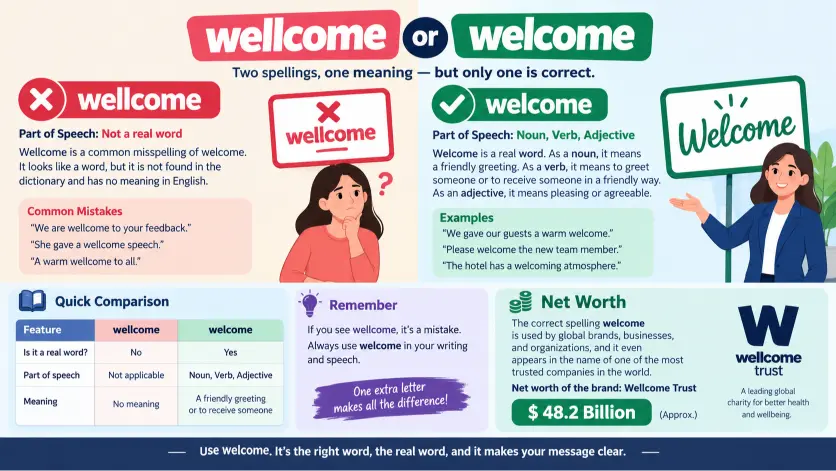
Have you ever typed wellcome or welcome and wondered which spelling is correct? This is a surprisingly common mistake because the word “welcome” can sound as though it should contain two Ls. Whether you are writing an email, creating a business sign, greeting a guest, or learning English, using the correct spelling makes your writing look more polished and professional. The confusion is understandable, especially for English learners who often rely on pronunciation when spelling unfamiliar words.
The correct spelling in standard modern English is welcome, with only one “l” after the “we.” It can function as a verb, adjective, noun, or interjection depending on the context. For example, you can say, “We welcome new customers,” or simply, “Welcome!”
Understanding why wellcome is incorrect can help you avoid repeating the mistake. This guide explains the meaning, correct spelling, pronunciation, grammatical uses, and common examples of “welcome.” It also shows how to remember the correct form so you can use it confidently in everyday, academic, and professional writing.
What’s the Difference?
The difference between wellcome and welcome is simple once you understand their status in standard English. Welcome is an established English word with several grammatical functions. It can describe a greeting, an act of receiving someone warmly, a favorable reception, or something that is gladly accepted.
On the other hand, wellcome is normally an incorrect spelling when someone intends to write the standard word. The additional letter can make the form look plausible, especially because English contains many words with repeated consonants. Nevertheless, standard spelling does not require the second letter in this case.
What Does Welcome Mean?
Welcome has several meanings depending on how it appears in a sentence.
As a verb, it means to receive someone gladly.
Example:
“We welcome visitors throughout the year.”
As an adjective, it means gladly received or appreciated.
Example:
“Your suggestions are always welcome.”
As a noun, it refers to a greeting or friendly reception.
Example:
“The new students received a warm welcome.”
As an interjection, it expresses a greeting.
Example:
“Welcome to our school!”
Therefore, one spelling can perform several grammatical jobs.
What Does Wellcome Mean?
In ordinary contemporary English, wellcome is not the standard spelling of the word described above. When a writer types this form in a sentence such as “Wellcome to our website,” the intended word is almost certainly welcome.
Consequently, the safest approach is straightforward. Whenever you mean the familiar greeting, reception, or act of receiving someone gladly, write welcome.
| Form | Part of Speech | Meaning | Standard Usage |
|---|---|---|---|
| Welcome | Verb | To receive gladly | Correct |
| Welcome | Noun | A friendly reception | Correct |
| Welcome | Adjective | Gladly accepted | Correct |
| Welcome | Interjection | A friendly greeting | Correct |
| Wellcome | Not standard for this meaning | Usually a spelling error | Incorrect in ordinary usage |
Quick Recap
Welcome is the standard English spelling.
It can function as a noun, verb, adjective, or interjection.
Wellcome is generally a spelling mistake when used for these meanings.
Therefore, standard writing should use welcome.
Is Wellcome or Welcome a Grammar, Vocabulary, or Usage Issue?
The question is primarily a spelling and usage issue, rather than a grammatical disagreement.
Grammar determines how words function within sentences. In this case, however, the main concern is whether the word itself has been spelled correctly. Once the correct form has been identified, grammar determines whether welcome acts as a noun, verb, adjective, or interjection.
Are Wellcome and Welcome Interchangeable?
No. They should not normally be treated as interchangeable forms.
For example:
“Welcome to the meeting.”
This is correct.
“We welcome your feedback.”
This is also correct.
“Your feedback is welcome.”
Again, the spelling remains the same.
Replacing welcome with wellcome does not create a different grammatical meaning. Instead, it introduces a spelling error.
Formal Versus Informal Usage
Correct spelling matters in both formal and informal writing. However, mistakes become especially noticeable in professional communication.
For instance, a typo in a private text message may be understood immediately. Nevertheless, the same mistake on a company website, official invitation, business letter, or public sign can affect the perceived quality of the communication.
Therefore, using welcome consistently is the better choice in every setting.
Academic Versus Casual Usage
Academic writing requires precision. Students should consequently use welcome in essays, reports, presentations, examinations, and research assignments.
Casual writing may tolerate occasional spelling errors. Even so, learning the correct form helps prevent the same mistake from appearing repeatedly.
Practical Usage of Welcome
Since wellcome is normally an incorrect spelling, practical usage focuses on the correct form, welcome.
Workplace Example
Imagine that a company has hired a new employee. A manager might write:
“Please welcome Daniel to our team.”
Here, welcome functions as a verb because it describes the action of receiving Daniel positively.
Now consider another sentence:
“Your ideas are always welcome.”
In this example, welcome functions as an adjective. It describes the ideas as gladly accepted.
Thus, the same word can appear naturally in different professional situations.
Academic Example
A professor might begin a course by saying:
“Welcome to the first class of the semester.”
A university department could also write:
“Questions from students are always welcome.”
The first example uses welcome as a greeting. The second describes something that is gladly accepted.
Technology Example
Technology has made the word welcome especially common. Websites and applications frequently display phrases such as:
“Welcome to your account.”
“Welcome back.”
“Welcome to the learning platform.”
These messages often appear immediately after registration or login. Because they can be displayed to thousands of users, correct spelling is essential.
Usage Recap
Use welcome when greeting someone.
Use welcome when describing something as appreciated.
Use welcome when referring to a friendly reception.
Use welcome in digital interfaces and professional communication.
Avoid replacing it with wellcome.
Practical Examples of Welcome in Everyday English
Understanding examples makes the spelling rule easier to remember.
Consider the sentence:
“Welcome home.”
Here, the word expresses a warm greeting.
Now consider:
“We welcome new members.”
Here, it describes an action.
Another example is:
“Your assistance would be welcome.”
In this sentence, the word means appreciated or gladly received.
Finally:
“They gave her a warm welcome.”
Here, welcome functions as a noun.
Although the grammatical roles differ, the spelling never changes to wellcome.
This consistency is one of the easiest ways to remember the distinction.
When You Should NOT Use Wellcome or Welcome
Although welcome is extremely useful, context still determines whether it belongs in a sentence. More importantly, wellcome should not be substituted for it.
1. Do Not Write Wellcome as a Greeting
Incorrect:
“Welcome to our store.”
The sentence should use welcome, not wellcome.
2. Do Not Use Wellcome in Professional Emails
A business email may begin with:
“Welcome to the company.”
Adding an extra letter makes the message look unpolished.
3. Do Not Use Wellcome in Academic Assignments
Academic writing depends on careful word choice and accurate spelling. Therefore, students should always use welcome.
4. Do Not Use Wellcome on Signs
Public signs often contain short messages such as:
“Welcome to our community.”
Because these words are highly visible, a spelling error can be especially noticeable.
5. Do Not Assume It Is a Regional Variant
Some English words genuinely have different British and American spellings. Wellcome is not normally one of those differences.
6. Do Not Copy the Error From Other Sources
Seeing wellcome online does not make the spelling correct. Websites, comments, messages, and user generated content can all contain mistakes.
7. Do Not Depend Entirely on Pronunciation
English spelling cannot always be predicted perfectly from pronunciation. Therefore, hearing the word should not encourage you to add an unnecessary letter.
8. Do Not Confuse Familiar Appearance With Correctness
Because wellcome looks similar to welcome, it can seem reasonable at first glance. However, standard usage establishes welcome as the correct form.
Common Mistakes and Decision Rules
The following examples highlight frequent errors.
| Correct Sentence | Incorrect Sentence | Explanation |
|---|---|---|
| Welcome to our office. | Wellcome to our office. | Welcome is the standard spelling. |
| We welcome your suggestions. | We wellcome your suggestions. | Welcome is the correct verb. |
| Your feedback is welcome. | Your feedback is wellcome. | Welcome is the correct adjective. |
| She received a warm welcome. | She received a warm wellcome. | Welcome is the correct noun. |
| Welcome back to class. | Wellcome back to class. | Welcome is the standard greeting. |
| Everyone is welcome here. | Everyone is wellcome here. | Welcome is the correct adjective. |
Decision Rule
If you mean a greeting, a friendly reception, or something gladly accepted, use “welcome.”
If you have written “wellcome” for the ordinary English word, change it to “welcome.”
This rule covers the overwhelming majority of situations in which writers encounter the two forms.
Why Is Wellcome Such an Easy Spelling Mistake?
There are several reasons why people occasionally write wellcome.
First, English contains many familiar words that use doubled consonants. Consequently, writers may assume that another letter belongs in the middle of welcome.
Second, typing quickly can produce accidental repetitions. A person may press the same key twice without noticing.
Third, visual memory can sometimes be unreliable. When a word is familiar, people often recognize its general shape instead of examining every letter.
Finally, spelling mistakes can become self reinforcing. If someone has repeatedly seen an incorrect form, that version may begin to look familiar.
Nevertheless, familiarity does not determine correctness. Standard spelling does.
Wellcome or Welcome in Modern Technology and Smart Tools
The word welcome appears frequently in modern digital experiences.
When users create an account, they may see:
“Welcome to your new profile.”
When they return to an application, they might see:
“Welcome back.”
Online education platforms may display:
“Welcome to the course.”
Customer service systems can also use:
“Welcome. How can we help you?”
Because these messages are often repeated automatically, a spelling mistake can spread across many screens.
Spelling assistants can sometimes identify wellcome as an unusual form. However, understanding the rule remains useful because automated suggestions are not always perfect.
For writers, editors, designers, and developers, the best approach is to review interface text before publication. A short greeting may contain only one word, yet that word can shape the user’s first impression.
Etymology of Welcome
The history of welcome stretches back to Old English. Its development is associated with ideas involving being pleasing, desirable, or received favorably.
Over centuries, the expression evolved into the modern English word associated with hospitality and friendly reception.
This historical background also explains why the spelling should not be reconstructed according to modern assumptions about repeated letters. English spelling contains many forms that reflect long linguistic development rather than simple pronunciation rules.
Consequently, welcome should be learned as an established vocabulary item.
An Expert Style Explanation
“When two spellings look almost identical, writers should first determine whether both forms belong to standard usage before treating them as alternatives.”
That principle is particularly useful here. The visual similarity between wellcome and welcome does not mean that they represent two accepted spellings.
Case Study One: A Business Invitation
Consider a company preparing invitations for an annual conference.
The intended opening message is:
“Welcome to our annual business conference.”
During design, an employee accidentally enters wellcome.
Although the audience would probably understand the message, the error could make the organization appear less attentive to detail.
After proofreading, the spelling is corrected to welcome.
The concrete result is a cleaner invitation and a more professional presentation. Nothing about the message’s meaning changes. The correction simply restores the standard form.
Case Study Two: A Website Registration Message
Imagine an online service that displays a message after a visitor creates an account.
The intended message is:
“Welcome to your personal dashboard.”
Suppose the interface contains the incorrect spelling wellcome. A content review identifies the problem before the page is released.
The wording is corrected to:
“Welcome to your personal dashboard.”
The concrete result is consistency between the site’s interface language and standard written English.
This example also demonstrates why even very short pieces of text deserve proofreading. A two word greeting can still influence a user’s impression of a website.
Error Prevention Checklist
Always Use Welcome When
✓ Greeting a person
✓ Greeting a group
✓ Describing something as gladly accepted
✓ Referring to a friendly reception
✓ Writing business communication
✓ Preparing academic material
✓ Creating website messages
✓ Writing invitations
✓ Producing public notices
Never Use Wellcome When
✓ You mean the ordinary English greeting
✓ You are writing an academic assignment
✓ You are preparing a professional email
✓ You are creating a website interface
✓ You are designing public signage
✓ You are describing something as gladly accepted
✓ You are referring to a friendly reception
Related Grammar Confusions You Should Master
Learning welcome also provides a useful opportunity to study other frequently confused English forms.
Your or You’re
Your indicates possession, while you’re means “you are.”
Their or There or They’re
These three forms have different grammatical functions even though they can sound similar.
Its or It’s
Its commonly expresses possession, while it’s is a contraction of “it is” or “it has.”
Then or Than
Then commonly relates to time or sequence, whereas than is generally used in comparisons.
Affect or Effect
These forms often differ in grammatical function and meaning, although their usage can vary depending on context.
Advice or Advise
Advice is generally a noun, while advise is a verb.
Accept or Except
Accept generally means to receive or agree to something, while except commonly indicates exclusion.
Principal or Principle
Principal can refer to a person or something primary, whereas principle generally refers to a rule, belief, or fundamental idea.
Compliment or Complement
A compliment is an expression of praise, while a complement is something that completes or enhances another thing.
Practice or Practise
The distinction depends partly on the variety of English being used, making this pair especially useful for advanced learners.
Advanced FAQs
Is wellcome or welcome correct?
Welcome is correct when you mean the ordinary English word associated with greeting, receiving someone warmly, or describing something as gladly accepted. Wellcome is generally an incorrect spelling in this context.
Why is wellcome incorrect?
The standard spelling of the everyday word is welcome. The additional letter in wellcome is not required and generally represents a spelling mistake.
Is wellcome a real English word?
In ordinary contemporary English, wellcome is not the standard spelling of the familiar word meaning greeting or friendly reception. Therefore, writers should normally choose welcome.
What does welcome mean?
Welcome can mean to receive someone gladly, to describe something as gladly accepted, or to refer to a friendly greeting or reception.
Is welcome a noun or verb?
It can be either. In “We welcome visitors,” it is a verb. In “They received a warm welcome,” it is a noun. It can also act as an adjective or interjection.
How do you spell welcome correctly?
The standard spelling is welcome, with one letter l after the initial we. The form wellcome contains an unnecessary additional letter.
Is wellcome accepted in British English?
No, not as the ordinary alternative spelling of welcome. British English uses welcome in the standard word.
Is wellcome accepted in American English?
No. American English also uses welcome as the standard spelling for the familiar word.
How can I remember welcome spelling?
Think of the common expressions welcome home, welcome back, and welcome here. Each uses the same spelling: welcome.
Conclusion:
The answer to wellcome or welcome is clear. Welcome is the standard spelling used throughout ordinary English. It can function as a noun, verb, adjective, or interjection, making it one of the most flexible words associated with greetings and hospitality.
Meanwhile, wellcome is generally an incorrect spelling when someone intends to use the everyday English word. Therefore, it should not replace welcome in academic assignments, professional correspondence, invitations, public signs, websites, or digital interfaces.
Ultimately, the easiest rule is also the most useful one: whenever you mean a greeting, friendly reception, or something gladly accepted, choose welcome. Once this spelling becomes familiar, the confusion disappears.









