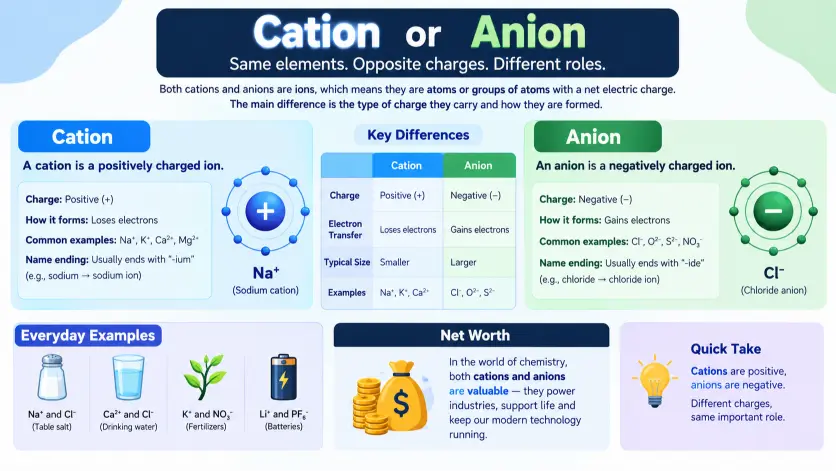
Understanding whether an ion is a cation or anion is one of the most important foundations in chemistry. At first, the two terms can seem confusing because both describe charged atoms or groups of atoms. The key is to understand what happens to electrons. A cation carries a positive charge because it has lost one or more electrons, while an anion carries a negative charge because it has gained electrons. Once this basic principle is clear, identifying ions becomes much easier. Whether you are studying chemistry for school, preparing for an exam, or reviewing fundamental science concepts, knowing the difference between cations and anions helps you understand ionic compounds, chemical reactions, and electrical behavior.
The distinction between a cation and an anion is based on electron transfer and electrical charge, not simply on the element involved. Metals commonly form cations by losing electrons, while many nonmetals form anions by gaining electrons. For example, sodium becomes Na⁺ after losing an electron, whereas chlorine becomes Cl⁻ after gaining one. These charged particles then interact through electrostatic attraction, producing familiar ionic compounds such as sodium chloride. Learning to recognize these patterns gives students a practical way to predict ion charges and understand why different elements combine in specific ways.
A reliable understanding of cation or anion also prevents several common chemistry mistakes. Students sometimes confuse positive and negative charges or try to memorize individual examples without understanding the underlying rule. A stronger approach is to connect the charge to electron movement and then apply that principle to real chemical formulas and reactions. In this guide, you will learn what cations and anions are, how they differ, how to identify them, which elements commonly form each type, and how their charges affect ionic compounds. With clear definitions, examples, and easy memory techniques, the difference becomes much more straightforward.
Cation or Anion: What Is the Difference?
To understand the difference clearly, first remember that both cations and anions are ions. An ion is an atom or group of atoms that carries an electrical charge because its number of protons and electrons is no longer equal.
However, the two terms describe opposite types of charge.
A cation is a positively charged ion. Generally, it forms when an atom loses one or more electrons. Since electrons have a negative charge, losing them leaves the particle with a greater positive charge.
An anion, on the other hand, is a negatively charged ion. Usually, it forms when an atom gains one or more electrons. Consequently, the additional electrons give the particle a negative charge.
Consider sodium and chlorine. A neutral sodium atom contains eleven protons and eleven electrons. When it loses one electron, it becomes Na⁺. Therefore, sodium ion is a cation.
Chlorine behaves differently. A neutral chlorine atom has seventeen protons and seventeen electrons. When it gains one electron, it becomes Cl⁻. Thus, chloride ion is an anion.
These two ions can then combine to form sodium chloride, commonly represented as NaCl.
| Feature | Cation | Anion |
|---|---|---|
| Meaning | Positively charged ion | Negatively charged ion |
| Charge | Positive | Negative |
| Electron change | Usually loses electrons | Usually gains electrons |
| Example | Na⁺ | Cl⁻ |
| Another example | Ca²⁺ | O²⁻ |
| Commonly formed by | Metals | Nonmetals |
| Electrical behavior | Moves toward a negative electrode in suitable electrochemical systems | Moves toward a positive electrode in suitable electrochemical systems |
In simple terms, a cation is positive and an anion is negative.
Therefore, the two words should never be treated as interchangeable.
Whenever you’re uncertain, check the charge shown beside the chemical symbol. A plus sign indicates a cation, whereas a minus sign indicates an anion.
Is Cation or Anion a Grammar, Vocabulary, or Usage Issue?
The difference between cation and anion is primarily a matter of scientific vocabulary and correct usage rather than ordinary grammar.
Both words function as nouns. However, they refer to different chemical categories. Consequently, substituting one for the other changes the scientific meaning of a sentence.
For example, the sentence “Sodium ion is a cation” is scientifically correct when referring to Na⁺. However, saying “Sodium ion is an anion” would be incorrect because Na⁺ has a positive charge.
Likewise, chloride ion is an anion because Cl⁻ carries a negative charge.
In academic writing, laboratory reports, scientific textbooks, and examination answers, this distinction is especially important. A small terminology mistake can make an otherwise accurate explanation scientifically incorrect.
In casual conversation, people may use the broader word “ion” when the charge isn’t relevant. Nevertheless, when the exact electrical behavior matters, the more specific term should be selected.
Therefore, cation and anion are not alternative spellings, informal versus formal versions, or interchangeable vocabulary choices. They identify opposite electrical categories.
Cation: Meaning, Formation, and Practical Usage
A cation is an ion with a positive electrical charge.
Generally, a cation forms when an atom loses electrons. Since protons remain in the nucleus while electrons move outside the nucleus, removing negative electrons changes the balance between positive and negative charges.
For example, sodium has eleven protons and eleven electrons when it is neutral. If one electron leaves, eleven positive protons remain against ten negative electrons. The result is Na⁺.
Calcium provides another useful example. A neutral calcium atom can lose two electrons and become Ca²⁺. Therefore, calcium ion has a positive two charge.
Workplace Example
In a chemistry laboratory, a technician may analyze a sample containing calcium ions. Because Ca²⁺ carries a positive charge, it is classified as a cation.
Similarly, water testing may involve identifying positively charged species such as sodium, potassium, calcium, or magnesium.
Academic Example
A chemistry examination may present several formulas and ask students to identify the cations. For instance, Na⁺, K⁺, Mg²⁺, and Al³⁺ are all cations because each carries a positive charge.
Therefore, students don’t need to memorize every classification separately. Instead, they can inspect the charge.
Technology Example
Cations also play an important role in electrochemical technology. Battery systems involve movement and interaction of charged particles during charging and discharging.
For example, lithium ions can move through an electrolyte inside certain rechargeable battery systems. Therefore, understanding positive ions helps explain fundamental battery behavior.
Usage Recap
Use cation when referring to a positively charged ion.
Moreover, remember that positive charge commonly results from electron loss.
Consequently, Na⁺, K⁺, Ca²⁺, Mg²⁺, and Al³⁺ are familiar examples of cations.
Anion: Meaning, Formation, and Practical Usage
An anion is an ion with a negative electrical charge.
Usually, an anion forms when an atom gains one or more electrons. Because electrons carry negative charge, adding them causes the resulting particle to become negatively charged.
Chlorine provides one of the easiest examples. A neutral chlorine atom has seventeen protons and seventeen electrons. When it gains one electron, it has seventeen protons and eighteen electrons. Therefore, it becomes Cl⁻.
Oxygen can gain two electrons and become O²⁻. Consequently, oxide ion is an anion.
Anions can also consist of groups of atoms. For example, nitrate is NO₃⁻, while sulfate is SO₄²⁻. Both are negatively charged polyatomic ions.
Workplace Example
Environmental laboratories frequently examine anions such as chloride, nitrate, sulfate, and phosphate. These substances can provide useful information about water composition and other samples.
Therefore, recognizing anions is important when interpreting chemical test results.
Academic Example
A student may encounter formulas such as Cl⁻, O²⁻, NO₃⁻, and SO₄²⁻ during chemistry lessons. Since all of these carry negative charges, each belongs to the anion category.
Technology Example
Anions also participate in electrochemical systems and ionic transport. Their movement can contribute to chemical and electrical processes within various devices.
Consequently, understanding negative ions is useful when studying batteries, sensors, electrolytes, and related technologies.
Usage Recap
Use anion whenever an ion carries a negative charge.
Furthermore, electron gain commonly produces this negative state.
Therefore, chloride, oxide, nitrate, sulfate, and phosphate are familiar examples.
When You Should Not Use Cation or Anion
Knowing when not to use a term is just as important as knowing its definition.
1. Don’t use cation for every ion
The word ion is a general term. Therefore, use cation only when the particle is positively charged.
2. Don’t call chloride a cation
Chloride is represented by Cl⁻. Since its charge is negative, it is an anion.
3. Don’t call sodium ion an anion
Sodium commonly forms Na⁺. Therefore, sodium ion is a cation.
4. Don’t confuse a neutral atom with an ion
A neutral atom has equal numbers of protons and electrons. Consequently, it doesn’t qualify as either a cation or anion.
5. Don’t guess the charge from the element alone
Some elements can form ions with different charges. Iron, for instance, can form Fe²⁺ and Fe³⁺. Therefore, the actual species should be examined.
6. Don’t assume every metal has one fixed charge
Although metals frequently form cations, their charges aren’t always identical. Consequently, chemical context remains important.
7. Don’t use anion simply because a substance contains a nonmetal
A neutral nonmetal atom isn’t automatically an anion. It becomes an anion only after gaining electrons and acquiring a negative charge.
8. Don’t use cation and anion as synonyms
Both words describe ions, but their charges are opposite.
Common Mistakes and Decision Rules
Several errors appear repeatedly when learners first study ionic chemistry. Fortunately, most can be prevented by checking the charge.
| Correct sentence | Incorrect sentence | Explanation |
|---|---|---|
| Na⁺ is a cation. | Na⁺ is an anion. | The positive sign identifies Na⁺ as a cation. |
| Cl⁻ is an anion. | Cl⁻ is a cation. | The negative sign identifies Cl⁻ as an anion. |
| Ca²⁺ is a cation. | Ca²⁺ is an anion. | Calcium ion has a positive two charge. |
| O²⁻ is an anion. | O²⁻ is a cation. | Oxide ion has a negative two charge. |
| K⁺ is a cation. | K⁺ is an anion. | Potassium ion has a positive charge. |
| SO₄²⁻ is an anion. | SO₄²⁻ is a cation. | Sulfate carries a negative two charge. |
| NO₃⁻ is an anion. | NO₃⁻ is a cation. | Nitrate carries a negative one charge. |
Decision Rule
If you mean a positively charged ion, use cation.
If you mean a negatively charged ion, use anion.
This rule works for both single atom ions and polyatomic ions.
For instance, Mg²⁺ is a cation because its charge is positive. Meanwhile, CO₃²⁻ is an anion because its charge is negative.
Therefore, looking at the charge is usually more reliable than trying to remember a long list of examples.
Cation or Anion in Modern Technology and Scientific Tools
Charged particles are important in many modern technologies. Batteries, electrochemical sensors, laboratory instruments, water treatment systems, and numerous industrial processes depend on controlled ionic behavior.
For example, rechargeable batteries involve ions moving through an electrolyte as the device operates. Consequently, both positively and negatively charged species can contribute to the overall electrochemical process.
Scientific software can also represent ionic structures, calculate molecular properties, and visualize charge distributions. Nevertheless, the fundamental terminology remains the same.
A positively charged ion is a cation.
A negatively charged ion is an anion.
Therefore, technological advances haven’t changed the basic definitions. Instead, they have expanded the number of situations in which understanding those definitions is useful.
Why Cations and Anions Matter in Chemistry
The distinction between these two ion types provides a foundation for understanding ionic compounds.
Opposite charges attract. Therefore, positively charged cations can interact strongly with negatively charged anions.
Sodium chloride demonstrates this principle clearly. Na⁺ has a positive one charge, while Cl⁻ has a negative one charge. Consequently, their charges balance when they combine in a one to one ratio.
Calcium chloride provides another example. Calcium forms Ca²⁺, whereas chloride forms Cl⁻. Therefore, two chloride ions are needed to balance one calcium ion.
This principle also helps explain why chemical formulas have particular ratios.
Furthermore, ions are important in biological systems. Sodium, potassium, calcium, chloride, and other charged species participate in numerous cellular and physiological processes.
Consequently, understanding ionic charge is useful far beyond introductory chemistry.
Cation and Anion Etymology
The terms cation and anion have historical roots in nineteenth century electrochemistry.
Their names are connected with Greek language concepts describing movement. These terms were introduced to describe the behavior of charged substances in electrochemical systems.
Over time, the words became standard scientific terminology.
Today, however, students generally learn them through their electrical charges rather than their historical meanings.
Therefore, although etymology can provide interesting background, the most practical memory rule remains straightforward: cations are positive and anions are negative.
An Expert Explanation of Cation and Anion
A useful scientific approach is to identify the charge before identifying the category.
When a chemical symbol contains a positive charge, classify the species as a cation. When the formula contains a negative charge, classify it as an anion.
This method is particularly helpful with polyatomic ions because their names may not immediately reveal their electrical properties.
For example, sulfate may be unfamiliar to a beginner. However, once its formula SO₄²⁻ is recognized, its classification becomes obvious.
Therefore, charge provides a dependable decision point.
Case Study One: Sodium Chloride
Sodium chloride is one of the clearest examples of cation and anion behavior.
A sodium atom can lose one electron and become Na⁺. Therefore, sodium ion functions as the cation.
A chlorine atom can gain one electron and become Cl⁻. Consequently, chloride ion functions as the anion.
When these ions combine, their opposite charges balance.
One Na⁺ carries a positive one charge.
One Cl⁻ carries a negative one charge.
Together, they produce an electrically neutral combination represented by NaCl.
Therefore, understanding the individual charges immediately explains the formula.
Case Study Two: Calcium Chloride
Calcium chloride demonstrates why charge must be considered when interpreting chemical formulas.
Calcium can lose two electrons and form Ca²⁺. Thus, calcium is the cation in this compound.
Chlorine can gain one electron and form Cl⁻. Therefore, chloride is the anion.
Because calcium carries a positive two charge, one chloride ion isn’t enough to balance it.
Instead, two Cl⁻ ions are required.
The overall relationship can therefore be represented as one Ca²⁺ combined with two Cl⁻ ions.
As a result, the formula is CaCl₂.
This example shows how identifying cations and anions can help explain chemical formulas rather than simply memorizing them.
Error Prevention Checklist
Always use cation when
The ion has a positive charge.
The particle has lost electrons compared with its neutral form.
The formula contains a positive charge such as +1, +2, or +3.
You are discussing species such as Na⁺, K⁺, Ca²⁺, Mg²⁺, or Al³⁺.
Always use anion when
The ion has a negative charge.
The particle has gained electrons compared with its neutral form.
The formula contains a negative charge such as −1, −2, or −3.
You are discussing species such as Cl⁻, O²⁻, NO₃⁻, or SO₄²⁻.
Never use cation when
The ion is negatively charged.
Never use anion when
The ion is positively charged.
Ultimately, checking the superscript charge is the safest method.
Related Grammar Confusions You Should Master
Although cation and anion aren’t grammar alternatives, learners studying scientific English often encounter other terminology pairs that can cause confusion.
Ion or Atom
An atom is electrically neutral when its positive and negative charges balance. An ion has an overall charge.
Element or Compound
An element contains one type of chemical element, whereas a compound contains different elements chemically combined.
Molecule or Ion
A molecule is generally an electrically neutral group of atoms, while an ion has an overall charge.
Solute or Solvent
The solute is dissolved within a solution, whereas the solvent is the substance that performs the dissolving.
Oxidation or Reduction
Oxidation generally involves electron loss, while reduction generally involves electron gain.
Acid or Base
Acids and bases represent different categories of chemical behavior and should not be treated as interchangeable terms.
Anode or Cathode
These words refer to electrodes and their roles in electrochemical systems. They shouldn’t be confused with anion and cation.
Valence or Oxidation State
These concepts are related to chemical bonding and charge, but they don’t always mean exactly the same thing.
Electrolyte or Nonelectrolyte
An electrolyte produces mobile ions under suitable conditions, whereas a nonelectrolyte generally doesn’t produce significant ionic conductivity in solution.
Ionic or Covalent
Ionic bonding involves electrostatic attraction between charged species, whereas covalent bonding involves sharing electrons between atoms.
Frequently Asked Questions
What is the difference between a cation and an anion?
A cation is positively charged, whereas an anion is negatively charged. Generally, a cation forms after electron loss, while an anion commonly forms after electron gain. Therefore, checking the charge is the easiest way to distinguish the two.
Is Na⁺ a cation or anion?
Na⁺ is a cation because it carries a positive one charge. Sodium commonly loses one electron to reach this charged state. Consequently, Na⁺ belongs to the cation category.
Is Cl⁻ a cation or anion?
Cl⁻ is an anion because it carries a negative one charge. Chlorine gains one electron when forming chloride. Therefore, chloride belongs to the anion category.
Does a cation gain or lose electrons?
A cation generally forms when an atom loses one or more electrons. Since electrons carry negative charge, losing them causes the resulting species to become positively charged.
Does an anion gain or lose electrons?
An anion generally forms when an atom gains one or more electrons. Consequently, the additional negative charge makes the resulting species negatively charged.
Are cations positive or negative?
Cations are positive. Therefore, any ion carrying an overall positive charge is classified as a cation.
Are anions positive or negative?
Anions are negative. Consequently, any ion carrying an overall negative charge is classified as an anion.
Why are cations and anions important?
They help explain ionic compounds, chemical formulas, electrical conductivity, electrochemical reactions, and many biological processes. Therefore, learning this distinction provides an important foundation for further chemistry study.
How can I remember cation versus anion?
The easiest method is to associate cation with positive charge and anion with negative charge. Additionally, look at the charge written beside the chemical symbol whenever you’re unsure.
Can one element form both cations and anions?
In some chemical circumstances, different species involving the same element can have different charge states. Therefore, classification should be based on the actual ion being discussed rather than only the element’s name.
Conclusion:
The difference between a cation and an anion is ultimately based on electrical charge.
A cation has a positive charge, while an anion has a negative charge. Generally, cations form through electron loss, whereas anions commonly form through electron gain.
Therefore, whenever you encounter an unfamiliar ion, begin by checking its charge.
If the charge is positive, it is a cation.
If the charge is negative, it is an anion.
This simple approach works with common ions such as Na⁺, K⁺, Ca²⁺, Cl⁻, O²⁻, NO₃⁻, and SO₄²⁻. Furthermore, it helps when interpreting ionic compounds, laboratory results, chemical equations, and electrochemical processes.
Consequently, there is no need to treat the distinction as complicated. Once the relationship between electrons and charge becomes clear, choosing between cation and anion becomes much easier.









