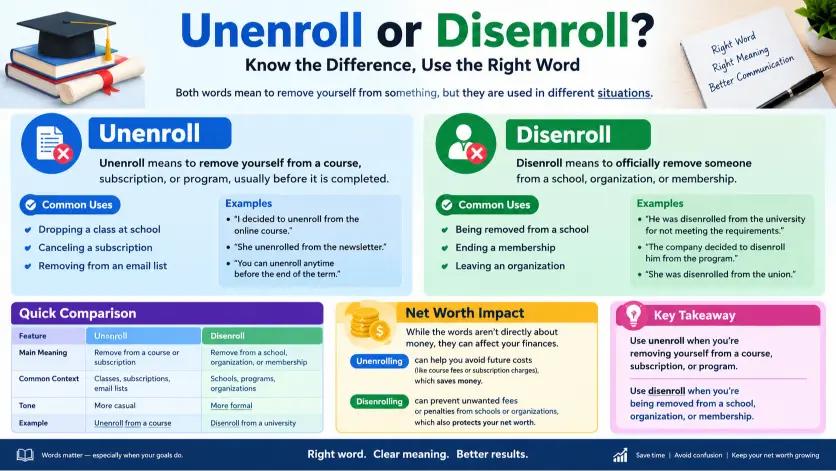
Choosing between unenroll or disenroll can be confusing because both words are used when someone leaves a course, program, class, or organization. You may see one form more often depending on the country, institution, or context, which can make a simple spelling choice feel surprisingly complicated. If you are writing an email to a school, updating an enrollment record, or simply trying to use natural English, knowing the difference can help you communicate more clearly and professionally.
In this guide, we will examine unenroll or disenroll, explain what each term means, and show how they are commonly used in real English. We will also look at grammar, regional usage, example sentences, and common mistakes so you can confidently choose the right word. The goal is not simply to memorize a spelling but to understand the practical distinction and recognize which expression sounds most appropriate in different situations.
Unenroll or Disenroll: What’s the Difference?
Both unenroll and disenroll are verbs. They describe the process of ending an existing enrollment, although their usage differs slightly depending on context, audience, and institutional preference.
Unenroll commonly means to remove yourself or someone else from a class, course, service, mailing program, subscription, or other organized enrollment. For example, a student may unenroll from an online course before the registration deadline.
Disenroll carries essentially the same basic meaning. It refers to removing an enrolled person from a program, plan, class, membership, or service. However, the word can sound more administrative or institutional in some settings.
| Term | Part of speech | Basic meaning | Common setting | Tone |
|---|---|---|---|---|
| Unenroll | Verb | To remove from enrollment | Education, websites, courses, services | Familiar and direct |
| Disenroll | Verb | To remove from enrollment | Institutions, programs, administration | More formal |
| Enrollment | Noun | The state or process of being registered | Schools, courses, programs | Neutral |
| Enrolled | Adjective or participle | Registered in something | Academic and professional contexts | Neutral |
| Unenrolled | Adjective or participle | No longer registered | General and educational contexts | Neutral |
| Disenrollment | Noun | The act of removing enrollment | Administrative contexts | Formal |
In practice, the two verbs overlap considerably.
Nevertheless, unenroll is often easier for general readers to understand immediately.
Meanwhile, disenroll may appear more naturally in policies, official notices, and institutional documents.
The correct choice therefore depends not only on dictionary meaning, but also on audience, setting, and established terminology.
Is Unenroll or Disenroll a Grammar, Vocabulary, or Usage Issue?
The distinction is primarily a vocabulary and usage issue, rather than a basic grammar problem. Both words function as verbs, and both can grammatically describe the ending or removal of an enrollment.
However, vocabulary choice matters because readers may associate each expression with different environments.
For example, a university website might say, “Students may unenroll from the course before Friday.” A benefits administrator, on the other hand, might write, “Members may be disenrolled when eligibility requirements are no longer met.”
Both sentences are grammatically sound.
Even so, they create slightly different impressions. Unenroll feels straightforward and accessible, whereas disenroll can feel more procedural.
In casual conversation, someone is more likely to say, “I want to unenroll from this class.” Conversely, a formal notice may use “disenroll” when describing an institutional action.
Therefore, neither word is automatically incorrect.
Instead, the important question is whether the expression sounds natural for your intended audience and situation.
How to Use Unenroll Correctly
Unenroll means to stop being enrolled or to remove an individual from an enrollment. Because the word is transparent and easy to understand, it works especially well when communicating with students, customers, employees, or general users.
Workplace example
Suppose an employee is registered for an internal training program but can no longer attend. A manager might write:
“Please unenroll from the training session before registering for the replacement workshop.”
This wording is direct and easy to follow.
Academic example
A student might say:
“I decided to unenroll from the evening biology course because the schedule conflicts with my job.”
Here, the speaker is describing a personal decision to leave a registered course.
Technology example
Online learning platforms may provide an option such as:
“Select this button to unenroll from the course.”
This wording is particularly effective in software because users usually understand “enroll” and “unenroll” as opposing actions.
Usage recap
Use unenroll when you want a clear, familiar expression.
It works especially well for education, online courses, digital services, and everyday communication.
Furthermore, it is a useful choice when your readers may not be familiar with institutional terminology.
How to Use Disenroll Correctly
Disenroll also means to remove someone from an enrollment. However, it can have a more formal or administrative flavor.
The word may appear when an organization, institution, insurer, program administrator, or governing body officially removes a participant.
Workplace example
An employer could state:
“Employees who fail to complete the required documentation may be disenrolled from the benefits program.”
The sentence sounds procedural because the organization is describing an official administrative action.
Academic example
A college policy might say:
“Students who fail to satisfy the attendance requirement may be disenrolled from the program.”
Here, the institution is describing a formal consequence.
Technology example
A software platform could state:
“Users may be disenrolled from the certification pathway if required assessments remain incomplete.”
Although this sentence is understandable, a consumer focused platform might choose “unenroll” because it sounds simpler.
Usage recap
Choose disenroll when the context involves official removal, institutional procedures, eligibility rules, or formal documentation.
However, don’t assume that formal writing always requires this term. Clear communication remains more important than sounding complicated.
When You Should NOT Use Unenroll or Disenroll
Although both expressions concern enrollment, neither word fits every situation involving cancellation, departure, or removal.
1. When someone has never registered
If a person never joined a course, program, or service, saying they were unenrolled can create confusion.
Instead, explain that they did not enroll or were not registered.
2. When discussing ordinary cancellation
If you’re canceling an appointment, reservation, or order, enrollment terminology may be inappropriate.
For instance, “cancel my appointment” is clearer than “unenroll me from my appointment.”
3. When describing graduation
A graduate is not normally described as being unenrolled simply because the program ended.
Instead, say that the person completed the program or graduated.
4. When discussing suspension
Suspension and disenrollment can have different consequences.
A suspended student may remain enrolled while temporarily losing access to classes.
Therefore, don’t replace “suspended” with “disenrolled” unless the person’s registration has actually ended.
5. When someone transfers
A student who moves from one institution to another may be transferring, rather than simply being unenrolled.
The exact administrative situation should determine the wording.
6. When a subscription is being canceled
For a normal consumer subscription, “cancel,” “unsubscribe,” or “end the subscription” may be more natural.
7. When membership is the real issue
If someone leaves an organization, “end membership” or “resign” may communicate the situation more precisely.
8. When the organization removes eligibility
If a person loses eligibility for a benefit, the formal context may require language such as “coverage ended” or “eligibility terminated” rather than either enrollment verb.
Common Mistakes and Decision Rules
Many mistakes happen because writers treat every form of departure as enrollment removal.
| Correct sentence | Incorrect sentence | Explanation |
|---|---|---|
| I want to unenroll from the course. | I want to unenrollment from the course. | “Unenroll” is the verb; “unenrollment” is a noun. |
| The student was disenrolled from the program. | The student was disenroll from the program. | A past participle is required after “was.” |
| She chose to unenroll from the class. | She chose to unenrolled from the class. | After “to,” use the base verb. |
| The school may disenroll students who violate the policy. | The school may disenrolled students. | Modal verbs require the base form. |
| He is no longer enrolled. | He is no longer disenroll. | “Enrolled” correctly describes registration status. |
Decision Rule Box
If you mean the action of removing yourself or someone from an enrollment, “unenroll” is usually the clearest everyday choice.
If you mean formal institutional removal, “disenroll” can be appropriate.
If you mean the person or tool, neither verb should replace the relevant noun.
For example, an enrollment administrator is a person or role. A course management system is a tool. Neither should be called “unenroll” or “disenroll.”
Unenroll and Disenroll in Modern Technology and Smart Tools
Digital education has made enrollment language especially visible. Online classrooms, certification portals, membership systems, and training dashboards frequently allow users to join and leave programs without contacting an administrator.
Because of this shift, unenroll has become particularly intuitive in interface language. Users often recognize the relationship between “enroll” and “unenroll” immediately.
For example, a course page may contain a control labeled “Unenroll from course.” The wording tells users exactly what will happen.
Meanwhile, “disenroll” may be more suitable in system messages that describe an administrative decision. A platform could explain that a participant was disenrolled because eligibility requirements were not met.
However, interface writers should prioritize clarity over unnecessary formality.
If the audience is broad, familiar vocabulary usually reduces confusion.
Where Did Unenroll and Disenroll Come From?
Both words are built around enroll, which ultimately relates to the idea of entering someone’s name into a record or list.
The prefix un commonly expresses reversal or removal. Therefore, “unenroll” naturally suggests reversing enrollment.
The prefix dis can also express separation, reversal, or removal. Consequently, “disenroll” developed with a closely related meaning.
This construction explains why the two verbs are so similar.
English frequently creates new verbs by adding prefixes to established words. As a result, parallel forms can sometimes coexist even when one becomes more common in ordinary communication.
A useful expert style observation is:
“When two words share the same practical meaning, context and audience often determine which expression communicates the idea most naturally.”
That principle applies particularly well here because neither term needs to be treated as universally wrong.
Two Practical Case Studies
Case Study 1: University Course Withdrawal
Imagine a university student registered for five courses at the beginning of a semester. After several weeks, the student realizes that one course conflicts with a work schedule.
The student contacts the learning portal and selects the option to leave that course.
For a student facing this situation, “unenroll” is likely to feel immediately understandable:
“I need to unenroll from my afternoon course.”
The expression focuses on the student’s action and avoids unnecessary administrative language.
However, the university’s internal policy might describe the same event as disenrollment if the document concerns official registration records.
Therefore, the same event can reasonably receive different wording depending on the audience.
Case Study 2: Program Eligibility
Now consider a professional certification program. Participants must maintain an active license and submit required documents each year.
One participant fails to meet the eligibility requirements. The program administrator removes that participant from the active roster.
In this context, “disenroll” can communicate the institutional nature of the action:
“The administrator may disenroll participants who no longer satisfy eligibility requirements.”
The wording emphasizes an official decision rather than a casual personal choice.
These cases demonstrate why meaning alone doesn’t settle the choice. Context, audience, and administrative purpose also influence natural usage.
Error Prevention Checklist
Before choosing either expression, review the situation carefully.
Always use unenroll when
☐ You are describing a personal decision to leave a course.
☐ You are writing simple instructions for general users.
☐ You are explaining how to leave an online class.
☐ You want a familiar and straightforward expression.
☐ The audience includes beginners or casual readers.
Consider disenroll when
☐ An institution is formally removing a participant.
☐ The wording concerns eligibility or administrative rules.
☐ You are describing an official program action.
☐ The surrounding document already uses formal enrollment terminology.
Never use either term when
☐ The person never enrolled in the first place.
☐ The actual action is cancellation rather than enrollment removal.
☐ The person is merely suspended.
☐ The situation concerns graduation or successful completion.
☐ Another verb describes the event more precisely.
Related Grammar Confusions You Should Master
Understanding enrollment vocabulary can also help you recognize several related language distinctions.
Enroll vs Register
These words frequently overlap, although institutions may assign them different administrative meanings.
Enrolled vs Enrolling
“Enrolled” normally describes completed registration, while “enrolling” describes the process.
Withdraw vs Unenroll
“Withdraw” is especially common when a student formally leaves a course after joining it.
Drop vs Withdraw
Educational institutions may distinguish these terms according to deadlines and academic consequences.
Cancel vs Unsubscribe
Both can describe ending a service, but “unsubscribe” commonly relates to recurring communications or subscriptions.
Member vs Participant
A member belongs to an organization, whereas a participant takes part in an activity or program.
Admission vs Enrollment
Admission concerns acceptance into an institution or program, while enrollment concerns officially registering.
Registration vs Enrollment
These nouns often overlap, although particular institutions may define them differently.
Suspension vs Disenrollment
Suspension may temporarily restrict participation, while disenrollment generally ends active enrollment.
Former Student vs Unenrolled Student
A former student may have completed or left an institution, whereas “unenrolled” specifically emphasizes registration status.
Frequently Asked Questions
Is unenroll a proper English word?
Yes. Unenroll is an established English verb meaning to remove someone or oneself from enrollment. It is especially common in educational and digital contexts.
Is disenroll a proper English word?
Yes. Disenroll is also an established verb. It generally means to remove a person from an enrolled status, program, plan, or organized service.
Is it better to say unenroll or disenroll?
The choice depends on context. “Unenroll” is generally clear and familiar for everyday communication, while “disenroll” may fit formal institutional or administrative writing.
What is the past tense of unenroll?
The past tense is unenrolled. For example, “She unenrolled from the course yesterday.”
What is the past tense of disenroll?
The past tense is disenrolled. For example, “The participant was disenrolled from the program.”
Can I say I disenrolled from a class?
Yes. The sentence is grammatically possible and understandable. Nevertheless, many speakers may find “I unenrolled from the class” more natural in ordinary educational conversation.
Is disenrollment the same as withdrawal?
Not necessarily. Institutions can define withdrawal and disenrollment differently. Therefore, always check the specific policy when academic, financial, or eligibility consequences matter.
Should websites use unenroll or disenroll?
For general user interfaces, “unenroll” is often easier to understand. However, organizations should maintain consistent terminology across their policies, buttons, notifications, and help materials.
Is unenrollment one word?
Yes. Unenrollment is commonly written as one word when used as a noun referring to the process or state of ending enrollment.
Final Verdict: Unenroll or Disenroll?
The practical distinction between unenroll or disenroll is less about grammar and more about usage, tone, and context. Both verbs can describe removing someone from an enrolled status, so neither should automatically be treated as incorrect.
For ordinary conversations, course instructions, student guidance, and digital interfaces, unenroll offers a familiar and transparent choice. Meanwhile, disenroll can work naturally in institutional policies, administrative notices, and formal descriptions of participant removal.
Ultimately, choose the word that matches the situation and audience. If clarity is your priority, use the simpler expression. If you’re describing an official administrative action, the more formal alternative may fit the surrounding language.
The most important point is to distinguish enrollment removal from related actions such as cancellation, suspension, withdrawal, transfer, or graduation. Once that distinction is clear, choosing the appropriate verb becomes much easier.









