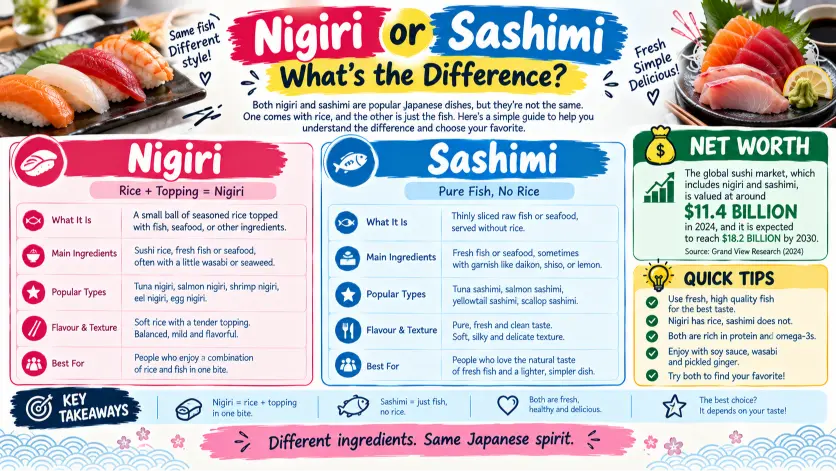
If you have ever looked at a Japanese menu and wondered whether to order nigiri or sashimi, you are not alone. Both feature carefully prepared seafood, but they are served in noticeably different ways. Nigiri typically consists of a slice of fish or seafood placed over a small portion of seasoned sushi rice, while sashimi is served as sliced seafood without rice. Understanding this basic difference can make ordering easier and help you choose according to your taste, appetite, and dining preferences.
In this guide, we will compare nigiri or sashimi from several practical angles, including ingredients, preparation, texture, flavor, nutrition, portion size, and traditional serving styles. Drawing on established Japanese culinary practices and sushi terminology, we will explain the differences in simple language without assuming you already know sushi culture. Whether you are trying Japanese food for the first time or simply want to understand the menu better, this comparison will give you a clear and reliable starting point.
What’s the Difference?
Although nigiri and sashimi both appear frequently on Japanese restaurant menus, they describe different preparations. Therefore, understanding the distinction becomes much easier when you focus on what accompanies the seafood.
Nigiri is a Japanese dish made by shaping a small amount of vinegared rice and placing a slice of seafood over it. Usually, the topping is raw fish, although cooked seafood and other ingredients can also appear. Consequently, rice is the defining structural feature.
Sashimi, by contrast, is thinly sliced raw fish or seafood served without rice. Instead, the quality, freshness, texture, cutting technique, and presentation of the seafood receive the greatest attention. Therefore, sashimi is not simply another word for sushi.
For grammatical purposes, both words function primarily as noun terms because they identify particular foods or culinary preparations. However, their meanings are not interchangeable.
In short, nigiri includes rice, whereas sashimi does not. Moreover, nigiri belongs to the broader sushi family. Sashimi, however, is traditionally presented independently from sushi rice. Therefore, the presence or absence of rice provides the quickest way to tell them apart.
Nigiri or Sashimi: Is This a Grammar, Vocabulary, or Usage Issue?
The difference between these expressions is primarily a vocabulary and usage issue, rather than a grammar problem. Neither term represents an alternative spelling of the other. Instead, each word identifies a different culinary concept.
For example, saying, “I ordered salmon nigiri” communicates that the salmon comes with seasoned rice. Conversely, saying, “I ordered salmon sashimi” tells the listener that the salmon was served as sliced seafood without rice.
Therefore, the terms cannot normally be substituted for one another. In casual conversation, someone unfamiliar with Japanese cuisine might use them loosely. However, accurate writing, restaurant communication, culinary education, and academic discussion require the distinction.
In formal contexts, using the correct culinary term also demonstrates precision. Meanwhile, casual diners don’t necessarily need to memorize every Japanese food expression. Nevertheless, knowing this difference can prevent ordering mistakes.
What Does Nigiri Mean?
Nigiri describes a compact serving of seasoned sushi rice topped with seafood or another suitable ingredient. Traditionally, the rice is shaped by hand into a small oval form. Then, a topping is placed over the rice.
Common toppings include tuna, salmon, yellowtail, shrimp, eel, and various other seafood choices. Additionally, some versions may include a small amount of wasabi between the rice and topping.
The rice matters because it gives nigiri its characteristic structure. Without that rice base, a seafood slice would generally not be described as nigiri.
For instance, imagine ordering two pieces of salmon nigiri. You would typically receive two small portions of rice, each carrying a slice of salmon. Thus, the dish combines the texture and acidity of sushi rice with the flavor of its topping.
Workplace Example
Suppose you’re organizing a restaurant lunch for colleagues. You might write, “Please include salmon nigiri and tuna nigiri in the shared order.” Therefore, everyone understands that the request involves sushi pieces containing rice.
Academic Example
In a culinary studies paper, a student could write, “Nigiri combines hand formed seasoned rice with a topping, creating a preparation in which both components contribute to the final taste.” Consequently, the sentence uses the term precisely.
Technology Example
Food delivery applications commonly separate sushi varieties into categories. Therefore, a menu might display salmon nigiri as a specific item alongside rolls and sashimi selections.
Usage Recap
Use nigiri when the food consists of a small rice base topped with seafood or another ingredient. Therefore, if you can clearly see a piece of sushi rice underneath the topping, nigiri is usually the appropriate term.
What Does Sashimi Mean?
Sashimi refers to thinly sliced raw fish or seafood that is presented without sushi rice. Consequently, the seafood itself becomes the central element of the dish.
Common examples include salmon sashimi, tuna sashimi, yellowtail sashimi, and various shellfish preparations. Depending on the restaurant and ingredient, slices may differ in thickness, shape, and presentation.
Importantly, sashimi isn’t simply “raw fish.” The term describes a specific Japanese preparation and presentation. Therefore, the cutting technique and quality of the ingredient are significant.
Sashimi may be accompanied by garnishes such as shredded daikon, shiso leaves, or other traditional accompaniments. However, those additions don’t transform it into sushi because the defining seafood portion remains separate from sushi rice.
Workplace Example
If you’re discussing a business dinner reservation, you could say, “Several guests prefer sashimi because they don’t want rice.” Therefore, the preference is immediately understandable.
Academic Example
A food culture researcher might write, “Sashimi places particular emphasis on the quality, freshness, texture, and cutting of seafood.” Consequently, the term accurately describes the culinary preparation.
Technology Example
Restaurant ordering platforms often allow customers to select sashimi separately from sushi. Therefore, digital menus make the distinction especially useful for customers who want seafood without rice.
Usage Recap
Use sashimi when thinly sliced seafood is presented without a rice base. Therefore, if you’re ordering seafood pieces specifically without sushi rice, sashimi is generally the correct choice.
When You Should NOT Use Nigiri or Sashimi
Understanding when these terms don’t apply is just as valuable as learning their basic definitions. Therefore, consider these common situations.
1. Don’t call every raw fish dish sashimi
Raw seafood alone doesn’t automatically qualify as sashimi. Instead, the preparation and presentation matter.
2. Don’t call every sushi piece sashimi
If seafood sits on a portion of sushi rice, the dish is not sashimi. Therefore, nigiri may be the more accurate description.
3. Don’t use nigiri for ordinary raw fish slices
A slice of fish without rice doesn’t become nigiri merely because the seafood is suitable for sushi.
4. Don’t assume sushi and sashimi are synonyms
Sushi generally involves vinegared rice, whereas sashimi is traditionally served without it.
5. Don’t describe a sushi roll as nigiri
Nigiri has a distinct hand shaped rice structure. A rolled preparation follows a different format.
6. Don’t treat cooked seafood as automatically impossible for nigiri
Although raw fish is common, nigiri can feature cooked toppings as well.
7. Don’t assume sashimi always means one specific fish
Sashimi can involve several types of seafood. Therefore, the term identifies the preparation rather than one particular species.
8. Don’t choose the term based only on whether the seafood is raw
The presence of rice is often a more useful clue than rawness alone.
Common Mistakes and Decision Rules
Because these words appear together on many restaurant menus, mistakes are understandable. However, the following examples make the distinction clearer.
Decision Rule Box
If you mean seafood served on seasoned sushi rice, choose nigiri.
If you mean sliced seafood served without sushi rice, choose sashimi.
Therefore, when you’re uncertain at a restaurant, simply look underneath the seafood. If there’s a compact portion of sushi rice, nigiri is the likely answer. If there’s no rice and the seafood appears as individual slices, sashimi is the appropriate term.
Nigiri and Sashimi in Modern Technology and Digital Menus
Modern restaurant technology has made these distinctions increasingly visible. Digital menus, delivery platforms, touchscreen ordering systems, and food databases often separate nigiri and sashimi into different categories.
Consequently, customers can make more informed selections before placing an order. A menu might group nigiri according to toppings such as salmon or tuna, while a separate section presents sashimi selections.
Furthermore, recommendation systems can use ingredients, dietary preferences, and previous orders to suggest related dishes. Therefore, accurate terminology helps digital food catalogs classify dishes more consistently.
Even so, technology doesn’t change the traditional definitions. Whether you encounter these terms on a printed menu or a digital screen, the basic distinction remains the same: nigiri has a rice base, while sashimi is served without sushi rice.
The Etymology Behind Nigiri and Sashimi
The history of these words provides another useful way to understand them. Nigiri comes from Japanese terminology associated with grasping or forming something by hand. This connection reflects the traditional technique of shaping sushi rice by hand.
Sashimi has a different linguistic background. The Japanese term refers to pierced or sliced flesh, reflecting the preparation of cutting seafood into portions.
Therefore, the origins of both words connect naturally with their culinary characteristics. Nigiri emphasizes the hand shaped rice structure, whereas sashimi emphasizes the sliced seafood.
Expert Style Explanation
“The simplest distinction is structural: nigiri pairs seafood with sushi rice, while sashimi presents sliced seafood on its own.”
This explanation captures the practical difference without suggesting that the two dishes are interchangeable.
Two Practical Case Studies
Case Study 1: Ordering at a Japanese Restaurant
Imagine a customer who wants salmon but doesn’t want rice. The customer sees salmon nigiri and salmon sashimi on the menu.
If the customer chooses nigiri, the order will normally include salmon placed over seasoned rice. However, choosing sashimi communicates a preference for sliced salmon without the rice.
Consequently, knowing one vocabulary distinction prevents an unwanted side dish and makes the ordering process easier.
Case Study 2: Writing a Food Description
Consider a food blogger describing two dishes. The first contains several pieces of tuna resting on compact rice portions. The second contains thin tuna slices arranged on a plate with garnishes.
If the writer labels both dishes “sashimi,” readers may misunderstand the presentation. However, identifying the first as tuna nigiri and the second as tuna sashimi provides an accurate description.
Therefore, precise terminology improves both reader understanding and culinary credibility.
Error Prevention Checklist
Before using either term, pause and identify the structure of the dish.
Always use Nigiri when
You see a small portion of seasoned sushi rice beneath the topping.
The seafood sits directly on the rice.
You’re describing a hand formed sushi preparation.
The menu identifies a rice based sushi piece as nigiri.
Never use Sashimi when
The seafood is clearly sitting on sushi rice.
You’re describing a conventional nigiri piece.
You mean a sushi preparation rather than sliced seafood alone.
You are using sashimi merely as another word for sushi.
Related Grammar Confusions You Should Master
Learning one distinction often makes other food and language comparisons easier. Therefore, these related topics are worth mastering:
- Sushi vs sashimi
- Nigiri vs sushi
- Sushi roll vs nigiri
- Raw vs rare
- Recipe vs dish
- Cuisine vs food
- Ingredient vs topping
- Menu vs meal
- Taste vs flavor
- Fresh vs raw
These comparisons matter because everyday language frequently uses closely related words as though they were identical. However, subtle differences often change the meaning significantly.
Nigiri or Sashimi
What is the difference between nigiri and sashimi?
Nigiri consists of seasoned sushi rice topped with seafood or another ingredient. Sashimi consists of carefully sliced seafood served without sushi rice. Therefore, the presence of rice is the easiest practical distinction.
Is nigiri considered sushi?
Yes. Nigiri is generally considered a type of sushi because it incorporates seasoned sushi rice. However, sashimi isn’t usually classified as sushi because it doesn’t contain the characteristic rice component.
Is sashimi healthier than nigiri?
Neither choice is automatically healthier for everyone. Sashimi typically contains no rice, while nigiri includes a small serving of seasoned rice. Therefore, the better option depends on your dietary needs, portion preferences, and the specific ingredients selected.
Does sashimi always mean raw fish?
Traditionally, sashimi is strongly associated with raw seafood, particularly fish. However, the broader concept concerns carefully sliced seafood preparation. Therefore, it’s better not to reduce the word to simply “raw fish.”
Does nigiri always contain raw fish?
No. Raw fish is common, but nigiri can also feature cooked seafood and other toppings. Therefore, rawness alone doesn’t define nigiri.
Which has rice, nigiri or sashimi?
Nigiri has seasoned sushi rice. Sashimi is served without sushi rice. Consequently, checking for rice is the fastest way to distinguish them.
Can you eat sashimi without sushi?
Yes. Sashimi is normally served independently from sushi. Therefore, ordering sashimi doesn’t mean you also need to order sushi.
Why do people confuse nigiri and sashimi?
Both are closely associated with Japanese cuisine and seafood, and restaurant menus frequently display them together. Consequently, diners unfamiliar with their structure can easily mix up the names.
How do you remember the difference between nigiri and sashimi?
Remember one simple rule: rice underneath means nigiri, while sliced seafood without rice means sashimi. This shortcut works well when ordering at a restaurant.
Final Verdict
The difference between nigiri or sashimi becomes simple once you focus on structure rather than rawness. Nigiri combines a small portion of seasoned sushi rice with a topping, while sashimi presents carefully sliced seafood without a rice base.
Therefore, choose nigiri when you want the combination of seafood and sushi rice. On the other hand, choose sashimi when you want the seafood itself to remain the central focus.
Ultimately, neither term is a variation of the other. They describe different Japanese culinary preparations, and using the correct word makes restaurant orders, food writing, conversations, and academic descriptions much clearer.









