Have you ever written camaraderie and suddenly wondered whether comradery might actually be the correct spelling? You’re not alone. These two forms look and sound remarkably similar, and both appear in modern English, which can make the choice confusing. Understanding the difference matters when you’re writing an email, essay, article, report, or professional document where accurate word choice builds credibility.
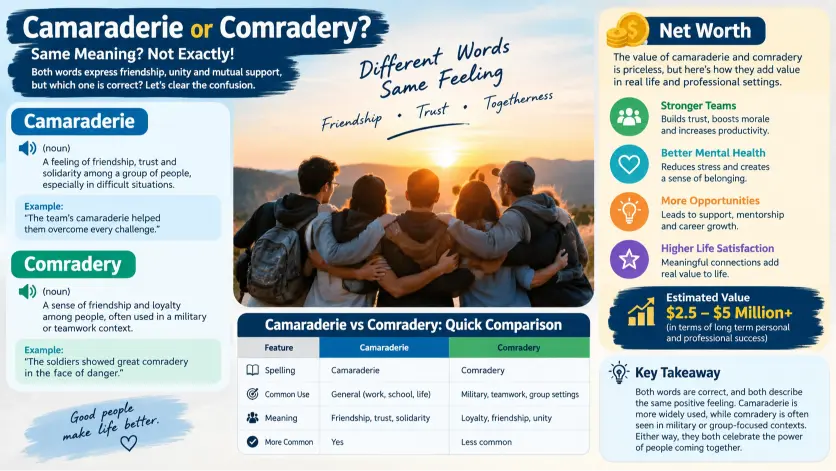
The standard and more widely accepted spelling is camaraderie, a noun describing a feeling of friendship, trust, and mutual support among people who share an experience, activity, or goal. Comradery is also used, particularly in American English, but it is generally considered a less common variant.
In this guide, we’ll examine their meanings, spelling, pronunciation, origins, grammar, and real world usage. You’ll also see clear examples and a simple rule to help you confidently choose the right form whenever this common spelling question comes up.
Camaraderie vs Comradery: What’s the Difference?
At first glance, camaraderie or comradery may seem like a simple spelling choice. However, the distinction becomes important when you’re writing an essay, preparing a professional report, or choosing language for an important publication.
Camaraderie is a noun meaning a feeling of friendship, trust, companionship, and mutual understanding between people. It commonly describes groups whose members have developed a strong connection through shared experiences.
Comradery is also a noun with essentially the same meaning. Nevertheless, it is much less common in contemporary standard English. Therefore, readers are generally more familiar with camaraderie.
| Feature | Camaraderie | Comradery |
|---|---|---|
| Part of speech | Noun | Noun |
| Meaning | Friendship and mutual trust | Friendship and mutual trust |
| Standard usage | Strongly preferred | Less common variant |
| Formal writing | Recommended | Usually avoid when a conventional form is expected |
| Workplace writing | Natural | May appear unusual |
| Academic writing | Preferred | Less frequently used |
| Pronunciation | Usually pronounced with emphasis near the final syllables | Pronunciation can vary |
| General recognition | Very high | Comparatively low |
Therefore, camaraderie is the safest choice for almost every context.
Meanwhile, comradery isn’t necessarily a meaningless or invented form, although it is considerably less established.
Consequently, if you’re unsure which spelling to choose, use camaraderie.
That choice will generally sound more natural to readers and editors.
Mini Recap
Camaraderie is the preferred spelling in modern standard English.
Comradery has the same basic meaning but is less common.
Therefore, formal and academic writers should normally choose camaraderie.
Ultimately, familiarity makes camaraderie the better default.
Is Camaraderie vs Comradery a Grammar, Vocabulary, or Usage Issue?
The question of camaraderie or comradery is primarily a spelling and usage issue rather than a grammatical one.
Both forms function as nouns. Moreover, both can describe a warm relationship created through shared activities, responsibilities, challenges, or interests.
However, grammar isn’t the main reason writers hesitate between them. Instead, the problem comes from vocabulary familiarity and conventional usage.
For example, someone might write, “The team developed strong camaraderie during the project.” This sentence sounds natural because camaraderie is widely recognized.
On the other hand, “The team developed strong comradery during the project” can still communicate the intended meaning. Nevertheless, some readers may consider the spelling unusual or less polished.
In formal environments, conventional vocabulary usually provides the clearest communication. Therefore, choosing the more familiar form reduces unnecessary distraction.
In casual conversation, either spelling may occasionally appear. Still, written communication benefits from the established form.
Similarly, academic publications generally favor the widely recognized spelling because consistency and reader expectations matter.
Thus, this isn’t a case where one word represents a completely different concept. Instead, it is mainly a matter of choosing the form that communicates your meaning with the least uncertainty.
How to Use Camaraderie Correctly
Camaraderie works especially well when you’re describing a positive relationship developed through shared experiences.
For example, a workplace team may become closer after completing a difficult assignment together. Likewise, athletes may develop camaraderie after training for an important competition.
Workplace Example
“After several months of collaboration, the department developed a strong sense of camaraderie.”
Here, the noun describes the trust and fellowship that developed among coworkers.
Academic Example
“The study group created a sense of camaraderie by meeting regularly and supporting one another.”
In this context, camaraderie refers to the social connection created within the learning environment.
Technology Example
“Although the developers worked remotely, regular discussions helped maintain camaraderie across the team.”
Consequently, the word can describe relationships even when people communicate through digital platforms rather than sharing the same physical space.
Usage Recap
Use camaraderie when describing friendship, unity, fellowship, or mutual support.
Furthermore, it works naturally in professional, educational, social, and digital contexts.
Most importantly, it is the preferred spelling when you want conventional written English.
How to Use Comradery Correctly
Comradery has essentially the same meaning as camaraderie. However, it appears far less frequently in polished contemporary writing.
For instance, you might encounter a sentence such as, “The players developed comradery after spending years together.” The intended meaning is understandable because the surrounding context clearly indicates friendship and unity.
Nevertheless, many readers expect camaraderie instead.
Workplace Example
“The workers developed comradery after completing several demanding projects together.”
Although the sentence is understandable, camaraderie would usually be the stronger choice for professional communication.
Academic Example
“The researchers noted a growing sense of comradery within the interdisciplinary group.”
Again, the meaning is clear. However, academic writers generally benefit from selecting the more familiar form.
Technology Example
“Online communities can create comradery among users who share similar interests.”
This usage communicates the intended idea, yet camaraderie remains the more conventional spelling.
Usage Recap
Comradery can convey the intended meaning.
However, it is considerably less familiar to many readers.
Therefore, unless you have a specific reason to use it, camaraderie is usually preferable.
When You Should NOT Use Camaraderie or Comradery
Although these nouns describe fellowship, they aren’t suitable for every situation. Therefore, choosing them simply because several people are involved can create an inaccurate sentence.
1. When You Mean Simple Cooperation
If people are working together without developing a friendly relationship, cooperation may be more precise.
2. When You Mean Friendship Between Two People
Camaraderie often suggests fellowship within a group or among people sharing an experience. Therefore, friendship may be clearer when discussing a personal relationship.
3. When You Mean Professional Agreement
If colleagues simply agree about a business decision, collaboration or agreement may communicate the idea more accurately.
4. When You Mean Competition
People can compete while respecting each other, but competition itself doesn’t automatically create camaraderie.
5. When You Mean Physical Closeness
Being together in the same room doesn’t necessarily indicate fellowship. Therefore, proximity would be more appropriate when physical distance is the subject.
6. When You Mean Team Membership Alone
Membership in a team doesn’t automatically prove that members share emotional connection or mutual trust.
7. When You Need the Most Conventional Formal Spelling
In this situation, choose camaraderie rather than comradery because the former is much more widely recognized.
8. When the Relationship Is Negative
Camaraderie normally carries a positive sense. Therefore, hostility, rivalry, or distrust requires different vocabulary.
Common Mistakes and Decision Rules
Spelling confusion often becomes noticeable when writers rely on pronunciation rather than established written usage.
| Correct sentence | Incorrect or weaker sentence | Explanation |
|---|---|---|
| The team developed strong camaraderie. | The team developed strong comradery. | Camaraderie is the preferred conventional spelling. |
| Camaraderie improved after the retreat. | Comradery improved after the retreat. | The meaning remains understandable, but the spelling is less familiar. |
| Their shared experience created camaraderie. | Their shared experience created comradery. | The established noun is preferable in polished writing. |
| Workplace camaraderie can improve morale. | Workplace comradery can improve morale. | Professional contexts generally favor the standard form. |
| The players showed remarkable camaraderie. | The players showed remarkable comradery. | Camaraderie is the natural choice for formal prose. |
Decision Rule Box
If you mean a feeling of friendship, fellowship, trust, and mutual support, use camaraderie.
If you encounter comradery, understand it as a less common variant with essentially the same meaning.
When writing formally, choose camaraderie unless there is a specific reason to reproduce the alternative spelling.
Therefore, the easiest practical rule is simple: when in doubt, write camaraderie.
Camaraderie and Comradery in Modern Technology and Digital Tools
Modern communication has changed how people develop relationships, yet the meaning of these words remains remarkably stable.
For example, remote employees can develop camaraderie through video meetings, shared workspaces, online discussions, and informal team conversations.
Similarly, gaming communities can develop a sense of camaraderie after members cooperate toward shared objectives.
Furthermore, digital learning platforms can encourage fellowship among students who rarely meet face to face.
However, technology itself doesn’t create camaraderie automatically. Instead, repeated interaction, trust, shared goals, and positive experiences usually create the connection.
Consequently, a sentence such as “The online community developed strong camaraderie” is perfectly natural when members have formed a genuine sense of belonging.
Etymology and Language History
The history behind camaraderie helps explain why its spelling can feel unfamiliar to English learners.
The word entered English through French, where camaraderie relates to companionship among comrades. Its deeper background is connected with the idea of a companion or fellow member of a group.
Over time, English adopted the term while retaining much of its original spelling.
Because English frequently absorbs vocabulary from other languages, pronunciation and spelling don’t always develop in perfectly predictable ways.
As a result, some speakers naturally create alternative spellings based on how the word sounds. Comradery can be understood partly in this context.
Nevertheless, established written usage matters. Therefore, the historical form camaraderie remains the safer choice in standard English.
An Expert Style Principle
“When two forms carry the same meaning, the established form usually gives readers the clearest path to understanding.”
This principle is especially useful when a less familiar spelling can distract from an otherwise clear message.
Two Practical Case Studies
Case Study One: Workplace Communication
Consider a project manager preparing a company report after a successful team assignment.
The manager initially writes, “The project created strong comradery among employees.”
However, during editing, the wording is changed to, “The project created strong camaraderie among employees.”
The second version is more suitable because it follows the widely recognized spelling and avoids distracting readers.
Consequently, the message remains focused on the team’s positive relationship rather than an unusual vocabulary choice.
Case Study Two: Academic Writing
Now consider a student describing cooperation within a research group.
The original sentence reads, “The researchers developed comradery during the experiment.”
Because the assignment requires polished formal English, the student replaces it with, “The researchers developed camaraderie during the experiment.”
As a result, the sentence aligns more closely with conventional usage while preserving the original meaning.
These examples demonstrate an important point: the issue isn’t usually comprehension. Instead, the stronger form improves familiarity, consistency, and editorial confidence.
Error Prevention Checklist
Before publishing or submitting your writing, check the following points.
Always use Camaraderie when
You mean fellowship among people.
You are writing an academic assignment.
You are preparing workplace communication.
You are creating formal documentation.
You want the most widely recognized spelling.
You are writing for a broad audience.
Never use Comradery when
You need the safest conventional spelling.
Your editor expects standard formal vocabulary.
Your audience may question unfamiliar variants.
You are unsure which spelling is preferred.
You are writing an important professional document.
You could use camaraderie without changing your meaning.
Therefore, the practical solution is straightforward: select camaraderie whenever there isn’t a compelling reason to reproduce the alternative.
Related Grammar Confusions You Should Master
Once you’ve understood camaraderie or comradery, several other commonly confused terms are worth learning because similar spelling questions can create avoidable mistakes.
1. Affect or Effect
These words often create confusion because both can function differently depending on context.
2. Fewer or Less
This distinction involves countable and uncountable nouns in many standard constructions.
3. Advice or Advise
One is generally a noun, while the other functions as a verb.
4. Complement or Compliment
Their pronunciations can be similar, but their meanings are different.
5. Principal or Principle
One commonly refers to a person or main element, whereas the other describes a rule or belief.
6. Stationary or Stationery
The difference becomes important in business and office writing.
7. Altar or Alter
Although their sounds are identical in many varieties of English, their meanings are completely different.
8. Latter or Former
These terms require careful attention when comparing two previously mentioned items.
9. Discreet or Discrete
Their meanings differ despite their similar appearance and pronunciation.
10. Practice or Practise
Usage depends partly on regional English conventions.
Learning these pairs alongside camaraderie and comradery can significantly improve vocabulary accuracy.
Frequently Asked Questions
Is camaraderie or comradery correct?
Camaraderie is the preferred and more widely recognized spelling in standard English. Comradery exists as a less common variant, but writers generally choose camaraderie for formal, academic, and professional communication.
What is the difference between camaraderie and comradery?
There is little difference in basic meaning. Both nouns describe friendship, fellowship, and mutual support among people. However, camaraderie is much more established and familiar, making it the stronger choice for most written contexts.
Is comradery an actual word?
Yes, comradery is used as a variant spelling of camaraderie. Nevertheless, it is considerably less common. Therefore, its existence doesn’t make it the preferred option for formal writing.
Is camaraderie formal or informal?
Camaraderie can be used in both formal and informal contexts. However, it is particularly suitable for professional reports, academic writing, workplace communication, journalism, and polished general prose.
How do you spell camaraderie correctly?
The standard spelling is camaraderie. Because its spelling doesn’t always match what speakers expect from its pronunciation, it can be useful to memorize the complete form rather than reconstructing it phonetically.
Can I use comradery in academic writing?
You can encounter comradery in written English, but camaraderie is generally the safer choice for academic work. Moreover, using the established form reduces the possibility that an instructor or editor will regard the spelling as unusual.
Why do people spell camaraderie as comradery?
The alternative spelling likely feels natural to some writers because it resembles the pronunciation and the familiar word comrade. Consequently, speakers may simplify the spelling when writing from sound.
What does camaraderie mean in the workplace?
In workplace communication, camaraderie describes a positive sense of fellowship, trust, and mutual support among colleagues. It can develop through shared projects, common goals, difficult experiences, and regular interaction.
Does camaraderie mean friendship?
Camaraderie can involve friendship, but it usually emphasizes shared fellowship and mutual understanding rather than a deeply personal relationship. Therefore, it can describe connections among coworkers, teammates, classmates, soldiers, or community members.
Which spelling should I use in formal writing?
Choose camaraderie. Since it is the established and widely recognized form, it provides the clearest option for professional documents, academic assignments, reports, and other polished writing.
Final Verdict: Camaraderie or Comradery?
When deciding between camaraderie or comradery, the best answer is straightforward: use camaraderie in most situations.
Both forms communicate the idea of fellowship, companionship, and mutual support. However, camaraderie is considerably more established in contemporary standard English and is therefore more familiar to readers.
Meanwhile, comradery can appear as a variant, but its lower frequency makes it a weaker choice for formal communication.
Ultimately, the goal of good vocabulary isn’t simply to find a word that readers can understand. Instead, strong writing uses the form that feels natural, conventional, and precise within the intended context.
Therefore, whenever you’re unsure, remember this simple rule: camaraderie is the standard choice, while comradery is the less common alternative.









