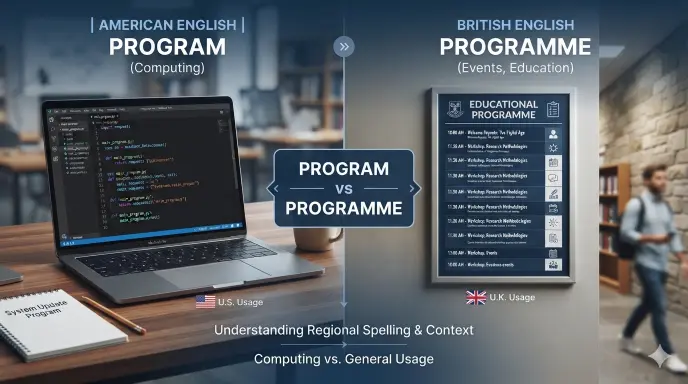
Have you ever wondered whether program or programme is the correct spelling? You may see both forms in books, websites, workplaces, schools, and official documents, which can make this small spelling difference surprisingly confusing. The good news is that both spellings are correct, but they are generally used in different varieties of English.
The main difference comes down to American and British English. “Program” is the standard spelling in American English and is also widely used internationally, especially in technology and computing. “Programme” is traditionally preferred in British English when referring to an organized plan, event, or series of activities. However, British English commonly uses “program” for computer software.
In this guide, you’ll learn the meaning, regional differences, pronunciation, common examples, and practical usage of both forms. Whether you’re writing for school, work, or everyday communication, this explanation will help you confidently choose the right spelling.
Program or Programme: What’s the Difference?
At first glance, these two spellings appear to describe exactly the same idea. However, their preferred use changes according to the variety of English being used.
Program is a noun and, in American English, can also function as a verb. It commonly refers to an organized plan, course, broadcast schedule, event series, or computer application. For example, someone may join a training program or program a computer.
Programme is primarily a noun in British English and many other varieties influenced by British usage. It can describe an organized activity, educational course, performance schedule, or planned series of events.
| Point of comparison | Program | Programme |
|---|---|---|
| Main usage | American English | British English |
| Part of speech | Noun and verb | Mainly noun |
| Education | Common | Common |
| Workplace | Common | Common |
| Events | Common | Common |
| Television | Common | Common in British usage |
| Computer software | Standard | Less common |
| Programming action | Standard verb | Usually “program” |
| Regional preference | United States and some international contexts | United Kingdom and related varieties |
Therefore, neither spelling is automatically wrong. Instead, the surrounding language variety determines which form sounds natural.
In American writing, program is normally the safest choice.
In British writing, programme is usually preferred for organized activities.
However, computer related terminology generally keeps program, even in British English.
Is Program or Programme a Grammar, Vocabulary, or Usage Issue?
Primarily, this is a usage and regional spelling issue, rather than a fundamental grammar problem.
Both forms can refer to a planned series of activities, an educational course, or an organized event. Consequently, the meaning often remains understandable regardless of the spelling.
However, choosing the expected regional form makes writing appear more polished and consistent. For instance, an American reader will normally expect “community program,” while a British reader may expect “community programme.”
Furthermore, the distinction becomes clearer in computing. A program is standard terminology for a set of instructions that a computer executes. The verb is also “program,” as in “developers program the application.”
In British English, therefore, you may encounter “television programme” alongside “computer program.” That combination is perfectly normal.
Thus, the important question isn’t simply which spelling is correct. Instead, ask which English variety and context are you writing for?
How to Use Program in American English
In American English, program is the standard spelling across many contexts.
For example, a company might introduce a “leadership development program” for employees. Likewise, a university may offer a “graduate program” for advanced students.
Workplace example
“Our company launched a new employee wellness program this year.”
Here, program refers to an organized workplace initiative.
Academic example
“She enrolled in a master’s program in environmental science.”
Here, the word describes an organized course of study.
Technology example
“The developer installed a new computer program.”
In this case, program refers to software.
Furthermore, American English uses program as a verb.
For example:
“Students learn how to program computers.”
“The engineer programmed the device to respond automatically.”
Therefore, American usage gives this spelling particularly broad flexibility.
Usage recap: Choose program when following American English. It works naturally for education, business, events, television, software, and the related verb describing computer coding.
How to Use Programme in British English
In British English, programme is commonly used when discussing organized activities, educational courses, broadcasts, and planned initiatives.
For example, a British newspaper might describe a government “employment programme.” A university could advertise a “degree programme,” while a television station may publish its “evening programme.”
Workplace example
“The company has introduced a graduate training programme.”
Here, the term refers to an organized professional development scheme.
Academic example
“She applied for a postgraduate programme in economics.”
This spelling is particularly familiar in British educational writing.
Technology example
There is an important exception. British English commonly uses computer program, not “computer programme,” when referring to software.
Likewise, the verb remains program:
“The technician programmed the machine.”
Therefore, British usage does not mean that every occurrence should automatically receive an extra “me.”
Usage recap: Select programme for many organized activities in British English, but retain program for computer software and the related computing verb.
When You Should NOT Use Program or Programme
Although both spellings are legitimate, several situations can create awkward or inconsistent writing.
- Do not mix regional styles without a reason. A document written in American English should generally maintain American spelling throughout.
- Do not assume programme is required simply because the audience is British. Computing terminology normally uses “program.”
- Do not change official names unnecessarily. If an institution officially calls something a “Program,” preserve its established name.
- Do not switch spelling between headings and body text. Consistency makes professional material easier to read.
- Do not treat regional spelling as a difference in meaning. In many ordinary contexts, the underlying concept is identical.
- Do not use programme for the verb meaning computer coding. The standard form is “program.”
- Do not select a spelling solely because it looks more formal. Regional convention matters more than perceived sophistication.
- Do not combine American and British conventions randomly. Consistency is more important than choosing one variety because it seems superior.
Consequently, deciding on a regional variety before drafting a long document can prevent many small corrections later.
Common Mistakes: Program or Programme
The most frequent errors occur when writers know both spellings but aren’t sure when the extra letters belong.
| Correct sentence | Incorrect sentence | Explanation |
|---|---|---|
| She joined a training program. | She joined a training programme. | The first is appropriate for American English. |
| She joined a training programme. | She joined a training program. | The first follows common British usage. |
| He installed a computer program. | He installed a computer programme. | Software is normally called a program. |
| They programmed the system. | They programmeed the system. | The computing verb is “program.” |
| The university offers a degree programme. | The university offers a degree program. | British academic usage commonly favors “programme.” |
| The university offers a degree program. | The university offers a degree programme. | American academic usage normally favors “program.” |
The key point is that context and regional convention work together.
Decision Rule Box
If you are writing in American English, use “program” in almost every relevant context.
If you are writing in British English, use “programme” for organized activities, courses, and broadcasts.
For computer software and computer coding, use “program” regardless of whether the surrounding English is British or American.
That final rule is especially useful because technology vocabulary often follows its own established convention.
Program and Programme in Modern Technology and Computing
Technology creates one of the clearest distinctions between these spellings.
A program is a collection of instructions that tells a computer how to perform particular operations. This terminology is standard in both American and British computing contexts.
For example, a programmer may write a program that processes information, manages files, controls hardware, or performs calculations.
Likewise, the verb program describes the act of creating or configuring instructions.
Consider these sentences:
“The programmer wrote a program for data processing.”
“The engineer programmed the device.”
“The software program checks incoming information.”
These examples remain natural regardless of whether the writer normally uses British or American English.
By contrast, “programme” is generally associated with non computing meanings in British usage. Therefore, technology provides a useful memory aid: software is a program.
Program or Programme in Education
Education is one area where regional differences are particularly visible.
American institutions commonly use phrases such as “degree program,” “honors program,” “exchange program,” and “graduate program.”
British institutions frequently use expressions such as “degree programme,” “study programme,” and “training programme.”
Neither pattern is inherently more correct. Instead, each reflects the spelling convention of the institution and country.
Moreover, international universities may adopt terminology based on their institutional identity. Therefore, when referring to an official course name, preserve the institution’s published spelling rather than changing it to match your personal preference.
This approach also avoids creating inconsistency between headings, certificates, descriptions, and supporting material.
Program or Programme in the Workplace
Professional communication follows the same regional pattern.
An American company might announce a “leadership program,” “internship program,” or “customer loyalty program.”
A British organization might describe a “leadership programme,” “graduate programme,” or “customer loyalty programme.”
However, corporate branding can override ordinary regional expectations. An international company may deliberately use one spelling across all markets.
Consequently, official terminology should be copied accurately when discussing a named initiative.
For ordinary workplace writing, though, maintaining one regional variety throughout the document remains the clearest approach.
A Short History of Program and Programme
The difference has historical roots in English spelling conventions.
Programme entered English through French influence and became established in British usage. Over time, American English increasingly favored the shorter program.
The shorter spelling eventually became strongly associated with American usage. Meanwhile, British English retained programme in many non computing contexts.
Computing introduced another development. Because American terminology strongly influenced early computer science vocabulary, program became the standard technical form internationally.
As a result, modern British English can comfortably contain both forms:
“The television programme begins at eight.”
“The computer program requires an update.”
This isn’t an inconsistency. Instead, it reflects two different established conventions operating within the same variety of English.
Expert Style Explanation
A useful way to understand the distinction is this:
“Spelling follows both language variety and established terminology, so context matters as much as the dictionary definition.”
This principle explains why two spellings can coexist without creating two completely different meanings.
In practical writing, the strongest choice is therefore the form expected by your audience and subject area.
Two Practical Case Studies
Case Study 1: International University
Imagine an international university publishing information for American students. Its existing materials consistently use “degree program.”
If an editor changes every occurrence to “degree programme,” the meaning doesn’t suddenly become incorrect. Nevertheless, the alteration creates inconsistency with the institution’s established American style.
The better decision is to preserve program throughout that material.
Case Study 2: British Technology Company
Now consider a British technology company discussing two subjects on the same website.
Its employee development initiative is called a “professional development programme.”
Its software documentation refers to a “computer program.”
That combination is entirely natural. Changing both terms to “programme” would make the computing terminology unusual.
Therefore, context can override a simple country based rule.
Error Prevention Checklist
Before publishing your writing, check the following points.
Always use program when:
You are following American English.
You are referring to computer software.
You are describing computer coding as a verb.
You are following an official American institutional name.
You are maintaining an established technical term.
Never use programme when:
You mean computer software.
You need the standard verb for computer coding.
Your document follows American spelling conventions.
You are altering an official technical name that already uses “program.”
You are choosing the longer spelling merely because you believe it sounds more formal.
Above all, consistency should guide the final decision.
Related Grammar Confusions You Should Master
Once you understand this distinction, several related spelling and usage pairs are worth learning.
- Practice or practise: noun versus verb distinctions in British English.
- License or licence: American usage compared with British conventions.
- Color or colour: regional spelling differences.
- Center or centre: American and British preferences.
- Theater or theatre: another familiar regional variation.
- Traveler or traveller: differences involving doubled consonants.
- Canceled or cancelled: contrasting American and British spellings.
- Organization or organisation: regional choices involving the ending.
- Catalog or catalogue: shortened versus traditional forms.
- Analog or analogue: technical and regional preferences.
Understanding these patterns makes spelling decisions easier because they reveal a broader principle: English varies naturally across regions.
Frequently Asked Questions
Is program or programme correct?
Both spellings are correct. Program is preferred in American English, while programme is commonly preferred in British English for organized activities. However, computer software is generally called a program in both varieties.
Should I use program or programme in British English?
For many non computing meanings, British English traditionally uses programme. Examples include educational courses, television schedules, and organized initiatives. However, computer software and the computing verb remain program.
Is programme British or American?
Programme is primarily associated with British English and other varieties influenced by British spelling conventions. American English generally uses program instead.
Is program American or British?
Program is strongly associated with American English. Nevertheless, British English also uses the spelling for computers, software, programming, and certain established names.
Is a computer programme correct in British English?
Although readers may understand “computer programme,” standard contemporary British computing terminology generally uses computer program. The same applies to the verb “program.”
Which is correct: degree program or degree programme?
Both can be correct depending on regional style. American English normally uses degree program, whereas British English commonly uses degree programme.
Why does British English use programme but program for computers?
Historical spelling preferences and the development of international computing terminology explain much of this difference. British English retained “programme” for many traditional meanings, while “program” became established as the technical computing term.
Should an international website use program or programme?
Choose the spelling that matches your primary audience and maintain it consistently. If the website targets American readers, program is usually appropriate. If it targets British readers, programme may be preferable for non computing contexts.
Can program be used as a verb?
Yes. “Program” functions as a verb, particularly when describing computer coding or configuring a device. For example, “The engineer programmed the machine.”
Does program mean something different from programme?
Usually, no. The core meaning can be the same. The distinction mainly involves regional spelling, context, and established technical terminology.
Final Verdict
The simplest answer is that program and programme are both legitimate spellings, but they belong to different usage patterns. American English generally prefers program for organized activities, education, business initiatives, and technology. British English commonly uses programme for courses, events, broadcasts, and planned initiatives.
Nevertheless, both British and American English use program for computer software and computer coding. Therefore, don’t memorize the difference as a strict right versus wrong rule. Instead, identify your audience, determine the relevant context, and remain consistent.
When writing for American readers, choose program. When writing in British English, choose programme for traditional non computing meanings. For software and coding, choose program. That approach is simple, accurate, and reliable across modern English usage.









