Have you ever struggled to describe something so beautiful, emotional, strange, or powerful that ordinary words simply did not seem enough? You may have searched for “undescribable or indescribable” and wondered which spelling is actually correct. Although both forms may look understandable, they are not equally standard in modern English. Choosing the right word matters when you want your writing to sound natural, polished, and grammatically reliable.
This small spelling difference can easily create confusion, especially for students, writers, bloggers, and English learners who want to communicate clearly. In this guide, we’ll explain undescribable or indescribable in simple English, including the correct spelling, meaning, pronunciation, grammar, and real world examples. We’ll also look at why indescribable is generally the preferred standard form and when people may encounter the less common alternative.
The goal is not just to give you a quick answer, but to help you confidently recognize and use the word in everyday writing. Whether you are checking a sentence, improving your vocabulary, or writing professionally, this guide will make the distinction easy to remember.
Undescribable or Indescribable: What’s the Difference?
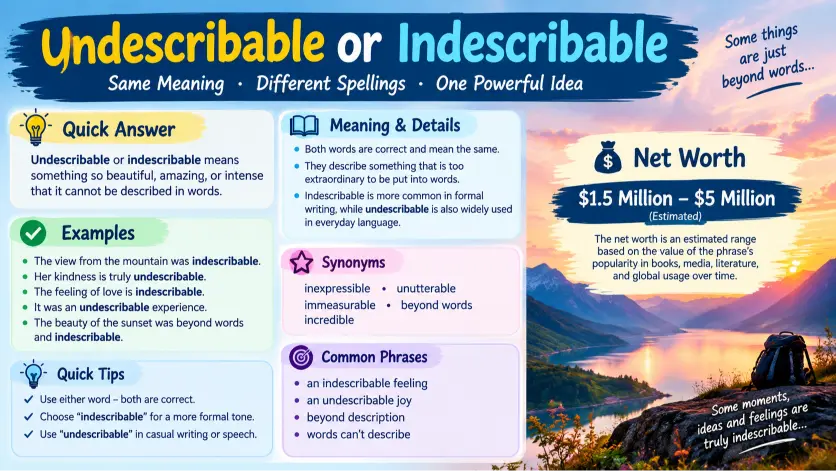
First, indescribable is the standard adjective in modern English. It describes something that cannot be adequately expressed, explained, or represented through ordinary words.
For example:
The beauty of the sunset was indescribable.
Here, the speaker means that the sunset was so impressive that ordinary language couldn’t fully capture the experience.
On the other hand, undescribable can sometimes be encountered because English speakers naturally associate un with negation. Nevertheless, it isn’t the preferred standard form. Consequently, careful writers should choose indescribable.
| Word | Part of Speech | Standard Usage | Meaning | Example |
|---|---|---|---|---|
| Indescribable | Adjective | Standard | Impossible or extremely difficult to describe adequately | The view was indescribable. |
| Undescribable | Adjective | Generally nonstandard | Intended to mean impossible to describe | The view was undescribable. |
Therefore, the practical distinction is simple.
Indescribable is the established English adjective.
Undescribable is usually treated as an incorrect or nonstandard alternative.
Consequently, if you’re unsure which spelling to use, choose indescribable.
Is Undescribable or Indescribable a Grammar, Vocabulary, or Usage Issue?
Primarily, this is a vocabulary and usage issue, although spelling and word formation are also involved.
Both forms look grammatically possible because English frequently uses prefixes to create negative meanings. For instance, unhappy means not happy, while unclear means not clear.
However, English vocabulary isn’t always completely predictable. Therefore, a word may have a negative prefix that differs from the pattern a learner expects.
In this case, indescribable is the conventional form.
Furthermore, the two words aren’t equally interchangeable in careful English. While readers may understand undescribable, it can look unusual, incorrect, or poorly edited.
In casual conversation, someone might use undescribable without causing confusion. However, formal documents, academic assignments, workplace communication, published writing, and professional content should use indescribable.
Thus, the distinction isn’t primarily about changing the meaning. Instead, it concerns selecting the established form that native and proficient English speakers generally recognize.
What Does Indescribable Mean?
Indescribable is an adjective meaning extremely difficult or impossible to describe accurately using words.
The word often expresses an experience, emotion, sensation, appearance, or situation that feels beyond ordinary language.
For example:
Her happiness after receiving the award was indescribable.
Here, indescribable doesn’t necessarily mean that absolutely no description is possible. Rather, it suggests that available words aren’t sufficient to communicate the full intensity of the feeling.
Moreover, the adjective can describe both positive and negative experiences.
A breathtaking landscape can be indescribable. Likewise, overwhelming grief can also be indescribable.
Therefore, context determines whether the word communicates wonder, beauty, excitement, pain, fear, shock, or another powerful experience.
Workplace Example
A manager might write:
The team’s excitement after completing the project was indescribable.
Here, the adjective emphasizes the strength of the employees’ emotional response.
Academic Example
A student might write:
The historical significance of the discovery was indescribable.
However, academic writers should use the term carefully because scholarly writing generally benefits from precise explanation rather than relying heavily on emotional language.
Technology Example
A technology reviewer might say:
The visual experience offered by the new display was indescribable.
Nevertheless, a stronger technical review would explain brightness, color accuracy, resolution, contrast, and viewing quality rather than depending entirely on the adjective.
Usage recap: Consequently, use indescribable when something is exceptionally difficult to express accurately in words.
What Does Undescribable Mean?
Undescribable is intended to communicate essentially the same idea as indescribable. Nevertheless, it isn’t the preferred standard spelling.
The form probably seems logical because un often creates negative adjectives. However, established English vocabulary doesn’t always follow a simple prefix formula.
For example, someone might instinctively write:
The feeling was undescribable.
Yet, in polished writing, the preferred version is:
The feeling was indescribable.
Workplace Example
Instead of writing:
The employee’s excitement was undescribable.
Use:
The employee’s excitement was indescribable.
Academic Example
Instead of:
The experience was undescribable.
Prefer:
The experience was indescribable.
Technology Example
Instead of:
The graphics were undescribable.
Choose:
The graphics were indescribable.
Usage recap: Therefore, although readers can usually understand undescribable, it isn’t the recommended choice when correctness and standard usage matter.
When You Should NOT Use Undescribable or Indescribable
Although indescribable is correct, it isn’t suitable for every situation. Sometimes a more precise adjective communicates your meaning much better.
Consider these common misuse scenarios.
1. When You Can Describe Something Precisely
If you can clearly explain an object or experience, indescribable may be unnecessarily vague.
Instead of:
The device was indescribable.
Write:
The device had a compact design and an unusually bright display.
2. When You Mean “Unknown”
If you don’t know what something is, indescribable isn’t the right choice.
Use unknown, unidentified, or another precise term.
3. When You Mean “Complicated”
Something complicated isn’t necessarily indescribable.
For instance, a scientific theory may be difficult to understand while still being thoroughly explainable.
4. When You Mean “Unusual”
An unusual experience can still be described clearly.
Therefore, unusual, remarkable, or extraordinary may be more accurate.
5. In Highly Technical Writing
Technical documents generally benefit from measurable descriptions.
Instead of calling performance indescribable, provide specific figures, characteristics, or observations.
6. When You Mean “Unnamed”
If something doesn’t have a name, indescribable isn’t necessarily appropriate.
Use unnamed or nameless, depending on context.
7. When the Emotion Can Be Explained
If you can explain exactly why you felt something, a more specific emotional adjective may provide greater clarity.
Consequently, words such as overwhelming, joyful, frightening, or heartbreaking can sometimes be stronger choices.
Common Mistakes and Decision Rules
Because undescribable looks structurally reasonable, it frequently appears in informal writing.
| Correct sentence | Incorrect sentence | Explanation |
|---|---|---|
| The scenery was indescribable. | The scenery was undescribable. | Indescribable is the standard form. |
| Her joy was indescribable. | Her joy was undescribable. | The established adjective uses in. |
| The experience was indescribable. | The experience was undescribable. | Use the dictionary recognized form. |
| His grief was indescribable. | His grief was undescribable. | The standard spelling is indescribable. |
| The beauty of the place was indescribable. | The beauty of the place was undescribable. | Indescribable is preferred in polished writing. |
Decision Rule Box
If you mean something cannot be adequately expressed in words, use “indescribable.”
Unlike some vocabulary pairs, this isn’t a situation where one word describes an action and the other identifies a person or tool. Instead, the key decision concerns standard versus nonstandard word formation.
Therefore, when correctness matters, choose indescribable.
Undescribable or Indescribable in Modern Technology and Digital Communication
Modern communication has made expressive adjectives increasingly common. People frequently use indescribable when discussing photographs, games, films, music, travel experiences, virtual environments, and memorable moments.
For example:
The atmosphere inside the concert hall was indescribable.
Similarly:
The new game created an indescribable sense of immersion.
However, digital writing often encourages informal spellings and rapid communication. Consequently, nonstandard forms such as undescribable may occasionally appear in comments, posts, messages, or user generated content.
Nevertheless, frequency doesn’t automatically establish correctness.
A word appearing repeatedly online doesn’t necessarily make it the preferred standard form. Therefore, professional writers should distinguish between common internet usage and accepted standard English.
The Etymology Behind Indescribable
Understanding the structure of indescribable makes its spelling easier to remember.
The word comes from describe, which ultimately traces back through French and Latin linguistic history. The negative prefix in conveys the idea of not or incapable of being.
Thus:
in + describable = indescribable
The important point is that indescribable became the established English formation. Therefore, learners shouldn’t assume that every adjective naturally accepts un as its negative prefix.
English has numerous historical patterns that cannot always be predicted from modern logic alone.
For example, speakers learn independent rather than inventing an alternative negative construction based on another familiar prefix pattern.
Consequently, vocabulary familiarity and dictionary based usage remain important when deciding between apparently logical alternatives.
An Expert Style Observation
A useful linguistic principle is:
Standard vocabulary depends on established usage, not simply on what seems logically possible.
Therefore, undescribable may appear understandable, yet indescribable remains the stronger choice for standard English.
Two Practical Case Studies
Case Study 1: Academic Writing
Imagine a university student describing a historical exhibition.
The first version says:
The museum experience was undescribable.
Although the intended meaning is understandable, the spelling may attract correction from an instructor.
A revised version says:
The museum experience was indescribable.
However, an even stronger academic sentence could provide evidence:
The museum experience was deeply moving because the exhibits presented personal accounts alongside original historical artifacts.
Consequently, the correction improves both vocabulary accuracy and overall credibility.
Case Study 2: Professional Review
Suppose a reviewer writes about a new entertainment product.
The original statement says:
The visual experience was undescribable.
After editing, it becomes:
The visual experience was indescribable.
Yet, a detailed review could go further:
The visual experience was remarkable because the display combined strong contrast with unusually detailed imagery.
As a result, the second revision communicates more information while retaining natural language.
Error Prevention Checklist
Always Use “Indescribable” When
You mean something is extremely difficult to express with words.
You are writing an academic assignment.
You are preparing professional communication.
You are publishing polished content.
You want the standard dictionary recognized adjective.
You are describing an overwhelming emotional or sensory experience.
Never Use “Undescribable” When
Correct standard English is required.
You are submitting formal academic work.
You are preparing a professional report.
You are writing for publication.
You are editing an important document.
You want to avoid a spelling or usage correction.
Related Grammar Confusions You Should Master
Once you’ve understood undescribable or indescribable, several other commonly confused forms are worth learning because they involve similar questions about spelling, meaning, or established usage.
- Affect or effect
- Fewer or less
- Disdain or distain
- Altar or alter
- Phase or faze
- Shiny or shiney
- Stayed or staid
- Troubleshot or troubleshooted
- Affective or effective
- Michael or Micheal
These pairs demonstrate an important principle: English isn’t always spelled exactly as pronunciation suggests, and familiar prefixes don’t always produce the standard word a learner might expect.
Therefore, learning words in context is often more reliable than applying a single spelling rule mechanically.
Frequently Asked Questions
Is indescribable the correct spelling?
Yes. Indescribable is the standard spelling in English. It describes something that is extremely difficult or impossible to express adequately with words. Therefore, it is the preferred form for academic, professional, and polished everyday writing.
Is undescribable a real word?
Undescribable can be found in some informal or nonstandard usage, and most readers can understand what it is intended to mean. Nevertheless, indescribable is the established standard form. Consequently, writers should generally avoid undescribable.
Should I say indescribable or undescribable?
You should say and write indescribable. Although the prefix un may seem logical, established English uses in in this adjective. Therefore, the safest choice is always indescribable when standard usage is expected.
What does indescribable mean in simple English?
Indescribable means something is so powerful, beautiful, unusual, emotional, or extreme that ordinary words cannot adequately explain it. For example, you might describe an extraordinary view as indescribable because language doesn’t fully capture how impressive it feels.
Why is indescribable spelled with in?
The form developed as an established English word using the prefix in before describable. Consequently, its spelling isn’t determined simply by the general rule that un can mean not. English contains many historically established word formations that must be learned individually.
Can I use undescribable in casual writing?
Someone may understand undescribable in casual communication. However, it isn’t the preferred standard form. Therefore, even in informal writing, indescribable is the better choice if you want your spelling to follow conventional English usage.
Is indescribable an adjective?
Yes. Indescribable is an adjective. It modifies a noun by explaining that something cannot be adequately described. For example, in “an indescribable feeling,” the adjective describes the nature of the feeling.
What is the opposite of indescribable?
There isn’t one single perfect opposite in every context. Depending on your intended meaning, possible alternatives include describable, explainable, clear, or expressible. Therefore, the best opposite depends on what you are trying to communicate.
Can indescribable describe a person?
Yes, but the meaning depends on context. You could describe a person’s beauty, kindness, grief, talent, or emotional impact as indescribable. However, saying simply “the person is indescribable” may sound vague, so specifying the quality is usually clearer.
Final Verdict:
When deciding between undescribable or indescribable, choose indescribable. It is the standard English adjective used when something is too extraordinary, intense, emotional, unusual, or complex to be adequately expressed through words.
Although undescribable may appear logical because un commonly creates negative forms, that logic doesn’t make it the preferred established word. Therefore, writers should rely on the conventional form rather than constructing an alternative spelling.
Ultimately, remember one simple rule: if you mean “too difficult or impossible to describe adequately,” write indescribable. This choice works naturally in everyday conversation, professional communication, academic writing, reviews, and polished published content.









