Have you ever typed “curios” and wondered whether it should actually be “curious”? You are not alone. These two spellings look remarkably similar, but they do not serve the same purpose in everyday English. One is commonly used when describing someone who wants to know or learn something, while the other can appear as a noun or in specific contexts. This small spelling difference can easily cause confusion, especially when writing quickly, checking grammar, or searching online.
In this guide, we will clearly explain curios or curious, including their meanings, correct usage, pronunciation, examples, and the common mistake behind their confusion. The goal is to give you a reliable, easy-to-understand explanation based on standard English usage rather than simply telling you which spelling “looks right.” Whether you are a student, writer, English learner, or everyday communicator, this guide will help you choose the correct word confidently and avoid this common spelling mix-up.
Curios vs Curious: What’s the Difference?
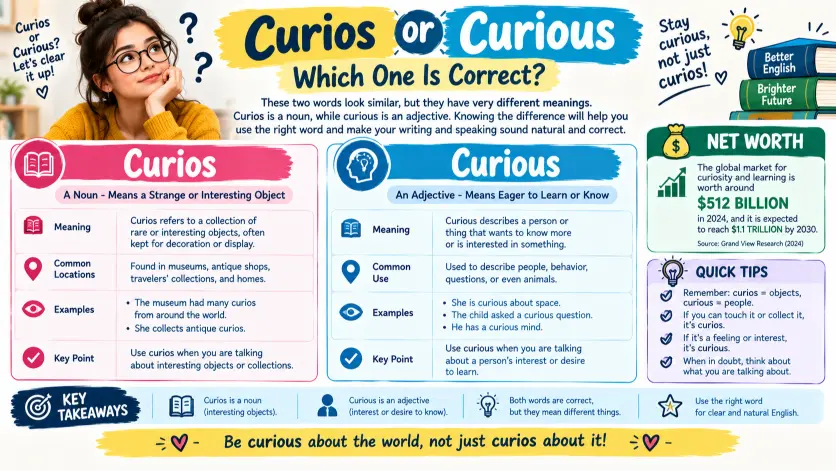
The simplest way to understand curios vs curious is to look at their parts of speech and meanings.
Curios is a noun. It is the plural form of curio. A curio is an unusual object, often collected because it is interesting, rare, decorative, historical, or mysterious.
Curious is an adjective. It normally describes a person, question, situation, object, or feeling that involves a desire to know more or something unusual.
| Word | Part of speech | Meaning | Example |
|---|---|---|---|
| Curios | Noun | Unusual or interesting collectible objects | The shop displayed antique curios. |
| Curious | Adjective | Eager to know or interested in learning | She was curious about the result. |
| Curious | Adjective | Strange or unusual | A curious sound came from the room. |
The distinction becomes easier when you ask what the word is doing in the sentence.
Curios names things.
Curious describes people, feelings, questions, or unusual situations.
If you’re talking about a collection of unusual objects, curios may be correct. If you’re describing someone’s desire to learn or investigate, curious is the correct choice.
Mini Recap
Curios is a plural noun.
Curious is an adjective.
A person can be curious, but a person isn’t normally described as a curios.
A collection can contain curios, while a person can have a curious mind.
Is Curios vs Curious a Grammar, Vocabulary, or Usage Issue?
The confusion between curios vs curious is primarily a vocabulary and spelling issue, but grammar also plays an important role.
The two words look similar because they share several letters. However, their meanings and grammatical functions are completely different.
You cannot normally substitute one for the other.
For example:
I am curious about the answer.
Here, curious describes the speaker’s state of mind.
Now compare:
The museum contains several ancient curios.
Here, curios refers to objects.
The words also differ in their typical contexts.
Curious is common in everyday conversation, education, journalism, professional communication, and academic writing. It can describe intellectual interest, investigation, or something unusual.
Curios is more specialized. You’ll often encounter it when discussing antiques, collectibles, museums, vintage shops, historical objects, decorative pieces, or unusual collections.
In casual speech, someone might say:
I’m curious about that.
In a historical or collecting context, someone might say:
The cabinet contains several fascinating curios.
The words therefore aren’t interchangeable in formal or informal English. The correct choice depends on what you’re trying to express.
What Does Curios Mean?
Curios is the plural form of curio, a noun referring to an unusual, rare, interesting, or collectible object.
A curio might be an antique, a small historical artifact, an unusual decorative item, or an object collected because of its distinctive character.
For example:
The antique store was filled with fascinating curios.
Here, curios refers to the unusual objects inside the store.
You might also see the word in descriptions of cabinets, museums, private collections, antique shops, and historical displays.
Workplace Example
The company’s reception area displayed several cultural curios collected by the founder.
The word curios refers to physical objects.
Academic Example
The researcher examined several historical curios preserved in the university archive.
Again, curios functions as a noun because it names objects.
Technology Example
The digital museum catalog includes photographs of rare curios from the nineteenth century.
The objects are still the subject, even though technology is being used to display or catalog them.
Usage Recap
Use curios when you mean unusual objects or collectibles.
It is a plural noun.
It does not describe a person’s interest or desire to learn.
What Does Curious Mean?
Curious is an adjective with two major meanings.
The first meaning relates to a strong desire to know, discover, understand, or learn something.
For example:
The student was curious about how the experiment worked.
Here, curious describes the student’s desire for information.
The second meaning relates to something strange, unusual, or unexpected.
For example:
A curious pattern appeared on the old wall.
In this sentence, curious means unusual or peculiar rather than intellectually interested.
Workplace Example
I’m curious to know whether the new process will improve productivity.
The speaker wants additional information.
Academic Example
Curious students often ask questions that lead to deeper research.
Here, curious describes students who want to understand more.
Technology Example
Users may be curious about how a system generates its responses.
The adjective describes people’s desire to understand technology.
Usage Recap
Use curious when describing someone who wants to know something.
Use it when describing something unusual or unexpected.
It is an adjective, not a plural noun.
When You Should NOT Use Curios or Curious
Knowing when not to use a word can prevent many mistakes. Here are common situations where choosing the wrong form can change the meaning.
1. Don’t use curios to describe an interested person
Incorrect:
She is very curios about science.
Correct:
She is very curious about science.
The person has an interest in learning, so the adjective curious is required.
2. Don’t use curious when referring to multiple collectible objects
Incorrect:
The shop sells several curious.
Correct:
The shop sells several curios.
The sentence needs a plural noun.
3. Don’t treat curios as an adjective
Incorrect:
He has a curios mind.
Correct:
He has a curious mind.
The word modifies mind, so an adjective is required.
4. Don’t use curious as the plural of curio
Incorrect:
The museum displayed several curious from the collection.
Correct:
The museum displayed several curios from the collection.
Curios is the plural noun.
5. Don’t assume the spelling difference is only one letter
The words have different grammatical jobs. This isn’t merely a spelling variation.
6. Don’t use curios when talking about curiosity
Incorrect:
Her curios made her investigate the problem.
Correct:
Her curiosity made her investigate the problem.
The noun for the desire to know is curiosity.
7. Don’t confuse curious with curiosity
Curious is an adjective.
Curiosity is a noun.
For example:
He is curious.
His curiosity is obvious.
8. Don’t use curios simply because the sentence sounds formal
Curios has a specialized meaning. Using it just because it resembles curious will make the sentence incorrect.
Common Mistakes: Curios vs Curious
The following examples show how easily the two words can be confused.
| Correct sentence | Incorrect sentence | Explanation |
|---|---|---|
| She is curious about astronomy. | She is curios about astronomy. | Use the adjective curious for a person’s interest. |
| The museum contains several curios. | The museum contains several curious. | Use curios as the plural noun for unusual objects. |
| He has a curious mind. | He has a curios mind. | Curious describes the noun mind. |
| They collected unusual curios. | They collected unusual curious. | The sentence needs a plural noun. |
| I was curious about the answer. | I was curios about the answer. | A person’s desire to know requires curious. |
| The cabinet held rare curios. | The cabinet held rare curious. | Curios names the objects. |
Decision Rule Box
If you mean unusual or collectible objects, use curios.
If you mean someone who wants to know or understand something, use curious.
If you mean something strange or unusual, curious can also be correct as an adjective.
Curios and Curious in Modern Technology
Modern technology has created many situations where the word curious is especially common.
People frequently describe themselves as curious about modern technology, search engines, robotics, software, digital security, and emerging technologies.
For example:
I’m curious about how this in modern technology works.
Here, curious describes the user’s desire for information.
Technology can also involve physical curios. Museums and collectors increasingly use digital catalogs, high resolution photography, virtual exhibitions, and databases to document unusual historical objects.
For example:
The museum’s modern technology assisted catalog identifies unusual curios in its collection.
In this sentence, curios refers to physical objects.
This distinction remains the same regardless of whether the context is traditional or technological.
Curios or Curious: Why Does the Spelling Cause Confusion?
The confusion comes largely from visual similarity.
Both words begin with curio and contain the letters curi. When typing quickly, writers may remember the general appearance of the word without remembering its grammatical function.
There is another reason for the confusion: curios can look like an incomplete spelling of curious.
However, the words have different origins and meanings.
A useful mental trick is to associate curios with things and curious with thinking.
If you can point to the things being discussed, curios may be appropriate.
If you’re describing a person’s interest, question, investigation, or reaction to something unusual, curious is usually the better choice.
Etymology: Where Do Curios and Curious Come From?
The history of these words helps explain why they look related.
Curio comes from a form associated with the idea of something curious or interesting, and English eventually used curio as a noun for an unusual or interesting object.
The plural form is curios.
Curious developed from Latin and French forms connected with careful attention, inquiry, and a desire to know. Over time, English developed its modern meanings involving both intellectual interest and unusual qualities.
Although the words are historically related in concept, modern English gives them different grammatical roles.
That distinction is what matters when you’re writing today.
Expert Insight on Curios vs Curious
A useful linguistic principle is that similar spelling does not mean identical grammatical function.
When two words look alike, writers should consider three questions before choosing one:
- What does the word mean?
- What part of speech does the sentence require?
- What exactly is the word describing or naming?
This approach works beyond curios and curious. It can help with many English words that look or sound similar but perform different jobs.
Two Practical Case Studies
Case Study 1: A Student Writing About Learning
Imagine a student writing:
I am curios about how volcanoes form.
The intended meaning is clear, but the spelling is incorrect.
The corrected version is:
I am curious about how volcanoes form.
Why? The student is describing a desire to learn. The adjective curious modifies the subject.
This correction improves both spelling and grammatical accuracy.
Case Study 2: A Museum Description
Now consider a museum description:
The exhibition features several curious from around the world.
The intended meaning is physical objects. The correct version is:
The exhibition features several curios from around the world.
Here, curios is a plural noun referring to unusual objects.
The practical result is important: choosing the right word makes the description immediately understandable and professionally written.
Error Prevention Checklist
Always use curious when:
☐ Describing someone who wants to know more
☐ Describing intellectual interest
☐ Describing an unusual or strange situation
☐ Modifying nouns such as person, mind, question, or idea
☐ Talking about someone’s desire to investigate something
Always use curios when:
☐ Referring to multiple unusual objects
☐ Describing collectible items
☐ Discussing antique or historical objects
☐ Talking about unusual museum pieces
☐ Referring to a collection of interesting physical objects
Never use curios when:
☐ You mean an interested person
☐ You mean intellectual curiosity
☐ You are describing someone’s personality
☐ You need an adjective
Never use curious when:
☐ You need the plural noun for curio
☐ You are naming multiple unusual collectible objects
☐ You are referring specifically to a collection of curios
Related Grammar Confusions You Should Master
Learning curios vs curious is useful, but English contains many other confusing word pairs worth mastering.
1. Curiosity vs Curious
Curiosity is a noun, while curious is an adjective.
2. Advice vs Advise
Advice is a noun, while advise is a verb.
3. Affect vs Effect
These words usually have different grammatical functions and meanings, although both have several specialized uses.
4. Compliment vs Complement
A compliment is praise, while a complement completes or enhances something.
5. Lose vs Loose
Lose generally means to misplace or fail to win, while loose describes something that isn’t tight.
6. Principal vs Principle
A principal can be a person or something considered most important. A principle is a rule, belief, or standard.
7. Their vs There vs They’re
These words sound alike but have different meanings and grammatical functions.
8. Your vs You’re
Your indicates possession, while you’re means you are.
9. Its vs It’s
Its indicates possession, while it’s usually means it is or it has.
10. Then vs Than
Then commonly relates to time or sequence, while than is generally used for comparisons.
Understanding these distinctions strengthens writing because correct vocabulary depends on meaning as much as spelling.
FAQs
What is the difference between curios and curious?
Curios is the plural form of the noun curio, meaning unusual or collectible objects. Curious is an adjective describing someone who wants to know more or something that is strange or unusual.
Is curios a correct English word?
Yes. Curios is a correct English word. It is the plural form of curio and commonly refers to unusual, interesting, antique, or collectible objects.
Is curious the correct word for an interested person?
Yes. Curious is the correct adjective when describing someone who wants to learn, investigate, discover, or understand something.
Can I say curios about something?
No. In standard English, you should say curious about something. For example, “I am curious about the results.”
What is the plural of curio?
The standard plural is curios. For example, “The store contains several unusual curios.”
Is curious a noun or an adjective?
Curious is an adjective. It can describe a person’s desire to know something or something that is unusual, strange, or unexpected.
Is curiosity the noun form of curious?
Yes. Curiosity is the noun related to curious. For example, “Her curiosity led her to investigate the subject.”
How do you use curios in a sentence?
You can use curios as a plural noun when referring to unusual or collectible objects. For example, “The antique shop displayed several fascinating curios.”
How do you remember the difference between curios and curious?
Remember that curios are things, while curious describes a person, feeling, question, or unusual situation. This simple distinction prevents most errors.
Final Verdict
The correct choice between curios vs curious depends on meaning and grammar.
Use curios when you are talking about two or more unusual, interesting, antique, or collectible objects. It is the plural noun of curio. Use curious when describing someone who wants to know more, or when describing something strange or unusual. It is an adjective.
The easiest rule is simple: curios are objects, while curious describes interest or unusual qualities. Once you identify whether your sentence needs a noun or an adjective, the correct spelling becomes much easier to choose.









