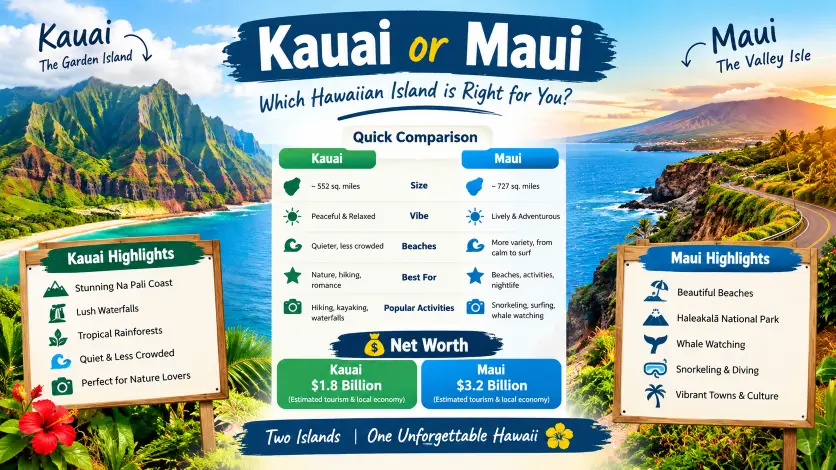
Choosing between Kauai or Maui can be surprisingly difficult because both islands offer breathtaking scenery, beautiful beaches, outdoor adventures, and unforgettable Hawaiian experiences. But they are not exactly the same. One may appeal more to travelers seeking dramatic nature and a quieter escape, while the other can be a better fit for visitors who want a wider mix of beaches, resorts, activities, dining, and sightseeing. So, which island deserves your vacation time?
In this guide, we’ll compare Kauai and Maui through the things travelers actually care about, including beaches, natural beauty, activities, accommodation, food, driving, atmosphere, costs, couples, families, and first-time visits. Rather than simply declaring one island the winner, we’ll explain where each destination stands out and what type of traveler it suits best. By the end, you’ll have a clearer, practical answer to Kauai or Maui and can choose the Hawaiian island that matches your travel style, priorities, and budget.
Kauai vs Maui: What’s the Difference?
Kauai and Maui are both major Hawaiian vacation destinations, yet their personalities are quite different. Kauai is the oldest of Hawaii’s main inhabited islands and is especially famous for its exceptionally green terrain, rugged mountains, valleys, cliffs, and waterfalls.
Maui is generally more developed as a visitor destination. It offers a broad selection of resorts, beaches, restaurants, scenic drives, snorkeling opportunities, and organized excursions.
The biggest difference is often the overall travel experience. Kauai tends to feel more natural and secluded, whereas Maui provides a more varied resort and activity environment.
| Feature | Kauai | Maui |
|---|---|---|
| Island type | Hawaiian island and proper noun | Hawaiian island and proper noun |
| General atmosphere | Quiet, lush, natural | Diverse, lively, resort friendly |
| Best known for | Mountains, waterfalls, hiking, scenery | Beaches, resorts, road trips, whales |
| Landscape | Extremely green and rugged | Beaches, mountains, valleys, volcanic terrain |
| Hiking | Excellent | Excellent |
| Beach vacation | Very good | Excellent |
| Resort selection | More limited | Broader |
| Nightlife | Relatively quiet | More options |
| Road trip appeal | Strong | Exceptional |
| Luxury travel | Available | Extensive |
| Nature focused trip | Excellent | Excellent |
| Relaxing vacation | Excellent | Excellent |
Quick recap
Choose Kauai if you want lush scenery, hiking, waterfalls, and a quieter environment.
Choose Maui if you want beaches, resorts, sightseeing, dining, and a broader activity selection.
Neither island is automatically better. Your travel style should determine the choice.
Is Kauai vs Maui a Grammar, Vocabulary, or Usage Issue?
Unlike spelling questions such as “affect or effect,” the phrase Kauai vs Maui isn’t really a grammar problem. It is a vocabulary and usage clarification involving two proper nouns.
Both words identify specific Hawaiian islands. They aren’t interchangeable because they refer to different geographical places.
You can use either name in formal writing, academic writing, travel articles, conversations, maps, and technology searches. The important point is accuracy.
For example:
“I’m planning a trip to Maui.”
This sentence identifies Maui specifically. Replacing Maui with Kauai changes the destination.
In casual conversation, someone might say, “Which is better, Kauai or Maui?” That’s perfectly natural. In academic or professional writing, you might instead write, “How does Kauai compare with Maui as a tourism destination?”
The meaning remains clear in both cases.
Using Kauai Correctly
Kauai should be used whenever you’re referring specifically to the Hawaiian island of Kauai.
The name commonly appears in discussions about the Na Pali Coast, Waimea Canyon, waterfalls, hiking trails, tropical scenery, beaches, and outdoor recreation.
Workplace example
A travel consultant might write:
“Our clients are considering Kauai because they prefer a peaceful destination with extensive outdoor opportunities.”
Here, Kauai identifies the specific island being considered.
Academic example
A geography student could write:
“Kauai provides an interesting example of how volcanic landscapes and erosion shape island environments.”
The name works naturally in formal educational writing.
Technology example
A traveler searching a navigation application might enter:
“Kauai hiking trails.”
The technology interprets Kauai as a geographical destination and can provide relevant locations.
Usage recap
Use Kauai when the destination, landscape, trip, business, attraction, or experience is specifically associated with that island.
Don’t substitute Maui simply because both are Hawaiian vacation destinations.
Using Maui Correctly
Maui should be used when you’re specifically discussing the island of Maui.
It is frequently associated with resort areas, beaches, Haleakala, the Road to Hana, whale watching, snorkeling, golf, restaurants, and scenic coastal drives.
Workplace example
A travel company might write:
“Maui remains a strong choice for travelers looking for a combination of beach relaxation and organized excursions.”
The sentence clearly identifies Maui as the destination.
Academic example
A student researching Hawaiian geography could write:
“Maui’s volcanic landscape has influenced the island’s physical geography and tourism patterns.”
Again, the proper noun identifies a particular island.
Technology example
A traveler might ask an AI travel assistant:
“What should I do in Maui for five days?”
The destination name gives the system an important piece of context for producing a relevant itinerary.
Usage recap
Use Maui when you’re referring to Maui specifically. Its name shouldn’t be treated as a generic word for Hawaii or Hawaiian islands.
When You Should NOT Use Kauai or Maui
Because these names identify different places, accuracy matters whenever you’re writing about a specific destination.
Here are common situations where choosing the wrong term can create confusion.
1. Referring to the entire Hawaiian Islands
Don’t use Kauai or Maui when you actually mean the Hawaiian Islands as a whole.
The appropriate wording would be “Hawaii” or “the Hawaiian Islands,” depending on your meaning.
2. Talking about Hawaii Island
Hawaii Island is commonly called the Big Island. It is different from both Kauai and Maui.
Calling Hawaii Island Maui is geographically incorrect.
3. Describing an attraction on the other island
If an attraction is located on Kauai, don’t describe it as a Maui attraction simply because Maui is a more familiar travel destination.
4. Writing a travel itinerary
A detailed itinerary needs accurate island names. Mixing destinations can create practical problems involving transportation, accommodation, and travel time.
5. Giving directions
Geographical names become especially important when providing directions. A recommendation on one island may not be conveniently accessible from another.
6. Comparing hotel options
A Kauai resort and a Maui resort aren’t interchangeable options. They belong to different destinations and may provide entirely different experiences.
7. Discussing local geography
Academic, professional, and educational writing should always identify the correct island.
8. Answering a travel question
If someone asks about Maui but you provide recommendations for Kauai without explaining the difference, your answer may be accurate in isolation but still fail the user’s intent.
Common Mistakes With Kauai and Maui
| Correct sentence | Incorrect sentence | Explanation |
|---|---|---|
| I want to visit Kauai for hiking. | I want to visit Maui for hiking in Kauai. | The destination needs to match the location being discussed. |
| Maui is known for its resort areas. | Kauai is the same as Maui. | The islands are separate destinations. |
| We stayed on Kauai. | We stayed in Maui when referring to Kauai. | Use the correct island name for the actual destination. |
| We’re comparing Kauai and Maui. | We’re comparing Hawaii and Maui when only two islands are intended. | Hawaii can refer to the state or Hawaii Island depending on context. |
| Maui is one of the Hawaiian Islands. | Maui is another name for Kauai. | The names identify different islands. |
| Kauai offers spectacular natural scenery. | Kauai means all of Hawaii. | Kauai is one island, not the entire state. |
Decision Rule
If you mean the island known for exceptionally lush scenery, dramatic valleys, waterfalls, and a quieter atmosphere, use Kauai.
If you mean the island known for beaches, resorts, scenic drives, whale watching, and a broader mix of vacation experiences, use Maui.
A simple memory trick is this: Kauai often fits the nature focused traveler, while Maui often fits the traveler seeking variety.
Kauai or Maui for Different Types of Travelers
The better choice becomes much easier when you start with your priorities.
For couples
Both islands can work beautifully for couples.
Kauai may appeal more to couples who want secluded scenery, hiking, waterfalls, and peaceful evenings. Maui can be attractive to couples who want beaches, upscale accommodations, restaurants, excursions, and scenic drives.
For families
Maui often has an advantage because its visitor infrastructure and range of activities can make planning easier for families.
Kauai can still be an excellent family destination, particularly for families who prioritize nature and outdoor exploration.
For adventure travelers
Kauai is especially compelling for travelers who love dramatic landscapes and hiking.
Maui also offers substantial adventure opportunities, particularly around its volcanic landscapes, coastal areas, and scenic roads.
For beach lovers
Maui generally has the stronger reputation for a classic beach focused vacation because of its broad selection of beaches and visitor facilities.
Kauai is still an excellent choice if beaches are only one part of a wider nature focused trip.
For a peaceful vacation
Kauai usually has the stronger appeal.
Its atmosphere can feel less centered around large resort experiences and more focused on landscapes and outdoor exploration.
Kauai or Maui for Nature and Scenery
If scenery is your main priority, the decision becomes particularly interesting.
Kauai is famous for its intense greenery and dramatic geological formations. Its landscapes can look almost cinematic, with steep mountains, valleys, tropical vegetation, and coastal cliffs.
Maui offers a different visual experience. The island combines beaches, mountains, volcanic terrain, agricultural areas, and coastal scenery.
So the choice depends on what kind of scenery you prefer.
If you imagine dense greenery, waterfalls, rugged cliffs, and tropical wilderness, Kauai may be the better match.
If you picture golden beaches, volcanic landscapes, coastal roads, and varied terrain, Maui may be more appealing.
Kauai or Maui for Beaches
Maui is generally the easier recommendation for travelers whose main goal is a traditional beach vacation.
The island offers a broad selection of beach experiences, along with many nearby resorts, restaurants, water activities, and visitor services.
Kauai also has beautiful beaches, but its overall identity is more strongly connected to its natural landscapes.
This distinction is important. A traveler who spends most of the trip relaxing beside the ocean may prefer Maui. Someone who wants beaches combined with hiking, waterfalls, scenic viewpoints, and exploration may find Kauai more satisfying.
Kauai or Maui for Hiking
Kauai is a standout choice for hiking enthusiasts.
Its rugged geography creates opportunities to explore valleys, forests, coastal landscapes, and dramatic viewpoints. Some hikes can be demanding, so travelers should consider weather, trail conditions, fitness level, and local guidance before setting out.
Maui also offers excellent hiking, particularly in areas where volcanic terrain and mountain landscapes create striking scenery.
For serious nature lovers, Kauai may have the stronger overall appeal. For travelers who want hiking as one activity among many, Maui provides a balanced alternative.
Kauai or Maui for a First Hawaiian Vacation
For a first trip, Maui is often easier for travelers who want a little bit of everything.
You can build a vacation around beaches, scenic drives, restaurants, resorts, outdoor activities, and sightseeing without having to make the trip exclusively nature focused.
Kauai can be the better first choice for someone whose image of Hawaii centers on untouched scenery, tropical landscapes, hiking, and relaxation.
There isn’t a universally correct answer. Your first Hawaiian vacation should reflect what you actually want to experience rather than what another traveler considers the “best” island.
Kauai and Maui in Modern Technology
Modern travelers increasingly use search engines, maps, booking platforms and to compare destinations.
That makes precise wording more important than ever.
For example, asking a tool “Which is better, Kauai or Maui?” produces a broad comparison. Asking “Which is better for hiking, Kauai or Maui?” creates a more useful question because the user’s priority is clear.
Technology also benefits from geographic precision. Searching for “Maui snorkeling” and “Kauai snorkeling” produces different destination specific results.
The same principle applies to the content. A page targeting “Kauai or Maui” should answer the comparison directly rather than treating the names as interchangeable keywords.
Etymology and Name Background
Kauai and Maui are traditional Hawaiian place names with long cultural and historical associations.
Their names are not modern marketing terms created for tourism. They are established geographical names connected to the history, language, traditions, and identity of Hawaii.
Pronunciation can also be unfamiliar to visitors because Hawaiian pronunciation follows linguistic patterns that differ from English.
When writing the names, capitalization is important because both are proper nouns.
For professional content, accurate spelling and respectful treatment of Hawaiian place names are essential.
“The best destination is the one that matches the traveler, not the one that wins every comparison.”
This principle is especially useful when comparing Kauai and Maui because each island serves a somewhat different travel style.
Two Practical Case Studies: Choosing the Right Island
Case Study 1: The nature focused traveler
Imagine a traveler with seven days who wants hiking, waterfalls, photography, scenic viewpoints, and quiet surroundings. Nightlife and large resort facilities aren’t important.
For this traveler, Kauai is likely the stronger fit.
The decision is based on priorities rather than a claim that Kauai is objectively better. The island’s landscape aligns closely with the traveler’s goals.
Case Study 2: The balanced vacation traveler
Now imagine a couple who wants several days of beach relaxation, comfortable accommodation, restaurants, sightseeing, whale watching during the appropriate season, and one or two major excursions.
Maui may be the more suitable choice because it provides a broad mix of experiences that can be combined into one trip.
These examples demonstrate an important lesson: the best island depends on the vacation you are trying to create.
Related Grammar Confusions You Should Master
Kauai and Maui aren’t grammar alternatives, but the comparison can lead to other common language questions.
Here are several related topics worth understanding:
- Hawaii vs Hawaii Island
- Island vs state
- Then vs than
- Affect vs effect
- Fewer vs less
- Its vs it’s
- There vs their vs they’re
- Lay vs lie
- Who vs whom
- Further vs farther
The broader lesson is simple: precise word choice depends on understanding what each term actually represents.
Error Prevention Checklist
Always use Kauai when:
You mean the island of Kauai.
You’re discussing Kauai’s attractions.
You’re describing its landscapes or geography.
You’re recommending accommodation located there.
You’re discussing a Kauai specific itinerary.
Never use Maui when:
The subject is specifically Kauai.
You’re identifying the location of a Kauai attraction.
You’re giving directions to a Kauai destination.
You’re describing Kauai’s geography.
You’re answering a question specifically about Kauai.
Always use Maui when:
You mean the island of Maui.
You’re discussing Maui’s beaches, resorts, or attractions.
You’re describing an itinerary based on Maui.
You’re discussing Maui specific geography.
You’re identifying a destination located on Maui.
Advanced FAQs
Is Kauai or Maui better for a first trip to Hawaii?
Maui is often a strong choice for first time visitors who want a mixture of beaches, sightseeing, resorts, restaurants, and outdoor activities. Kauai may be better for travelers whose first priority is nature, hiking, dramatic scenery, and a quieter environment.
Is Kauai or Maui better for couples?
Both can be excellent for couples. Kauai tends to suit couples looking for peaceful scenery and nature focused experiences, while Maui can be a better fit for couples who want beaches, restaurants, resorts, and a broader range of activities.
Is Kauai or Maui better for families?
Maui can be particularly convenient for families because of its broad visitor infrastructure and range of activities. Kauai can be an excellent family destination for those who prioritize nature and outdoor exploration.
Is Kauai more beautiful than Maui?
Beauty is subjective. Kauai is especially known for lush greenery, waterfalls, mountains, and dramatic cliffs. Maui offers beaches, volcanic scenery, coastal landscapes, and varied terrain. Your preferred landscape should guide the decision.
Is Kauai or Maui better for beaches?
Maui is generally the stronger choice for travelers who want a traditional beach centered vacation. Kauai has beautiful beaches as well, but its biggest appeal often lies in its overall natural environment.
Is Kauai or Maui better for hiking?
Kauai is particularly attractive to hikers because of its rugged and exceptionally green terrain. Maui also offers excellent hiking, so travelers who want hiking alongside many other vacation activities may prefer Maui.
Are Kauai and Maui the same island?
No. Kauai and Maui are two separate Hawaiian islands. They have different geography, attractions, communities, accommodations, and travel experiences.
Which is cheaper, Kauai or Maui?
There isn’t one fixed answer because costs depend on travel dates, accommodation, transportation, activities, and dining choices. Compare the complete trip rather than judging the islands by accommodation prices alone.
How many days do you need in Kauai or Maui?
A week can provide a useful introduction to either island. Longer stays allow travelers to explore more thoroughly without rushing between activities.
Should I visit Kauai or Maui for a relaxing vacation?
Kauai is often the stronger choice for travelers who associate relaxation with quiet surroundings and nature. Maui can be better for people who prefer relaxation combined with resorts, restaurants, beaches, and organized activities.
Final Verdict: Kauai or Maui?
So, which should you choose: Kauai or Maui?
Choose Kauai if your ideal Hawaiian vacation revolves around lush scenery, waterfalls, hiking, dramatic landscapes, photography, and a peaceful atmosphere. Choose Maui if you want a broader combination of beaches, resorts, restaurants, sightseeing, scenic drives, outdoor activities, and comfortable tourist infrastructure.
Neither island wins every category. Kauai is often the better match for nature focused travelers, while Maui is often the better match for travelers who want variety.
The smartest choice isn’t simply asking which island is better. Ask what you want to do, how you want your vacation to feel, and which landscape makes you most excited to wake up each morning.









