Have you ever wondered whether crawfish or crayfish is the correct word? You may have seen both terms used for the same small freshwater crustacean and wondered if they actually refer to different animals. The confusion is understandable because the name can change depending on location, culture, and everyday usage.
In this guide, we’ll explain crawfish vs crayfish in simple language, including what each term means, where the names are commonly used, and whether there is any real difference between them. You’ll also learn how regional English influences the words people choose in conversation, cooking, restaurants, and writing.
The goal is to give you a clear, reliable answer based on established language and zoological usage rather than common assumptions. Whether you’re writing an article, checking your spelling, ordering seafood, or simply curious about the terminology, this guide will help you confidently understand when and why people say crawfish or crayfish.
X vs Y: What’s the Difference?
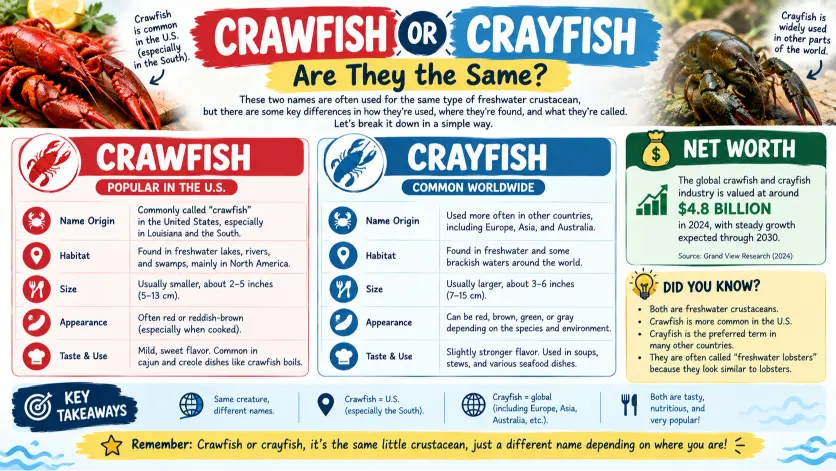
The words crawfish and crayfish describe the same basic animal. Both are nouns, and both refer to small freshwater crustaceans with hard shells, claws, and segmented bodies.
The main difference isn’t the animal itself. The difference is largely regional, cultural, and stylistic.
Crawfish is strongly associated with American English, especially the southern United States. If you’ve ever seen a Louisiana seafood menu, attended a crawfish boil, or read about Cajun food, you’re likely to encounter this spelling.
Crayfish is also completely correct. It’s particularly common in scientific writing and in varieties of English outside the southern United States. British English, Australian English, and many international sources commonly use crayfish.
| Feature | Crawfish | Crayfish |
|---|---|---|
| Part of speech | Noun | Noun |
| Meaning | A freshwater crustacean | A freshwater crustacean |
| Animal referred to | Same general animal | Same general animal |
| Common American usage | Very common in southern regions | Also common |
| Louisiana usage | Extremely common | Less culturally associated |
| Scientific writing | Less common | Common |
| British English | Less common | Common |
| Australian English | Less common | Common |
| Formal usage | Acceptable | Acceptable |
| Informal usage | Very common in the southern United States | Common internationally |
Quick Recap
Both words identify the same type of freshwater crustacean.
Crawfish has a particularly strong connection with southern American culture.
Crayfish is often preferred in scientific and international English.
Neither spelling is inherently wrong.
Your best choice depends on your audience, location, and context.
Is Crawfish vs Crayfish a Grammar, Vocabulary, or Usage Issue?
This is primarily a vocabulary and usage issue, rather than a grammar problem.
Grammar determines how words function in sentences. In this case, both words function as nouns and can occupy the same grammatical positions.
For example:
We ordered crawfish for dinner.
You could also write:
We ordered crayfish for dinner.
The grammatical structure remains correct.
The real question is which vocabulary choice sounds natural to your intended audience.
In southern American English, particularly around Louisiana, crawfish can feel much more natural and culturally familiar. A restaurant advertising a traditional Louisiana seafood event would probably choose crawfish because the word carries a strong regional association.
In academic or scientific writing, crayfish may be the safer choice because it is widely recognized internationally.
Neither word should automatically be considered informal or incorrect.
The important distinction is regional preference rather than grammatical correctness.
When Should You Use Crawfish?
Use crawfish when your writing is aimed at an American audience, especially readers familiar with southern food, Louisiana culture, Cajun traditions, or regional seafood.
The word works naturally in everyday conversations.
For example:
We’re having a crawfish boil this weekend.
It also works perfectly well in business communication.
Workplace Example
Imagine a Louisiana restaurant manager sending an announcement to employees:
Our crawfish special begins Friday and will continue through Sunday.
Using crawfish makes sense because the word matches the restaurant’s regional identity and the audience’s expectations.
Academic Example
In an academic paper discussing Louisiana food culture, you might write:
Crawfish has become an important part of Louisiana’s culinary identity.
Here, the regional spelling helps communicate the cultural context.
Technology Example
Suppose a food delivery application has a restaurant category called:
Crawfish Specials
That wording is immediately understandable to American users, particularly those searching for southern seafood.
Usage Recap
Choose crawfish when regional American usage matters.
It is especially natural for Louisiana food, southern traditions, restaurant menus, festivals, recipes, and casual American conversation.
When Should You Use Crayfish?
Use crayfish when writing for an international audience or when scientific and general reference language is more appropriate.
The word is especially useful when discussing biology, freshwater ecosystems, species identification, conservation, or international English.
For example:
Crayfish are important members of many freshwater ecosystems.
Workplace Example
A conservation organization preparing an international report might write:
The project examines the impact of invasive crayfish on freshwater habitats.
Here, crayfish fits the scientific and international setting naturally.
Academic Example
A biology textbook could state:
Crayfish belong to the larger group of crustaceans and are adapted to freshwater environments.
The word is broadly recognizable and suitable for educational writing.
Technology Example
A wildlife identification application might use crayfish as the category name because users from different English speaking countries may search for the animal using different regional vocabulary.
Usage Recap
Choose crayfish for scientific, educational, international, and formal informational contexts.
It is also perfectly natural in everyday English outside regions where crawfish is especially dominant.
When You Should NOT Use Crawfish or Crayfish
There are situations where choosing between these words isn’t actually the main issue. The surrounding context may require a more precise term.
1. When You Mean a Different Animal
Don’t assume every clawed freshwater crustacean belongs to exactly the same species group.
Scientific identification can require a species name rather than a general common name.
2. When Writing a Species Specific Scientific Paper
If your research concerns one particular species, use the accepted scientific classification where appropriate rather than relying only on a common name.
3. When Your Audience Has a Strong Regional Preference
A local publication should generally follow the vocabulary its readers naturally recognize.
4. When Reproducing an Official Name
If a restaurant, organization, event, or product uses a particular spelling in its official name, don’t change it merely to follow your preferred regional form.
5. When Discussing Invasive Species
Environmental writing often requires more precision. Identify the species or region whenever the distinction matters to the research.
6. When Translating Scientific Material
A translator should consider the target variety of English rather than mechanically replacing one spelling with another.
7. When Creating a Local Search Phrase
Search behavior can differ by region. Someone looking for Louisiana seafood may search for crawfish, while another audience may naturally search for crayfish.
8. When Quoting a Source
If you are quoting a source, preserve the source’s original wording and spelling.
Common Mistakes and Decision Rules
One of the biggest mistakes is treating one spelling as correct and the other as incorrect.
That’s not an accurate way to understand this vocabulary difference.
| Correct sentence | Incorrect sentence | Explanation |
|---|---|---|
| We bought crawfish for the party. | We bought crawfishs for the party. | The plural form does not normally require an added s. |
| The crayfish lives in freshwater. | The crayfishes lives in freshwater. | Singular agreement is required with a singular subject. |
| Louisiana is famous for crawfish dishes. | Louisiana is famous for crawfishs dishes. | Crawfish already works as a noun in this construction. |
| Scientists studied crayfish populations. | Scientists studied crayfishes populations. | Crayfish can function as a plural noun. |
| We ordered crawfish at the restaurant. | We ordered crayfish at the Louisiana restaurant because crawfish is wrong. | Both terms can be correct. |
| The study discusses crayfish habitats. | The study discusses crawfish habitats because academic writing requires crayfish. | Context determines the preferred term. |
Decision Rule Box
If you’re describing southern American food or Louisiana culture, crawfish is often the most natural choice.
If you’re writing for an international, scientific, or educational audience, crayfish is often the safer choice.
If the audience has a known regional preference, follow that preference.
The most important rule is simple: don’t treat regional vocabulary as a spelling error.
Crawfish and Crayfish in Modern Technology and Tools
Modern technology has made regional vocabulary differences even more visible.
Search engines, voice assistants, food delivery platforms, language models, spell checkers, and writing applications may encounter both forms.
If you type a query such as:
What is a crawfish?
you can receive information about the same general animal that appears when searching for:
What is a crayfish?
The difference becomes particularly important in search engine optimization.
A website targeting Louisiana food lovers may naturally use crawfish because that is the language its audience expects. A wildlife education website targeting readers around the world may prefer crayfish.
Modern writing tools can also produce either term depending on the context provided in the prompt. This is why writers shouldn’t automatically replace one word with the other without considering their target audience.
For content creators, the best strategy is semantic clarity rather than forcing one spelling everywhere.
A useful article can even acknowledge both terms naturally:
Crawfish, also called crayfish in many regions, are freshwater crustaceans related to lobsters.
That approach helps readers understand the vocabulary variation without suggesting that one spelling is wrong.
Etymology: Where Do Crawfish and Crayfish Come From?
The history of these words helps explain why two forms exist.
Crayfish developed through changes in English pronunciation and spelling associated with the French word écrevisse, a term referring to a freshwater crustacean.
English speakers adapted unfamiliar terminology over time, and several related forms appeared.
Crawfish is generally understood as a later English form influenced by the pronunciation and association of the word with crawling.
The result is a fascinating example of how everyday vocabulary changes.
Languages don’t develop in perfectly straight lines. Regional communities reshape words according to pronunciation, cultural identity, historical contact, and local usage.
That’s why two words can survive while referring to essentially the same animal.
Expert Style Insight
“When two regional words describe the same thing, correctness often depends less on the dictionary and more on the audience you’re trying to reach.”
This principle applies far beyond crawfish and crayfish. English contains countless regional vocabulary differences, including variations between American, British, Australian, and other forms of the language.
Two Practical Case Studies: Regional Vocabulary in Action
Case Study 1: Louisiana Food Culture
Consider a Louisiana seafood restaurant creating a menu for local customers.
The restaurant could describe its signature dish as:
Spicy Crawfish Étouffée
Using crawfish immediately matches the regional culinary vocabulary associated with Louisiana.
If the restaurant replaced every occurrence with crayfish, the meaning would remain understandable, but the wording could feel less locally authentic.
The practical result is clear: regional vocabulary can influence how natural and culturally appropriate marketing language feels.
Case Study 2: International Environmental Research
Now consider an environmental research organization publishing an article about freshwater crustaceans for an international audience.
A heading such as:
Crayfish and Freshwater Ecosystems
is likely to feel more neutral and internationally recognizable than a strongly regional term.
The practical result is that crayfish can provide broader vocabulary recognition when the audience includes readers from multiple English speaking regions.
These examples demonstrate an important writing principle: the strongest word isn’t always the most universal word. Sometimes the strongest word is the one that best matches the audience.
Error Prevention Checklist
Always Use Crawfish When
You are writing specifically about Louisiana food culture.
You are describing a southern American crawfish boil.
Your restaurant or event traditionally uses the word crawfish.
Your audience strongly prefers southern American terminology.
You are creating locally targeted food content where crawfish is the natural search term.
Never Use Crayfish When
Don’t use crayfish merely because you believe crawfish is grammatically wrong.
Don’t replace an official name without a reason.
Don’t assume that scientific writing automatically makes crawfish incorrect.
Don’t treat regional vocabulary as a spelling mistake.
Don’t change a quotation’s original spelling.
The same principle works in reverse. Don’t replace crayfish with crawfish simply because you personally hear crawfish more often.
Related Grammar Confusions You Should Master
Understanding crawfish and crayfish can lead naturally into other common English vocabulary questions.
Here are several useful comparisons worth mastering:
- Advice vs Advise
Advice is a noun, while advise is a verb.
- Affect vs Effect
These words often differ in grammatical function and meaning.
- Fewer vs Less
Fewer generally works with countable items, while less commonly works with uncountable quantities.
- Everyday vs Every Day
Everyday is an adjective, while every day refers to each day.
- Than vs Then
Than is generally used for comparisons, while then commonly relates to time or sequence.
- Compliment vs Complement
Compliment relates to praise, while complement relates to something that completes or enhances another thing.
- Principal vs Principle
Principal can refer to a person or something primary, while principle generally refers to a rule, belief, or fundamental idea.
- Practice vs Practise
These forms vary according to the variety of English being used.
- Lay vs Lie
These verbs create confusion because their grammatical patterns differ.
- Among vs Between
The appropriate choice depends on the relationship being described and the context.
Learning these distinctions helps develop vocabulary awareness instead of relying only on spell checking software.
Frequently Asked Questions
Is crawfish or crayfish the correct spelling?
Both spellings are correct. They generally refer to the same type of freshwater crustacean. Crawfish is especially common in southern American English, while crayfish has broader international and scientific usage.
Is crawfish the same thing as crayfish?
Yes, in ordinary usage, both words refer to freshwater crustaceans that resemble small lobsters. The difference is mainly regional and stylistic rather than a simple difference between two unrelated animals.
Which is more common, crawfish or crayfish?
Usage depends heavily on location. Crawfish is particularly common in the southern United States, especially Louisiana. Crayfish is widely used in scientific and international English.
Why do Americans say crawfish?
Crawfish developed as an English regional form and became strongly associated with southern American culture. Louisiana cuisine helped make the word especially familiar throughout the United States.
Is crayfish more correct than crawfish?
No. Crayfish is not inherently more correct. It may be more appropriate in scientific or international writing, while crawfish may be more natural in southern American contexts.
Should I use crawfish in a formal essay?
You can use crawfish in a formal essay when the context calls for it. Formal writing doesn’t make the word incorrect. If you’re discussing biology for an international audience, however, crayfish may be the more broadly recognized choice.
Do crawfish and crayfish have different meanings?
Generally, no. Both names identify freshwater crustaceans commonly associated with small lobster like animals. Some specific species or regional classifications may require more precise terminology.
What is the plural of crawfish?
Crawfish can function as both a singular and plural noun. You can say one crawfish or many crawfish. The same pattern commonly applies to crayfish.
Is crayfish British English?
Crayfish is widely used in British English and other varieties of international English. It is also common in scientific and educational writing.
Which word should I use for SEO?
Choose the term that matches your target audience and search intent. Crawfish is highly relevant to southern American food and Louisiana content, while crayfish may provide broader international recognition. When appropriate, naturally mention both terms.
Crawfish or Crayfish
Crawfish and crayfish are both correct words for the same general type of freshwater crustacean. The real difference is regional usage, cultural association, and writing context.
Choose crawfish when you’re writing about Louisiana cuisine, southern American traditions, crawfish boils, restaurants, recipes, or a local American audience. Choose crayfish when you’re writing for an international audience or discussing freshwater biology, environmental science, education, or scientific subjects.
Most importantly, don’t mistake vocabulary variation for grammatical error. English is a living language, and regional communities often develop different names for the same object, animal, or idea.









