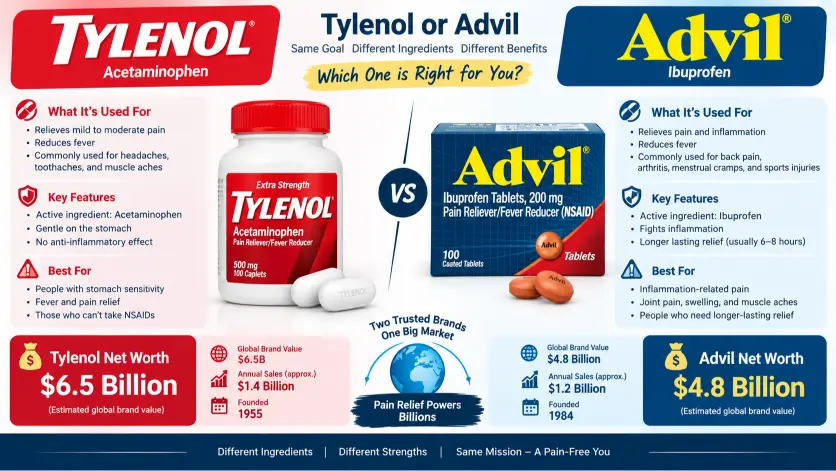
When you have a headache, fever, muscle aches, or everyday pain, Tylenol or Advil may be two of the first options that come to mind. But are they really the same? Not quite. Although both can help relieve pain and reduce fever, they contain different active ingredients and work differently in the body. That means the better choice can depend on the type of pain, your health needs, other medicines you take, and how your body responds.
Understanding the difference between Tylenol and Advil can help you make a more informed decision instead of choosing based only on brand familiarity. In this guide, we’ll compare their active ingredients, common uses, effectiveness, side effects, safety considerations, and key differences.
This article is for general education, not personal medical advice, and medication labels or advice from a qualified healthcare professional should take priority, especially for children, pregnancy, chronic conditions, or regular medication use.
Tylenol or Advil: What’s the Difference?
The most important distinction is their active ingredients and drug classes.
Tylenol is a brand name for products containing acetaminophen. Acetaminophen is an analgesic, meaning it relieves pain, and an antipyretic, meaning it reduces fever. It isn’t classified as an NSAID and doesn’t provide the same anti inflammatory effect as ibuprofen.
Advil is a brand name for ibuprofen, which belongs to a group of medicines called nonsteroidal anti inflammatory drugs, commonly shortened to NSAIDs. Ibuprofen can relieve pain and fever while also reducing inflammation.
| Feature | Tylenol | Advil |
|---|---|---|
| Active ingredient | Acetaminophen | Ibuprofen |
| Drug class | Analgesic and antipyretic | NSAID |
| Relieves pain | Yes | Yes |
| Reduces fever | Yes | Yes |
| Reduces inflammation | Not significantly | Yes |
| Common concern | Liver damage from excessive dosing | Stomach, kidney, bleeding and cardiovascular risks |
| Common uses | Headache, fever, general aches | Muscle pain, inflammatory pain, cramps, arthritis |
| Available without prescription | Yes | Yes |
Mini recap
Tylenol and Advil aren’t simply two names for the same medicine.
Tylenol contains acetaminophen, while Advil contains ibuprofen.
Advil has an anti inflammatory effect that acetaminophen doesn’t provide.
Neither is automatically better for every person or every type of pain.
Is Tylenol or Advil a Grammar, Vocabulary, or Usage Issue?
Unlike many comparison queries, this isn’t a grammar problem. It’s primarily a medical vocabulary and usage distinction.
The terms aren’t interchangeable because they refer to different medicines with different active ingredients.
In casual conversation, people may say, “Take Tylenol” or “Take Advil” when they simply mean “take a pain reliever.” However, medically, the distinction matters because the ingredients, risks, interactions, and appropriate uses aren’t identical.
In an academic or healthcare context, it is more precise to identify the active ingredient. For example, saying acetaminophen or ibuprofen eliminates ambiguity between brands and combination products.
The same principle applies when reading medicine labels. A product’s brand name doesn’t always tell you everything you need to know. Checking the active ingredient helps prevent accidental duplication.
Tylenol or Advil for Pain: When Tylenol May Be Considered
Tylenol may be useful for mild to moderate pain when inflammation isn’t the primary concern.
Common examples include headaches, fever associated with common illnesses, and general aches. Acetaminophen is also found in numerous combination prescription and nonprescription medicines, which makes label checking particularly important.
Workplace example
Imagine someone develops a mild headache during a workday. If they normally tolerate acetaminophen and have no contraindication, a properly labeled acetaminophen product may be an option.
The key isn’t simply choosing a familiar brand. The person should check the label, consider other medicines they have taken, and follow the package directions.
Academic example
A health education assignment might state:
“Acetaminophen is an analgesic and antipyretic but is not an NSAID.”
That wording is more accurate than saying acetaminophen is an anti inflammatory medicine.
Technology example
Medication reminder apps and electronic health records may display acetaminophen rather than the brand name Tylenol. Understanding that relationship can help users recognize duplicate ingredients across several products.
Tylenol usage recap
Tylenol means a brand associated with acetaminophen.
Acetaminophen can reduce pain and fever.
It doesn’t have the same anti inflammatory action as ibuprofen.
Excessive acetaminophen can cause serious liver injury.
Tylenol or Advil for Inflammation: When Advil May Be Considered
Advil contains ibuprofen, an NSAID. Because ibuprofen has anti inflammatory properties, it may be particularly useful when pain involves inflammation, such as certain muscle, joint, menstrual, or arthritis related pain.
That doesn’t mean ibuprofen is automatically the better painkiller. The best choice depends on the person and the situation.
Workplace example
A person with temporary muscle soreness after physical work may consider an NSAID if inflammation is part of the problem and they can safely take ibuprofen.
Academic example
In a pharmacology paper, ibuprofen would be classified as an NSAID rather than simply described as a general painkiller.
Technology example
A medication database may identify Advil through its active ingredient, ibuprofen. This matters because different brands can contain the same active ingredient.
Advil usage recap
Advil contains ibuprofen.
Ibuprofen reduces pain, fever, and inflammation.
NSAIDs can cause stomach irritation, ulcers, bleeding, and other serious complications, particularly with higher doses or longer use.
When You Should NOT Use Tylenol or Advil
There are situations where choosing either medicine without professional guidance can be inappropriate.
1. Don’t exceed the labeled acetaminophen amount
Taking too much acetaminophen can cause severe liver injury. The FDA states that adults and children 12 years and older should not exceed 4,000 mg of acetaminophen in 24 hours from all sources. Individual products can have different labeling directions, so the package should always be followed.
2. Don’t combine multiple acetaminophen products unknowingly
Cold, flu, prescription, and pain medicines may contain acetaminophen. Taking several products without checking their ingredients can unintentionally increase the total dose.
3. Don’t treat ibuprofen as harmless because it is over the counter
Ibuprofen can cause gastrointestinal bleeding, ulcers, and other serious problems. It can also increase cardiovascular risks in certain circumstances.
4. Don’t use ibuprofen casually with certain medicines
People taking blood thinners or other medicines that increase bleeding risk should ask a healthcare professional before using NSAIDs.
5. Don’t ignore kidney concerns
People with kidney disease or significant dehydration may need specific medical advice before using NSAIDs such as ibuprofen.
6. Don’t assume pregnancy changes nothing
Medication decisions during pregnancy deserve professional guidance. Ibuprofen has important pregnancy related precautions, particularly later in pregnancy.
7. Don’t keep treating persistent symptoms indefinitely
For adults, persistent pain or fever despite appropriate over the counter treatment deserves medical evaluation rather than repeated self treatment. MedlinePlus advises seeking medical advice when pain or fever persists beyond the recommended period.
8. Don’t choose a medicine based only on brand familiarity
A recognizable brand isn’t a substitute for checking the active ingredient, dose, warnings, and other medicines being taken.
Common Mistakes and Decision Rules
| Correct sentence | Incorrect sentence | Explanation |
|---|---|---|
| Tylenol contains acetaminophen. | Tylenol contains ibuprofen. | The active ingredients are different. |
| Advil contains ibuprofen. | Advil contains acetaminophen. | Advil is an ibuprofen brand. |
| Ibuprofen is an NSAID. | Acetaminophen is an NSAID. | Acetaminophen isn’t classified as an NSAID. |
| Acetaminophen can reduce fever. | Acetaminophen strongly reduces inflammation. | Its primary actions are pain relief and fever reduction. |
| Ibuprofen can reduce inflammation. | Ibuprofen has no anti inflammatory effect. | Ibuprofen is an NSAID. |
| Check for acetaminophen in combination products. | Assume cold medicine has no pain reliever. | Combination products may contain acetaminophen. |
Decision Rule Box
If you mean acetaminophen based pain or fever relief, think Tylenol.
If you mean ibuprofen based pain, fever, or inflammation relief, think Advil.
If you’re deciding which medicine is safer for you, don’t rely on the brand name alone. Consider your medical history, other medicines, age, pregnancy status, and the product label.
The action, person, or tool rule sometimes used for vocabulary comparisons does not apply here because Tylenol and Advil are medicine brand names, not grammatical forms representing different actions or people.
Tylenol or Advil in Modern Technology and Tools
Modern medication databases, pharmacy systems, health apps and tools increasingly identify medicines by their active ingredients rather than relying only on brand names.
That distinction is useful because one active ingredient can appear under multiple brand names and in combination products.
For example, someone searching a digital medication database for Tylenol may need to understand that the relevant ingredient is acetaminophen. Someone searching for Advil should recognize ibuprofen.
Modern tools can explain these distinctions, but they shouldn’t replace a pharmacist or physician when a decision involves serious medical conditions, drug interactions, pregnancy, children, overdose concerns, or persistent symptoms.
What Are the Origins of Tylenol and Advil?
The names come from different histories.
Tylenol is a brand name associated with acetaminophen. In the United States, the same active ingredient is commonly called acetaminophen, while many other countries use the name paracetamol.
Advil is a brand name associated with ibuprofen.
The more medically useful vocabulary is therefore the active ingredient rather than the trademark. Knowing both names makes it easier to understand labels and avoid duplicate medication.
What Does Medical Evidence Say About Tylenol and Advil?
Clinical evidence doesn’t support the idea that one medicine is universally superior.
A randomized dental pain study involving 184 patients found that a single 400 mg dose of ibuprofen produced greater pain relief than 1,000 mg of acetaminophen across several measured outcomes during six hours.
Another randomized osteoarthritis study involving 222 patients found ibuprofen produced significantly greater pain improvement than paracetamol over the study period, including improvements in stiffness, pain, and physical function.
However, those results don’t mean everyone should automatically choose ibuprofen. A more recent 2026 systematic review and meta analysis involving 15 studies and 2,847 participants found no statistically significant difference in overall short term adverse events between ibuprofen and acetaminophen in the analyzed pediatric and acute pain populations, while emphasizing that certainty was limited and patient factors should guide choice.
Expert style takeaway: The better medicine isn’t determined by brand popularity. It is determined by the pain being treated, the person’s risk factors, and the medicine’s benefits and potential harms.
Case study 1: Acute dental pain
In a randomized trial of 184 patients after dental impaction surgery, ibuprofen 400 mg and acetaminophen 1,000 mg both relieved pain better than placebo. Ibuprofen produced stronger overall analgesic outcomes and a greater peak effect in that study.
Case study 2: Knee or hip osteoarthritis
In the IPSO randomized study, 222 patients with knee or hip osteoarthritis received ibuprofen or paracetamol. Pain scores and functional measures favored ibuprofen during the 14 day treatment period.
These studies demonstrate why context matters. Results from a particular pain condition shouldn’t be converted into a universal rule for every person.
Author expertise: Written from an educational health information perspective with emphasis on medication terminology, evidence interpretation, and safe consumer health communication.
Tylenol or Advil: Safety Considerations You Should Know
The two medicines have different major safety concerns.
With acetaminophen, the central issue is dose accumulation and liver injury. People may unintentionally exceed the recommended amount when they use several products containing acetaminophen.
With ibuprofen, important concerns include stomach bleeding, ulcers, kidney effects, and cardiovascular risks. Risk can increase with higher doses, prolonged use, certain medical conditions, and particular medicine combinations.
Neither medicine should be treated as risk free simply because it can be purchased without a prescription.
Error Prevention Checklist
Always use Tylenol only after checking:
- The active ingredient and strength
- Whether another medicine already contains acetaminophen
- The package directions
- Your liver health and relevant medical history
- Any professional advice you’ve received
Always use Advil only after checking:
- The active ingredient and strength
- Whether you’re already taking another NSAID
- Your stomach and kidney health
- Other medicines that may interact with ibuprofen
- Pregnancy related precautions
- The package directions
Never assume:
- More medicine means faster relief
- Two brand names always contain different ingredients
- An over the counter medicine has no serious risks
- A result from one clinical trial applies equally to everyone
Related Medication Confusions You Should Master
Understanding Tylenol and Advil becomes easier when you also understand several related distinctions:
- Acetaminophen vs paracetamol
- Ibuprofen vs naproxen
- NSAID vs analgesic
- Pain reliever vs anti inflammatory
- Brand name vs active ingredient
- Regular release vs extended release
- Adult medicine vs children’s medicine
- Combination medicine vs single ingredient medicine
- Acetaminophen vs aspirin
- Ibuprofen vs aspirin
These aren’t merely vocabulary differences. In medication contexts, confusing two terms can change the safety profile of what a person takes.
FAQs
Is Tylenol or Advil better for a headache?
Both can relieve many common headaches. The better choice depends on individual health factors, the type of headache, other medicines, and the product directions. Neither medicine is universally best for every headache.
Is Tylenol or Advil better for inflammation?
Advil contains ibuprofen, an NSAID, so it has an anti inflammatory effect. Acetaminophen primarily provides pain relief and fever reduction rather than significant anti inflammatory action.
Can you take Tylenol and Advil together?
They contain different active ingredients, and healthcare professionals sometimes recommend using both in certain circumstances. However, combining medicines should be done carefully and according to professional or product guidance because individual risks and dosing schedules matter.
Is Advil harder on the stomach than Tylenol?
Ibuprofen can cause stomach irritation, ulcers, and gastrointestinal bleeding, whereas acetaminophen generally doesn’t have the same NSAID related gastrointestinal effects. That doesn’t make acetaminophen risk free because excessive doses can seriously damage the liver.
Is Tylenol safer for people with stomach problems?
Acetaminophen doesn’t have the same NSAID related stomach risks as ibuprofen, but whether it is appropriate depends on the person’s overall health. People with liver disease or other risk factors should seek professional guidance before using it.
Does Advil reduce fever?
Yes. Ibuprofen is used to reduce fever as well as relieve pain and inflammation.
Does Tylenol reduce inflammation?
Not in the same way that ibuprofen does. Acetaminophen is primarily an analgesic and antipyretic rather than an NSAID.
Which is better for muscle pain, Tylenol or Advil?
Either may help depending on the cause of the pain. If inflammation is an important component, ibuprofen may provide an additional anti inflammatory effect. Personal medical factors still determine whether an NSAID is appropriate.
Can you take ibuprofen if you have kidney problems?
People with kidney disease or other kidney related risk factors should speak with a healthcare professional before using ibuprofen because NSAIDs can affect kidney function.
Final Verdict
The simplest answer is that Tylenol and Advil are different medicines, not interchangeable names. Tylenol is associated with acetaminophen, while Advil contains ibuprofen. Acetaminophen is mainly used for pain and fever, whereas ibuprofen can additionally reduce inflammation.
Clinical research shows that ibuprofen can provide stronger relief than acetaminophen for some types of acute and inflammatory pain, but that doesn’t make it the safest choice for everyone.
The safest decision comes from matching the medicine to the situation while considering your health conditions, other medicines, age, pregnancy status, and the product label. When you’re uncertain, a pharmacist or healthcare professional can help you choose appropriately.









