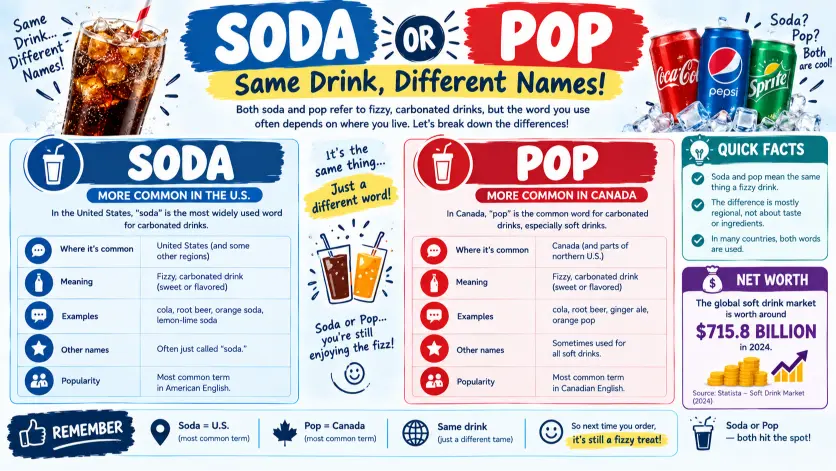
Have you ever asked for a soda and heard someone else call the exact same drink a pop? You are not using the wrong word. In American English, both terms can refer to a carbonated soft drink, but the choice often depends on where someone grew up. Regional vocabulary has made this simple drink one of the most recognizable examples of language variation in the United States.
Understanding soda or pop is useful if you are learning English, writing for an American audience, traveling across the US, or simply curious about regional speech. Research into American English has documented these differences for decades, with soda particularly common in many Northeastern and Western areas and pop strongly associated with parts of the Midwest and other regions.
This guide explains the meaning, regional differences, history, examples, and which term sounds most natural in different parts of America.
Introduction: Why Do People Say Soda or Pop?
The question “soda or pop” looks simple, but it reveals an interesting difference between vocabulary and regional usage. Both words can refer to a sweetened, carbonated beverage, yet people in different parts of the United States may strongly prefer one term over the other.
Soda is generally used as a noun for a carbonated soft drink. For example, someone might say, “I ordered a soda with my meal.” Pop is also a noun when it refers to the same kind of drink, as in, “Do you want a pop?”
This creates confusion because neither word is necessarily incorrect. The real issue is geographical preference. A person from one region may naturally say soda, while another person may say pop for exactly the same beverage.
The distinction matters in everyday conversation, restaurant ordering, marketing, surveys, and online content. A business that uses one regional term may sound perfectly natural to one audience but noticeably unfamiliar to another.
Understanding this difference also helps writers avoid treating regional vocabulary as a strict grammar rule. In most cases, choosing soda or pop is a matter of regional English and audience awareness, rather than grammatical correctness.
Soda vs Pop: What’s the Difference?
Soda and pop are both nouns when they refer to a carbonated soft drink. Their basic meaning overlaps, but their popularity varies by region.
Soda is especially common in much of the northeastern United States, the western United States, and several other areas. It is also widely understood throughout the country.
Pop is particularly associated with parts of the Midwest and some northern areas of the United States. In those regions, saying soda may sound less natural to some speakers.
Neither term automatically describes a different type of beverage. In ordinary American English, both can refer to drinks such as cola, lemon lime soft drinks, root beer, and other carbonated beverages.
| Feature | Soda | Pop |
|---|---|---|
| Part of speech | Noun | Noun |
| Main meaning | Carbonated soft drink | Carbonated soft drink |
| Usage | Strong regional preference | Strong regional preference |
| Common in | Many eastern and western US regions | Many Midwestern and northern US regions |
| Formality | Neutral | Neutral |
| Grammar status | Correct | Correct |
| Main difference | Regional vocabulary | Regional vocabulary |
Mini Recap
Soda and pop generally describe the same kind of beverage.
The difference is mainly regional rather than grammatical.
Soda is more common in many parts of the United States.
Pop is especially common in parts of the Midwest and northern United States.
Is Soda vs Pop a Grammar, Vocabulary, or Usage Issue?
The difference between soda and pop is primarily a vocabulary and usage issue, not a grammar problem.
Both words function naturally as nouns:
“Can I have a soda?”
“Can I have a pop?”
Both sentences are grammatically acceptable. The choice simply reflects the speaker’s regional vocabulary.
Are Soda and Pop Interchangeable?
In most everyday situations, yes. If someone asks for a soda, a listener who normally says pop will usually understand what they mean.
The words aren’t completely interchangeable in every cultural or regional context, however. A person may have a strong local preference and immediately associate one term with their home region.
Formal vs Casual Usage
Both terms are relatively casual because they describe an everyday beverage. In formal writing, carbonated soft drink may be more precise when regional language could create ambiguity.
For example, a scientific or technical document might refer to a “carbonated beverage” rather than soda or pop.
Academic vs Casual Usage
In academic writing, the best word depends on the subject. If you’re studying American dialects, using soda and pop is appropriate because the regional distinction is itself part of the topic.
If you’re writing about nutrition, consumer behavior, or food science, “carbonated soft drink” may provide greater precision.
How to Use Soda Correctly
The word soda is normally used as a noun.
You can use it when talking about a specific beverage:
“I bought a soda after lunch.”
You can also use it when discussing the drink as a general category:
“Many people drink soda with their meals.”
Workplace Example
“I’ll grab a soda before the meeting starts.”
This sounds natural in an informal workplace conversation.
For a more professional document, you might write:
“The office refrigerator contains several carbonated beverages.”
Academic Example
“The survey examined how frequently college students consumed soda.”
Here, soda works naturally because the sentence discusses a broad category of beverages.
Technology Example
Technology companies can also use the term when discussing food delivery, vending machines, or consumer preferences:
“The vending machine app allows users to select a soda before completing payment.”
Soda Usage Recap
Use soda as a noun when referring to a carbonated soft drink.
It is grammatically standard and widely understood.
Its main distinction from pop is regional preference rather than meaning.
How to Use Pop Correctly
Pop can also function as a noun meaning a carbonated soft drink.
For example:
“I picked up a pop on my way home.”
Another example is:
“Which kind of pop do you want?”
In regions where pop is common, these sentences sound completely ordinary.
Workplace Example
“Would you like a pop from the refrigerator?”
This is perfectly natural in an informal workplace setting, particularly in areas where pop is the dominant regional term.
Academic Example
“The study measured weekly pop consumption among participants.”
This can work in academic writing when the study specifically examines regional language or consumer terminology. Otherwise, “carbonated soft drink” may be more precise.
Technology Example
“A grocery app lets customers add pop to their shopping cart.”
The sentence is grammatically correct, although a national brand may choose “soda” or “soft drink” to appeal to a broader audience.
Pop Usage Recap
Use pop when referring to a carbonated soft drink.
It is not grammatically inferior to soda.
Its strongest association is with particular American regions.
When You Should NOT Use Soda or Pop
Although soda and pop are widely understood, there are situations where another expression may be more appropriate.
1. When Scientific Precision Matters
A nutrition report may benefit from the expression carbonated soft drink rather than either regional term.
2. When Writing for an International Audience
Readers outside the United States may use terms such as soft drink, fizzy drink, or another local expression.
3. When Discussing the General Beverage Category
If your subject includes both carbonated and noncarbonated beverages, soda may be too specific.
4. When Regional Dialect Is the Subject
Don’t assume that one word is universally correct. If you’re studying American English, regional variation should be acknowledged.
5. When Creating National Advertising
A company targeting customers across the United States should research regional preferences before choosing one term.
6. When Writing a Formal Technical Document
Technical terminology can provide greater clarity than informal regional vocabulary.
7. When the Context Is Ambiguous
Some meanings of pop have nothing to do with beverages. The surrounding sentence should make the intended meaning clear.
8. When Translating for Another English Speaking Country
A direct translation may not preserve the most natural local vocabulary. Audience location matters.
Common Mistakes: Soda or Pop
One of the biggest mistakes is claiming that soda is correct and pop is incorrect, or vice versa.
That statement ignores regional English.
| Correct Sentence | Incorrect Sentence | Explanation |
|---|---|---|
| I ordered a soda. | I ordered a pop is grammatically wrong. | Pop can be correct in regions where it is the normal term. |
| I bought a pop. | Pop is never used for drinks. | Pop commonly refers to carbonated drinks in several US regions. |
| She drinks soda occasionally. | She drinks sodas occasionally is always wrong. | The plural form can be acceptable when discussing individual drinks or varieties. |
| Do you want a pop? | Do you want a pop is incorrect English. | The sentence is grammatically sound. |
| He works for a soda company. | He works for a pop company is always wrong. | Either term may work depending on the context and audience. |
Decision Rule
If you mean a carbonated soft drink, both soda and pop can be correct. Choose the term that fits your region, audience, and context.
This is different from spelling pairs where one form is correct and the other is a mistake. Soda and pop are legitimate vocabulary choices.
Soda and Pop in Modern Technology and Tools
Digital technology has made regional vocabulary even more interesting.
Search engines, voice assistants, chatbots, translation systems, and modern writing tools may encounter both soda and pop in user queries. A good language system needs to recognize that the words can describe the same beverage while preserving their regional differences.
For example, a user might ask:
“Where can I buy pop near me?”
Another user might ask:
“Where can I buy soda near me?”
The underlying search intent can be almost identical.
The same principle applies to content marketing. A website targeting customers in one region may benefit from using the locally familiar word, while a national website might use broader terminology such as soft drink.
Modern technology generated text also needs contextual awareness. Simply replacing every occurrence of soda with pop can make content sound unnatural because vocabulary is influenced by geography, culture, and audience.
Why Do Americans Say Soda or Pop?
The regional divide developed through historical changes in American vocabulary.
The word soda is connected to “soda water,” a term associated with carbonated water and soda fountains. Over time, soda became a common general term for carbonated soft drinks.
Pop developed from the sound associated with opening a carbonated beverage bottle. The word became established as a regional term and remained particularly strong in parts of the Midwest and northern United States.
American English contains many similar regional differences. People may use different words for the same object without either version being grammatically wrong.
Expert Style Insight
“Regional vocabulary is not incorrect English; it is evidence of how language changes across communities.”
This principle is important for both writers and learners. Language is shaped by geography, history, culture, and repeated everyday use.
Two Practical Case Studies
Case Study 1: Restaurant Ordering
Imagine a restaurant chain operating in several American states.
In one location, customers frequently ask for a soda. In another, customers commonly ask for a pop. If the restaurant menu uses only one regional term, some customers may notice the wording even though they understand it.
A practical solution is to use a broader phrase such as “soft drinks” on national menus while allowing employees and customers to use their natural regional vocabulary.
Result: The wording becomes easier for customers from different regions to understand without treating either regional term as incorrect.
Case Study 2: National Content Marketing
Consider a hypothetical beverage retailer creating a national search campaign.
The marketing team initially targets only the phrase “soda.” After examining regional search behavior, they recognize that some audiences commonly use “pop.” They expand their content language naturally rather than forcing one term throughout every page.
Result: The campaign can better reflect regional search behavior while maintaining a consistent national message.
These examples illustrate a broader: vocabulary should match search intent and audience language, not simply a writer’s personal preference.
Error Prevention Checklist
Always Use Soda When
You are writing for an audience that commonly uses the term soda.
Your source material or audience specifically uses soda.
You are discussing the regional vocabulary associated with soda.
The context makes soda the most natural choice.
Never Assume Pop Is Wrong When
A speaker from the Midwest or another pop using region says it.
A customer asks for a pop at a restaurant.
A regional publication uses pop consistently.
You’re analyzing American dialects.
The sentence clearly uses pop to mean a carbonated soft drink.
Related Grammar Confusions You Should Master
Understanding regional vocabulary can help you recognize other English distinctions.
Here are several useful language topics worth studying:
- Soda vs pop
- Soft drink vs fizzy drink
- Sneakers vs trainers
- Apartment vs flat
- Elevator vs lift
- Vacation vs holiday
- Truck vs lorry
- Fries vs chips
- Cookie vs biscuit
- Pants vs trousers
These pairs demonstrate an important principle: different English varieties can use different words without either variety being grammatically wrong.
Advanced FAQs
Is soda or pop more correct?
Neither is inherently more correct. Both are accepted English nouns for a carbonated soft drink. The preferred term depends mainly on regional vocabulary and the audience you are addressing.
What is the difference between soda and pop?
There is generally no major difference in the beverage itself. Soda and pop are regional terms for carbonated soft drinks, with soda being especially common in many eastern and western US areas and pop strongly associated with parts of the Midwest and northern US.
Do Americans say soda or pop?
Americans use both words. Regional patterns vary considerably. Some states and communities strongly prefer soda, while others commonly use pop.
Is pop a slang word for soda?
Pop is an established regional English noun rather than simply an incorrect slang version of soda. It has a long history of use in parts of the United States.
Why do some people call soda pop?
The phrase soda pop combines two established terms for a carbonated beverage. It can be heard in areas where pop is familiar and is also understood more broadly.
Is soda or pop more common in America?
Usage varies by region. Soda has broad recognition across the United States, while pop has especially strong regional usage in parts of the Midwest and northern United States.
Should I say soda or pop in formal writing?
For general formal writing, either can be grammatically acceptable, but carbonated soft drink may be more precise for technical or international audiences. If regional language is relevant, soda or pop can be appropriate.
Do soda and pop mean the same thing?
In most American English contexts, yes. Both can refer to a carbonated soft drink. The important distinction is regional usage rather than the basic meaning.
Which word should I use , soda or pop?
Choose based on your target audience and search intent. If your audience is regional, local vocabulary can be valuable. For national content, naturally incorporating related terminology can help address different ways users describe the same beverage.
Final Verdict: Soda or Pop?
The answer to soda or pop isn’t that one word is correct and the other is wrong. Both are legitimate English terms for a carbonated soft drink, but their popularity varies by region.
Soda has broad usage and is especially common in many eastern and western parts of the United States. Pop is strongly associated with parts of the Midwest and northern United States.
The smartest choice depends on your audience. For everyday conversation, use the word that sounds natural in your region. For professional, academic, or national communication, consider whether carbonated soft drink or soft drink would provide greater clarity. The key lesson is simple: this is a regional vocabulary difference, not a grammar mistake.









