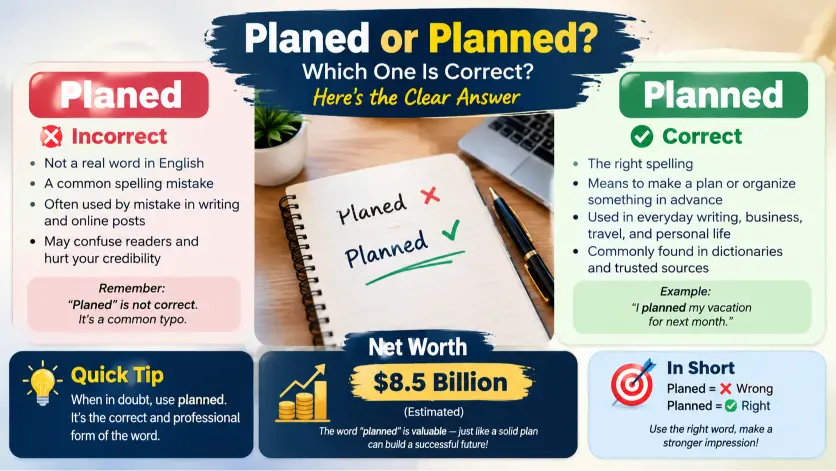
Have you ever typed “planed or planned” and stopped because both words looked correct? You’re not alone. The difference is only one letter, but that extra n can completely change the meaning of your sentence. Planned is the past tense and past participle of plan, meaning something was arranged, organized, or decided in advance. Planed, meanwhile, comes from plane and is commonly used when talking about smoothing or shaping wood with a tool.
Understanding this small spelling difference can make your emails, essays, articles, schoolwork, and professional writing much clearer.
In this guide, we’ll explain planed vs planned in simple English, show you practical examples, and explain when each word is appropriate. You’ll also learn an easy way to remember the difference so you can choose the right spelling confidently every time. Since both words are legitimate English forms, context is the key to knowing which one belongs in your sentence.
Planed vs Planned: What’s the Difference?
The two words look almost identical, but they come from different verbs and have different meanings.
Planed is the past tense and past participle of plane. As a verb, plane means to smooth, level, or shape a surface, usually with a woodworking tool or machine. For example, a carpenter might say, “She planed the wooden board until the surface was smooth.”
Planned is the past tense and past participle of plan. As a verb, plan means to decide what you intend to do and arrange the necessary steps beforehand. For example, “We planned the meeting for Friday.”
| Word | Base verb | Part of speech | Main meaning | Example |
|---|---|---|---|---|
| Planed | Plane | Verb | Smoothed or shaped a surface | He planed the rough board. |
| Planned | Plan | Verb | Arranged or decided something beforehand | She planned the event carefully. |
The easiest distinction is meaning.
Planed relates to plane, especially smoothing or shaping a material.
Planned relates to plan, especially preparing or arranging something.
If you are talking about an intention, schedule, strategy, event, trip, or future action, planned is almost certainly the word you need.
If you are talking about woodworking or smoothing a physical surface with a plane, planed may be correct.
Is Planed vs Planned a Grammar, Vocabulary, or Usage Issue?
This confusion is mainly a vocabulary and spelling issue, although grammar also plays a role because both words function as verb forms.
The important point is that they are not interchangeable.
Consider these two sentences:
We planned the project last week.
We planed the wooden surface last week.
Both sentences are grammatically correct, but they describe completely different actions.
The first sentence concerns preparation and decision making. The second describes physical work performed on a material.
In formal writing, choosing the right word is especially important because context makes meaning precise. Academic papers, business reports, technical instructions, and professional emails should never rely on a reader guessing what the writer intended.
In casual communication, a spelling mistake may be understood from context. Even so, writing planed when you mean planned can make the sentence look careless.
The words also differ in their commonness. Planned is extremely common because people frequently discuss plans, schedules, projects, meetings, goals, and intentions. Planed is much less common and generally appears in woodworking, construction, manufacturing, carpentry, and related technical contexts.
Planed: Meaning, Examples, and Correct Usage
Planed is the past tense of plane.
A plane is a tool traditionally used by woodworkers to remove thin layers from wood. Modern machines can perform the same general function on a larger scale.
When someone planed a piece of wood, they removed material from its surface to make it smoother, flatter, thinner, or more accurately shaped.
Workplace example
A carpenter might write:
The technician planed the cabinet door so it would fit properly.
Here, planed is correct because the action involves physically shaping material.
Academic example
A technical report might state:
The wooden samples were planed before their dimensions were measured.
The word is appropriate because the report describes a specific preparation process involving a physical surface.
Technology example
A manufacturing document could say:
The automated machine planed the wooden panels to a uniform thickness.
Again, the word describes a physical manufacturing process.
Usage recap
Use planed when the action comes from the verb plane.
Think of a carpenter, wooden board, workshop, surface, or machine removing material.
A useful memory connection is:
Plane → planed
The extra letter in planed does not indicate planning. It simply belongs to the verb plane.
Planned: Meaning, Examples, and Correct Usage
Planned is the past tense and past participle of plan.
To plan something means to think about it beforehand and decide how, when, where, or why it should happen.
This word is common in everyday English and appears in conversations about travel, education, work, business, relationships, projects, events, and personal goals.
Workplace example
The marketing team planned the campaign several months in advance.
The sentence describes preparation, so planned is the correct form.
Academic example
The researchers planned the experiment before collecting the data.
Here, planned means they decided in advance how the experiment would be conducted.
Technology example
The developers planned a major software update for September.
The word refers to an intended future action or scheduled development.
Usage recap
Use planned when you mean organized, prepared, arranged, intended, or decided beforehand.
If the sentence involves a meeting, project, trip, goal, strategy, event, experiment, schedule, or intention, planned will usually be the appropriate choice.
When You Should NOT Use Planed or Planned
Understanding when not to use each word can prevent many mistakes.
1. Do not use planed for ordinary preparation
Incorrect:
We planed our vacation last month.
Correct:
We planned our vacation last month.
A vacation is arranged or organized. It is not physically smoothed with a plane.
2. Do not use planned for woodworking
Incorrect:
The carpenter planned the rough board.
Correct:
The carpenter planed the rough board.
The carpenter is shaping a physical surface, so the verb plane is required.
3. Do not use planed when discussing schedules
Incorrect:
The meeting was planed for Monday.
Correct:
The meeting was planned for Monday.
4. Do not use planned when describing surface preparation
Incorrect:
The wood was planned to make it smoother.
Correct:
The wood was planed to make it smoother.
5. Do not confuse the spelling with pronunciation
The words are related visually but come from different base words. Their meanings should determine your choice.
6. Do not assume the shorter spelling is always correct
Some writers see planed and assume it is simply a shortened version of planned. It isn’t.
7. Do not rely only on spell checking
A spelling checker may not identify the problem because both words are legitimate English words. Context and meaning are what distinguish them.
8. Do not choose based on appearance
The correct question is not “Which spelling looks right?”
Ask instead:
What action am I describing?
Common Mistakes and Decision Rules
The most common mistake occurs when writers know they need the past tense of plan but accidentally remove one of the two letters in planned.
| Correct sentence | Incorrect sentence | Explanation |
|---|---|---|
| We planned the conference. | We planed the conference. | A conference is arranged, not physically shaped. |
| She planned her schedule. | She planed her schedule. | A schedule is organized in advance. |
| He planed the wooden board. | He planned the wooden board. | The board was physically smoothed. |
| They planned the project. | They planed the project. | A project is prepared and organized. |
| The carpenter planed the surface. | The carpenter planned the surface. | The surface was shaped with a plane. |
| We planned the trip carefully. | We planed the trip carefully. | A trip is arranged beforehand. |
Decision Rule Box
If you mean arranging, preparing, organizing, or deciding in advance, use planned.
If you mean smoothing, shaping, or leveling a physical surface with a plane, use planed.
This rule solves almost every ordinary spelling question involving these two words.
Planed or Planned in Modern Technology and Tools
Modern technology has made this distinction more interesting because digital tools frequently discuss both planning and physical manufacturing.
Project management software uses planned when referring to scheduled tasks, deadlines, milestones, or future activities.
For example:
The update was planned for the next release cycle.
Manufacturing technology can use planed when automated machinery physically shapes wood or another suitable material.
For example:
The production machine planed the wooden component to the required thickness.
Modern technology can also produce either word because both are legitimate English terms. This means automated writing tools cannot always determine the intended word without understanding the surrounding context.
That is why human proofreading still matters. A sentence can be grammatically formed and contain a real English word while still expressing the wrong meaning.
Why Do We Double the N in Planned?
The spelling of planned follows a common English spelling pattern.
The base verb is plan. When the verb takes the suffix ed, the final consonant is doubled:
plan + ed = planned
The same pattern appears in several other short verbs.
For example:
stop → stopped
drop → dropped
prefer → preferred
The doubling helps preserve the pronunciation pattern of the original word.
By contrast, plane already ends in the letter e.
Its past tense is:
plane → planed
The final e remains part of the spelling.
This gives us a simple structural comparison:
plan → planned
plane → planed
The difference of one letter changes the source verb and therefore changes the meaning.
Etymology of Planed and Planned
The two words have different histories because their base verbs are different.
Plan ultimately developed through French and Latin influences associated with an idea of a flat surface or a drawing representing something. Over time, English developed the modern sense of deciding or arranging what will happen.
Plane, in the woodworking sense, is connected with the idea of making something flat or smooth. The noun refers to the tool, while the verb describes the action performed with it.
This historical relationship helps explain why the words look similar while having different modern meanings.
Their resemblance is a spelling trap rather than evidence that they are interchangeable.
Expert Insight: Why This Mistake Survives Spell Checking
“The hardest spelling mistakes are often not misspellings at all. They are correct words placed in the wrong context.”
This is an important lesson for anyone trying to improve English writing.
A traditional spelling checker can identify an unknown or incorrectly formed word. It may not recognize that a perfectly valid word has been used incorrectly.
For example, planed is correctly spelled English. If you write it instead of planned, the problem is semantic rather than simply orthographic.
Good proofreading therefore asks two questions:
Is the word spelled correctly?
Does the word express the intended meaning?
The second question is often more important.
Two Practical Case Studies
Case Study 1: A business schedule
Imagine a company preparing a customer event.
The original sentence reads:
The team planed the product launch for October.
A reader may understand the intended meaning, but the sentence contains the wrong verb.
The corrected version is:
The team planned the product launch for October.
The change is only one letter, but the meaning becomes immediately clear because planned is the correct past tense of plan.
Case Study 2: A woodworking instruction
Now consider a workshop manual:
The operator planned the wooden edge before assembly.
Here, the intended meaning is physical shaping. The correct sentence is:
The operator planed the wooden edge before assembly.
These examples show why context matters more than visual similarity.
In one context, the additional n is necessary. In the other, it would create the wrong word.
Author Expertise
This guide is written from a professional English language perspective, with attention to spelling, grammar, contextual usage, search intent, and practical communication.
Error Prevention Checklist
Always use planned when:
You mean arranged something in advance.
You mean prepared for an event.
You mean decided what to do.
You are discussing a schedule.
You are discussing a project or strategy.
You are describing an intended action.
You are talking about meetings, trips, goals, or events.
Never use planed when:
You mean organized an activity.
You mean prepared a schedule.
You mean arranged a meeting.
You mean decided on a strategy.
You mean prepared a project.
You mean intended to do something.
Use planed only when the verb plane makes sense in the sentence.
Related Grammar Confusions You Should Master
Once you understand this distinction, several similar English spelling problems become easier to recognize.
Affect vs effect: one commonly functions as a verb, while the other commonly functions as a noun.
Advice vs advise: one is a noun and the other is a verb.
Practice vs practise: spelling varies according to the variety of English being used.
Lose vs loose: one concerns failing to keep or win something, while the other means not tight.
Then vs than: one commonly relates to time or sequence, while the other is used for comparison.
Your vs you’re: one shows possession, while the other means you are.
Their vs there vs they’re: these words have different grammatical roles despite similar pronunciation.
Affect vs effected: changes in grammatical form can alter both meaning and function.
Complement vs compliment: one refers to something that completes or enhances another thing, while the other expresses praise.
Principal vs principle: one commonly refers to a person or something primary, while the other means a rule, belief, or fundamental idea.
Learning these pairs together can significantly improve proofreading accuracy.
Advanced FAQs
Is planned the correct spelling for arranging something?
Yes. Planned is the correct past tense and past participle of plan when you mean arranging, preparing, organizing, or deciding something in advance.
Is planed a real word in English?
Yes. Planed is a legitimate English word. It is the past tense and past participle of plane, especially when referring to smoothing or shaping a surface.
What is the difference between planed and planned?
Planned comes from plan and means arranged or decided beforehand. Planed comes from plane and means smoothed or shaped a surface.
Should I write planed or planned a meeting?
Use planned. A meeting is arranged or scheduled, so the correct sentence is, “We planned a meeting for Thursday.”
Should I write planed or planned a trip?
Use planned because a trip is organized or arranged in advance.
Is it correct to say the carpenter planned the wood?
Usually, no, if you mean the carpenter smoothed the wood with a plane. In that context, planed is the appropriate word.
Why does planned have two n letters?
The base verb is plan. When the suffix ed is added, the final consonant is doubled, producing planned.
Can spelling software tell the difference?
It can sometimes detect contextual errors, but it may not always do so because both planed and planned are valid English words. Human attention to meaning remains important.
Which word is more common, planed or planned?
Planned is much more common in ordinary English because people frequently discuss plans, schedules, projects, events, and intentions. Planed is more specialized and commonly appears in woodworking and manufacturing contexts.
How can I remember the difference easily?
Connect each word to its base verb. Plan becomes planned when you arrange something. Plane becomes planed when you smooth or shape a surface.
Final Verdict: Planed or Planned
The correct choice depends entirely on the verb behind the word.
Use planned when you mean arranged, prepared, organized, or decided in advance. It is the normal choice for meetings, trips, projects, schedules, goals, strategies, and future activities.
Use planed when you mean smoothed, leveled, or shaped a physical surface with a plane. This usage is most common in woodworking, carpentry, and manufacturing.
The easiest memory trick is simple:
Plan → planned
Plane → planed
If your sentence is about an intention or arrangement, choose planned. If someone is physically shaping a surface, choose planed. Once you connect each spelling to its base verb, this common English confusion becomes much easier to avoid.









