Have you ever typed glamor or glamour and paused because both spellings look correct? You are not alone. These two forms have the same meaning and pronunciation in most varieties of English, but the spelling depends largely on which version of English you are using. Choosing the right form can make your writing look more polished, especially in professional, academic, publishing, and international contexts.
In this guide, we will explain glamor or glamour in a simple and practical way. You will learn where each spelling is commonly used, what the word means, how American and British English differ, and which version you should choose for your audience. We will also look at clear examples and common mistakes so you can use the word confidently. Whether you are writing an article, email, social media post, or formal document, understanding this small spelling difference can help you communicate more accurately and naturally.
Glamor or Glamour: What’s the Difference?
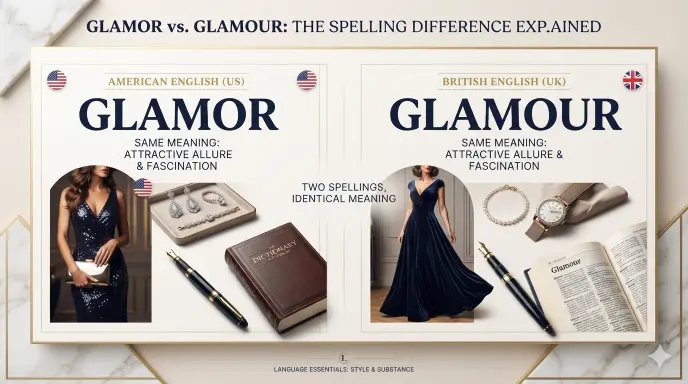
The main difference between glamor and glamour is spelling rather than meaning. Both words function primarily as nouns and describe an appealing quality that makes someone or something seem attractive, fascinating, sophisticated, or exciting.
Glamor is the preferred spelling in American English. For example, an American magazine might describe a celebrity’s appearance as full of glamor.
Glamour is the traditional spelling used in British English. It is also common in Australian, Canadian, and other varieties of English, although regional preferences can vary.
| Feature | Glamor | Glamour |
|---|---|---|
| Part of speech | Noun | Noun |
| Meaning | Attractive or fascinating quality | Attractive or fascinating quality |
| Pronunciation | Usually the same | Usually the same |
| American English | Common | Less common |
| British English | Less common | Common |
| Meaning difference | None in ordinary usage | None in ordinary usage |
| Formal writing | Correct in American English | Correct in British English |
Mini Recap
Glamor is the usual American spelling.
Glamour is the usual British spelling.
Both describe beauty, fascination, elegance, or appeal.
Therefore, the appropriate choice usually depends on your variety of English and your intended audience.
Is Glamor or Glamour a Grammar, Vocabulary, or Usage Issue?
Primarily, this is a spelling and usage issue, not a difference in grammar or meaning.
Both forms identify the same concept. Consequently, choosing one instead of the other usually won’t change what a reader understands. However, regional writing conventions matter when consistency and professional presentation are important.
For instance, an American newspaper may use glamor, whereas a British publication may use glamour. Neither publication is necessarily making a grammatical mistake. Instead, each follows a different spelling convention.
Furthermore, the distinction becomes especially noticeable in academic writing. Students studying in the United States will generally be expected to follow American spelling conventions. Conversely, students working with British English may be expected to retain the spelling glamour.
In casual communication, readers usually understand both versions. Nevertheless, switching between them within the same document can make writing appear inconsistent.
Formal Versus Informal Usage
Neither spelling is inherently more formal. Instead, formality depends on context.
For example, glamor is perfectly suitable for an American business report. Likewise, glamour can be entirely appropriate in a British academic essay.
Therefore, don’t assume that the spelling containing the extra letter is automatically more sophisticated. The important consideration is regional convention.
Academic Versus Casual Usage
Academic writing requires consistency. Thus, if your institution follows American English, use glamor throughout your work. If it follows British English, use glamour.
Meanwhile, casual messages are more flexible. Even so, choosing the spelling associated with your usual variety helps your writing remain natural.
How to Use Glamor Correctly
Glamor is the standard American English spelling. It refers to a quality that creates admiration, fascination, attractiveness, or a sense of luxury.
For example:
“The actress brought old Hollywood glamor to the event.”
Here, the noun describes an appealing atmosphere connected with elegance and celebrity culture.
Workplace Example
A marketing professional might write:
“The campaign aims to bring a sense of modern glamor to the brand.”
In this sentence, glamor describes an attractive quality associated with the brand.
Academic Example
A student discussing popular culture could write:
“Hollywood glamor has influenced public perceptions of celebrity life.”
Here, the word refers to the appealing image created around celebrities and entertainment.
Technology Example
A technology company might describe a premium product by saying:
“The new device combines practical features with visual glamor.”
In this case, glamor communicates aesthetic appeal.
Usage Recap
Use glamor when following American English conventions.
It works naturally in professional, academic, creative, and everyday contexts.
Most importantly, its meaning is not different from glamour.
How to Use Glamour Correctly
Glamour is the traditional spelling used in British English and several other English varieties. Like its American counterpart, it describes an attractive, exciting, elegant, or fascinating quality.
For example:
“The ceremony had an atmosphere of timeless glamour.”
The noun describes the impressive beauty and sophistication associated with the occasion.
Workplace Example
A British fashion editor might write:
“The collection combines contemporary design with classic glamour.”
The term describes the sophisticated visual quality of the clothing.
Academic Example
A researcher studying media culture might write:
“Celebrity glamour can shape how audiences perceive success.”
Here, glamour refers to the appealing image surrounding celebrity lifestyles.
Technology Example
A product review might state:
“The latest smartphone adds a touch of glamour to everyday photography.”
The word communicates visual attractiveness rather than a technical function.
Usage Recap
Choose glamour when following British English conventions.
It is suitable for formal documents, journalism, academic work, advertising, and everyday writing.
However, the meaning remains the same as glamor.
When You Should NOT Use Glamor or Glamour
Although both spellings are correct in their appropriate regional contexts, there are situations where choosing either one can create an unnecessary problem.
1. Don’t Mix Regional Spellings
If an article consistently follows British English, suddenly switching to glamor can create an inconsistent appearance.
2. Don’t Assume One Form Is More Correct Everywhere
American and British English follow different spelling traditions. Therefore, treating one version as universally correct can lead to inaccurate corrections.
3. Don’t Change a Quotation Without a Reason
If you are reproducing an exact quotation, preserve the original spelling unless your publication rules require a documented editorial change.
4. Don’t Change Brand Names
Some organizations use a particular spelling as part of their official identity. Consequently, their chosen form should not automatically be altered.
5. Don’t Use Regional Spelling Randomly in Academic Work
Academic assignments often follow institutional style requirements. Thus, check the expected variety before selecting your preferred spelling.
6. Don’t Treat the Extra Letter as a Meaning Marker
The u in glamour does not create a different definition. It represents a regional spelling convention.
7. Don’t Switch Forms Within One Article
Consistency improves readability. Therefore, select the form appropriate for your audience and maintain it.
8. Don’t Correct Someone Automatically
If a British writer uses glamour, that isn’t a spelling mistake simply because American English commonly uses glamor.
Common Mistakes With Glamor and Glamour
Understanding the regional distinction prevents several common errors.
| Correct sentence | Incorrect sentence | Explanation |
|---|---|---|
| The event had Hollywood glamor. | The event had Hollywood glamor in a British style document. | American spelling may conflict with an established British style. |
| The event had Hollywood glamour. | The event had Hollywood glamour in an American style document. | British spelling may conflict with an established American style. |
| The magazine celebrated classic glamour. | The magazine celebrated classic glamor in a British publication. | British publications generally favor glamour. |
| The designer added modern glamor. | The designer added modern glamour in an American publication. | American publications generally favor glamor. |
| Her dress had timeless glamour. | Her dress had timeless glamor under British conventions. | The regional convention determines the preferred spelling. |
Decision Rule Box
If you are writing in American English, use glamor.
If you are writing in British English, use glamour.
If your audience is international, choose one variety and remain consistent.
This simple rule resolves most spelling questions involving these two forms.
Glamor and Glamour in Modern Technology and Digital Tools
Modern writing environments often expose differences between regional English varieties. For example, spelling tools may recognize both glamor and glamour as valid words while applying different regional dictionaries.
Consequently, a document configured for American English may accept glamor naturally, whereas a British English setting may prefer glamour.
Furthermore, digital publishing has made regional consistency more important. Websites can reach readers across several countries, so writers must decide which English convention they are following.
For international audiences, consistency matters more than trying to make every spelling appeal equally to every region.
For example, an American focused publication can consistently use glamor, while a British focused publication can consistently use glamour.
The Etymology of Glamor and Glamour
The history of this word is particularly interesting because the unusual spelling is connected with Scottish English.
The older form glamour developed from a Scottish form associated with magic, enchantment, or a spell. Over time, the meaning expanded toward the idea of an attractive or fascinating quality that seems almost enchanting.
Eventually, the word became strongly associated with beauty, elegance, celebrity culture, fashion, and sophistication.
American English later developed the simplified spelling glamor, following a broader tendency in American spelling to remove certain letters found in traditional British forms.
As a result, the two modern spellings represent regional development rather than separate meanings.
An Expert Style Observation
“When two regional spellings carry the same meaning, consistency with the chosen variety of English matters more than treating one form as universally correct.”
This principle applies beyond glamor and glamour. English contains many regional spelling pairs that differ without changing the underlying meaning.
Two Practical Case Studies
Case Study 1: American University Assignment
Imagine a student in the United States writing an essay about celebrity culture. Throughout the paper, the student follows American spelling conventions.
The student writes:
“Hollywood glamor has shaped the public image of famous performers.”
Because the paper follows American English, glamor fits naturally.
Now imagine that the student suddenly writes glamour several times. The meaning remains understandable, but the spelling becomes inconsistent with the rest of the assignment.
The lesson is straightforward: regional consistency can make academic writing cleaner and more professional.
Case Study 2: British Fashion Publication
Now consider a British fashion publication discussing luxury clothing.
The writer says:
“The collection captures the glamour of classic evening fashion.”
Here, glamour aligns with the publication’s British English convention.
If the same article repeatedly switched to glamor, readers would still understand the meaning. However, the inconsistent spelling could make the publication appear less carefully edited.
The practical lesson is the same: select the appropriate regional form and maintain it throughout the document.
Error Prevention Checklist
Always Use Glamor When
- You are writing in American English.
- Your organization follows American spelling standards.
- Your academic institution requires American English.
- Your publication uses American spelling consistently.
- Your intended audience is primarily American.
Always Use Glamour When
- You are writing in British English.
- Your organization follows British spelling standards.
- Your academic institution requires British English.
- Your publication follows British conventions.
- Your intended audience is primarily British or uses another variety that favors the traditional spelling.
Never Choose Based Only on Appearance
The additional u does not make glamour more sophisticated.
Likewise, the shorter glamor is not less formal.
Instead, regional convention should guide your decision.
Related Grammar Confusions You Should Master
Once you understand glamor or glamour, several other spelling differences become easier to recognize. These pairs often involve regional conventions, pronunciation, or historical spelling patterns.
- Color or colour
- Favor or favour
- Honor or honour
- Center or centre
- Theater or theatre
- Analyze or analyse
- Catalog or catalogue
- Traveling or travelling
- License or licence
- Practice or practise
These examples demonstrate why English spelling cannot always be judged using a single universal rule. Regional standards frequently influence which form is preferred.
Frequently Asked Questions
Is glamor or glamour correct?
Both spellings are correct. Glamor is generally preferred in American English, while glamour is generally preferred in British English and several other varieties. The two forms have the same ordinary meaning.
Is glamor American or British?
Glamor is the standard American spelling. Therefore, American publications, educational materials, and professional documents commonly use this form.
Is glamour American or British?
Glamour is traditionally associated with British English. It is also used in various other English speaking regions, so it isn’t exclusively limited to Britain.
Does glamor mean the same as glamour?
Yes. Both words describe an appealing, fascinating, elegant, or attractive quality. The spelling difference does not normally create a difference in meaning.
Which spelling should I use in academic writing?
Follow the English variety required by your institution, instructor, publisher, or style guide. If no requirement exists, choose a consistent variety and use it throughout the assignment.
Why does glamour have a U?
The spelling glamour reflects the traditional British form. American English later adopted the shorter spelling glamor, following other American spelling patterns that removed certain letters.
Can I use glamour in American English?
Yes, readers in the United States will generally understand glamour. However, glamor is the more typical American spelling, so it may be preferable when maintaining American English consistency.
Can I use glamor in British English?
Readers in Britain will understand glamor, but glamour is generally the expected traditional spelling in British English. For formal British writing, consistency with the local convention is advisable.
Is glamor a noun or adjective?
Glamor is primarily a noun. The corresponding adjective is glamorous, which describes someone or something possessing an attractive, exciting, or sophisticated quality.
Is glamour a noun or adjective?
Glamour is also primarily a noun. Its related adjective is glamorous. Therefore, both forms belong to the same basic word family.
Final Verdict: Glamor or Glamour
When deciding between glamor or glamour, don’t search for a difference in meaning because there normally isn’t one. Instead, identify the variety of English you are using.
Glamor is the standard American spelling.
Glamour is the traditional British spelling and is also common in several other English varieties. Therefore, the best practical approach is simple: match the spelling to your regional English convention and remain consistent throughout your writing.
If you’re preparing an American document, choose glamor. If you’re following British English, choose glamour. When writing for an international audience, either form can work, provided the spelling remains consistent. Ultimately, neither spelling is inherently superior. The important distinction is regional usage, editorial consistency, and awareness of your readers.









