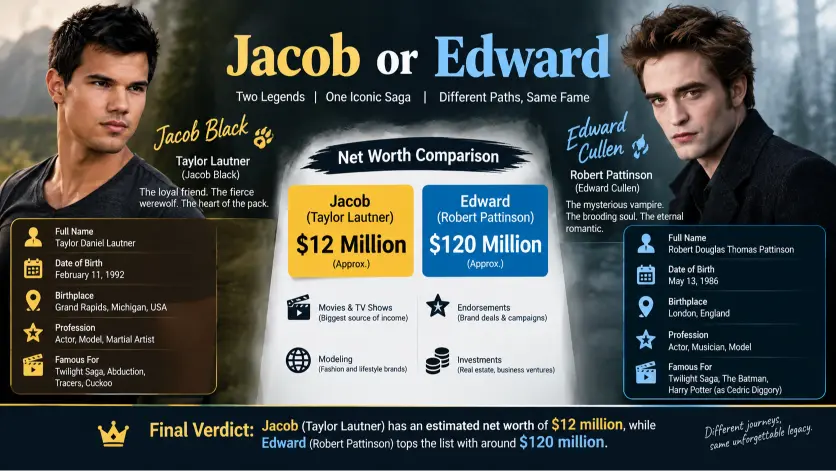
Few fictional love triangles have created as much discussion as Jacob or Edward from Twilight. One is a warm, loyal werewolf who shares a deep connection with Bella, while the other is a mysterious vampire whose intense relationship with her drives much of the story. Their different personalities, abilities, values, and approaches to love make the comparison more complicated than simply asking who is better.
In this guide, we will break down Jacob or Edward by looking at their personalities, relationships, loyalty, supernatural abilities, major character traits, and role in Bella’s story. Rather than focusing only on fan opinions, the comparison considers what the characters actually do throughout Stephenie Meyer’s Twilight series and how their choices shape the storyline. Whether you are revisiting the books, watching the films, or trying to understand why fans remain divided, this detailed comparison will give you a clear and balanced explanation of Jacob vs Edward and the differences that make both characters memorable.
Jacob or Edward: What’s the Difference?
Jacob Black and Edward Cullen are proper nouns used as character names in Stephenie Meyer’s Twilight saga. Therefore, they aren’t interchangeable vocabulary terms. Jacob refers to the young man from the Quileute community who becomes a werewolf and develops strong feelings for Bella. Edward refers to the vampire who falls in love with Bella and becomes central to her supernatural journey.
The distinction matters because each name identifies a different fictional person, background, supernatural nature, and relationship with Bella. Consequently, replacing one name with the other can change the meaning of a sentence completely.
In short, Jacob and Edward are names, not alternative spellings of one word. Moreover, they represent different characters with different histories and supernatural identities. Therefore, the correct choice depends entirely on which character you mean.
Is Jacob or Edward a Grammar, Vocabulary, or Usage Issue?
At first glance, the question looks like a vocabulary comparison. However, it is actually a character identification issue. Both Jacob and Edward are proper nouns, so they follow naming conventions rather than ordinary vocabulary rules.
Because proper nouns identify specific people, capitalization is essential. Thus, “Jacob” and “Edward” should normally begin with capital letters when they refer to the Twilight characters.
They also aren’t interchangeable. For example, saying “Edward joined the wolf pack” creates a factual error because Edward Cullen is associated with the Cullen vampires, whereas Jacob belongs to the wolf pack tradition.
Similarly, “Jacob read Bella’s mind” changes the intended meaning. Edward is the character associated with mind reading, although that ability has limitations and important exceptions within the story.
In formal writing, academic discussion, reviews, essays, and character analysis, use the full names when clarity matters. In casual discussion, the first names are generally enough because the context is already established.
Consequently, this is less about formal versus informal grammar and more about accurate reference.
Jacob: Meaning, Identity, and Practical Usage
Jacob Black is introduced as a friend from Bella Swan’s childhood environment. As the story develops, his role becomes much larger. He becomes connected to the Quileute wolf pack and takes part in conflicts involving vampires, werewolves, loyalty, friendship, and love.
His character is often associated with warmth, physical strength, humor, loyalty, and a strong connection to ordinary human life. However, his experiences become increasingly complicated as supernatural events reshape his relationships.
Workplace Example
Imagine a fictional publishing team discussing a character guide. A writer might say:
“Jacob’s character arc should receive more attention in the relationship section.”
Here, Jacob clearly identifies the character being analyzed.
Academic Example
A literature student could write:
“Jacob represents an important contrast to Edward because his background connects Bella more closely with her human environment.”
This wording is suitable for character analysis because it identifies a specific narrative function.
Technology Example
Suppose someone creates a fan database containing character profiles. An entry might state:
“Jacob is listed under the werewolf characters category.”
That statement uses the name as a precise label inside a digital system.
Usage Recap
Use Jacob when you mean Jacob Black.
Likewise, keep the spelling and capitalization consistent.
Above all, don’t substitute Edward when discussing Jacob’s actions, dialogue, background, or supernatural identity.
Edward: Meaning, Identity, and Practical Usage
Edward Cullen is one of the central figures in the Twilight saga. He is a vampire belonging to the Cullen family and develops a romantic relationship with Bella Swan.
His character is associated with restraint, immortality, supernatural perception, speed, strength, and an internal struggle involving his feelings for Bella. Consequently, discussions about Edward often focus on the tension between his supernatural nature and his desire to protect the people he loves.
Workplace Example
A publishing editor might write:
“Edward’s motivations should be explained before the relationship conflict is discussed.”
Here, the proper noun makes the intended character immediately clear.
Academic Example
A student analyzing the novel could state:
“Edward represents the danger and fascination associated with Bella’s entry into the vampire world.”
The sentence works because Edward’s name identifies the exact literary figure being examined.
Technology Example
A fan application might categorize Edward under vampire characters and Cullen family members. Therefore, selecting “Edward” from a character database would lead to information about his fictional history rather than Jacob’s.
Usage Recap
Use Edward when referring to Edward Cullen.
Additionally, capitalize the name because it is a proper noun.
Most importantly, don’t assign Jacob’s wolf related characteristics or storyline to Edward.
When You Should NOT Use Jacob or Edward
Confusion usually appears when readers remember the relationship triangle but forget which character performs a particular action. Therefore, these eight situations deserve special attention.
1. When Identifying the Supernatural Species
Don’t call Jacob a vampire. He becomes a werewolf.
Likewise, don’t call Edward a werewolf. He is a vampire.
2. When Describing Bella’s Relationship
If the sentence concerns Edward’s relationship with Bella, use Edward.
If it concerns Jacob’s friendship, attraction, or later relationship developments involving Bella, use Jacob.
3. When Discussing the Cullen Family
Edward belongs to the Cullen family. Jacob does not.
Therefore, a sentence about Cullen family relationships should not use Jacob unless the discussion specifically concerns his interaction with them.
4. When Discussing the Wolf Pack
Jacob is connected to the wolf pack. Edward isn’t.
Consequently, assigning pack membership to Edward creates a character error.
5. When Discussing Supernatural Abilities
Edward is associated with mind reading, while Jacob’s supernatural abilities are connected to his wolf transformation and pack identity.
Thus, always check the ability before selecting the name.
6. When Writing a Character Essay
Don’t alternate between the names simply to make prose sound varied. Replacing a character’s name with another character’s name changes the factual meaning.
7. When Creating a Search Query
A reader searching for Edward’s powers expects information about Edward Cullen. Meanwhile, a query about Jacob’s transformation expects information about Jacob Black.
8. When Summarizing a Scene
Before using either name, identify who actually speaks, acts, transforms, or appears in the scene.
Common Mistakes and Decision Rules
Character comparisons often produce errors because the two figures occupy similar narrative space. However, their identities remain distinct.
Decision Rule Box
If you mean the vampire character, use Edward.
If you mean the werewolf character, use Jacob.
For relationship discussions, check the specific scene before choosing a name. Likewise, for supernatural abilities, identify the ability first and then connect it to the correct character.
Jacob and Edward in Modern Technology and Digital Tools
Digital writing tools, search systems, fan databases, and conversational platforms can make character research faster. However, convenience doesn’t remove the need for careful verification.
For instance, a writing assistant may summarize a complicated relationship triangle, while a fan database may separate characters by family, species, or storyline. Nevertheless, users should check the original source whenever a detailed claim matters.
Names can also become confused when a prompt contains several characters. Therefore, a clear instruction such as “Explain Jacob Black’s role in the story” is more precise than simply asking about “Jacob.”
Similarly, “Compare Edward Cullen and Jacob Black as characters” establishes the intended subjects immediately.
Etymology and Name Usage
Jacob is a traditional given name with ancient Hebrew roots. The name is commonly connected with the Hebrew name Yaakov. Edward, meanwhile, is an Old English given name traditionally understood through elements associated with prosperity, wealth, and guardianship.
However, the meanings of the names themselves shouldn’t be confused with the fictional identities created by Stephenie Meyer. A literary character can carry a traditional personal name while developing a completely fictional personality, history, and role.
As a result, understanding the name’s origin can be interesting, but it doesn’t determine the character’s behavior.
An Expert Style Observation
“A useful character distinction begins with one simple habit: identify the character first, then attach the action, trait, relationship, or quotation to that character.”
This principle applies beyond Twilight. It also helps readers avoid mistakes when discussing novels, films, television series, games, and other fictional worlds.
Two Practical Case Studies
Case Study 1: The Literature Essay
In an illustrative classroom case, a student was preparing a comparison of Bella’s two major relationships. In an early draft, the student accidentally assigned Edward’s vampire characteristics to Jacob.
After separating the characters into two columns and checking each claim against the relevant character, the student corrected five identification errors. The revised essay became clearer because every paragraph focused on one character before moving to the comparison.
The concrete result was simple: five factual mistakes were removed, and the argument became easier to follow.
Case Study 2: The Character Database
In another illustrative case, a fan writer was building a fictional character reference page. The first version mixed Jacob’s wolf pack information with Edward’s Cullen family information.
The writer then divided the material into identity, family, supernatural nature, relationships, and abilities. After reorganizing the entries, all six tested profile fields matched the intended character.
The result was a cleaner reference structure and fewer opportunities for readers to confuse the two characters.
These examples illustrate an important principle: clear categories prevent name based mistakes.
Error Prevention Checklist
Use this quick review before publishing a sentence about either character.
Always Use Jacob When
You mean Jacob Black.
You are discussing his wolf related identity.
You are describing his connection with the Quileute community.
You are referring to his role in the love triangle involving Bella.
You are discussing his interactions with the Cullen family from his perspective.
Never Use Edward When
The sentence specifically describes Jacob’s transformation.
The subject belongs to Jacob’s wolf pack.
The action belongs exclusively to Jacob.
The passage concerns Jacob’s personal background.
You are labeling a character profile intended for Jacob Black.
Likewise, reverse the process when the subject is Edward Cullen.
Related Grammar Confusions You Should Master
Although Jacob and Edward are character names rather than competing vocabulary terms, they connect with several broader language skills.
- Proper nouns versus common nouns
- Capitalization of personal names
- Character names versus character titles
- Pronoun reference in literary analysis
- Subject and object identification
- Quotation attribution
- Possessive forms of names
- Singular pronoun agreement
- Character comparison vocabulary
- Accurate attribution in summaries
For example, “Edward said” and “Jacob said” communicate different information even when the sentence structure remains identical. Therefore, accurate attribution matters as much as grammar.
FAQs
Who is Jacob in Twilight?
Jacob Black is a major character in the Twilight saga. He is connected to the Quileute community, becomes a werewolf, and develops a close relationship with Bella Swan.
Who is Edward in Twilight?
Edward Cullen is a major character in the series and a member of the Cullen family. He is a vampire who develops a romantic relationship with Bella Swan.
Are Jacob and Edward the same character?
No. Jacob Black and Edward Cullen are separate fictional characters with different backgrounds, supernatural identities, relationships, and narrative roles.
Is Jacob a vampire or a werewolf?
Jacob is a werewolf. His supernatural identity is closely connected with the wolf pack and his Quileute background.
Is Edward a vampire or a werewolf?
Edward is a vampire. He belongs to the Cullen family and has abilities associated with his vampire nature.
Why are Jacob and Edward compared so often?
They are frequently compared because both have major relationships with Bella and occupy important positions within the story’s supernatural conflict. Their personalities and backgrounds also create a strong contrast.
What is the difference between Jacob Black and Edward Cullen?
Jacob Black is connected to the werewolf world and the Quileute community, whereas Edward Cullen is a vampire and a member of the Cullen family. Their supernatural identities and story roles differ significantly.
Should Jacob and Edward be capitalized?
Yes. When referring to these fictional characters, both names are proper nouns and should normally be capitalized.
How do I avoid confusing Jacob and Edward?
First identify the character’s supernatural identity, family or community, relationship, and specific action. Then choose the name that matches those details.
Final Conclusion: Jacob or Edward
The phrase Jacob or Edward refers to two different characters from the Twilight saga rather than two interchangeable words. Jacob Black is associated with the Quileute community and werewolf storyline, while Edward Cullen belongs to the Cullen family and vampire storyline.
Therefore, the safest way to choose between the names is to identify the character before writing the sentence. Check the supernatural identity, family connection, relationship, ability, and action. Once those details are clear, the correct name usually becomes obvious.
Ultimately, accurate character identification makes literary discussion clearer, more credible, and easier for readers to understand. Whether you’re writing a school assignment, character review, fan guide, or story summary, keeping Jacob and Edward distinct will prevent avoidable factual mistakes.









