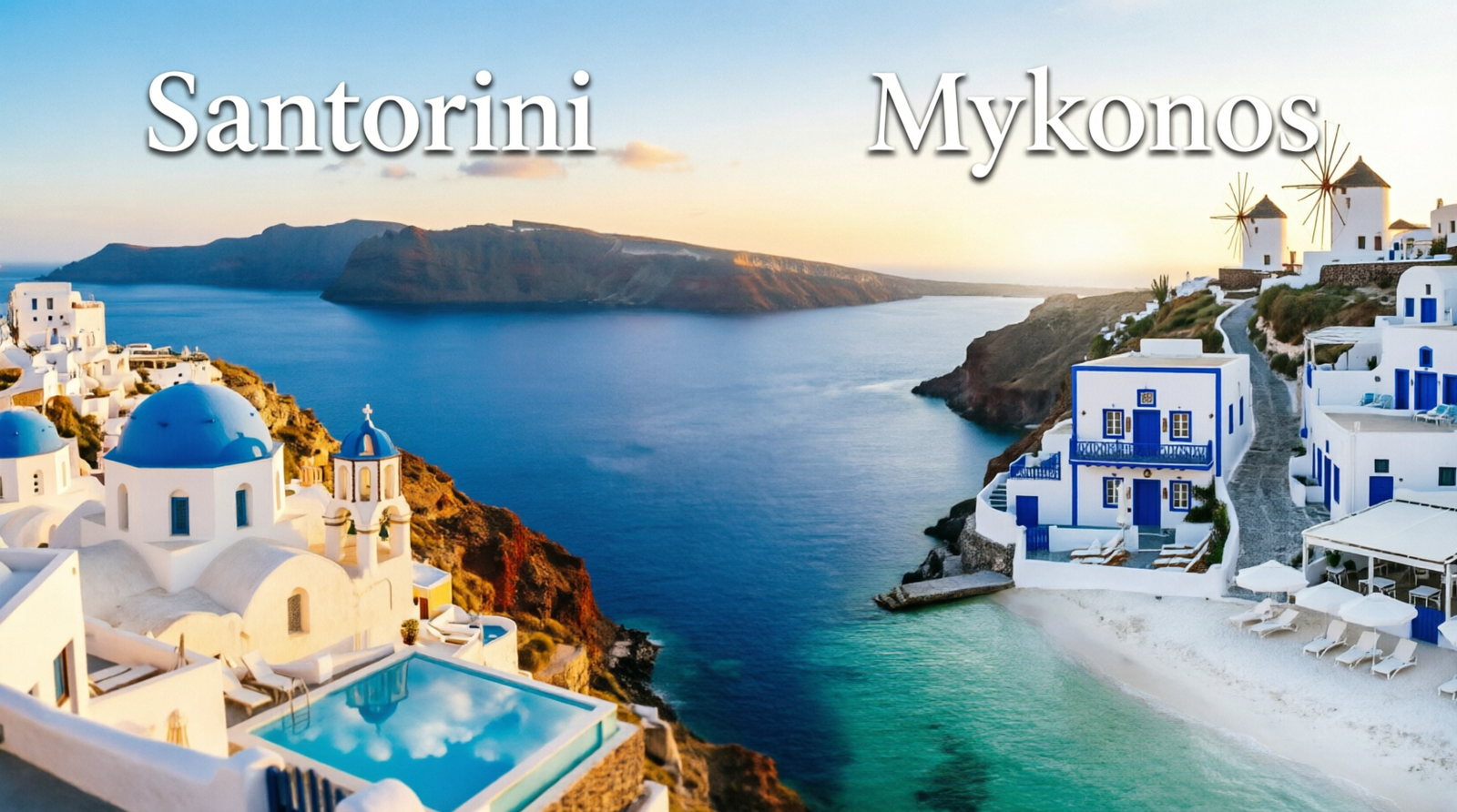
Choosing between Santorini or Mykonos can be surprisingly difficult because both Greek islands offer beautiful scenery, memorable food, luxury stays, and unforgettable experiences. Yet they create very different travel experiences. Santorini is widely associated with dramatic caldera views, whitewashed villages, and famous sunsets, while Mykonos is known for beaches, lively entertainment, stylish resorts, and its cosmopolitan atmosphere. So, which island actually fits your travel plans?
The answer depends on what you value most, including your budget, travel style, preferred activities, and the time of year you visit. In this guide, we will compare Santorini and Mykonos across important factors such as beaches, nightlife, sightseeing, accommodation, food, costs, romance, and overall atmosphere.
Rather than relying on a simple popularity contest, the goal is to give you practical, balanced information so you can make a choice that matches your own trip. Whether you are planning a honeymoon, family vacation, solo adventure, or first Greek island getaway, this comparison will help you understand the key differences before booking.
Santorini vs Mykonos: What’s the Difference?
First, Santorini and Mykonos are proper nouns because each identifies a specific geographical destination. Both are Greek islands in the Aegean Sea, although their landscapes, atmosphere, attractions, and typical travel experiences differ considerably.
Santorini is particularly recognized for its volcanic landscape. Moreover, the island’s villages are positioned along the caldera cliffs, creating the dramatic scenery often associated with Greece. White buildings, blue domes, winding lanes, sea views, wineries, and spectacular sunsets are major attractions.
Mykonos, by comparison, has a different personality. Instead of focusing primarily on volcanic cliffs and caldera panoramas, the island is better known for sandy beaches, beach clubs, traditional Cycladic architecture, fashionable restaurants, and an energetic social scene.
| Feature | Santorini | Mykonos |
|---|---|---|
| Type | Greek island and destination | Greek island and destination |
| Famous for | Caldera views, sunsets, volcanic scenery | Beaches, nightlife, beach clubs |
| Landscape | Cliffs, volcanic terrain, caldera | Sandy beaches, rolling terrain, coastal areas |
| Atmosphere | Romantic, scenic, relaxed in many areas | Social, fashionable, energetic |
| Popular with | Couples, honeymooners, photographers | Friends, social travelers, beach lovers |
| Architecture | White villages overlooking the caldera | White Cycladic houses and narrow lanes |
| Evening experience | Sunset dinners and relaxed nightlife | Clubs, bars, parties, late evenings |
| Food experience | Seafood, Greek cuisine, local wines | Greek cuisine, upscale dining, beach restaurants |
| Best known village area | Oia | Mykonos Town |
| Typical appeal | Views and atmosphere | Beaches and entertainment |
Therefore, the simplest distinction is this: Santorini emphasizes scenery, romance, and volcanic landscapes, while Mykonos emphasizes beaches, social life, and entertainment.
However, that doesn’t mean Santorini lacks nightlife or Mykonos lacks beautiful scenery. Instead, each island simply places greater emphasis on different experiences.
Consequently, choosing between them depends less on which island is universally preferable and more on what you want from your Greek holiday.
Is Santorini vs Mykonos a Grammar, Vocabulary, or Usage Issue?
Unlike spelling pairs such as two commonly confused English words, Santorini and Mykonos aren’t interchangeable vocabulary choices. Instead, this is primarily a destination usage and travel terminology issue.
Both names identify separate places. Therefore, replacing one with the other can create a factual mistake rather than a grammatical error.
For example, saying, “We stayed in Santorini and visited the beaches of Mykonos,” correctly identifies two destinations. Conversely, saying, “We stayed in Mykonos and watched the famous Santorini caldera from our hotel,” could become confusing if the speaker actually means they were staying on Santorini.
Furthermore, formal travel writing should use the official geographical names clearly. Academic assignments, travel guides, itineraries, reservations, and professional correspondence all benefit from precise destination names.
In casual conversation, people may shorten descriptions by saying “the Greek islands,” but that broader phrase doesn’t identify either destination specifically.
Ultimately, the names aren’t interchangeable. Santorini means one island destination, while Mykonos means another.
Santorini: Practical Usage and Travel Meaning
First, Santorini is a suitable choice for travelers who value scenery, photography, romantic settings, cultural exploration, and memorable views.
The island’s distinctive landscape comes from its volcanic history. As a result, settlements around the caldera provide viewpoints that are visually different from many traditional beach destinations.
Workplace example
For instance, imagine a travel consultant preparing a honeymoon itinerary. The consultant might write:
“Include two evenings in Santorini for sunset dining and caldera sightseeing.”
Here, the destination name communicates a specific type of itinerary experience.
Academic example
Similarly, a geography student could write:
“Santorini developed its distinctive landscape through major volcanic activity.”
In this context, the name identifies the precise location being studied.
Technology example
Likewise, mapping and travel applications use Santorini as a destination label. Consequently, entering “Santorini” rather than “Mykonos” directs a traveler toward a different island and different attractions.
Usage recap
Therefore, use Santorini when discussing the island associated with caldera landscapes, cliffside villages, volcanic scenery, sunset viewpoints, and romantic travel experiences. Nevertheless, remember that Santorini also has beaches, restaurants, cultural attractions, and nightlife.
Mykonos: Practical Usage and Travel Meaning
Conversely, Mykonos generally appeals to travelers seeking beaches, social activities, stylish hospitality, and lively evenings.
The island has a recognizable Cycladic appearance, with whitewashed buildings, narrow lanes, windmills, waterfront areas, and traditional details. Meanwhile, its beach culture has contributed significantly to its international reputation.
Workplace example
For example, a travel planner could write:
“Reserve Mykonos for the group portion of the itinerary because the travelers want beach clubs and evening entertainment.”
Here, the destination communicates the intended travel environment.
Academic example
A tourism student might write:
“Mykonos has developed a strong international tourism identity around beaches, hospitality, and entertainment.”
Thus, the name functions as a precise geographical reference.
Technology example
Similarly, navigation platforms, hotel applications, and travel planners distinguish Mykonos from Santorini because they are separate destinations. Therefore, selecting the correct island matters when searching for accommodation, transportation, restaurants, attractions, or activities.
Usage recap
In short, use Mykonos when the subject involves the island itself, its beaches, nightlife, Cycladic streets, social atmosphere, or popular coastal venues. However, Mykonos isn’t exclusively a party destination, since quieter experiences are also available.
When You Should NOT Use Santorini or Mykonos
Although both names frequently appear together, there are several situations where substituting one for the other creates confusion.
1. When describing the caldera
If your subject is the famous volcanic caldera landscape, Santorini is the geographically appropriate name.
2. When discussing Mykonos beaches
If you’re specifically referring to beaches and beach clubs on Mykonos, replacing the island’s name with Santorini changes the location.
3. When discussing accommodation
Hotel reservations depend on exact location. Therefore, writing the wrong island name can lead to an entirely different booking.
4. When planning transportation
Ferries, flights, transfers, and local transportation are destination specific. Consequently, confusing the names can create practical problems.
5. When writing an academic report
A geography, tourism, history, or cultural studies paper needs precise geographical terminology. Thus, using the wrong island weakens factual accuracy.
6. When giving directions
A traveler asking for directions needs the correct destination. Saying Mykonos when you mean Santorini could send the person to another island.
7. When comparing hotel prices
Accommodation costs can vary according to island, season, neighborhood, and property type. Therefore, the island must be identified correctly.
8. When discussing personal travel memories
If someone says they watched the sunset from Oia, identifying the experience as Mykonos would be geographically inaccurate because Oia is on Santorini.
Common Mistakes and Decision Rules
One of the most frequent mistakes is treating the two names as interchangeable simply because both are famous Greek holiday destinations.
| Correct sentence | Incorrect sentence | Explanation |
|---|---|---|
| We visited Santorini for its caldera views. | We visited Mykonos for its caldera views. | The famous caldera setting belongs to Santorini. |
| We spent several days in Mykonos. | We spent several days in Santorini. | The second sentence changes the destination. |
| Our hotel overlooks Santorini’s caldera. | Our hotel overlooks Mykonos’s caldera. | The geographic reference is incorrect. |
| We went to Mykonos for its beach clubs. | We went to Santorini for Mykonos beach clubs. | The named experience belongs to a different island. |
| Oia is in Santorini. | Oia is in Mykonos. | Oia is a settlement on Santorini. |
Decision Rule Box
If you mean the volcanic caldera, cliffside villages, Oia, or famous Santorini sunset viewpoints, use Santorini.
If you mean Mykonos Town, major beach club culture, or the island’s well known social scene, use Mykonos.
When the context involves both destinations, mention each name explicitly. That small step prevents geographical ambiguity.
Santorini and Mykonos in Modern Technology and Digital Travel Tools
Today, destination names appear across booking platforms, navigation applications, travel planners, weather services, digital maps, and itinerary tools.
Therefore, accurate spelling and destination selection matter more than they might seem.
For example, searching for a hotel in Santorini produces accommodation options on that island. Meanwhile, searching for Mykonos produces properties elsewhere in the Aegean.
Likewise, digital mapping systems rely on exact geographical labels. Consequently, a small naming mistake can affect directions, transportation planning, hotel searches, restaurant discovery, and activity reservations.
Furthermore, modern travel planning tools often combine several destinations into one itinerary. In such situations, clearly distinguishing Santorini from Mykonos helps organize ferry schedules, lodging dates, excursions, and transportation segments.
Thus, the distinction is not merely linguistic. Correct destination terminology supports accurate travel planning.
Etymology and Historical Naming
The names Santorini and Mykonos have different historical backgrounds.
Santorini is a name that developed through historical linguistic changes associated with the island’s long relationship with Mediterranean cultures and European travelers. Its ancient name is commonly connected with Thera.
Mykonos, meanwhile, has roots in ancient Greek tradition. The island’s name is traditionally associated with Mykons, a figure connected with Greek mythology and local tradition.
Over centuries, geographical names often change through pronunciation, translation, administration, and cultural contact. Therefore, modern names don’t always look or sound identical to their oldest forms.
From a language perspective, both names are proper nouns. They should normally retain their established capitalization because they identify specific geographical places.
An Expert Style Perspective on the Difference
A useful travel writing principle is:
“Precise destination names turn a general travel description into reliable geographical information.”
This principle matters because readers often use travel content to make practical decisions. Consequently, clear terminology should accompany attractive descriptions.
A polished article shouldn’t simply say that both islands are beautiful. Instead, it should explain what distinguishes their landscapes, activities, atmosphere, and visitor experiences.
That approach gives readers information they can actually use.
Two Illustrative Case Studies
Case Study 1: The Couple Planning a Romantic Holiday
Consider an illustrative couple planning a seven day Greek island trip. Their priorities include sunset views, photography, scenic restaurants, and relaxed evenings.
Initially, they considered both destinations without identifying their main travel priorities. After separating their goals into scenery, nightlife, beaches, and atmosphere, they allocated four nights to Santorini and three nights to another destination.
The concrete result was a more focused itinerary because their primary interest was scenic exploration rather than nightlife.
This example demonstrates why destination names should be connected to specific travel goals.
Case Study 2: The Friends Planning a Social Trip
Now consider a group of four friends looking for beaches, restaurants, social activities, and late evening entertainment.
Initially, they searched broadly for “Greek islands.” However, after identifying their preferred activities, they compared Mykonos with several alternatives and created a schedule centered around beach visits and evening venues.
Their concrete result was a seven day plan with fewer unnecessary sightseeing transfers and more time allocated to their preferred activities.
Therefore, the important lesson isn’t that one island suits everyone. Rather, clear destination comparison helps travelers match a location with their actual priorities.
Error Prevention Checklist
Always use Santorini when
You mean the caldera landscape.
You are discussing Oia.
You are referring to cliffside villages overlooking the caldera.
You are describing the island’s volcanic character.
You are discussing a destination specifically located on Santorini.
Never use Mykonos when
You mean Santorini’s caldera.
You are specifically discussing Oia.
You are identifying a Santorini hotel.
You are describing a Santorini itinerary.
You are referring to a location that exists on Santorini.
Always use Mykonos when
You mean Mykonos Town.
You are discussing Mykonos beaches.
You are describing the island’s established beach club culture.
You are identifying accommodation located on Mykonos.
You are discussing an itinerary specifically centered on Mykonos.
Related Grammar Confusions You Should Master
Once you’ve understood the distinction between these two destination names, several related geographical and language topics are worth learning.
Greece vs Greek
Greece identifies the country, while Greek describes something connected with Greece.
Island vs archipelago
An island is an individual landmass surrounded by water, whereas an archipelago is a group of islands.
Athens vs Acropolis
Athens is the city, while the Acropolis is a historic citadel within Athens.
Venice vs Venetian
Venice is the place, whereas Venetian describes something associated with that city.
Italy vs Italian
Italy identifies the country, while Italian functions as an adjective and noun depending on context.
Destination vs attraction
A destination can be an entire city, island, or region, while an attraction is a specific place or experience visitors seek.
Coast vs beach
A coast refers broadly to land bordering the sea, whereas a beach is a particular type of coastal environment.
Resort vs island
An island is geographical land, while a resort is a property or destination developed around leisure and hospitality.
Village vs town
These terms describe settlements of different sizes and functions. Therefore, they shouldn’t automatically be treated as synonyms.
Tourist destination vs tourist attraction
A destination can contain numerous attractions. Consequently, the two expressions describe different levels of travel geography.
People Also Ask Questions
Is Santorini or Mykonos better for a first trip to Greece?
Both offer different experiences. Santorini is particularly associated with caldera scenery, sunsets, and romantic sightseeing, whereas Mykonos is strongly associated with beaches, social activities, and nightlife.
Is Santorini more expensive than Mykonos?
Travel costs vary according to season, accommodation, dining choices, transportation, and activities. Therefore, neither island has one universal price level for every traveler.
Is Santorini or Mykonos better for couples?
Santorini is commonly associated with romantic scenery and sunset experiences. However, couples who prioritize beaches, social venues, and energetic evenings may prefer the atmosphere associated with Mykonos.
Is Mykonos or Santorini better for beaches?
Mykonos is particularly recognized for its sandy beaches and established beach culture. Santorini also has beaches, but its volcanic geography gives many coastal areas a noticeably different appearance.
Can you visit Santorini and Mykonos on the same trip?
Yes. Many travelers combine Greek islands in one itinerary. However, transportation schedules and seasonal availability should be checked carefully before finalizing dates.
Is Santorini quieter than Mykonos?
The atmosphere varies by neighborhood, season, and time of day. Generally, Santorini is strongly associated with scenic and romantic travel, while Mykonos has a particularly prominent social and nightlife reputation.
Which island has better sunsets, Santorini or Mykonos?
Santorini is especially famous for sunset viewing because of its caldera geography and elevated villages. However, sunset quality depends on weather, location, season, and viewing conditions.
Are Santorini and Mykonos close to Athens?
Both islands are connected with Athens through transportation services, but travel times and schedules vary. Travelers should check current transportation information for their exact dates.
Should I choose Santorini or Mykonos for a honeymoon?
Consider the experience you want. Santorini fits travelers prioritizing dramatic views and romantic scenery, while Mykonos can suit couples who place greater emphasis on beaches, restaurants, social activities, and entertainment.
Can Santorini and Mykonos be used interchangeably?
No. They are separate Greek islands. Using one name when referring to the other creates a geographical error rather than a simple wording variation.
Final Answer
The choice between Santorini or Mykonos becomes much clearer when you focus on the experience rather than reputation alone. Santorini is closely associated with volcanic scenery, the caldera, cliffside settlements, sunset viewpoints, photography, and romantic travel. Meanwhile, Mykonos is strongly associated with beaches, beach clubs, nightlife, stylish hospitality, and an energetic social atmosphere.
However, both islands offer much more than their popular stereotypes suggest. Santorini has beaches, food, wine, history, and nightlife, while Mykonos offers architecture, culture, quieter corners, restaurants, and beautiful coastal scenery. Therefore, use Santorini when your subject is the island famous for its caldera landscape and dramatic sunset views. Use Mykonos when your subject concerns its beaches, social atmosphere, Cycladic streets, and entertainment culture.
Most importantly, don’t treat the names as interchangeable. They identify different places, and precise geographical language makes travel planning, academic writing, workplace communication, and everyday conversation much clearer.









