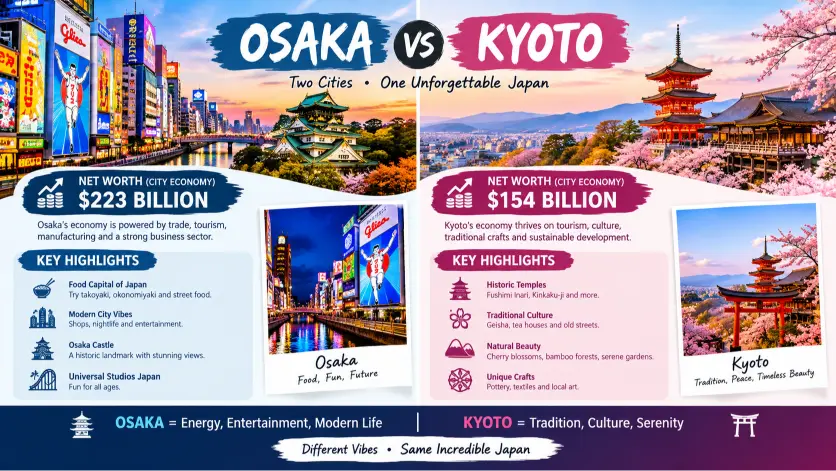
Planning a trip to Japan but stuck between Osaka or Kyoto? You are not alone. Both cities offer unforgettable experiences, yet they have very different personalities. Osaka is widely known for its energetic atmosphere, famous food culture, shopping districts, and lively nightlife, while Kyoto is celebrated for historic temples, traditional neighborhoods, gardens, and cultural experiences. Choosing between them can depend on your budget, travel style, available time, and the type of Japanese experience you want.
In this guide, we will compare Osaka and Kyoto across the factors travelers usually care about most, including attractions, food, transportation, accommodation, costs, nightlife, culture, and overall travel experience. Rather than simply calling one city better, we will explain what each destination offers and which type of traveler may enjoy it most. Whether you are visiting Japan for the first time, planning a short trip, or deciding where to spend more nights, this comparison will help you make a more informed and practical travel decision.
Osaka vs Kyoto: What’s the Difference?
First, Osaka and Kyoto are both proper nouns because they identify specific geographical places. However, they refer to different cities in Japan and should not be treated as alternative spellings of the same destination.
Osaka is widely known as a major urban center with a strong reputation for commerce, entertainment, street food, shopping, and lively neighborhoods. Meanwhile, Kyoto is especially recognized for its historic districts, Buddhist temples, Shinto shrines, gardens, traditional houses, and longstanding cultural traditions.
Therefore, the distinction is primarily geographical and contextual rather than grammatical.
| Term | Part of speech | Meaning | Typical context | Main association |
|---|---|---|---|---|
| Osaka | Proper noun | A city in Japan | Travel, geography, business | Food, commerce, nightlife |
| Kyoto | Proper noun | A city in Japan | Travel, geography, culture | Temples, heritage, traditions |
| Osaka | Place name | Specific destination | Itineraries and addresses | Modern urban life |
| Kyoto | Place name | Specific destination | Itineraries and addresses | Historic cultural experiences |
Consequently, someone discussing restaurants, entertainment districts, shopping, or a large metropolitan environment may be referring to Osaka.
By contrast, someone discussing historic streets, traditional architecture, temples, gardens, or cultural sightseeing may be referring to Kyoto.
In short, Osaka is not another name for Kyoto, and Kyoto isn’t another name for Osaka.
The two cities can appear together in travel plans because they are relatively close to one another, yet their identities remain separate.
Osaka or Kyoto: Is the Difference Grammar, Vocabulary, or Usage?
The distinction between Osaka and Kyoto isn’t really a grammar problem. Instead, it is primarily a vocabulary and usage issue involving proper nouns and geographical names.
Grammar determines how words function within a sentence. However, vocabulary determines what a particular word or name refers to. Since Osaka and Kyoto identify different places, replacing one with the other changes the meaning of the sentence.
For example:
Correct: I spent three days in Osaka.
Different meaning: I spent three days in Kyoto.
Both sentences are grammatically correct. Nevertheless, they describe different destinations.
Similarly, formal writing should use the correct city name when discussing research, geography, tourism, transportation, business, or history. Casual conversation doesn’t make the names interchangeable either.
Therefore, whether you’re writing an academic assignment, booking accommodation, preparing a travel itinerary, or simply describing a vacation, selecting the correct geographical name matters.
Are Osaka and Kyoto interchangeable?
No. They aren’t interchangeable.
Although both are Japanese cities and frequently appear in the same travel conversation, substituting one for the other produces inaccurate information.
Formal and academic usage
In formal writing, geographical precision is especially important. A university report about Kyoto’s historical architecture shouldn’t suddenly refer to Osaka when describing the same location.
Likewise, an academic discussion of Osaka’s commercial development shouldn’t replace Osaka with Kyoto merely because both cities belong to the same country.
Casual usage
Even in everyday conversation, accuracy remains useful. Saying that you visited Kyoto when you actually visited Osaka tells the listener that you went somewhere else.
Thus, the difference is simple once the geographical identities are understood.
Osaka: Meaning, Usage, and Practical Examples
Osaka is a proper noun used to identify a specific Japanese city. Because it is a geographical name, it normally begins with a capital letter.
For instance:
“I’m staying in Osaka for four nights.”
The word Osaka doesn’t describe an object, action, emotion, or person. Instead, it identifies a location.
Workplace example
A business report might state:
“Our company opened a new office in Osaka.”
Here, Osaka identifies the location of the office.
Academic example
A student researching urban development could write:
“Osaka became an important commercial center in Japan.”
In this context, the city name identifies the geographical subject of the discussion.
Technology example
A navigation application might display:
“Osaka, Japan.”
Likewise, a weather service could show Osaka as the selected location for temperature and forecast information.
Usage recap
Therefore, use Osaka whenever you specifically mean the city of Osaka.
It works naturally in addresses, travel plans, research papers, news reports, business documents, maps, weather applications, and everyday conversations.
Kyoto: Meaning, Usage, and Practical Examples
Kyoto is also a proper noun and geographical name. It identifies a separate Japanese city known particularly for its historic and cultural character.
For example:
“We visited Kyoto during the spring.”
The name tells readers exactly which destination is being discussed.
Workplace example
A company document might say:
“Our Kyoto branch will host the meeting.”
Here, Kyoto identifies the branch’s location.
Academic example
A history paper could state:
“Kyoto played an important role in Japanese cultural history.”
In this sentence, Kyoto identifies the city being examined.
Technology example
A mapping service might display:
“Kyoto, Japan.”
Similarly, a travel application may use Kyoto as the destination when showing hotels, attractions, transportation routes, or weather information.
Usage recap
Consequently, choose Kyoto whenever your sentence refers specifically to that city.
The word should not be substituted with Osaka simply because both destinations are located in Japan or commonly included in the same itinerary.
When You Should NOT Use Osaka or Kyoto
Understanding when not to use either name can prevent surprisingly common mistakes.
1. Don’t use Osaka when you mean Kyoto
If the subject is a Kyoto temple, Kyoto neighborhood, or Kyoto accommodation, replacing Kyoto with Osaka changes the location.
2. Don’t use Kyoto when you mean Osaka
Likewise, a restaurant, hotel, office, or attraction located in Osaka shouldn’t be described as being in Kyoto.
3. Don’t treat them as alternative spellings
Osaka and Kyoto aren’t spelling variants. Each has its own identity.
4. Don’t assume cultural similarity means identical location
Both cities are Japanese, but shared national identity doesn’t make their names interchangeable.
5. Don’t use either city name as a generic word for Japan
Japan is the country. Osaka and Kyoto are individual cities.
6. Don’t confuse a destination with a regional reference
A sentence about a specific city requires the correct geographical name.
7. Don’t switch names merely for stylistic variety
In ordinary writing, repeating the correct place name is preferable to replacing it with an inaccurate alternative.
8. Don’t rely solely on context
Even when readers might understand what you mean, precise wording remains important in travel documents, academic work, and professional communication.
Common Mistakes: Osaka or Kyoto
The following examples show how a small substitution can produce a completely different meaning.
| Correct sentence | Incorrect sentence | Explanation |
|---|---|---|
| I flew to Osaka for work. | I flew to Kyoto for work. | The destinations are different. |
| Kyoto is famous for historic sites. | Osaka is famous for historic sites. | The statement changes the subject. |
| We booked a hotel in Osaka. | We booked a hotel in Kyoto. | The accommodation locations differ. |
| Our Kyoto itinerary includes several temples. | Our Osaka itinerary includes several temples. | The itinerary now refers to another city. |
| She studied in Osaka. | She studied in Kyoto. | The person’s educational location changes. |
| They traveled through Kyoto. | They traveled through Osaka. | The route description changes. |
Decision Rule Box
If you mean the city known as Osaka, use Osaka.
If you mean the city known as Kyoto, use Kyoto.
If you’re describing Japan as a country, use Japan instead.
This rule is more useful than trying to memorize complicated grammar terminology.
Osaka or Kyoto in Modern Technology and Digital Tools
Modern technology makes geographical names appear constantly in everyday communication. Consequently, knowing the distinction becomes increasingly useful.
For example, navigation applications use city names to identify destinations. Weather platforms use them to provide local forecasts. Hotel reservation systems use them to distinguish accommodation locations. Online shopping platforms may also display city names when processing delivery information.
Meanwhile, translation tools can recognize both Osaka and Kyoto as proper geographical names. However, recognizing a word doesn’t mean that two names can be substituted for one another.
Voice assistants can also respond differently depending on the city selected. A request for the weather in Osaka concerns one location, whereas a request for Kyoto concerns another.
Therefore, digital systems reinforce the same basic language principle: a proper place name identifies a specific geographical entity.
Etymology and Historical Naming
The names Osaka and Kyoto have long histories connected with Japan’s language and geography.
Osaka has traditionally been written 大阪 in Japanese. The name is commonly interpreted through its component characters, although historical forms and interpretations of place names can be more complex than a simple word for word translation suggests.
Kyoto, written 京都, is associated with the idea of a capital city. Historically, Kyoto served as Japan’s imperial capital for many centuries, which strongly shaped its cultural importance.
Consequently, the two names developed through different historical circumstances.
An expert style principle worth remembering is:
“A place name carries identity, so accuracy matters more than stylistic variation.”
That principle applies beyond Japanese geography. London and Paris, Madrid and Rome, or Boston and Chicago are similarly distinct proper nouns.
Two Practical Case Studies
Case Study 1: The Travel Itinerary
Imagine a traveler creates a five day Japanese itinerary and writes “Kyoto” throughout the document, even though several reservations are actually located in Osaka.
As a result, the traveler may misunderstand transportation plans, hotel locations, and daily routes.
After correcting the city names, the itinerary becomes much easier to interpret because every reservation corresponds to the correct destination.
The concrete result is improved geographical accuracy and fewer planning errors.
Case Study 2: The University Assignment
Consider a student writing about Japanese cultural history. The student initially uses Osaka whenever discussing historic traditions associated with Kyoto.
After separating the two geographical subjects, the paper becomes more precise. Statements about Kyoto’s cultural heritage remain attached to Kyoto, while observations about Osaka’s urban and commercial development remain associated with Osaka.
The concrete result is a clearer argument with fewer factual location errors.
Osaka or Kyoto: Error Prevention Checklist
Always use Osaka when
You mean the city of Osaka.
You are identifying an Osaka address.
You are describing an Osaka hotel or restaurant.
You are discussing an Osaka based organization.
You are referring to an Osaka itinerary or destination.
Always use Kyoto when
You mean the city of Kyoto.
You are identifying a Kyoto address.
You are describing a Kyoto hotel or restaurant.
You are discussing a Kyoto based organization.
You are referring to a Kyoto itinerary or destination.
Never use Kyoto when
Your subject is specifically Osaka.
Never use Osaka when
Your subject is specifically Kyoto.
The easiest solution is to identify the exact place before writing the sentence.
Related Grammar Confusions You Should Master
Once you’ve understood Osaka and Kyoto, several other geographical and language distinctions become easier to handle.
- Japan vs Japanese: country name versus adjective or nationality term
- Tokyo vs Kyoto: two different Japanese cities
- Osaka vs Tokyo: separate urban destinations
- Country vs city names: geographical hierarchy and usage
- Proper nouns vs common nouns: capitalization and identity
- Capitalization of place names: when geographical names require capitals
- City vs prefecture: different geographical categories
- Location vs destination: context dependent usage
- Historic vs historical: closely related but different meanings
- Traveling vs travelling: regional spelling variation
These distinctions are useful because geographical writing often combines vocabulary, capitalization, location, and contextual accuracy.
Frequently Asked Questions
Is Osaka or Kyoto the correct name?
Both are correct names, but they identify different Japanese cities. The appropriate choice depends entirely on which destination you mean.
Are Osaka and Kyoto the same city?
No. Osaka and Kyoto are separate cities in Japan. They may appear together in travel plans, but they have different geographical identities.
Should I write Osaka or Kyoto in a sentence?
Use Osaka when the sentence refers to Osaka. Use Kyoto when the sentence refers to Kyoto. The two names shouldn’t be exchanged.
Is Osaka a proper noun?
Yes. Osaka is a proper noun because it identifies a specific geographical location.
Is Kyoto a proper noun?
Yes. Kyoto is a proper noun because it identifies a particular city.
Can Osaka and Kyoto be used interchangeably?
No. Although both names identify cities in Japan, substituting one for the other changes the geographical meaning.
Which city name is more formal?
Neither name is inherently more formal. Both are standard proper names and should be used according to the location being discussed.
Why do people confuse Osaka and Kyoto?
The confusion often occurs because both cities are well known Japanese destinations and are frequently discussed together. However, their names represent separate locations.
Is Kyoto part of Osaka?
No. Kyoto and Osaka are separate cities. They can be connected through transportation and commonly appear in the same itinerary, but one city isn’t simply another neighborhood of the other.
How can I remember the difference between Osaka and Kyoto?
Think of the names as labels for two separate destinations. If your subject is Osaka, write Osaka. If your subject is Kyoto, write Kyoto. Avoid treating the names as synonyms.
Final Answer
The correct choice between Osaka or Kyoto depends on the place you mean. Osaka and Kyoto are both proper geographical names, but they identify separate Japanese cities with different histories, environments, and cultural associations.
Therefore, there isn’t a grammar rule that makes one universally correct. Instead, the essential rule is geographical accuracy. When your subject is Osaka, write Osaka. When your subject is Kyoto, write Kyoto.
Once you understand that both terms identify different locations, the confusion becomes straightforward. The most reliable approach is to focus on the destination you actually mean rather than choosing a name based on similarity or context alone.









