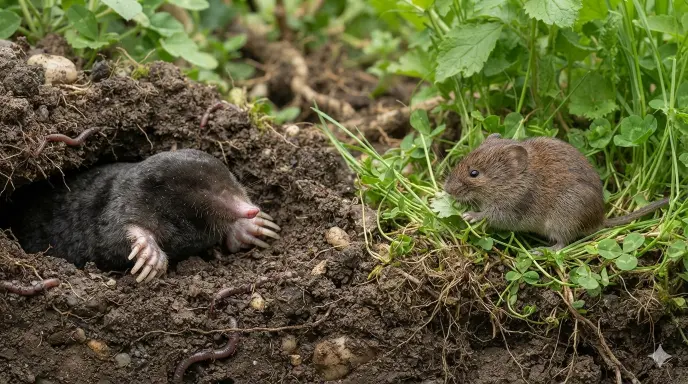
Have you noticed small holes, raised tunnels, or unusual damage in your yard and wondered whether you are dealing with a mole or vole? These two small mammals are often confused because both can appear around gardens, lawns, and landscapes. However, they are quite different in appearance, diet, behavior, and the type of damage they can cause. Knowing which animal you are looking at can make identification much easier and help you understand what is happening in your yard.
In this guide, we will break down the mole vs vole difference in simple language, covering their physical features, habitats, feeding habits, underground activity, and common signs. You will also learn how their tunnels, holes, and plant damage can help you distinguish one from the other. The information is based on established wildlife and biological characteristics, giving you a practical and reliable way to identify these animals without relying on guesswork.
Mole vs Vole: What’s the Difference?
First, a mole is a noun referring to a small burrowing mammal with powerful front feet, tiny eyes, and a pointed snout. Moles spend much of their time beneath the ground while searching for insects and other small organisms.
In contrast, a vole is also a noun, but it describes a compact rodent that looks somewhat like a mouse. Voles generally have rounded bodies, visible ears, short tails, and a strong preference for plant material.
Therefore, the two names aren’t interchangeable. Although both animals can live near lawns and gardens, their body structures and lifestyles reveal an important distinction.
| Feature | Mole | Vole |
|---|---|---|
| Part of speech | Noun | Noun |
| Animal group | Mammal | Rodent mammal |
| Appearance | Pointed snout and broad digging feet | Rounded body resembling a mouse |
| Eyes | Very small | Clearly visible |
| Ears | Mostly hidden | Noticeable |
| Tail | Short | Short but visible |
| Main food | Earthworms, insects, larvae, and other small organisms | Grass, roots, bulbs, bark, seeds, and vegetation |
| Main activity | Digging underground tunnels | Feeding and traveling through vegetation and shallow pathways |
| Common garden sign | Raised soil ridges and mounds | Gnawed plants, roots, and narrow surface pathways |
Mini Recap
A mole is primarily a specialized underground digger.
A vole is primarily a plant eating rodent.
Consequently, their tracks and damage patterns can look different.
Most importantly, identifying the animal correctly prevents the wrong word from being used.
Is Mole vs Vole a Grammar, Vocabulary, or Usage Issue?
The distinction between these terms is mainly a vocabulary and usage issue, rather than a grammar problem. Both words function naturally as nouns, yet they identify different animals.
For example, saying “I saw a vole digging through the soil” may create an inaccurate picture if the animal was actually a mole. Similarly, calling a mouse like garden rodent a mole changes the intended meaning.
Moreover, neither term is simply a formal or informal version of the other. Both are standard English nouns. Their difference comes from biological meaning, not social register.
In academic writing, wildlife reports, gardening discussions, and educational material, choosing the precise noun matters because readers may rely on the description to understand a particular species or behavior.
In casual conversation, people sometimes confuse the names because both creatures are small and can occur around yards. Nevertheless, context doesn’t make the words interchangeable.
Understanding the Mole
A mole has a body specially suited to life beneath the surface. Its front limbs are powerful and positioned for pushing soil, while its streamlined shape allows it to move through narrow underground spaces.
Furthermore, moles have very small eyes because vision isn’t their primary method of finding food. Instead, they rely heavily on touch, smell, and sensitivity to movement.
Their diet also separates them from many common garden rodents. Moles commonly consume earthworms, insects, larvae, and other small invertebrates. Therefore, a tunnel in the lawn doesn’t automatically mean that a plant eating animal caused it.
Workplace Example
Suppose an employee prepares a property management report describing lawn damage. A precise sentence would be:
“The raised soil ridges appear consistent with mole activity.”
This wording identifies the suspected animal without confusing it with a rodent.
Academic Example
In a biology assignment, a student might write:
“Moles possess specialized forelimbs that help them excavate underground tunnels.”
This sentence is suitable because it connects the animal with its distinctive physical adaptation.
Technology Example
Garden monitoring software may categorize animal activity from photographs or sensor information. In that setting, selecting “mole” instead of “vole” can affect how the observation is recorded.
Usage Recap
Use mole when referring to the small mammal adapted for underground excavation. Its pointed face, digging limbs, and subterranean lifestyle are useful clues. Consequently, visible soil ridges are often associated with its activity.
Understanding the Vole
A vole belongs to the rodent family and often resembles a short, stocky mouse. However, its body tends to appear more compact, while its ears may be smaller than those of familiar house mice.
Unlike moles, voles commonly eat vegetation. They may feed on grasses, roots, bulbs, seeds, stems, and bark. As a result, their presence can become noticeable when plants suddenly show chewing damage.
Additionally, voles frequently move through grassy areas and vegetation. They can create narrow pathways close to the surface, particularly where dense growth provides cover.
Workplace Example
A landscaper documenting plant damage could write:
“Voles may be responsible for the gnawed roots around the shrubs.”
Here, the noun correctly identifies a rodent associated with plant feeding.
Academic Example
A biology student might explain:
“Voles are small rodents that commonly consume vegetation and other plant material.”
This description separates them from insect and earthworm feeding moles.
Technology Example
Image recognition applications may attempt to distinguish voles from mice, rats, and other small mammals. However, photographs can sometimes be insufficient, particularly when the animal is partially hidden.
Usage Recap
Use vole when the animal is a small rodent with a rounded appearance and plant focused diet. Visible vegetation damage can provide a useful clue, although identification should consider several characteristics rather than one sign alone.
When You Should NOT Use Mole or Vole
Several situations can cause confusion, particularly when someone identifies an animal from a single observation.
- Don’t use mole for a mouse like rodent.
If the creature has obvious ears, a rounded body, and a visible tail, another identification may be more appropriate. - Don’t use vole for a specialized underground digger.
A pointed snout and powerful digging feet suggest a very different mammal. - Don’t assume every lawn tunnel belongs to a mole.
Surface pathways, plant damage, and underground activity can have different causes. - Don’t choose the term based only on size.
Both animals are relatively small, so size alone isn’t enough. - Don’t use the words as synonyms.
Their biological meanings are distinct. - Don’t rely entirely on one damaged plant.
Many animals can chew roots, stems, or bark. - Don’t treat mole as a general word for a garden pest.
The noun identifies a particular mammal. - Don’t identify an animal solely from an unverified online image.
Similar looking species can make visual identification difficult.
Therefore, the safest approach is to consider body shape, feet, eyes, ears, diet, movement, and signs of activity together.
Common Mistakes: Mole or Vole
The following examples demonstrate how a small vocabulary difference can produce a different meaning.
| Correct sentence | Incorrect sentence | Explanation |
|---|---|---|
| The mole created raised ridges in the lawn. | The vole created raised ridges in the lawn. | The first sentence refers to an underground digging mammal. |
| The vole damaged the plant roots. | The mole damaged the plant roots. | The second version changes the intended animal. |
| We identified a vole near the grass. | We identified a mole near the grass. | A grass dwelling rodent may be a vole. |
| The mole has specialized front feet. | The vole has specialized digging feet. | The physical adaptations differ. |
| Voles often feed on vegetation. | Moles often feed on vegetation. | The dietary description is generally associated with voles. |
Decision Rule Box
If you mean the underground mammal with specialized digging adaptations, use “mole.”
If you mean the small plant eating rodent, use “vole.”
This simple distinction resolves most everyday usage problems.
Mole and Vole in Modern Technology
Modern technology increasingly uses photographs, motion sensors, trail cameras, and wildlife databases to identify small animals. Consequently, these terms can appear in gardening applications, ecological surveys, property monitoring systems, and educational platforms.
However, automated identification isn’t always definitive. Lighting, distance, image quality, body position, and species similarity can influence a classification.
For example, a blurry photograph of a small animal may not provide enough evidence to distinguish a vole from another rodent. Similarly, software might detect underground activity without directly observing the animal.
Therefore, technology can assist identification, but descriptive evidence remains valuable. When accuracy matters, users should examine several physical and behavioral characteristics rather than accepting a single label without question.
Etymology and Word History
The word mole has a long history in English and is connected with older Germanic forms referring to the familiar burrowing mammal. Over time, the term became firmly established as the common English name for this animal.
Meanwhile, vole entered English much later. Its history is connected with Scandinavian and northern European terminology associated with these small rodents.
Interestingly, the two words look and sound somewhat similar in modern English. Nevertheless, their histories and biological references are separate. That resemblance probably contributes to occasional confusion, especially among people who rarely encounter either animal.
An Expert Style Perspective
“Accurate word choice begins with identifying the exact thing a noun represents.”
That principle applies particularly well here because both terms name real animals rather than different spellings of the same concept.
Two Practical Case Studies
Case Study One: Lawn Damage
Consider a homeowner who notices raised ridges running across a grassy lawn. Initially, the homeowner describes the animal as a vole because the creature was assumed to be a small garden rodent.
After examining the signs more carefully, the description focuses on underground ridges and soil disturbance rather than chewed vegetation. Consequently, the original vocabulary choice becomes questionable.
The lesson is straightforward: physical evidence should guide the noun, rather than the general assumption that every small garden mammal is a rodent.
Case Study Two: Root Damage
Now consider a gardener who discovers damaged roots and bark around several young plants. The gardener initially assumes that moles caused the problem because tunnels were noticed nearby.
However, the visible feeding damage points toward a plant eating animal. Once the characteristics are evaluated together, the vocabulary changes accordingly.
The important lesson is that nearby tunnels don’t automatically identify the animal responsible for feeding damage. Observation should distinguish movement from feeding behavior.
Error Prevention Checklist
Always use mole when:
- You are describing the specialized burrowing mammal.
- The animal has prominent digging forefeet.
- The snout appears pointed.
- Underground movement is the dominant behavior being described.
- The context concerns raised soil ridges associated with burrowing.
Never use vole when:
- You specifically mean a mole.
- The animal’s defining feature is underground excavation.
- You’re describing specialized mole anatomy.
- A scientific or educational explanation requires precise terminology.
- The evidence clearly identifies the animal as a mole.
Likewise, choose vole when the intended subject is the compact rodent commonly associated with vegetation and plant feeding.
Related Grammar Confusions You Should Master
Once this distinction becomes clear, several other commonly confused terms are worth learning.
- Mouse vs rat: Both are rodents, yet their physical characteristics differ.
- Rabbit vs hare: These animals share similarities but aren’t identical.
- Turtle vs tortoise: Their habitats and physical adaptations provide useful distinctions.
- Frog vs toad: These names refer to related amphibians with different common characteristics.
- Alligator vs crocodile: Geographic and physical clues help separate them.
- Butterfly vs moth: Wing structure, activity patterns, and body features can help.
- Llama vs alpaca: Size, fiber characteristics, and traditional uses differ.
- Venomous vs poisonous: These terms describe different ways an organism can cause harm.
- Fewer vs less: The distinction concerns countable and uncountable nouns.
- Affect vs effect: Meaning and grammatical function determine the correct choice.
Learning these contrasts builds stronger vocabulary because it encourages precise word selection instead of relying on approximate meanings.
Frequently Asked Questions
What is the difference between a mole and a vole?
A mole is a specialized burrowing mammal with powerful front feet and a pointed snout. A vole is a small rodent with a rounded body that commonly feeds on vegetation. Therefore, they differ in anatomy, diet, and lifestyle.
Is a vole the same thing as a mole?
No. A vole and a mole are different animals. A vole is a rodent, while a mole belongs to a separate mammalian group adapted primarily for underground living.
How can you tell a mole from a vole?
Look at the animal’s body and behavior. Moles typically have tiny eyes, a pointed snout, and strong digging feet. Voles generally look more mouse like, with visible ears and a rounded body.
Do moles eat plants?
Moles primarily feed on earthworms, insects, larvae, and other small invertebrates. Therefore, extensive plant chewing is not the defining feeding behavior associated with moles.
Do voles dig underground?
Yes, voles can use underground burrows and pathways. However, their lifestyle differs from that of highly specialized digging mammals. They also spend time near vegetation and commonly feed on plant material.
Are moles rodents?
No. Moles aren’t rodents. They belong to a different mammalian lineage, whereas voles are rodents.
Are voles related to mice?
Yes. Voles are rodents and are related to mice. Their compact bodies can make them appear mouse like, although their proportions and habits differ.
Which animal causes raised ridges in a lawn?
Raised underground ridges are commonly associated with mole activity. However, lawn damage should be evaluated using several clues because different animals can disturb soil or vegetation.
Why do people confuse moles and voles?
People often confuse them because both are small mammals that can occur around lawns, gardens, and soil. Their names also sound similar. Nevertheless, their anatomy, diet, and behavior are substantially different.
Final Answer
The key difference is simple: a mole is a specialized underground mammal, while a vole is a small rodent commonly associated with vegetation. Their similar sounding names can create confusion, but they shouldn’t be treated as interchangeable.
When describing an animal, consider its physical structure first. Then examine its behavior, feeding pattern, habitat, and visible signs. Consequently, you’ll have a much stronger basis for selecting the correct noun.
For everyday writing, academic work, gardening discussions, and wildlife descriptions, this distinction improves clarity. Once you connect mole with specialized digging and vole with the compact plant eating rodent, the difference becomes much easier to remember.









