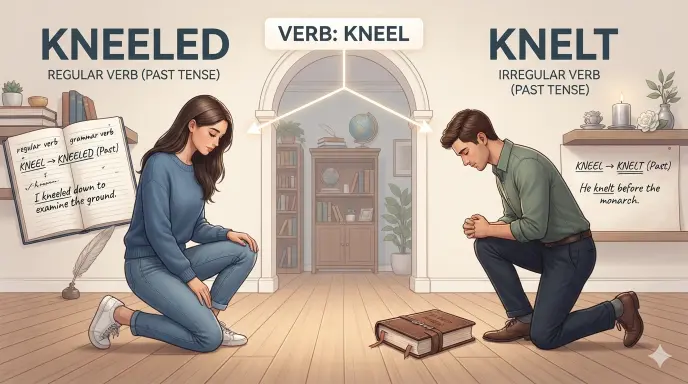
Have you ever stopped while writing a sentence and wondered whether “kneeled” or “knelt” is the correct word? You are not alone. Both forms are connected to the verb kneel, and you can find both in modern English, but their usage can vary depending on context, dialect, and writing style. This small grammar choice can easily create confusion, especially when you are writing formally or trying to improve your English.
Understanding kneeled vs knelt is easier once you know how English verbs change over time and how different varieties of English use alternative forms.
In this guide, we will explain the meaning, grammar, pronunciation, and correct usage of both words with clear examples. You will also learn when “knelt” is preferred, when “kneeled” can be used, and how to choose the natural form for your sentence. By the end, you will have a simple rule you can confidently apply whenever this common English question comes up.
Kneeled or Knelt: What’s the Difference?
To begin with, kneeled and knelt are both forms of the verb kneel, which means to lower the body so that one or both knees touch the ground. The main difference is not meaning. Instead, it concerns verb formation, regional usage, and stylistic preference.
Kneeled is the regular past tense and past participle form. It follows the familiar pattern of adding ed to a verb. For example, you can say, “She kneeled beside the child.”
Knelt, on the other hand, is an irregular form. It has been used in English for centuries and remains especially familiar in formal, literary, religious, historical, and British English contexts.
| Feature | Kneeled | Knelt |
|---|---|---|
| Part of speech | Verb | Verb |
| Base verb | Kneel | Kneel |
| Past tense | Kneeled | Knelt |
| Past participle | Kneeled | Knelt |
| Meaning | Lowered the body onto one or both knees | Lowered the body onto one or both knees |
| Style | Regular and increasingly common | Traditional and widely accepted |
| Formal writing | Correct | Correct |
| Casual speech | Common | Common |
| Regional tendency | Particularly common in American English | Particularly common in British and formal usage |
Therefore, neither form changes the basic meaning of the sentence. Both describe the same physical action.
In short, knelt is the traditional irregular form, whereas kneeled is the regular form.
Consequently, writers can choose according to audience, regional convention, and tone rather than worrying that one form automatically makes a sentence grammatically wrong.
Is Kneeled or Knelt a Grammar, Vocabulary, or Usage Issue?
Primarily, this is a verb usage issue, although grammar is involved because both words represent past forms of the same verb.
First, neither term represents a different action. If someone lowered themselves onto their knees yesterday, either form can describe that event. For example, “He knelt beside the bed” and “He kneeled beside the bed” communicate essentially the same idea.
However, style can influence which version sounds more natural. In formal prose, knelt may sound more traditional or polished. Meanwhile, kneeled can sound straightforward and contemporary, especially to readers accustomed to American usage.
Furthermore, dictionaries generally recognize both forms. Thus, choosing kneeled does not automatically create a grammatical error.
In academic writing, either form may appear, although consistency matters. If a document uses a formal narrative style, knelt may blend naturally with the surrounding language. Conversely, a modern descriptive passage may comfortably use kneeled.
In everyday conversation, both are understandable. Nevertheless, speakers often develop a personal preference based on geography, education, family speech patterns, and exposure to books or media.
Ultimately, the issue is best understood as a matter of accepted variation and stylistic preference, not a simple right versus wrong distinction.
How to Use Kneeled Correctly
The form kneeled works as both a simple past form and a past participle. Because it follows the regular ed pattern, many speakers find it easy to produce naturally.
For example, consider the sentence, “The manager kneeled beside the damaged machine.” Here, kneeled tells us that the action happened in the past.
Workplace Example
A workplace report might say:
“The technician kneeled beside the equipment to inspect the lower panel.”
Here, the word clearly describes a physical position adopted during an inspection.
Likewise, a safety report could state:
“The employee kneeled carefully while checking the floor beneath the workstation.”
Thus, kneeled can work perfectly well in professional documentation.
Academic Example
In a research paper discussing human movement, you might read:
“The participant kneeled on the platform before beginning the exercise.”
Similarly, a historical analysis could use:
“The subject kneeled before the ruler as part of the ceremony.”
In each case, the regular form communicates the action clearly without changing its meaning.
Technology Example
Modern technical instructions can also use kneeled when describing physical interaction with equipment.
“For a closer inspection, the technician kneeled beside the robotic unit.”
Consequently, the word is not limited to casual conversation.
Usage Recap
Overall, kneeled is grammatically acceptable and works naturally in contemporary English. Therefore, you don’t need to replace it automatically when you encounter it in professional or academic writing.
How to Use Knelt Correctly
The form knelt is the traditional irregular past tense and past participle of kneel. It appears frequently in literature, religious writing, historical descriptions, and formal narratives.
For instance:
“She knelt beside the window.”
Here, knelt describes a completed action in the past.
Likewise:
“The soldier knelt before the memorial.”
The word can also create a slightly more literary or solemn tone, depending on the surrounding sentence.
Workplace Example
A formal incident report could state:
“The employee knelt near the cabinet to retrieve the fallen document.”
Although kneeled would also be possible, knelt can sound concise and established.
Academic Example
Historical writing frequently uses this form:
“The petitioner knelt before the monarch during the ceremony.”
Similarly, literary analysis may state:
“The character knelt before the altar as a symbolic gesture.”
Consequently, knelt is especially useful when the writing has a traditional, ceremonial, or narrative quality.
Technology Example
Technical writing can use knelt as well:
“The engineer knelt beside the device while examining the connection.”
Thus, the word isn’t restricted to old fashioned language.
Usage Recap
In general, knelt is a fully established form of kneel. It is particularly suitable when a sentence benefits from a traditional, concise, or formal tone.
When You Should NOT Use Kneeled or Knelt
Although both forms are accepted, there are situations where choosing the wrong grammatical form can create confusion.
1. Don’t use either word as a noun
Neither kneeled nor knelt is normally a noun. If you need the name of the action, use kneeling or another suitable noun.
Incorrect:
“The knelt was uncomfortable.”
Better:
“The kneeling position was uncomfortable.”
2. Don’t use them for present tense
If the action is happening now, use kneel or kneels, depending on the subject.
Incorrect:
“She knelt beside him every morning” when describing a current habitual action.
Better:
“She kneels beside him every morning.”
3. Don’t confuse them with the noun knee
The noun knee refers to the body joint. Neither kneeled nor knelt means the joint itself.
4. Don’t switch tense unnecessarily
If a narrative is consistently written in the present tense, suddenly using knelt may create an unintended shift into the past.
5. Don’t treat knelt as a different action
There is no separate physical action called knelt. It is simply another past form of kneel.
6. Don’t assume kneeled is automatically incorrect
Some traditional grammar advice may encourage knelt, but modern dictionaries recognize kneeled as an established form.
7. Don’t assume knelt is outdated
Although knelt has a traditional character, it remains normal English. Therefore, replacing it merely because it sounds old fashioned isn’t necessary.
8. Don’t mix forms without a reason
Both forms are correct, yet consistency can improve the overall tone of a document. If a particular publication or institution follows a style preference, follow that preference throughout.
Common Mistakes and Decision Rules
The most frequent mistake is assuming that one form must always replace the other. In reality, the central distinction concerns usage preference rather than basic meaning.
| Correct sentence | Incorrect sentence | Explanation |
|---|---|---|
| She knelt beside the chair. | She knelted beside the chair. | Knelted is not a standard form. |
| He kneeled near the doorway. | He kneeleded near the doorway. | The regular form ends with ed only once. |
| They knelt before the ceremony began. | They kneel before the ceremony began. | Past time requires a past form. |
| She kneeled beside the child yesterday. | She kneels beside the child yesterday. | Present tense conflicts with the past time marker. |
| He has knelt there before. | He has kneel there before. | A past participle is required after has. |
| She has kneeled beside the altar. | She has kneeleded beside the altar. | Kneeled already contains the complete ending. |
Decision Rule Box
If you mean the past action of lowering yourself onto one or both knees, use either knelt or kneeled. Choose knelt for a traditional or formal tone, and choose kneeled when the regular form feels more natural to your audience.
Therefore, the decision isn’t about whether one word describes an action and the other describes a person or tool. Both are verbs, and both describe the same basic movement.
Kneeled or Knelt in Modern Technology and Smart Tools
Contemporary writing frequently describes physical actions performed around machines, laboratory equipment, vehicles, cameras, and other devices.
For example:
“The technician knelt beside the printer to replace the lower component.”
Another writer might naturally say:
“The technician kneeled beside the printer to replace the lower component.”
Both sentences are understandable and grammatically acceptable.
Furthermore, digital writing assistants and modern language tools may identify knelt as a traditional form while also accepting kneeled. Therefore, a suggestion to replace one with the other should be evaluated according to context rather than followed automatically.
When preparing technical documentation, clarity should remain the priority. If the intended audience includes international readers, consistency and straightforward wording can make the sentence easier to understand.
Where Did Kneeled and Knelt Come From?
The history of these forms helps explain why English has two accepted versions.
The verb kneel comes from Old English cnēowlian, which was related to the word for knee. Over time, English developed different ways of forming the past tense.
The form knelt reflects an older irregular pattern in which the vowel and consonant structure changed rather than simply adding ed. Similar historical patterns appear in other English verbs.
Meanwhile, kneeled follows the productive regular pattern that English speakers commonly apply to verbs. As language changed, regular forms became increasingly widespread.
Consequently, the coexistence of knelt and kneeled isn’t unusual. English contains many verbs with competing historical and regular forms.
“Language changes through use, while grammar records the patterns that speakers establish over time.”
This principle helps explain why a form that once seemed less common can eventually become widely accepted.
Two Practical Case Studies
Case Study 1: Formal Historical Writing
Imagine a university student writing about a medieval ceremony.
The sentence reads:
“The nobleman kneeled before the king.”
The sentence is understandable and grammatically acceptable. However, the surrounding passage uses traditional vocabulary and a formal historical tone.
In that context, the revised sentence:
“The nobleman knelt before the king.”
may blend more naturally with the established narrative style.
The result is not a correction from incorrect English to correct English. Instead, it is a style adjustment that better matches the historical register.
Case Study 2: Contemporary Technical Documentation
Now consider a maintenance manual written for technicians.
The original instruction says:
“The technician knelt beside the unit before removing the panel.”
Another version says:
“The technician kneeled beside the unit before removing the panel.”
Both communicate the physical action clearly. However, if the manual consistently uses regular past forms and straightforward contemporary wording, kneeled can fit comfortably.
The practical result is improved consistency rather than a change in factual meaning.
Therefore, context determines which version
Error Prevention Checklist
Always use kneeled when
You want the regular past form.
The wording sounds natural for your intended audience.
You are following a style that commonly favors regular verb forms.
You want a straightforward contemporary expression.
Always use knelt when
You prefer the traditional irregular form.
The passage has a formal, literary, religious, or ceremonial tone.
Your publication or instructor specifically prefers knelt.
You want a concise established form for a past action.
Most importantly, remember that neither form should be treated as universally forbidden.
Related Grammar Confusions You Should Master
Understanding this pair can also help you recognize other English variations and irregular forms.
1. Learned or Learnt
Both forms exist, with regional and stylistic differences.
2. Leaped or Leapt
Both can describe a past jumping action.
3. Spelled or Spelt
Regional preferences influence which form appears more frequently.
4. Dreamed or Dreamt
Both are established, although usage varies by region and context.
5. Burned or Burnt
Both forms occur, with different patterns of regional preference.
6. Hanged or Hung
These forms require careful attention because their meanings and grammatical contexts differ.
7. Shrank or Shrunk
The correct choice can depend on whether the word functions as simple past or past participle.
8. Sank or Sunk
These forms illustrate why tense and participle functions matter.
9. Sneaked or Snuck
Both appear in modern English, although usage varies.
10. Spit or Spat
Historical usage and regional convention influence these forms.
Studying these pairs makes it easier to understand why English sometimes permits more than one accepted past form.
Frequently Asked Questions
Is kneeled grammatically correct?
Yes. Kneeled is an accepted past tense and past participle form of kneel. It follows the regular pattern of adding ed. However, knelt is also standard and remains particularly common in formal and traditional contexts.
Is knelt the correct past tense of kneel?
Yes. Knelt is a standard irregular past tense and past participle of kneel. It has a long history in English and remains widely used.
Which is more formal, kneeled or knelt?
Generally, knelt can sound more traditional or formal, especially in literary, religious, historical, and ceremonial writing. Nevertheless, kneeled is not inherently informal or incorrect.
Should I use knelt in academic writing?
You can use knelt in academic writing when it accurately describes the action. However, kneeled is also possible. The key considerations are consistency, audience, and the style expected by your institution or publication.
Is kneeled more common in American English?
Kneeled is widely used in American English, while knelt is also familiar and accepted. Regional patterns can influence which form a speaker naturally chooses.
Is knelt more common in British English?
Knelt has traditionally been strongly associated with British usage and formal English. However, kneeled is also understandable and established, so the distinction should not be treated as absolute.
Can kneeled and knelt be used interchangeably?
For the basic past action of lowering the body onto the knees, yes. Their core meaning is the same. Nevertheless, their stylistic effect can differ, so context may make one sound more natural than the other.
What is the past participle of kneel?
Both knelt and kneeled can function as past participles. For example, “She has knelt there before” and “She has kneeled there before” are both possible.
Is knelt an old fashioned word?
Not necessarily. Although knelt is traditional, it remains a normal English form. It can sound literary or formal in some contexts, but it is not obsolete.
Final Answer
The choice between kneeled or knelt is mainly a matter of accepted verb variation and style. Both forms describe the past action of lowering the body onto one or both knees. Knelt is the traditional irregular form and often fits formal, literary, historical, religious, or ceremonial writing particularly well. Kneeled is the regular form and is also grammatically correct, especially in contemporary usage.
Therefore, if you’re writing a formal passage and want a traditional expression, knelt is a natural choice. Conversely, if kneeled sounds more natural for your audience or follows the style of the surrounding text, you can use it confidently. The most important rule is simple: both forms are valid, but consistency and context should guide your choice.









