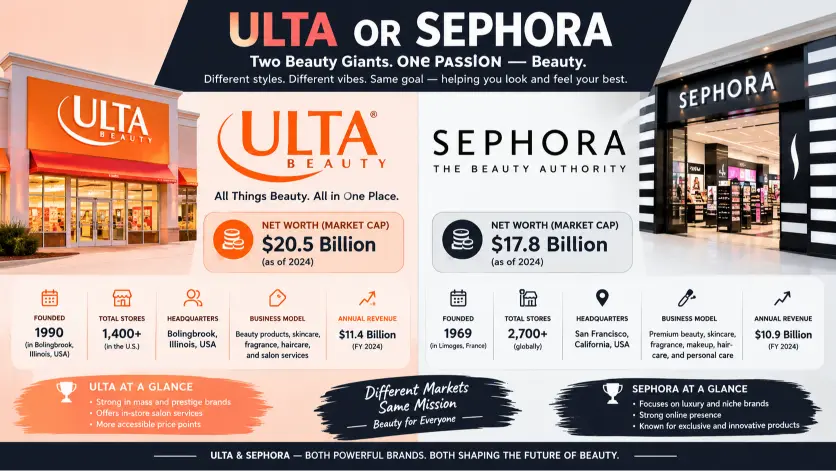
Beauty shopping can feel overwhelming when two of the biggest names, Ulta or Sephora, offer thousands of products, popular brands, exclusive launches, loyalty programs, and frequent promotions. While both retailers cater to makeup, skincare, haircare, fragrance, and beauty enthusiasts, their product selections, pricing strategies, rewards programs, and shopping experiences can differ in important ways.
Understanding these differences can help shoppers spend their money more confidently and find products that actually match their needs. In this guide, we’ll take a closer look at Ulta or Sephora by comparing their product ranges, brand availability, prices, rewards programs, discounts, store experience, and online shopping options.
Rather than relying on hype, the comparison focuses on practical factors that matter to everyday beauty shoppers. Whether you’re buying your first foundation, searching for premium skincare, comparing loyalty benefits, or simply looking for the best place to discover new beauty products, this guide will give you a clear, fact-focused overview to help you understand how Ulta and Sephora differ.
Ulta or Sephora: What Is the Difference?
Ulta Beauty and Sephora are major beauty retailers, although their retail models are noticeably different. In simple terms, Ulta offers a broader price spectrum, while Sephora has traditionally built its identity around prestige beauty.
Ulta Beauty operates more than 1,500 stores across the United States, with typical locations combining retail space and salon facilities. Its assortment covers cosmetics, skincare, haircare, fragrance, and professional beauty services. Its latest fiscal year filing also reports more than 46 million Ulta Beauty Rewards members.
Sephora, meanwhile, describes itself as a prestige omnichannel retailer. The company operates more than 2,700 stores across 35 countries and has more than 500 stores across the Americas. Its assortment includes established luxury names, emerging labels, Sephora Collection products, skincare, cosmetics, fragrance, and haircare.
The distinction becomes particularly useful when a shopper is deciding where to purchase a particular product. Someone looking for both inexpensive beauty essentials and premium cosmetics may appreciate Ulta’s wider price range. Conversely, a shopper focused primarily on prestige labels may prefer Sephora’s curated environment.
In short, Ulta is built around breadth and variety.
Sephora emphasizes prestige discovery and curated collections.
Both retailers provide digital shopping and physical store experiences.
Consequently, the right choice depends on what you actually want to buy.
Ulta or Sephora: Which Retail Model Fits Your Shopping Style?
The difference becomes clearer when shopping habits enter the picture. Rather than treating one retailer as universally preferable, consider the type of beauty journey you normally have.
For example, a customer purchasing shampoo, drugstore mascara, foundation, fragrance, and a salon treatment during one visit may find Ulta’s assortment particularly convenient. Ulta states that its stores commonly include full service salon areas, with services involving hair, makeup, brows, and skincare.
On the other hand, someone researching premium complexion products, luxury fragrances, or newer prestige brands may naturally gravitate toward Sephora’s environment. Sephora describes its assortment as a curated selection that includes emerging favorites, established products, its own collection, and exclusive brand relationships.
Furthermore, both companies continue developing omnichannel shopping. Ulta reported that 19 percent of its loyalty members shopped through both physical stores and digital platforms during fiscal 2025.
Therefore, the distinction isn’t simply about store names. It involves assortment, price positioning, services, loyalty benefits, convenience, and product discovery.
What Makes Ulta Beauty Different?
Ulta’s defining characteristic is assortment breadth. Its business model covers prestige merchandise alongside more accessible beauty products. That creates a shopping environment where customers can compare different price points without necessarily visiting multiple retailers.
Another important feature is its service component. A typical Ulta location is approximately 10,000 square feet, and the company says about 950 square feet is dedicated to a full service salon in a typical store.
Moreover, Ulta’s rewards ecosystem is substantial. The company reported more than 46 million loyalty members at the end of fiscal 2025, with approximately 95 percent of total sales coming from members during that fiscal year.
For a workplace example, imagine an employee preparing for a professional event who needs haircare, cosmetics, and a styling appointment. Instead of coordinating several vendors, that shopper can potentially combine merchandise and services during one Ulta visit.
For an academic example, consider a beauty student researching different product categories. A broad assortment can provide exposure to both professional and consumer oriented products.
For a technology example, Ulta’s digital ecosystem includes online purchasing, mobile functionality, personalized recommendations, and virtual product experiences.
Usage recap: Ulta is particularly relevant when assortment breadth, varied price points, salon services, and rewards matter.
What Makes Sephora Different?
Sephora has a somewhat different identity. Its emphasis is strongly connected to prestige beauty, curated discovery, and brand presentation.
The company says it operates more than 2,700 stores in 35 countries. It also describes an open sell environment designed around discovering carefully selected brands, including emerging names, established products, Sephora Collection, and selected exclusive brands.
Consequently, Sephora can appeal to shoppers who enjoy exploring premium skincare, cosmetics, fragrance, and haircare in an environment centered around prestige beauty.
For a workplace example, a customer searching for a premium fragrance or polished complexion product for a business occasion may value Sephora’s curated assortment.
For an academic example, a cosmetics student studying premium formulations can compare products across numerous prestige categories within a single retailer.
For a technology example, Sephora provides digital shopping through its website and mobile application, while its store ecosystem supports service discovery and appointment booking. The company notes that appointments are strongly encouraged for beauty services, although walk ins may be accepted depending on availability.
Usage recap: Sephora is especially relevant when prestige brands, curated discovery, premium categories, and beauty focused presentation are central to the purchase.
When You Should NOT Choose Ulta or Sephora Automatically
A common mistake is assuming that a larger beauty retailer will always have the exact product, shade, service, or price you need. In practice, individual circumstances matter.
Here are several situations where an automatic choice can create disappointment:
- When a specific brand is exclusive to the other retailer.
- When the desired product is available only through a particular store format.
- When a promotional price applies to one retailer but not the other.
- When your preferred salon service isn’t offered at the nearest location.
- When a rewards offer has product or category restrictions.
- When local inventory differs from the online assortment.
- When a particular shade or size has sold out.
- When the purchase involves international availability rather than United States availability.
For instance, Sephora states that beauty services are available in most stores, but availability varies and services aren’t offered at Sephora at Kohl’s locations.
Likewise, Ulta’s assortment and services vary according to location and store format. Therefore, checking the exact product and service availability before traveling is a practical step.
Common Ulta and Sephora Shopping Mistakes
Decision Rule
If you want a broader mixture of affordable, prestige, and professional beauty products, examine Ulta first.
If your priority is a prestige focused assortment and curated brand discovery, examine Sephora first.
However, product availability should always be checked before making the final purchase decision.
Ulta or Sephora in Modern Technology and Shopping Tools
Digital retail has changed how consumers investigate beauty products. Today, customers can browse ingredients, compare shades, examine reviews, check inventory, receive personalized recommendations, and arrange services before entering a store.
Ulta reported that approximately 60 percent of its online sales in fiscal 2025 were generated through its app, while active application users increased 15 percent year over year. The company also reported introducing more than 100 new brands during that period.
Sephora likewise operates a substantial digital ecosystem, including online shopping, mobile shopping, store discovery, beauty services, events, and Beauty Insider features.
Therefore, modern comparison shopping isn’t limited to walking through two stores. Instead, consumers can research product information first and use physical locations for testing, consultation, or services.
A Short History and Etymology of the Two Names
The name Sephora has a French retail heritage. Sephora states that the company was founded in France by Dominique Mandonnaud in 1970, while its first United States store opened in New York’s SoHo neighborhood in 1998.
Ulta Beauty has a distinctly American retail history and developed its identity around combining multiple beauty categories under one retail roof. Its current model continues to combine merchandise, digital shopping, loyalty, and salon services.
As retail concepts evolved, both companies expanded beyond simple product transactions. Today, each operates as part of a larger beauty ecosystem involving discovery, services, memberships, digital tools, and brand partnerships.
“The beauty shopping experience is no longer limited to a single channel.”
That principle helps explain why comparing only shelf prices can produce an incomplete picture.
Two Case Studies: Different Shoppers, Different Priorities
Case Study One: The Multi Category Shopper
Consider a customer who needs shampoo, skincare, foundation, fragrance, and a haircut.
First, that shopper values convenience. Next, they need access to different price levels. Finally, they may want a salon appointment.
Ulta’s combination of merchandise and salon services directly addresses those requirements. The company reports that its stores commonly include full service salon areas and offer hair, makeup, brow, and skincare related services.
The practical result is consolidation: multiple beauty needs can potentially be handled during one shopping trip.
Case Study Two: The Prestige Beauty Explorer
Now consider a shopper interested primarily in prestige skincare, luxury fragrance, and emerging cosmetic labels.
In this situation, product curation becomes more important than having the widest possible price spectrum. Sephora explicitly positions itself around prestige omnichannel retail and curated brands, while its global network exceeds 2,700 stores.
The practical result is a shopping journey centered more heavily around premium discovery and brand exploration.
Neither example establishes a universal winner. Instead, each demonstrates how purchasing objectives can change the relevance of individual retail features.
Error Prevention Checklist
Always Consider Ulta When
- You want multiple price ranges in one destination.
- You need salon related services.
- You regularly purchase haircare and professional beauty products.
- You value a large rewards membership ecosystem.
- You want to combine prestige products with more accessible brands.
Always Consider Sephora When
- Prestige beauty is your primary interest.
- You enjoy discovering curated brands.
- Premium skincare or cosmetics dominate your shopping list.
- You want to explore Sephora Collection products.
- You prefer a retail environment strongly centered on prestige beauty.
Related Beauty Shopping Comparisons You Should Understand
Understanding the difference between Ulta and Sephora becomes even more useful when combined with several related shopping questions.
- Prestige beauty versus mass market beauty
- Department stores versus specialty beauty retailers
- Brand exclusives versus widely distributed products
- Loyalty points versus promotional discounts
- Store pickup versus home delivery
- Professional salon services versus independent salons
- Retailer private labels versus third party brands
- Online product reviews versus in person testing
- Subscription purchasing versus individual shopping
- Price per ounce versus advertised shelf price
These comparisons help shoppers evaluate the complete purchase rather than focusing on a single headline price.
Frequently Asked Questions
Is Ulta or Sephora better for affordable beauty products?
Ulta generally offers a broader mixture of affordable, mass market, prestige, and professional beauty products. Sephora has a stronger emphasis on prestige beauty. Therefore, shoppers seeking lower priced alternatives should examine the exact assortment rather than assuming both retailers carry equivalent options.
Is Ulta or Sephora better for luxury makeup?
Sephora has a strong prestige focused identity and carries numerous premium beauty brands. However, Ulta also carries prestige cosmetics and continues expanding its premium assortment. The exact brand and product you want should determine the comparison.
Does Ulta have more products than Sephora?
The two companies organize their assortments differently, making a simple product count an unreliable comparison. Ulta emphasizes breadth across mass, prestige, professional, and salon categories, while Sephora emphasizes curated prestige beauty.
Which has a better beauty rewards program?
Both retailers operate established loyalty programs, but their structures differ. Ulta Beauty Rewards allows members to earn points on merchandise and services, while Sephora operates Beauty Insider. The practical value depends on purchase frequency, eligible products, redemption preferences, and current member offers.
Can you get salon services at Ulta?
Yes. Ulta operates salon areas in its stores, with services that can include hair, makeup, brow, and skincare offerings. Its latest filing states that a typical store includes approximately 950 square feet dedicated to a full service salon.
Does Sephora offer beauty services?
Yes. Sephora says beauty services are available in most stores, although availability depends on location and local requirements. The company recommends appointments for customers who want a specific date and time.
Why do people compare Ulta and Sephora?
People compare them because both are major beauty destinations carrying cosmetics, skincare, haircare, fragrance, and related products. However, their assortments, store concepts, services, loyalty programs, and brand strategies differ.
Does Ulta sell prestige beauty products?
Yes. Ulta explicitly describes its assortment as spanning prestige, mass, and salon beauty products. Its business strategy also includes continued expansion of prestige brands.
Does Sephora have its own beauty products?
Yes. Sephora operates Sephora Collection, its own product line, alongside products from numerous external brands.
Ulta or Sephora: What Should You Check Before Buying?
The most useful way to approach this comparison is to start with the product rather than the retailer.
First, identify the exact brand and product. Next, check the size, shade, ingredients, current price, availability, and applicable promotion. Then, examine loyalty benefits and delivery or pickup options.
For services, check the individual store because availability can vary. For prestige products, investigate whether the brand is exclusive or distributed through both retailers. Finally, consider whether your purchase involves one product or a complete beauty routine.
Ulta’s current strategy emphasizes store execution, digital development, personalization, new brands, and loyalty. Sephora’s current direction continues to emphasize prestige beauty, omnichannel retail, brand curation, and international expansion. LVMH reported Sephora revenue of €18.348 billion for 2025, up 4 percent from 2024 on a constant consolidation scope and currency basis, while the company opened around 100 stores during the year.
Meanwhile, Ulta reported 46.7 million rewards members at year end and 60 net new Ulta Beauty stores during fiscal 2025.
These figures illustrate the scale and continued expansion of both businesses, but they don’t determine which retailer suits an individual shopper.
Final Thoughts
The answer to ulta or sephora depends on the shopping mission.
Ulta combines a particularly broad assortment with prestige products, more accessible beauty choices, professional categories, salon services, digital shopping, and a large rewards program. Sephora places stronger emphasis on prestige beauty, curated brands, product discovery, international scale, and an experience built around premium beauty.
Therefore, instead of asking which retailer is universally superior, ask which characteristics matter for your current purchase. Check the exact brand, price, size, rewards conditions, availability, services, and convenience.
That approach produces a more useful comparison because beauty retail decisions are highly dependent on the individual product and shopper. Ultimately, the most practical choice is the retailer whose current assortment and purchasing conditions match your specific needs.









