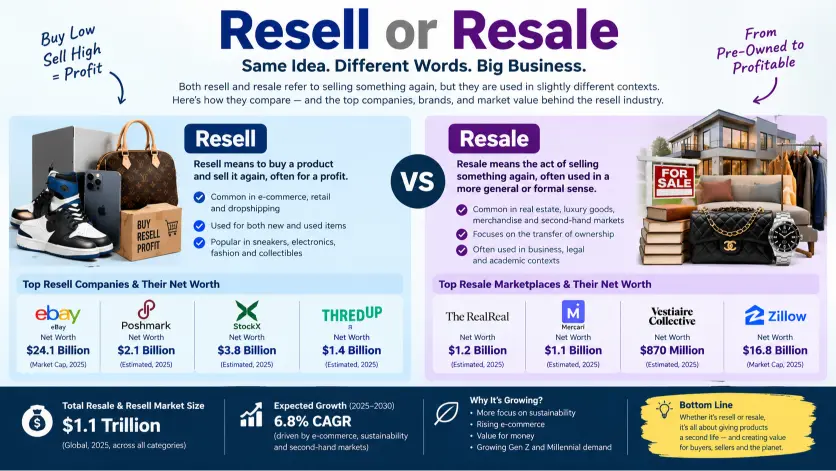
Have you ever wondered whether you should say “resell” or “resale” when talking about selling something again? These two terms look almost identical, but they play different grammatical roles and can change the meaning of a sentence.
Whether you are writing product descriptions, discussing secondhand items, running an online business, or simply improving your English, knowing the difference can help you communicate more accurately. The confusion is especially common in e-commerce, where both words frequently appear in conversations about products being sold again.
In this guide, we’ll explain resell or resale in clear, everyday English, including their meanings, grammatical functions, sentence examples, and practical usage. “Resell” is generally used as a verb for the action of selling something again, while “resale” is commonly used as a noun or adjective related to that activity or market. Understanding this simple distinction can make your writing more precise and professional. By examining standard English usage and real-world examples, you’ll be able to choose the right term confidently in different contexts.
Why Resell or Resale Causes Confusion
The question of resell or resale appears simple; however, the two expressions belong to different grammatical categories. Consequently, substituting one for the other can make a sentence sound unnatural or change its intended meaning.
First, resell is a verb. It describes an action that someone performs. For example, “I plan to resell my old laptop” tells the reader what the speaker intends to do.
By contrast, resale is primarily a noun. It describes the activity, process, or market associated with selling something again. For instance, “The resale value of this laptop remains high” identifies a characteristic of the item rather than an action being performed.
Therefore, this distinction matters in professional writing, online listings, academic work, ecommerce descriptions, and everyday conversation. Although both words relate to selling something again, they cannot always occupy the same position in a sentence.
Moreover, the confusion becomes more noticeable when writers discuss secondhand goods, used electronics, clothing marketplaces, collectibles, vehicles, or digital products. In each situation, understanding the part of speech makes the choice much easier.
Resell vs Resale: What’s the Difference?
To begin with, resell functions as a verb. It means to sell something again, usually after purchasing or obtaining it previously.
For example:
“She bought the camera at a discount and plans to resell it later.”
Here, “resell” identifies an intended action.
On the other hand, resale functions primarily as a noun. It refers to the act, process, opportunity, or market connected with selling something again.
For example:
“The camera has excellent resale value.”
In this sentence, “resale” does not describe something the camera owner is doing. Instead, it describes the camera’s potential value when it is sold again.
Mini Recap
Resell describes what someone does.
Resale names the activity, market, or related concept.
Therefore, use the verb when an action is involved.
Meanwhile, use the noun when you are discussing value, markets, opportunities, or the general process.
Is Resell vs Resale a Grammar, Vocabulary, or Usage Issue?
Primarily, this is a vocabulary and usage distinction supported by grammar. The words are related in meaning, yet their grammatical functions differ.
First, they are not fully interchangeable. A verb normally occupies a different position from a noun. Consequently, replacing one with the other can create an incorrect sentence.
For example:
“I want to resell this watch.”
This construction works because “want to” is followed by a verb.
However:
“I want to resale this watch.”
This version is incorrect because “resale” is not the appropriate verb in standard English.
Conversely, consider:
“The watch has excellent resale potential.”
Here, “resale” works naturally because it functions as part of a noun phrase.
In formal writing, the distinction becomes especially important. Academic papers, business reports, product descriptions, and professional correspondence benefit from precise word selection. Meanwhile, casual speakers may sometimes use related forms loosely, particularly in fast conversation.
Nevertheless, standard written English favors the correct grammatical form.
Therefore, the easiest approach is to identify the role of the word before selecting it.
How to Use Resell Correctly
First, use resell when you want to describe the action of selling an item again. The subject generally performs the action, while the object identifies what is being sold.
For example:
“The retailer buys returned products and resells them through another channel.”
Workplace Example
In a business context, a company might purchase surplus inventory and resell it to another customer.
“The distributor plans to resell excess inventory before the end of the quarter.”
Here, the word clearly describes a business activity.
Academic Example
In academic writing, the verb can describe a commercial practice or consumer behavior.
“Some consumers purchase limited edition products with the intention of reselling them.”
Consequently, the word fits naturally when the writer is explaining what consumers actually do.
Technology Example
Technology provides many familiar examples.
“Users sometimes resell older smartphones after upgrading to newer models.”
Likewise, a software company could resell certain licensed products under permitted arrangements.
Usage Recap
Use resell when an action is taking place.
Use it after expressions such as “plan to,” “want to,” “intend to,” “can,” “may,” and “will.”
For instance, “can resell,” “will resell,” and “plans to resell” are all grammatically natural.
How to Use Resale Correctly
By comparison, resale works as a noun. Therefore, it commonly appears alongside words connected with value, markets, prices, rights, opportunities, and transactions.
For example:
“This vehicle has a strong resale value.”
The sentence discusses the vehicle’s future worth rather than describing someone actively selling it.
Workplace Example
A business report might state:
“Management considered the product’s resale potential before approving the purchase.”
Here, “resale” forms part of a noun phrase and communicates a commercial concept.
Academic Example
An academic discussion could examine consumer behavior:
“Resale markets can influence the perceived value of scarce products.”
In this case, the term identifies a broader marketplace rather than an individual action.
Technology Example
Used technology provides another common setting:
“The phone’s resale value depends on its condition, storage capacity, and remaining support.”
Again, the sentence concerns future market value.
Usage Recap
Use resale when discussing the process, market, value, potential, or circumstances surrounding a second sale.
Common expressions include “resale value,” “resale market,” “resale price,” “resale opportunity,” and “resale demand.”
When You Should NOT Use Resell or Resale
Although the distinction is straightforward, several recurring situations cause problems.
1. Do not use resale after “to”
After “to” in an infinitive construction, a base form verb is required.
Incorrect:
“I want to resale the ticket.”
Correct:
“I want to resell the ticket.”
2. Do not use resell as a noun
Incorrect:
“The resell of the property was profitable.”
Correct:
“The resale of the property was profitable.”
Therefore, the noun form is necessary when naming the transaction itself.
3. Do not use resale when describing an action
Incorrect:
“They resale used furniture online.”
Correct:
“They resell used furniture online.”
4. Do not assume “resale” means the seller
A person who sells something again is not automatically called a “resale.”
Instead, depending on the context, terms such as reseller, seller, or merchant may be appropriate.
5. Do not confuse resale with resale value
“Resale value” refers specifically to the amount an item may command when sold again.
Therefore, saying “I will resale this phone” is different from saying “This phone has good resale value.”
6. Do not replace both terms with “reselling”
The form “reselling” is useful when the sentence requires a present participle or gerund.
For example:
“Reselling vintage clothing has become a profitable activity for some sellers.”
Consequently, the correct form depends on the entire sentence.
7. Do not rely solely on pronunciation
Because the words sound related, speakers may choose a form based on sound rather than grammar. However, sentence structure provides the better clue.
8. Do not treat every related word as interchangeable
Resell, resale, reseller, resaleable, and reselling belong to the same word family, but each has a different grammatical role.
Common Mistakes and Decision Rules
The following examples show how a small grammatical change can affect correctness.
Decision Rule Box
If you mean the action, use resell.
If you mean the person or tool, use reseller or another appropriate noun, not resale.
If you mean the market, process, value, or concept, use resale.
This simple test resolves most everyday questions immediately.
Resell and Resale in Modern Technology and Digital Tools
Technology has created countless situations in which these terms appear naturally. For example, consumers frequently upgrade smartphones, tablets, laptops, gaming systems, cameras, and other devices.
When discussing what the owner intends to do, use the verb:
“I might resell my laptop after upgrading.”
However, when discussing the economic condition surrounding that transaction, use the noun:
“The laptop has strong resale value.”
Similarly, ecommerce platforms frequently involve people who purchase products and later offer them to new buyers. Such individuals are commonly described as resellers.
Meanwhile, digital marketplaces may be described as resale markets when their central purpose involves transferring previously purchased goods between buyers and sellers.
Therefore, technology does not change the fundamental distinction. Instead, it gives writers more situations in which the difference becomes visible.
Etymology and Word Formation
Both terms belong to the same word family and are built around the idea of selling again.
The prefix re commonly communicates repetition or another occurrence. Meanwhile, sell provides the underlying commercial action.
Consequently, resell combines the repeated action with the verb “sell.”
The noun resale, meanwhile, combines the same underlying idea with the noun forming element associated with the act or process.
This relationship explains why the terms feel so similar. Nevertheless, their grammatical functions remain different.
Understanding word formation can therefore make vocabulary easier to remember. Instead of memorizing two unrelated definitions, think of them as connected forms serving different roles.
An Editor’s Rule of Thumb
“When a sentence tells the reader what someone does, choose the action word; when it names the surrounding transaction or market, choose the noun.”
That principle is useful well beyond this particular pair because English frequently creates related verbs and nouns from the same root.
Two Practical Case Studies
Case Study 1: Used Smartphone Listing
Suppose a seller writes:
“I bought this smartphone last year and plan to resale it after my upgrade.”
The meaning is understandable; however, the grammatical form is incorrect.
A revised version would be:
“I bought this smartphone last year and plan to resell it after my upgrade.”
The concrete improvement is grammatical accuracy. The sentence now contains the correct verb after “plan to,” while the intended meaning remains unchanged.
A separate product description could say:
“This model has excellent resale value.”
Here, the noun form communicates a different idea accurately.
Case Study 2: Business Report
Consider a company report containing this sentence:
“The retailer resale strategy focuses on refurbished devices.”
The intended meaning concerns a business model or market activity, so the verb form is unsuitable.
A clearer version is:
“The retailer’s resale strategy focuses on refurbished devices.”
The result is greater grammatical precision because “resale” functions as a noun modifying “strategy.”
Thus, the two examples demonstrate the same underlying rule in consumer and professional contexts.
Error Prevention Checklist
Before publishing or submitting a sentence, check the surrounding grammar.
Always use resell when:
You are describing someone selling an item again.
The word follows “to.”
The sentence contains a modal such as “can,” “may,” or “will.”
You are describing an intended or completed action.
Never use resale when:
You need a base form verb.
You are describing what a person actively does.
The sentence requires an infinitive after “to.”
You are identifying the seller rather than the transaction.
Use resale when:
You discuss market conditions.
You mention future selling value.
You describe a secondhand marketplace.
You name the process or concept of selling again.
Related Grammar Confusions You Should Master
Once this distinction becomes clear, several related vocabulary pairs become easier to understand. In particular, learners should study:
- Advise vs advice
- Practice vs practise
- Affect vs effect
- Licence vs license
- Device vs devise
- Compliment vs complement
- Principal vs principle
- Stationary vs stationery
- Breath vs breathe
- Then vs than
Similarly, learners should pay attention to word families in which a verb, noun, adjective, and person noun have closely related spellings.
For example, resell, reselling, resale, and reseller all share the same commercial idea. Nevertheless, their sentence functions differ.
Therefore, learning part of speech alongside meaning is often more effective than memorizing isolated definitions.
Frequently Asked Questions
What is the difference between resell and resale?
Resell is a verb meaning to sell something again. Resale is primarily a noun referring to the act, process, market, or value associated with selling something again.
Is it correct to say “I want to resale it”?
No. The standard construction is “I want to resell it.” The phrase “want to” requires a verb, and resell is the appropriate verb.
Is resale a noun or a verb?
Resale is normally a noun. It can refer to a second sale, a resale market, or the potential value an item has when sold again.
What is the correct phrase, “resell value” or “resale value”?
The standard phrase is resale value. It refers to the amount an item may be worth when it is sold again.
What do you call a person who resells products?
A person who sells products again is commonly called a reseller. The word identifies the person or business performing the selling activity.
Can resell and resale be used interchangeably?
No. Although they are closely related, their grammatical roles differ. Resell is a verb, while resale is primarily a noun.
Is reselling the same as resale?
Not exactly. Reselling is the act or activity expressed through a participle or gerund form. Resale is a noun referring to the transaction, process, market, or related concept.
Which is correct, “resale market” or “resell market”?
“Resale market” is the standard expression because market is being described by a noun functioning as a modifier.
Which word should I use in an online product listing?
Use resell when describing what you intend to do. Use resale when discussing the product’s future value, market, or second sale.
Final Takeaway:
Ultimately, the difference between resell or resale becomes simple once you identify the grammatical role required by the sentence.
Resell is a verb. It tells the reader that someone will sell an item again.
Resale is primarily a noun. It describes the transaction, market, process, opportunity, or value connected with selling again.
Therefore, remember one practical distinction: actions need the verb resell, while concepts surrounding a second sale generally need resale. Once this pattern becomes familiar, expressions such as “resell the phone,” “resale value,” “resell the vehicle,” and “resale market” become much easier to use correctly. Above all, examine what the sentence is trying to name or describe before choosing the word.









