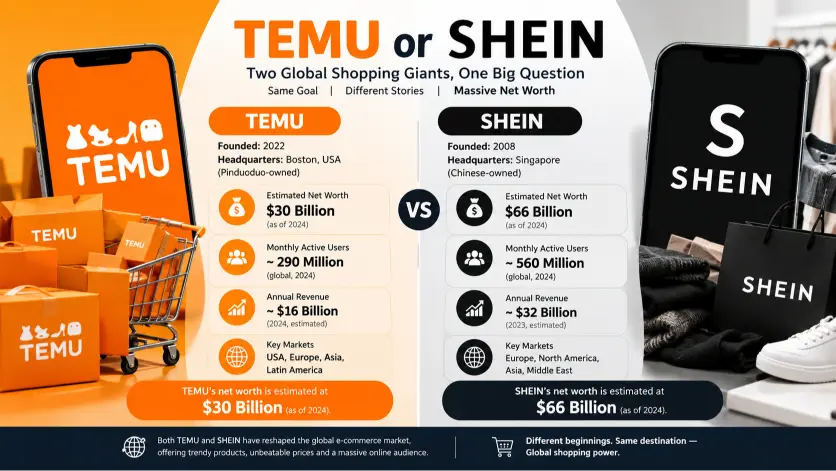
Online shopping has changed dramatically, and Temu or Shein is now a common comparison for shoppers looking for affordable products, trendy fashion, and frequent discounts. Although both platforms are known for competitive prices and a huge selection, they have different strengths when it comes to product categories, fashion, pricing, shipping, and the overall shopping experience. Understanding these differences can help shoppers make more informed purchasing decisions.
When comparing Temu or Shein, it is important to look beyond eye-catching discounts. Product quality, sizing, customer reviews, shipping times, return policies, seller information, and the consistency of product descriptions can all affect whether a purchase delivers good value. A reliable comparison should consider these practical factors rather than focusing only on advertised prices or promotional offers.
In this guide, we’ll break down Temu and Shein across the areas shoppers care about most, including prices, product variety, fashion options, quality, shipping, returns, and shopping experience. The goal is to provide clear, evidence-based information so you can understand how the two platforms differ and choose the one that better matches your own shopping needs.
Temu or Shein: What Is the Difference?
Although both platforms compete for budget conscious online shoppers, their business models and product emphasis are not identical. Temu describes itself as an ecommerce company connecting consumers with millions of merchandise partners, manufacturers, and brands.
Meanwhile, Shein describes itself as a global online fashion and lifestyle retailer offering Shein branded merchandise alongside products supplied through its broader seller marketplace.
Consequently, the simplest distinction is this: Temu functions more like a broad digital marketplace, while Shein remains strongly associated with fashion, clothing, beauty, accessories, and lifestyle products.
Furthermore, Temu has expanded into hundreds of product categories. Its marketplace currently supports local sellers in more than 35 markets, with sellers able to list merchandise across more than 600 categories.
By comparison, Shein has built its reputation around an extensive fashion catalog. Its current business description includes womenswear, menswear, childrenswear, beauty, home products, and merchandise from third party sellers.
In short, Temu is generally broader in merchandise variety.
In contrast, Shein has a stronger fashion identity.
Therefore, your intended purchase should determine which platform deserves closer attention.
Is Temu or Shein a Shopping, Brand, or Marketplace Question?
At first glance, the phrase Temu or Shein looks like a simple either or question. However, it actually combines several different comparisons.
First, shoppers may be comparing product categories. Secondly, they may be comparing prices. Thirdly, they may be asking about quality, delivery, returns, seller reliability, or product safety.
Because both platforms use marketplace elements, the product itself matters considerably. A purchase from one seller may differ from another purchase on the same platform.
For that reason, treating every item on Temu or every item on Shein as identical would be misleading.
Moreover, neither platform should automatically be viewed as a single manufacturer producing every product displayed in its catalog.
Temu connects shoppers with merchandise partners, manufacturers, and brands.
Similarly, Shein has expanded its marketplace model so third party merchants and brands can appear alongside Shein branded merchandise.
Consequently, product descriptions, seller information, measurements, material details, reviews, photographs, and return conditions deserve attention before checkout.
Temu: What Is It Best Used For?
Temu is particularly useful when the shopping mission involves many unrelated product categories.
For example, a customer might browse kitchen accessories, phone accessories, storage products, stationery, small household items, craft supplies, pet accessories, or personal gadgets during the same shopping session.
Furthermore, Temu has expanded its local seller model. According to the company, its Local Seller Program now operates in more than 35 markets and supports merchandise across more than 600 categories.
Workplace example
Suppose an office needs inexpensive desk organizers, cable management accessories, storage containers, decorative items, or small stationery products.
In that situation, Temu’s broad catalog can make category discovery easier because the shopper isn’t restricted to fashion merchandise.
Academic example
Likewise, students may search for notebooks, craft supplies, desk accessories, storage products, study tools, and other inexpensive items.
Therefore, Temu can be useful when one shopping trip covers several unrelated requirements.
Technology example
Similarly, people searching for phone cases, charging accessories, computer accessories, cable organizers, stands, and other low cost technology accessories may encounter a wide range of choices.
However, technology purchases deserve additional caution. In 2026, the European Commission fined Temu €200 million under the Digital Services Act after finding that the company had not adequately assessed systemic risks involving illegal products. The Commission also cited mystery shopping evidence involving unsafe chargers and certain baby toys.
Consequently, extremely low pricing should not replace careful examination of specifications, certifications, reviews, seller information, and applicable safety requirements.
Usage recap: Temu is particularly relevant for broad product discovery, household purchases, accessories, stationery, and miscellaneous everyday goods. Nevertheless, product quality and safety can vary by item and seller, so individual listings deserve careful review.
Shein: What Is It Best Used For?
Shein is especially recognizable for fashion focused shopping.
The company says its catalog includes womenswear, menswear, childrenswear, home, beauty, and products supplied by a global network of vendors.
Moreover, Shein’s business model emphasizes demand driven production. The company says its digitalized supply chain is designed to respond to customer demand while producing merchandise in smaller batches.
Workplace example
For workplace clothing, shoppers may use Shein to explore affordable dresses, shirts, trousers, blouses, jackets, accessories, and other appearance related items.
However, shoppers should compare measurements rather than relying solely on standard size labels.
Academic example
Students looking for inexpensive everyday outfits, seasonal clothing, bags, accessories, or casual pieces may find a broad selection.
Furthermore, the large number of styles means shoppers can compare colors, cuts, fabrics, and patterns within similar price ranges.
Technology example
Although Shein is primarily associated with fashion, its marketplace has expanded beyond clothing.
Consequently, users may encounter beauty products, home merchandise, accessories, and other lifestyle categories.
Still, its strongest consumer identity remains closely connected with fashion.
Usage recap: Shein is especially relevant for clothing, accessories, beauty, fashion trends, and lifestyle shopping. Therefore, it is often considered when appearance, style variety, and affordable apparel are central to the purchase.
When You Should NOT Use Temu or Shein
Although both platforms can be useful, neither should automatically be treated as the appropriate source for every purchase.
First, avoid relying exclusively on a platform’s lowest displayed price when buying safety critical equipment.
Secondly, do not assume that a product photograph proves material quality.
Thirdly, avoid selecting clothing solely because the model photograph looks attractive.
Fourthly, do not purchase electrical products without checking specifications, compatibility, voltage requirements, and applicable safety information.
Fifthly, do not assume that every marketplace seller follows identical manufacturing standards.
Sixthly, avoid ignoring return conditions simply because the item is inexpensive.
Seventhly, do not treat customer ratings as absolute proof of quality.
Finally, do not assume that Temu and Shein offer identical products merely because similar photographs appear on both platforms.
The European Commission has taken consumer protection action involving both companies, although the matters concern different proceedings and specific alleged practices.
For Temu, EU authorities identified concerns involving fake discounts, pressure selling, gamification, and incomplete or misleading information about consumer rights.
For Shein, EU consumer authorities announced action in 2025 concerning practices they considered contrary to EU consumer law, while the Commission subsequently opened formal Digital Services Act proceedings in 2026 concerning areas including illegal products, recommender system transparency, and potentially addictive design features.
Therefore, shoppers should distinguish documented regulatory proceedings from general assumptions about every product sold through either platform.
Temu or Shein: Common Shopping Mistakes and Decision Rules
Decision Rule Box
If you need a broad selection across unrelated categories, start by exploring Temu.
If fashion, clothing, accessories, or beauty merchandise is your primary goal, start by exploring Shein.
If safety, durability, compatibility, or professional reliability is critical, investigate the specific product rather than choosing solely according to platform reputation.
Temu or Shein in Modern Technology and Online Shopping
Both platforms rely heavily on digital shopping experiences, personalized product discovery, mobile applications, recommendation systems, promotions, and large online catalogs.
Consequently, the shopping experience can feel highly personalized.
However, shoppers should distinguish convenience from product certainty.
For instance, a recommendation system can surface products quickly, yet the recommendation itself does not establish that an item is durable, safe, authentic, or suitable for a particular purpose.
Furthermore, regulatory scrutiny has increasingly focused on how large online marketplaces manage product risks and consumer experiences.
In 2026, the European Commission’s proceedings involving Shein addressed recommender system transparency and the platform’s handling of illegal products.
Similarly, the European Commission’s 2026 decision concerning Temu addressed systemic risks associated with illegal products and the platform’s risk assessment processes.
Therefore, digital convenience should be combined with ordinary consumer judgment.
Temu and Shein: Business Models and Etymology
The name Temu is a commercial brand rather than a conventional English vocabulary term. The platform describes itself as an ecommerce company connecting consumers with merchandise partners, manufacturers, and brands.
Likewise, Shein is a company and brand name rather than a standard English noun with a shopping related dictionary meaning.
The more useful distinction is therefore commercial rather than linguistic.
Temu emphasizes marketplace breadth.
Shein emphasizes fashion and lifestyle retail while also operating marketplace services.
Interestingly, Shein’s current business description says its marketplace launched in key markets beginning in 2023, allowing third party sellers to participate alongside Shein’s own merchandise.
“The product itself deserves more attention than the platform label.”
That principle is useful because marketplace catalogs can contain substantial variation between individual listings.
Two Practical Case Studies
Case Study One: The Mixed Household Shopper
Consider a shopper who needs storage boxes, phone accessories, craft materials, kitchen organizers, pet accessories, and inexpensive home decorations.
In this situation, Temu’s broad marketplace structure can reduce the need to visit several specialized categories or stores.
Furthermore, Temu says local sellers can list products across more than 600 categories.
The practical result is greater category breadth within one shopping environment.
However, the shopper should still examine each listing independently because broad selection does not guarantee uniform product quality.
Case Study Two: The Fashion Shopper
Now consider someone searching for several seasonal outfits, accessories, beauty products, and lifestyle pieces.
Shein’s fashion centered catalog is more directly aligned with that shopping mission.
The company’s reported 2024 United Kingdom sales reached £2.05 billion, representing a 32.3 percent increase from the previous year, according to Reuters.
Therefore, Shein’s commercial scale demonstrates the significance of its fashion focused model.
Nevertheless, revenue growth does not prove that an individual garment will fit well or meet a particular shopper’s quality expectations.
Error Prevention Checklist
Always use Temu when
You need merchandise across many unrelated categories.
You are comparing household accessories and everyday products.
You want to explore a broad marketplace catalog.
You need to compare numerous inexpensive product types in one place.
Always consider Shein when
Your primary objective is clothing.
You want to explore fashion styles and accessories.
You are searching for affordable lifestyle merchandise connected with fashion.
You want a large fashion focused catalog.
Never choose either platform solely when
The product has serious safety implications.
Electrical compatibility is uncertain.
A medical or safety critical function is involved.
Product authenticity is essential but cannot be independently verified.
The item requires professional grade reliability.
Instead, investigate the exact manufacturer, specifications, certifications, seller information, warranty terms, and applicable consumer protections.
Related Shopping Comparisons You Should Understand
Understanding Temu or Shein becomes easier when several related ecommerce distinctions are also clear.
- Marketplace versus retailer
- Seller versus manufacturer
- Brand versus private label
- Product rating versus verified product quality
- Sale price versus total purchase cost
- Return policy versus consumer legal rights
- Product description versus technical specification
- Customer review versus independent testing
- Fashion retailer versus general merchandise marketplace
- Low price versus long term value
These distinctions matter because a low displayed price tells you only one part of the purchasing story.
Advanced FAQs
Is Temu or Shein cheaper?
Prices vary according to category, seller, promotion, quantity, shipping conditions, and market. Therefore, neither platform should be assumed to be universally cheaper. Compare the complete cost of the specific item before purchasing.
Is Temu better for general products than Shein?
Temu has a broader general merchandise identity, while Shein remains strongly associated with fashion and lifestyle products. Therefore, general household shopping may align more closely with Temu’s marketplace structure.
Is Shein mainly a clothing website?
Shein is strongly associated with fashion, although its current business also includes beauty, home, childrenswear, menswear, and marketplace products from third party sellers.
Does Temu sell clothing?
Yes. Temu has a broad merchandise catalog, so clothing is among the types of products shoppers can encounter. However, fashion is not the platform’s defining category.
Does Shein sell products besides clothes?
Yes. Shein describes its business as covering fashion and lifestyle categories, including beauty and home products, alongside merchandise from marketplace sellers.
Which platform has more product variety?
Temu has a particularly broad marketplace structure spanning hundreds of categories. Shein also has expanded beyond apparel, although fashion remains central to its identity.
Are Temu and Shein the same company?
No. They are separate ecommerce businesses with different corporate identities and marketplace models.
Why are Temu and Shein prices often so low?
Their pricing reflects factors such as marketplace structures, international supply networks, large catalogs, direct sourcing relationships, promotional strategies, and demand driven production models. However, the precise economics vary by product and market.
Is Temu or Shein safer for buying electronics?
The safest approach is to evaluate the exact electronic product rather than assume that one platform guarantees superior safety. Specifications, certification, seller information, product testing, and applicable regulations matter.
Should you choose Temu or Shein for clothes?
For clothing focused shopping, Shein has a stronger fashion centered identity. Temu can also offer apparel, but its marketplace covers a much wider range of merchandise. Therefore, compare the exact garments, measurements, material descriptions, reviews, prices, and return conditions.
Conclusion:
Ultimately, Temu or Shein is not a question with one universal answer because the two platforms serve overlapping yet different shopping purposes. Temu is built around broad marketplace variety, making it relevant to shoppers looking for household goods, accessories, stationery, gadgets, craft products, and many other categories.
Meanwhile, Shein has a much stronger fashion and lifestyle identity, making it especially relevant to shoppers exploring clothing, accessories, beauty products, and trend focused merchandise. However, the smartest comparison happens at the product level. Check measurements, specifications, seller information, reviews, return conditions, delivery details, and safety information before placing an order.
Therefore, instead of asking which platform is universally better, ask which platform more closely matches the product you actually need. That distinction makes the Temu or Shein comparison far more useful, practical, and accurate.









