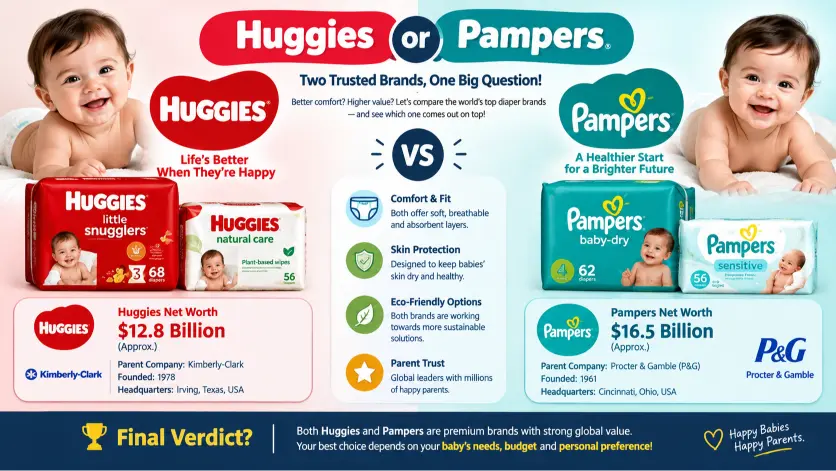
Choosing the right diaper can feel surprisingly difficult, especially when Huggies or Pampers are both among the options on your shopping list. Parents usually want the same things: a comfortable fit, reliable absorbency, good leak protection, and a diaper that works well for their baby’s individual needs. But differences in design, sizing, materials, product ranges, and price can make the decision less straightforward.
In this guide, we’ll compare Huggies or Pampers across practical factors such as fit, comfort, absorbency, overnight protection, sensitive-skin considerations, sizing, and overall value. Rather than relying only on brand popularity, the comparison focuses on the features parents can actually evaluate when choosing diapers.
Whether you’re preparing for a newborn, changing diaper brands, or simply trying to find a better option for your little one, this guide will help you understand the key differences and make a more informed purchase decision.
Huggies vs Pampers: What’s the Difference?
Huggies and Pampers are brand names, not two different types of diapers. Both companies produce disposable diapers, but their product ranges aren’t identical.
Huggies products are available in several designs intended for different stages and needs. Pampers likewise offers multiple diaper families, including products designed around newborn care, everyday wear, overnight use, and toddler development.
Consequently, there isn’t one universal Huggies diaper or one universal Pampers diaper. The characteristics can vary considerably between product lines.
| Feature | Huggies | Pampers |
|---|---|---|
| Product category | Disposable diapers | Disposable diapers |
| Brand type | Baby care brand | Baby care brand |
| Available stages | Newborn through toddler stages | Newborn through toddler stages |
| Fit | Varies by product and size | Varies by product and size |
| Absorbency | Depends on product range | Depends on product range |
| Skin comfort | Depends on materials and individual response | Depends on materials and individual response |
| Overnight options | Available in selected ranges | Available in selected ranges |
| Best comparison method | Compare equivalent products | Compare equivalent products |
Quick Recap
Huggies and Pampers are separate diaper brands.
Neither brand has one single design that represents every product.
Therefore, compare equivalent products rather than brand names alone.
Most importantly, your child’s fit and comfort should guide the final choice.
Huggies or Pampers: Which Factors Actually Matter?
When parents compare diapers, the package often receives most of the attention. However, several less obvious characteristics can have a greater effect on everyday performance.
First, consider fit. A diaper must sit securely around the waist and thighs without being excessively tight. At the same time, the leg openings need enough contact to help contain moisture and mess.
Next, consider absorbency. Babies may require frequent changes during the day, whereas nighttime use can involve a longer period between changes. Consequently, an appropriate product for overnight wear may have different characteristics from a basic daytime diaper.
Furthermore, comfort matters because a diaper remains against the child’s skin for extended periods. A soft feeling material can be helpful, but softness alone doesn’t guarantee that a particular product will suit every child.
Finally, consider cost per diaper rather than package price. A larger package can appear expensive while actually costing less per individual diaper.
Huggies: What Parents Should Know
Huggies is a major disposable diaper brand with products designed for different developmental stages. However, parents shouldn’t assume that every Huggies product provides the same fit or features.
Instead, examine the exact product range and size before comparing it with another brand.
Fit and Sizing
Fit is one of the most important factors when selecting Huggies diapers. A suitable size should sit comfortably around the child’s waist while maintaining a secure fit around the legs.
If the diaper leaves persistent marks, appears difficult to fasten, or frequently leaks, the size or product design may not be suitable.
Therefore, the printed weight guidance should be considered alongside the actual fit.
Absorbency
Different Huggies products can have different absorbency characteristics. Consequently, a daytime product shouldn’t automatically be judged against an overnight product.
For parents dealing with nighttime leakage, comparing products specifically intended for extended wear provides a more meaningful evaluation.
Comfort
Comfort depends on several factors, including the material, construction, size, and child’s body shape.
Moreover, a diaper that feels comfortable initially may become less suitable as the child grows. Therefore, parents should reassess fit regularly.
Huggies Workplace Example
Imagine a childcare center ordering diapers for several infants. Simply writing “Huggies diapers” on the purchasing request could create confusion.
Instead, the staff should specify the required product, size, and quantity. As a result, the correct supplies are more likely to arrive.
Huggies Academic Example
Suppose a researcher is examining disposable diaper absorbency. Rather than writing that “Huggies diapers” have a particular performance characteristic, the study should identify the exact product tested.
This distinction improves accuracy because one product cannot automatically represent an entire brand.
Huggies Technology Example
A digital shopping system may categorize Huggies products according to size, age range, product type, and package quantity.
Therefore, the brand name is only one piece of the information needed to identify the correct product.
Huggies Usage Recap
Huggies identifies the brand.
The exact product name identifies the particular diaper.
The size determines whether the product is appropriate for the child’s current measurements.
Pampers: What Parents Should Know
Pampers is another major disposable diaper brand offering products for various stages of childhood.
As with Huggies, parents should avoid assuming that every Pampers diaper has identical characteristics.
Instead, the exact product, size, and intended use should be considered.
Fit and Sizing
A good Pampers fit should feel secure without creating excessive pressure around the waist or legs.
However, babies have different proportions. One child may have slimmer legs, while another may have fuller thighs.
Consequently, the same numerical size can feel different depending on body shape.
Absorbency
Absorbency can vary between Pampers product ranges. Therefore, parents should identify whether they are comparing an everyday diaper, an overnight product, or another specialized design.
Furthermore, leakage can result from incorrect sizing rather than insufficient absorbency.
Comfort
Comfort is influenced by the diaper’s construction and the child’s individual response.
If redness, irritation, or discomfort appears repeatedly after using a particular product, parents should reconsider the product and discuss persistent concerns with an appropriate healthcare professional.
Pampers Workplace Example
A daycare employee preparing a supply request should identify the exact Pampers product and size.
As a result, the purchasing department can provide the intended diapers instead of choosing a different product from the same brand.
Pampers Academic Example
In a formal product comparison, researchers should identify the precise Pampers product being examined.
Otherwise, readers might incorrectly assume that the results apply to every Pampers diaper.
Pampers Technology Example
An online marketplace may organize Pampers products according to size, age, package quantity, and intended use.
Consequently, shoppers can narrow their selection more effectively when they understand the difference between brand and product.
Pampers Usage Recap
Pampers is the brand name.
The individual product provides the specific design characteristics.
The correct size and fit remain essential regardless of the brand.
Is Huggies vs Pampers a Grammar, Vocabulary, or Usage Issue?
Huggies and Pampers aren’t a traditional grammar confusion.
Instead, they are proper brand names.
Therefore, using Huggies instead of Pampers isn’t equivalent to confusing two grammatical terms. The main issue is product identification and accurate usage.
For example, saying “I bought Huggies” is perfectly understandable when discussing the brand. However, if someone is describing a particular product’s absorbency, fit, or construction, identifying the exact product provides greater clarity.
Similarly, saying “Pampers are better” is an overly broad statement because Pampers includes multiple products.
In casual conversation, people may use a brand name when referring generally to diapers. Nevertheless, formal writing should be more precise.
Academic articles, product reviews, purchasing documents, and childcare instructions should identify the specific product whenever a particular feature is being discussed.
Huggies or Pampers: How Fit Affects the Decision
Fit is arguably one of the most practical considerations when comparing diapers.
First, check the waist. The diaper should remain secure without causing excessive pressure.
Next, inspect the legs. Gaps can contribute to leakage, while excessive tightness can create uncomfortable marks.
Then, observe the diaper during normal movement. Crawling, walking, sitting, and sleeping can all change how a diaper behaves.
Furthermore, consider whether leakage occurs repeatedly in the same area. A pattern can provide useful information about fit.
For example, repeated leakage around the back may require a different fit or positioning. Leakage around the legs may indicate that the current size or shape isn’t providing an adequate seal.
Therefore, parents should treat leakage as information rather than automatically assuming that one entire brand is unsuitable.
When You Should NOT Use Huggies or Pampers as a General Comparison
There are several situations where using only the brand name can create confusion.
1. When Comparing Different Product Levels
Comparing a basic daytime diaper from one brand with a specialized overnight product from another doesn’t provide a balanced comparison.
2. When Discussing Exact Absorbency
Absorbency can vary between product ranges. Therefore, broad statements about an entire brand can be misleading.
3. When Discussing Fit
A particular diaper may fit one child better than another because body proportions differ.
4. When Discussing Skin Comfort
Individual skin responses can vary. Therefore, a personal experience shouldn’t automatically become a universal claim.
5. When Comparing Prices
Package prices can be misleading because package quantities differ. Instead, calculate the cost per diaper.
6. When Discussing Overnight Performance
Overnight products should be compared with other overnight products whenever possible.
7. When Writing a Product Review
A review should identify the exact product and size so readers know what was actually tested.
8. When Giving Childcare Instructions
Caregivers need precise information about the product and size rather than a broad brand reference.
Common Mistakes and Decision Rules
Many diaper comparisons become confusing because the writer treats an entire brand as one product.
| Correct sentence | Incorrect sentence | Explanation |
|---|---|---|
| This Huggies product fits my baby well. | Huggies fits every baby well. | Individual body shapes differ. |
| This Pampers product worked well overnight. | Pampers never leaks overnight. | Product performance isn’t universal. |
| I compared equivalent diaper sizes. | I compared the brands generally. | Equivalent products create a fairer comparison. |
| This diaper leaves marks because the fit may be too tight. | Every diaper in this brand is too tight. | One experience doesn’t represent every product. |
| The larger package costs less per diaper. | The larger package is cheaper. | Total price and unit price aren’t identical. |
Decision Rule Box
If you mean the brand, use Huggies or Pampers.
If you mean a specific product, identify the product range and size.
If you mean performance, describe the exact characteristic being evaluated.
If you mean value, compare the cost per diaper.
Huggies or Pampers in Modern Shopping Technology
Today, parents can compare diapers through online stores, mobile shopping applications, product databases, and digital recommendation systems.
Consequently, product information has become easier to access. However, more information can also create more confusion when product names aren’t clearly understood.
For instance, a shopping page might contain several Huggies products with different sizes and features. Similarly, a Pampers search can produce numerous product variations.
Therefore, shoppers should examine the product title, size, quantity, intended stage, and description before making a purchase.
Moreover, product images can sometimes show packaging that differs slightly by market or manufacturing period. As a result, checking the written product details remains important.
The Story Behind the Names
Huggies and Pampers are commercial brand names associated with baby care.
The name Huggies has a warm, affectionate quality that fits the company’s positioning around babies and caregiving.
Pampers has a connection with the idea of pampering, which naturally relates to comfort and caring for infants.
Therefore, neither term should be treated as a generic synonym for every disposable diaper.
This distinction matters particularly in professional writing. A brand name identifies a commercial source, whereas a generic category such as “disposable diaper” identifies the type of product.
As a practical editorial principle:
“A useful comparison begins by identifying exactly what is being compared.”
That principle applies equally to parenting guides, product reviews, purchasing documents, and educational content.
Two Practical Case Studies
Case Study 1: Repeated Nighttime Leakage
Consider a toddler who experiences leakage several nights each week.
Initially, the parent switches from one brand to another without changing the size or product type.
However, the problem continues.
At this point, simply blaming the brand doesn’t provide enough information. The parent should examine the child’s current size, diaper positioning, overnight product type, and frequency of changes.
The practical result is a more controlled comparison. Instead of asking which brand is universally better, the parent investigates which product characteristics address the specific problem.
Case Study 2: Marks Around the Thighs
Now consider a baby who develops noticeable marks around the thighs.
The parent assumes the diaper is unsuitable.
However, the first step should be checking whether the diaper is correctly positioned and whether the current size remains appropriate.
If the child has grown since the previous purchase, moving to another size may resolve the problem.
Therefore, the case demonstrates why size and fit should be evaluated before making a broad judgment about a brand.
Error Prevention Checklist
Always Use Huggies When
- You are specifically referring to the Huggies brand.
- You have confirmed that the product belongs to Huggies.
- You are discussing a particular Huggies product.
- You are comparing a Huggies product with an equivalent product from another brand.
Always Use Pampers When
- You are specifically referring to the Pampers brand.
- The product has been identified as Pampers.
- You are discussing a particular Pampers range.
- You are comparing equivalent products from both brands.
Never Make These Assumptions
- Don’t assume every product within one brand performs identically.
- Don’t assume numerical sizes will feel exactly the same.
- Don’t assume another baby’s successful experience guarantees the same result.
- Don’t assume the highest price means the best fit.
- Don’t judge overnight performance from a daytime product.
Related Grammar Confusions You Should Master
Although Huggies and Pampers aren’t grammar alternatives, several related language distinctions are useful when writing product content.
1. Brand Name vs Generic Product
A brand identifies the commercial source, while a generic term identifies the product category.
2. Proper Noun vs Common Noun
Brand names normally function as proper nouns, whereas words such as diaper are common nouns.
3. Company Name vs Product Name
A company can manufacture several product families, so these terms shouldn’t automatically be treated as identical.
4. Product Range vs Individual Product
A range can contain several products with different characteristics.
5. Personal Experience vs Universal Claim
One parent’s experience shouldn’t automatically be presented as a universal fact.
6. Marketing Claim vs Measurable Characteristic
Promotional language and independently measurable performance aren’t necessarily the same thing.
7. Package Price vs Unit Price
A larger package may have a higher total price while still costing less per diaper.
8. Size Label vs Actual Fit
The printed size provides guidance, while the child’s actual fit provides additional practical information.
9. Everyday Language vs Formal Description
Casual conversation can tolerate broader references, whereas formal writing benefits from greater precision.
10. Brand Comparison vs Product Comparison
A brand comparison looks broadly at product families, while a product comparison examines specific items.
Advanced FAQs
Are Huggies and Pampers the same?
No. Huggies and Pampers are separate diaper brands with their own product ranges, designs, and sizing systems.
Which is better, Huggies or Pampers?
There isn’t one universally suitable answer. Instead, parents should compare equivalent products according to fit, size, comfort, absorbency, leakage protection, skin response, and cost.
Can newborns use Huggies or Pampers?
Yes, both brands offer products intended for newborn stages. However, parents should select the appropriate newborn size and monitor the fit carefully.
Are Huggies and Pampers sizes interchangeable?
Not necessarily. Weight ranges can overlap, but the physical shape and fit of the diapers may differ.
Why does my baby’s diaper keep leaking?
Leakage can have several causes, including incorrect sizing, poor positioning, gaps around the legs, saturation, or a product that doesn’t suit the child’s body shape.
Which is better for overnight diapers?
Both brands offer products intended for overnight use. However, parents should compare specific overnight products rather than assuming an entire brand has identical nighttime performance.
Are Huggies or Pampers better for sensitive skin?
Individual responses differ. Parents should examine the exact product and monitor the child’s skin. Persistent irritation should be discussed with a qualified healthcare professional.
Should I choose diapers according to age or weight?
Weight is generally a useful starting point, but fit matters too. Therefore, parents should consider both the recommended weight range and the child’s actual body shape.
How do I compare diaper prices correctly?
Divide the package price by the number of diapers in the package. This provides the cost per diaper and makes different package sizes easier to compare.
Can I switch from Huggies to Pampers?
Yes. Switching brands is possible. However, check the new product’s size and fit because the same numerical size may feel different between brands.
Huggies or Pampers: A Practical Buying Guide
When choosing between these brands, start with your child’s current size.
Next, consider the child’s body shape. Pay particular attention to the waist and thighs because these areas influence the overall seal.
Then, decide whether the diaper is primarily intended for daytime use, nighttime use, travel, childcare, or another situation.
Afterward, compare equivalent products from each brand.
For example, don’t compare a basic daytime diaper from one company with a premium overnight diaper from the other. Such a comparison can make the results difficult to interpret.
Furthermore, calculate the cost per diaper rather than relying on the package price.
Finally, observe the child’s comfort and the diaper’s performance over several days. Repeated patterns are generally more informative than a single experience.
Huggies or Pampers: Final Verdict for Parents
The most important lesson is that Huggies and Pampers are brands rather than single products.
Therefore, asking which brand is universally better doesn’t provide enough information.
Instead, parents should compare specific products according to size, fit, absorbency, comfort, leakage protection, intended use, and cost per diaper.
Furthermore, every child has a different body shape and routine. Consequently, a diaper that works extremely well for one baby may not provide the same experience for another.
For that reason, the most practical approach is to begin with the child’s current needs, select an appropriate size, compare equivalent products, and then observe the real world fit.
Ultimately, the right choice is the product that provides a comfortable fit, reliable containment, and satisfactory everyday performance for your child.
Conclusion
Choosing between these two popular diaper brands doesn’t need to be complicated.
First, identify the child’s size and body shape. Next, decide whether daytime or nighttime performance is more important. Then, compare equivalent products rather than judging entire brands from one experience.
Additionally, consider comfort, leakage protection, skin response, package quantity, and cost per diaper.
Most importantly, remember that diaper selection is highly individual. Therefore, the most useful answer to the question of huggies or pampers comes from matching the exact product to the child’s needs rather than relying on a universal brand preference.









