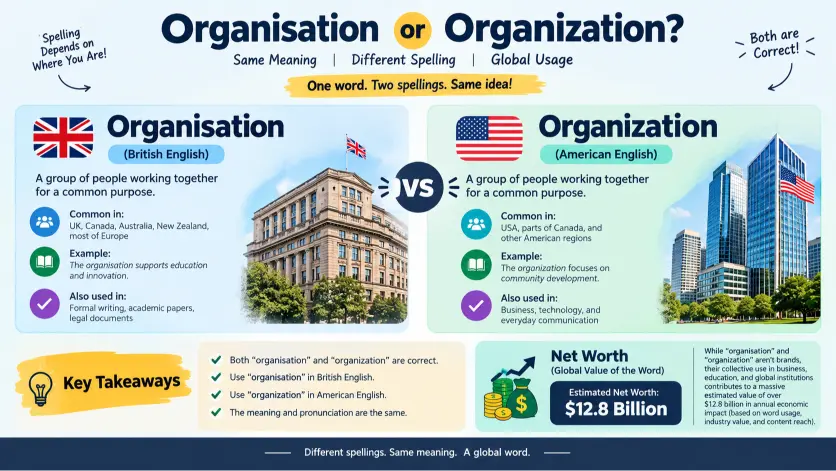
Have you ever wondered whether “organisation” or “organization” is the correct spelling? You’re not alone. Both forms are widely used, but the preferred spelling depends mainly on the variety of English you are writing in. “Organisation” is commonly associated with British English, while “organization” is the standard spelling in American English. This small spelling difference can create confusion, especially for students, bloggers, professionals, and anyone writing for an international audience.
Understanding the difference between organisation and organization is useful because choosing the right form helps your writing remain consistent and appropriate for your target readers. British English generally uses -isation endings in words such as organisation, while American English typically prefers -ization, as in organization. Neither spelling is inherently incorrect; the important point is to follow the language variety required by your audience, publication, school, workplace, or style guide.
In this guide, we’ll explain organisation vs organization, including their meanings, pronunciation, regional usage, examples, and practical spelling rules. You’ll also learn when to use each version and how to avoid switching between British and American English unnecessarily. Whether you’re improving your grammar, writing an article, preparing an assignment, or creating professional content, this clear comparison will help you choose the appropriate spelling with confidence.
Organisation or Organization: Which Spelling Is Correct?
The question organisation or organization creates confusion because both forms appear in reputable dictionaries, books, workplaces, universities, and official documents. However, they are not two different words with different meanings. Instead, they represent different spelling conventions within English.
The noun organisation is commonly associated with British English and other varieties influenced by British spelling. Meanwhile, organization is the usual spelling in American English.
For example, a British university might write, “The organisation has introduced a new policy.” An American university would typically write, “The organization has introduced a new policy.”
Therefore, neither spelling is automatically wrong. The important point is consistency. Once you choose a regional convention, continue using it throughout the same document.
Core Definitions
Organisation is a noun. It can refer to a group of people working toward a shared purpose, or to the act or process of arranging something systematically.
Organization is also a noun and carries the same meanings. The distinction is primarily spelling based rather than grammatical or semantic.
| Feature | Organisation | Organization |
|---|---|---|
| Part of speech | Noun | Noun |
| Meaning | Group, institution, arrangement, or structured system | Group, institution, arrangement, or structured system |
| Common variety | British English | American English |
| Pronunciation | Generally the same | Generally the same |
| Formal writing | Widely accepted | Widely accepted |
| Informal writing | Correct when regional style supports it | Correct when regional style supports it |
| Main distinction | Spelling convention | Spelling convention |
In short, both forms describe the same concept.
The difference is primarily geographical and stylistic.
Consequently, your audience should determine the spelling you select.
Most importantly, consistency matters more than switching between the two forms.
Is Organisation or Organization a Grammar, Vocabulary, or Usage Issue?
The distinction between organisation and organization is primarily a spelling and usage issue, rather than a grammar problem.
Both expressions function as nouns. Neither changes the grammatical meaning of a sentence. If you replace one with the other, the sentence usually retains exactly the same meaning.
For instance:
“Several organisations support environmental research.”
“Several organizations support environmental research.”
Both sentences are grammatically sound. The difference becomes visible when the expected variety of English changes.
Are They Interchangeable?
In meaning, yes. In regional style, however, your choice should be deliberate.
British English commonly favors organisation, although organization is also found in British writing. American English generally uses organization.
As a result, a British writer does not need to change the meaning of a sentence simply because an American reader sees the spelling with z.
Formal Versus Informal Usage
Both forms can appear in formal communication. Therefore, neither spelling should be considered inherently more professional.
Instead, formal writing requires consistency, accuracy, and appropriate style.
A government report written in British English can use organisation throughout. Likewise, an American corporate report can use organization consistently.
Academic Versus Casual Usage
Academic writing should follow the spelling conventions specified by the institution, publication, instructor, or style guide.
Meanwhile, casual communication is usually more flexible. However, consistency still improves readability.
Therefore, if you’re preparing a dissertation, business report, application, or published article, identify the required English variety before writing.
How to Use Organisation Correctly
The spelling organisation is widely used in British English. It can describe a company, charity, institution, association, or structured group.
Workplace Example
“The organisation has expanded its employee training programme.”
Here, the noun refers to an institution or business operating as a structured entity.
Academic Example
“The research organisation published its findings after three years of investigation.”
In this context, the term identifies an institution responsible for conducting research.
Technology Example
“The organisation stores customer information in a secure database.”
Here, the word identifies the institution responsible for the technology system.
Usage Recap
Use organisation when following British spelling conventions.
Furthermore, it works naturally in professional, academic, governmental, and everyday contexts.
It does not indicate a different meaning from organization.
How to Use Organization Correctly
The spelling organization is the standard choice in American English. It is common in business communication, university publications, government documents, software documentation, and general American writing.
Workplace Example
“The organization recently opened three regional offices.”
Here, the noun identifies a business or institution.
Academic Example
“The organization funded several independent research projects.”
In this sentence, it refers to a structured institution supporting academic activity.
Technology Example
“The organization uses cloud based systems to manage internal records.”
The word identifies the institution using the technology.
Usage Recap
Choose organization when following American spelling conventions.
Moreover, the term is fully appropriate for formal and informal communication.
Its meaning remains the same as the British spelling organisation.
When You Should NOT Use Organisation or Organization
Although both spellings are valid, several situations can make one form inappropriate for your document.
1. When Your Required Style Uses Another Regional Convention
If an American publication requires American spelling, consistently using organisation may create unnecessary inconsistencies.
Likewise, a British publication may expect organisation.
2. When You Are Copying an Official Name
Proper names should normally retain their official spelling.
For example, if an institution officially spells its name with Organization, changing it to Organisation can make the name inaccurate.
3. When You Are Quoting a Source
Do not silently alter the spelling inside a direct quotation.
If the original source uses organization, preserve that form when quoting it.
4. When You Are Mixing Regional Spellings
Using organisation in one paragraph and organization in another can make a document look poorly edited.
Therefore, establish your preferred variety before drafting.
5. When Your Institution Has a Style Guide
University departments, publishers, companies, and government bodies may establish specific spelling rules.
Consequently, their requirements should take priority.
6. When You Are Writing for an International Audience
An international audience may recognize both spellings. Nevertheless, selecting one convention creates a cleaner reading experience.
7. When You Are Naming a Specific Institution
Official names deserve special attention.
If an institution has legally or publicly established its English name, reproduce that name accurately.
Common Mistakes and Decision Rules
The most frequent mistake is assuming that one spelling is correct everywhere.
Another common error is changing spelling halfway through a document.
| Correct sentence | Incorrect sentence | Explanation |
|---|---|---|
| The organisation released its report. | The organization released its report. | The second sentence is not universally incorrect, but it may conflict with a British spelling convention. |
| The organization released its report. | The organisation released its report. | The second form may conflict with an American spelling convention. |
| The organisation supports local schools. | The organization supports local schools. | Choose the spelling that matches the document’s regional style. |
| The organization supports local schools. | The organisation supports local schools. | Both forms are meaningful, but consistency is essential. |
Decision Rule Box
If you are following British English, normally choose organisation.
If you are following American English, normally choose organization.
If you are reproducing an official name, preserve the institution’s established spelling.
If a style guide specifies a spelling, follow that guide consistently.
Organisation or Organization in Modern Technology and Digital Tools
Modern digital writing has made regional spelling differences more visible because users frequently encounter content created in different countries.
For example, a software interface designed for an American audience may display organization, while documentation prepared for a British audience may use organisation.
Furthermore, spelling preferences can affect automated proofreading, dictionaries, writing assistants, and content management systems.
However, the underlying meaning remains unchanged.
A technology platform may also use one spelling in its interface because its product language follows a particular regional convention. That does not make the alternative form grammatically incorrect.
Therefore, writers should distinguish between a platform’s preferred terminology and a universal language rule.
Etymology of Organisation and Organization
Both spellings ultimately trace back to the same linguistic family.
The word relates to the Greek organon, meaning an instrument or tool. Through Latin and later European languages, the word developed associations with arranging parts into a functioning whole.
English later adopted related forms through French and Latin influenced vocabulary.
The spelling difference emerged from broader English spelling traditions. British English retained or developed forms ending in isation in many contexts, while American English frequently favored ization.
Interestingly, the letter s in organisation is generally pronounced with a voiced sound, similar to the sound represented by z in organization.
Thus, the spelling difference does not normally create a pronunciation difference.
An Expert Style Observation
“The safest spelling is the one that consistently matches the variety of English required by your audience.”
This principle is particularly useful in academic and professional writing because consistency makes language easier to edit and understand.
Two Practical Case Studies
Case Study 1: British Business Report
Imagine a company preparing an annual report for readers in the United Kingdom.
The document contains phrases such as “the organisation’s employees,” “organisation policy,” and “international organisation.”
Using organisation throughout creates a consistent British spelling pattern.
If several paragraphs suddenly switch to organization, readers may notice the inconsistency even though the meaning remains clear.
The concrete result is improved stylistic consistency and easier editorial review.
Case Study 2: American University Paper
Now consider an American university student preparing a research paper.
The student writes “student organization,” “research organization,” and “nonprofit organization.”
Because the paper follows American English, organization maintains the expected spelling convention.
If the student repeatedly changes between organization and organisation, the terminology may appear inconsistent.
Therefore, selecting one regional convention before drafting reduces avoidable editing work.
Error Prevention Checklist
Always use organisation when
☑ You are following British English conventions.
☑ Your institution specifically prefers British spelling.
☑ Your publication uses organisation consistently.
☑ Your surrounding terminology follows British conventions.
Always use organization when
☑ You are following American English conventions.
☑ Your institution requires American spelling.
☑ Your publication follows American conventions.
☑ You are reproducing an official name that uses organization.
Never switch between forms without a reason
The biggest practical mistake is inconsistency.
For example, using organisation in headings and organization in body paragraphs creates unnecessary variation.
Instead, determine your regional spelling preference before beginning the final draft.
Related Grammar Confusions You Should Master
Once you understand this spelling distinction, several related English differences become easier to recognize.
- Colour or color
- Favourite or favorite
- Centre or center
- Theatre or theater
- Behaviour or behavior
- Travelling or traveling
- Cancelled or canceled
- Licence or license
- Defence or defense
- Programme or program
These pairs demonstrate an important principle: English contains multiple established spelling traditions.
Therefore, a difference in spelling does not automatically indicate a difference in meaning or grammatical correctness.
Advanced FAQs
Is organisation or organization correct?
Both spellings are correct. Organisation is widely used in British English, whereas organization is standard in American English. The correct choice depends primarily on the English variety and style requirements of your document.
Is organisation British or American spelling?
Organisation is predominantly associated with British English and other varieties that commonly follow British spelling conventions. American English generally uses organization.
Is organization British or American spelling?
Organization is the standard spelling in American English. It is also found in British writing, particularly in contexts or styles that favor the ization spelling pattern.
Does organisation mean the same as organization?
Yes. Both nouns can refer to a structured group, institution, or system. They can also describe the process of arranging something systematically.
Should I use organisation in academic writing?
Use organisation when your academic work follows British English conventions. However, always check your university, department, publisher, or instructor requirements before deciding.
Should I use organization in American English?
Yes. Organization is the normal American spelling and is appropriate for American academic, professional, governmental, and everyday writing.
Is organisation more formal than organization?
No. Neither spelling is inherently more formal. Formality depends on context, vocabulary, sentence construction, and the conventions required by the intended audience.
Can I use both spellings in one document?
You generally should not alternate between them without a specific reason. Consistent spelling makes your writing appear carefully edited and helps maintain a unified regional style.
Why does organisation have an s while organization has a z?
The difference reflects established spelling traditions. British English commonly uses organisation, while American English generally favors organization. The distinction developed through different spelling conventions rather than different meanings.
Which spelling should international writers choose?
International writers should first identify their intended audience. Then, they should select either British or American conventions and apply that choice consistently throughout the document.
Final Takeaway:
The choice between organisation and organization is mainly a matter of regional spelling rather than grammar or meaning. Both forms refer to the same concept, and both are established English words.
If your writing follows British English, organisation is generally the natural choice. Conversely, if your document follows American English, organization is normally preferred.
Above all, consistency is the practical rule that matters most. Check your audience, institutional requirements, publication style, and official names before choosing. Once your convention is established, maintain it throughout the entire document.
That simple approach prevents unnecessary spelling mistakes while making your writing clearer, more professional, and easier to edit.









