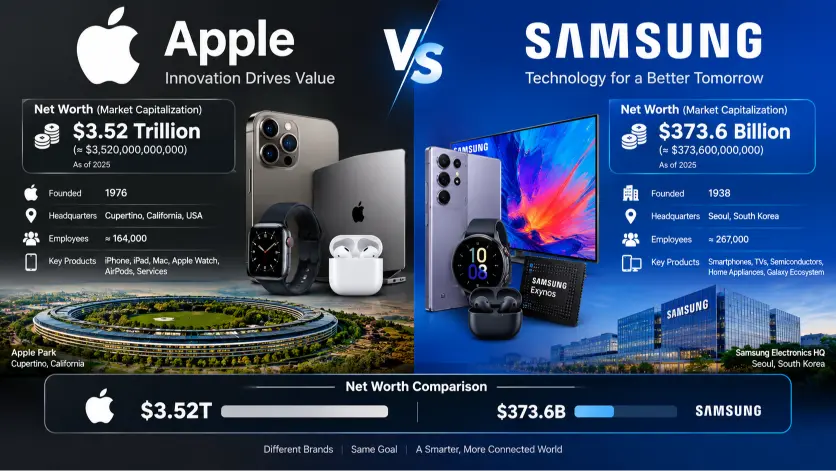
Choosing between Apple or Samsung can be surprisingly difficult, especially when both brands offer powerful smartphones, impressive cameras, premium designs, and advanced features. Whether you care most about performance, battery life, photography, software, price, or long-term usability, the right choice depends on what you actually need from your phone. With new models and features appearing regularly, comparing these two leading smartphone brands can help you avoid paying for features you may never use.
In this guide, we’ll break down Apple and Samsung across the factors that matter most to everyday buyers, including performance, camera quality, battery, software experience, ecosystem, durability, and overall value. The comparison is based on commonly documented specifications, manufacturer information, and practical smartphone considerations rather than brand hype.
By looking at the strengths and limitations of each platform, you can better understand which option matches your budget, preferences, and daily habits. Whether you are upgrading from an older phone or switching between ecosystems, this guide will help you make a more informed decision.
Apple or Samsung: What’s the Difference?
First, it helps to understand that these names identify companies and technology ecosystems, not two interchangeable grammatical terms.
| Term | Part of Speech | Meaning | Typical Reference | Example |
|---|---|---|---|---|
| Apple | Proper noun | A technology company and its product ecosystem | iPhone, iPad, Mac, Watch | Apple released a new iPhone |
| Samsung | Proper noun | A technology company with the Galaxy ecosystem and other electronics | Galaxy phones, tablets, watches, displays | Samsung introduced a new Galaxy phone |
Furthermore, both names function primarily as proper nouns because they identify specific organizations. Consequently, neither word is a general noun for a smartphone.
For example, saying “I bought an Apple” can create ambiguity because Apple produces several categories of devices. Likewise, saying “I bought a Samsung” usually depends on context because Samsung makes phones, televisions, appliances, monitors, and other products.
Mini Recap
Apple and Samsung are company names.
Neither term means “smartphone.”
The exact device should be named when precision matters.
Therefore, “iPhone” and “Galaxy” are often clearer product references.
Is Apple or Samsung a Grammar, Vocabulary, or Usage Issue?
Primarily, this is a vocabulary and usage issue, rather than a difficult grammar rule.
Because Apple and Samsung are proper nouns, their capitalization matters. However, the larger problem involves choosing the correct word for the intended meaning.
For instance, “I prefer Samsung” may be understandable in casual conversation, yet it can mean several things. The speaker might mean Samsung phones, Samsung tablets, Galaxy software, or the company itself.
Similarly, “I use Apple” sounds incomplete in formal writing. A clearer statement would be “I use an iPhone and a Mac.”
Furthermore, formal communication generally benefits from precise product terminology. Academic writing, technical documentation, business reports, and product reviews should identify the exact device whenever the distinction affects meaning.
Meanwhile, casual speech allows broader expressions because listeners can infer the intended reference from context.
Formal versus Casual Usage
In everyday conversation, someone might say, “I’m switching from Apple to Samsung.” The meaning is usually obvious: the person is changing smartphone ecosystems.
However, a technical article should specify whether the change involves an iPhone, Galaxy smartphone, iOS, Android, or another component.
Therefore, the issue isn’t simply which name sounds natural. Instead, the important question is what exactly the writer wants the reader to understand.
How to Use Apple Correctly
First, use Apple when referring to the company, brand, or broader ecosystem.
For example, a workplace statement could read:
Our company uses Apple devices for several creative workflows.
Here, Apple identifies the technology provider rather than one specific product.
Workplace Example
“Apple products are used by our design department.”
This sentence refers broadly to products associated with the company. Conversely, “Our designers use MacBook computers” identifies a specific category.
Academic Example
An academic report might state:
Apple developed an integrated hardware and software ecosystem around its major product lines.
That wording is more precise than saying:
Apple makes good technology.
The first sentence provides a factual description, whereas the second expresses a broad opinion.
Technology Example
Apple’s current ecosystem includes iPhone, iPad, Mac, Apple Watch, and Apple Vision Pro. Its current software strategy also includes Apple Intelligence and Siri AI across supported devices.
Usage Recap
Use Apple for the company or ecosystem.
Use iPhone for the smartphone.
Use Mac for Apple’s computer category.
Use the specific product name whenever technical precision matters.
How to Use Samsung Correctly
Likewise, use Samsung when referring to the company or its broad range of products.
For example:
Samsung develops smartphones, tablets, televisions, displays, and other consumer electronics.
Here, Samsung represents the organization rather than one particular device.
Workplace Example
“Our office purchased Samsung monitors for the design team.”
This statement identifies a product category and therefore avoids ambiguity.
Academic Example
A technology study could state:
Samsung operates across several electronics categories and maintains the Galaxy ecosystem for mobile devices.
That phrasing provides greater clarity than simply saying “Samsung makes phones.”
Technology Example
Samsung’s current mobile ecosystem centers heavily on Galaxy devices and Galaxy AI. Samsung states that Galaxy AI features are available across supported Galaxy phones, tablets, and wearables, although availability varies by model and software version.
Usage Recap
Use Samsung for the corporation or brand.
Use Galaxy when referring to Samsung’s mobile device family.
Name the exact Galaxy model when discussing specifications.
Check the device and software version before making feature claims.
When You Should NOT Use Apple or Samsung
Although both names are common in everyday speech, there are several situations where using either one alone can reduce clarity.
1. When You Mean a Specific Smartphone
Don’t write:
I bought an Apple yesterday.
Instead, write:
I bought an iPhone yesterday.
Likewise, identify the Galaxy model when the exact device matters.
2. When Discussing Operating Systems
Don’t automatically use a company name when discussing software.
For example, iOS and Android are operating systems. Apple and Samsung are companies.
3. When Comparing Cameras
If the comparison concerns camera hardware, identify the actual models. Different devices from the same manufacturer can have substantially different specifications.
4. When Discussing Computer Hardware
Apple makes multiple computer products, including MacBook and Mac desktop systems. Therefore, “Apple computer” may be less informative than naming the exact category.
5. When Discussing Software Features
A feature may depend on a particular operating system, model, region, or software release. Consequently, the company name alone may not provide enough information.
6. When Writing Academic Research
Academic readers generally benefit from exact terminology. Therefore, identify the manufacturer, product, model, software version, and relevant date when necessary.
7. When Reporting Technical Specifications
Storage, display technology, processor, camera configuration, battery capacity, and connectivity should be attached to the precise model.
8. When Making a Product Comparison
A company versus company comparison and a phone versus phone comparison are different subjects. Therefore, don’t mix corporate brands with individual products.
Common Mistakes and Decision Rules
| Correct sentence | Incorrect sentence | Explanation |
|---|---|---|
| I bought an iPhone. | I bought an Apple. | iPhone identifies the smartphone product |
| I bought a Galaxy phone. | I bought a Samsung. | Galaxy phone identifies the device category |
| Apple develops iOS. | Apple is iOS. | The company and operating system aren’t identical |
| Samsung produces Galaxy devices. | Samsung is a Galaxy. | Samsung is the company; Galaxy identifies a product family |
| I use a MacBook at work. | I use an Apple at work. | MacBook provides greater specificity |
| She purchased a Galaxy S26. | She purchased a Samsung S26. | Galaxy S26 is the recognized product name |
Decision Rule Box
If you mean the company or brand, use Apple or Samsung.
If you mean the smartphone, use iPhone or Galaxy phone.
If you mean the operating system, use iOS or Android.
If you mean a specific device, use its complete model name.
Consequently, choosing the correct term depends on the intended reference rather than on a universal preference.
Apple or Samsung in Modern Technology
Modern mobile technology makes precise terminology even more important.
Apple currently describes Apple Intelligence as a system integrated across supported Apple platforms, including iPhone, iPad, Mac, Apple Watch, and Apple Vision Pro. Its September 2026 software update also introduced the next generation of Siri AI with features involving personal context, onscreen awareness, and systemwide app actions.
Similarly, Samsung has expanded Galaxy AI across supported Galaxy phones, tablets, and wearables. Samsung describes features involving contextual suggestions, personalized briefings, photo editing, planning, and other everyday tasks.
Therefore, a technology writer should avoid treating the company name, device family, operating system, and intelligent software layer as synonyms.
Instead, each term should identify the precise layer being discussed.
Etymology and Naming Background
Apple has an ordinary English dictionary meaning referring to a fruit, but Apple as a corporate proper noun functions as a distinctive company name.
Samsung has a different linguistic background. The Korean name “Samsung” is commonly explained as meaning “three stars,” with the name reflecting an early corporate identity and later becoming associated with a global technology organization.
Consequently, these names have moved from ordinary or culturally meaningful language into highly recognizable commercial proper nouns.
That distinction matters because proper nouns normally identify particular entities rather than generic categories.
An Expert Style Explanation
“Precision in technology writing begins with naming the entity at the level the reader actually needs.”
This principle is especially useful when discussing consumer electronics. A company, product family, individual model, operating system, and software feature can all belong to the same ecosystem, yet they aren’t linguistically interchangeable.
Therefore, precise naming improves both readability and factual accuracy.
Two Technology Case Studies
Case Study 1: Apple and Current Platform Expansion
Apple’s fiscal 2026 third quarter, ending June 27, 2026, produced quarterly revenue of $109.4 billion, representing 16 percent year over year growth. Apple also reported record June quarter revenue for iPhone, Mac, and Services.
The linguistic lesson is straightforward. A statement such as “Apple grew” describes the company. A statement such as “iPhone revenue increased” describes a particular product category.
Therefore, substituting one term for another can change the factual meaning.
Case Study 2: Samsung Galaxy S26
Samsung reported that Galaxy S26 series preorders increased by double digits, while more than 70 percent of worldwide preorder customers selected the Galaxy S26 Ultra. Samsung also reported 20 percent year over year preorder growth for the S26 Ultra in Europe.
Consequently, “Samsung demand increased” and “Galaxy S26 Ultra preorder demand increased” are not equivalent statements.
The second sentence communicates substantially more information.
Apple or Samsung: Common Language Errors to Avoid
First, don’t use a company name as a generic substitute for every product associated with it.
Second, don’t assume every device from one manufacturer has identical specifications.
Third, don’t confuse brand identity with operating system terminology.
Fourth, don’t describe a particular smartphone simply by its manufacturer’s name when the model matters.
Fifth, don’t make a technology claim without checking whether the feature applies to the relevant model and software version.
Furthermore, avoid statements such as “Samsung is Android” because Samsung manufactures Android based devices but isn’t synonymous with Android itself.
Likewise, Apple isn’t synonymous with iOS. The company develops and operates the platform, but the two terms refer to different entities.
Error Prevention Checklist
Always use Apple when
You mean the technology company.
You mean Apple’s wider product ecosystem.
You are discussing corporate announcements or company results.
You are referring broadly to Apple branded products.
Always use Samsung when
You mean the electronics company.
You are discussing its corporate operations.
You are referring broadly to its product portfolio.
You are describing the Samsung ecosystem rather than one device.
Never use Apple when
You specifically mean an iPhone.
You specifically mean a MacBook.
You specifically mean iOS.
Never use Samsung when
You specifically mean a Galaxy model.
You specifically mean Android.
You are discussing a particular device feature without identifying the relevant model.
Related Grammar Confusions You Should Master
Once this distinction becomes clear, several related terminology questions become easier.
- iPhone vs smartphone
An iPhone is a smartphone, but not every smartphone is an iPhone.
- Galaxy vs Android
Galaxy identifies Samsung’s device family, while Android identifies the operating system platform.
- iOS vs Android
These are operating systems rather than manufacturers.
- Mac vs MacBook
Mac is a broader computer family, while MacBook identifies Apple’s laptop line.
- Brand vs company
A brand and the organization behind it aren’t necessarily linguistically identical.
- Product vs manufacturer
A product is an item; a manufacturer develops or produces it.
- Device vs ecosystem
A device is a specific piece of hardware, while an ecosystem includes interconnected products, software, and services.
- Model vs series
A model identifies a particular product, while a series can contain multiple related models.
- Software vs hardware
Hardware refers to physical components, whereas software refers to programs and operating systems.
- Company name vs product name
This distinction applies far beyond mobile technology and is useful in business and technical writing.
Frequently Asked Questions
Is Apple the same as an iPhone?
No. Apple is the company, while iPhone is Apple’s smartphone product line. Therefore, these terms shouldn’t automatically replace each other.
Is Samsung the same as Galaxy?
No. Samsung is the company, while Galaxy is a product family associated with Samsung. A Galaxy device is therefore more specific than simply saying Samsung.
Is Apple an operating system?
No. Apple is a technology company. iOS is Apple’s mobile operating system.
Is Samsung an operating system?
No. Samsung is a technology company. Many Samsung smartphones use Android, while Samsung also develops its own software experiences and ecosystem services.
Should I say Apple phone or iPhone?
In most precise contexts, iPhone is clearer because it identifies the actual smartphone product family.
Should I say Samsung phone or Galaxy phone?
Either expression can be understood, although Galaxy phone is more specific when referring to Samsung’s smartphone family.
What is the difference between Apple and Samsung?
The terms primarily identify two different technology companies with different product portfolios, software platforms, hardware strategies, and ecosystems.
Can Apple and Samsung be used interchangeably?
No. They identify different organizations. However, they can appear in the same comparison when discussing competing technology ecosystems.
Why do people say Apple when they mean iPhone?
Because everyday speech often uses a brand or manufacturer name as shorthand for a familiar product. Nevertheless, formal and technical writing benefits from the more precise product name.
Apple or Samsung: How to Choose the Correct Term in Writing
Ultimately, the correct expression depends on the level of specificity required.
If the subject is the corporation, write Apple or Samsung.
If the subject is a smartphone, identify the relevant iPhone or Galaxy device.
If the subject is software, identify iOS, Android, One UI, or another relevant platform.
If the subject is a technical specification, provide the exact model whenever possible.
Moreover, current market data demonstrates why this precision matters. IDC reported that Samsung accounted for 22.7 percent of worldwide smartphone shipments in the second quarter of 2026, while Apple accounted for 20.2 percent. Those figures describe companies and shipments, not identical individual products.
Therefore, careful terminology prevents readers from confusing a manufacturer with its products.
Conclusion:
The central distinction is simple: Apple and Samsung are company names, while iPhone and Galaxy identify product families associated with those companies. Consequently, using the manufacturer name as a substitute for a specific device can create unnecessary ambiguity.
For everyday conversation, broad expressions may be perfectly understandable. However, workplace communication, academic writing, technical documentation, product reviews, and educational content benefit from greater precision. Furthermore, modern ecosystems have become more complex. Apple now connects multiple hardware categories through its software platforms and Apple Intelligence, while Samsung continues expanding Galaxy devices and Galaxy AI across supported products.
Therefore, the safest writing habit is to identify the exact entity you mean. Name the company when discussing the company, the device when discussing the device, and the operating system when discussing software. That small distinction makes technology writing clearer, more accurate, and easier for readers to understand.









