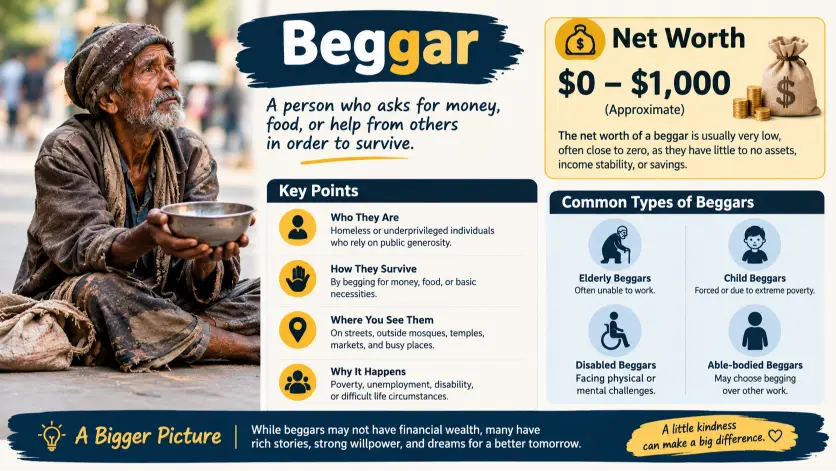
Have you ever typed “begger” and wondered whether it is actually the correct spelling? You are not alone. “Begger or beggar” is a common spelling question because English words do not always follow predictable spelling patterns. The correct spelling is “beggar,” with an -ar ending. It is a noun commonly used for a person who begs, although the word can have different tones depending on the context in which it appears.
Understanding the correct spelling can help you write more accurately in emails, school assignments, articles, professional documents, and everyday communication.
In this guide, we will clearly explain begger or beggar, including the correct spelling, meaning, pronunciation, word formation, and practical examples. The explanation follows standard English usage and focuses on the spelling distinction readers commonly encounter. You will also learn why “begger” is considered a misspelling and how to remember “beggar” more easily. Whether you are a student, content writer, English learner, or simply checking a word before using it, this straightforward guide will give you a reliable answer without unnecessary confusion.
X vs Y: What’s the Difference?
The difference between begger and beggar is primarily a matter of correct spelling and standard usage. Although both forms may appear in online searches, informal writing, or user generated content, they don’t have equal status in standard English.
Beggar is a noun and, in some contexts, a verb. As a noun, it refers to a person who asks for money, food, or assistance, especially in public. As a verb, it can mean to make someone poor or to exceed the ability of something to be adequately described.
Begger, meanwhile, is not the standard spelling of the noun. Consequently, using it in an essay, application, article, workplace document, or academic assignment can make the writing appear careless.
| Term | Part of speech | Standard spelling | Meaning | Recommended use |
|---|---|---|---|---|
| Beggar | Noun | Yes | A person who asks for money or assistance | Formal and informal writing |
| Beggar | Verb | Yes | To make someone poor or overwhelm description | Formal and literary contexts |
| Begger | Noun | No | Common spelling error for beggar | Avoid in standard writing |
Therefore, the practical distinction is simple. Beggar is the accepted spelling. Begger is usually an error.
As a result, learners who remember the pronunciation but not the spelling can easily add an extra “e.” However, standard dictionaries recognize beggar as the conventional form.
Is X vs Y a Grammar, Vocabulary, or Usage Issue?
The question of begger or beggar is mainly a spelling and vocabulary usage issue, rather than a complicated grammar problem.
First, the two forms aren’t interchangeable in standard English. If you intend to describe a person who begs, beggar is the appropriate noun. Consequently, substituting “begger” can create an orthographic error even when the surrounding grammar is perfectly correct.
Furthermore, the problem can become noticeable in different registers. In casual online communication, spelling mistakes sometimes go unnoticed. However, academic writing demands greater precision. Likewise, workplace communication generally benefits from conventional spellings because readers may interpret unusual forms as errors.
For example, a student might write, “The begger asked for assistance.” The grammatical structure is understandable, yet the spelling should be corrected to “The beggar asked for assistance.”
Similarly, a report might state, “The organization supports homeless beggars.” Here, beggars is the plural form of the standard noun.
Therefore, the issue isn’t whether readers can understand the intended meaning. Instead, it concerns whether the written form follows established English conventions.
Formal vs Informal Usage
In formal contexts, use beggar without hesitation. Academic essays, professional reports, applications, examinations, published material, and official correspondence should follow the standard spelling.
In casual communication, a person might encounter “begger” because of typing mistakes or user generated content. Nevertheless, familiarity does not make the spelling standard.
Academic vs Casual Writing
Academic writing places particular emphasis on consistency and accuracy. Therefore, “beggar” should be used whenever the word appears in an essay, research discussion, historical explanation, or classroom exercise.
Casual messages are more forgiving. Even so, learning the standard form prevents the error from becoming habitual.
Practical Usage of Begger
Although begger frequently appears when people search for the correct spelling, it shouldn’t normally be used as the intended standard noun.
In a workplace document, for instance, writing “The begger approached customers outside the building” introduces a spelling error. Instead, write “The beggar approached customers outside the building.”
Likewise, in an academic setting, a sentence such as “The novel presents a begger as a symbol of poverty” should be corrected to “The novel presents a beggar as a symbol of poverty.”
Technology creates another common situation. Search boxes, spell checkers, predictive keyboards, and writing applications may encounter “begger” because users type it frequently. However, search visibility doesn’t automatically establish grammatical or lexical correctness.
Therefore, treat begger as a spelling trap rather than as an alternative spelling.
Usage Recap
Consequently, begger is best recognized as the commonly mistaken form. In standard writing, replace it with beggar.
Practical Usage of Beggar
Beggar is the standard spelling and can function as both a noun and a verb.
As a noun, it describes a person who begs. For example, “The beggar sat near the entrance and asked passersby for assistance.”
In workplace writing, the noun may appear in discussions involving social services, homelessness, public policy, customer interactions, or community programs. For example, “The organization provides food and temporary accommodation for people who are homeless, including individuals who may beg for support.”
In academic writing, the term may appear in literature, history, sociology, economics, or cultural studies. For instance, “The author uses the figure of the beggar to represent social exclusion.”
The word also has a less familiar verb use. In the expression “beggars belief,” the verb means something is so extraordinary that it is difficult to believe. In American English, “beggars belief” is also encountered, although “beggars belief” is especially associated with British usage.
Technology provides another useful context. A content management system might flag “begger” as a spelling error and suggest “beggar.” Similarly, a digital dictionary or spell checker can help distinguish the conventional form from an incorrect variant.
Usage Recap
Therefore, beggar is the form to select when referring to a person who begs. Additionally, it has legitimate verb uses in established expressions and literary contexts.
When You Should NOT Use X or Y
Understanding when to avoid each form makes the distinction easier to remember.
- Don’t use “begger” in academic assignments.
Instead, use beggar, because academic writing requires standard spelling. - Don’t use “begger” in professional correspondence.
Consequently, reports, emails, applications, and official documents should contain the conventional form. - Don’t assume pronunciation determines spelling.
English spelling often doesn’t follow pronunciation perfectly. Therefore, hearing a word isn’t always enough to reconstruct its written form. - Don’t treat search frequency as proof of correctness.
A misspelling can appear thousands of times online. Nevertheless, repetition doesn’t transform an error into the standard form. - Don’t replace “beggar” with “begger” because it looks phonetic.
The familiar spelling contains an “a” after the “g.” - Don’t use “begger” in published content.
Consequently, editors and readers may identify it as a simple spelling mistake. - Don’t confuse “beggar” with related words such as “begging.”
These forms belong to the same word family, yet their spellings change according to grammatical form. - Don’t assume every dictionary style treats unusual variants equally.
Instead, rely on established standard usage when accuracy matters.
Common Mistakes and Decision Rules
The easiest way to avoid this error is to connect the spelling with the intended meaning.
| Correct sentence | Incorrect sentence | Explanation |
|---|---|---|
| The beggar asked for food. | The begger asked for food. | The standard noun is beggar. |
| Several beggars gathered near the station. | Several beggers gathered near the station. | The plural is beggars. |
| She donated money to a beggar. | She donated money to a begger. | The noun retains the standard spelling. |
| The story features a poor beggar. | The story features a poor begger. | “Beggar” is the accepted form. |
| The situation beggars belief. | The situation beggers belief. | The established verb is “beggars.” |
Decision Rule Box
If you mean the action, use X
When discussing the action itself, use forms such as beg, begging, or begged, depending on the grammatical context.
If you mean the person or tool, use Y
When referring to the person who begs, use beggar.
Therefore, don’t create “begger” by simply trying to form a person noun from the spelling of the verb.
Begger or Beggar in Modern Technology
Digital writing has made spelling questions easier to investigate, although it has also created new sources of confusion.
For example, search engines can return results for misspelled queries because they attempt to understand what users intended. Likewise, keyboards may preserve an incorrectly typed form if it has appeared repeatedly in a user’s writing.
Furthermore, automated writing assistants, dictionaries, and spell checking systems can identify many conventional spelling errors. However, users should still understand the underlying rule rather than accepting every suggestion without thought.
When a writer enters “begger,” a correction system may recommend “beggar.” That suggestion reflects the standard spelling rather than a change in meaning.
Consequently, technology is useful for error detection, but linguistic knowledge remains important. A person who knows that beggar is the conventional spelling can recognize the mistake even without a digital correction tool.
Etymology: Where Does Beggar Come From?
The history of beggar helps explain why the word doesn’t simply follow a modern spelling pattern.
The noun developed from the verb beg, with the suffix ar contributing to the formation of a noun referring to a person associated with the action. English has many historical spelling patterns that don’t always match the forms learners might construct today.
Therefore, someone may intuitively expect “begger” because the verb is “beg” and the ending seems to resemble patterns found in other English words. Nevertheless, historical development determines standard spelling, not modern guesswork.
This is an important lesson in English vocabulary. A logical sounding spelling isn’t necessarily an established spelling.
Expert Style Explanation
In standard English, beggar is the established noun for a person who begs, while “begger” is normally treated as a misspelling.
This distinction is especially useful because spelling accuracy depends on convention as well as pronunciation.
Two Practical Case Studies
Case Study One: Academic Writing
Consider a student preparing an essay about poverty in nineteenth century literature. The student writes:
“The begger represents the effects of economic inequality.”
Although the meaning is obvious, the spelling weakens the sentence. After correction, the sentence becomes:
“The beggar represents the effects of economic inequality.”
The result is more appropriate for formal academic writing because the standard lexical form is used.
Case Study Two: Workplace Communication
Imagine a community organization preparing a report about public assistance. A draft contains the sentence:
“The program provides meals to beggers in the surrounding area.”
The intended meaning is clear, yet the spelling should be corrected. The revised sentence reads:
“The program provides meals to beggars in the surrounding area.”
Consequently, the organization communicates the same idea while avoiding an unnecessary spelling error.
Error Prevention Checklist
Use the following checklist whenever you’re unsure about the spelling.
Always use X when
First, use beggar when referring to a person who begs.
Also, use beggar in academic writing.
Likewise, use beggar in professional reports.
Furthermore, use beggar in published articles.
Finally, use beggar whenever you need the standard English noun.
Never use Y when
Never use begger as the standard spelling of the person who begs.
Never select it merely because the pronunciation seems to support that spelling.
Never use it in formal assignments when beggar is intended.
Never assume frequent online appearance makes it correct.
Never allow the incorrect form to become a repeated habit.
Related Grammar Confusions You Should Master
Once you’ve understood begger or beggar, several other spelling and usage distinctions are worth learning because English frequently contains words that sound similar or look deceptively alike.
- Advice vs advise
The first is normally a noun, while the second is a verb. - Affect vs effect
Their meanings and grammatical functions differ depending on context. - Accept vs except
These words sound similar but serve completely different purposes. - Compliment vs complement
One relates to praise, whereas the other concerns completion or compatibility. - Principal vs principle
One can refer to a person or primary element, while the other concerns a rule or belief. - Stationary vs stationery
One means remaining still, whereas the other refers to writing materials. - Separate vs seperate
“Separate” is the standard spelling, while “seperate” is a frequent error. - Definitely vs definately
The latter is a common misspelling of the former. - Occurrence vs occurence
The correct form contains a double “r” and a double “c.” - Necessary vs neccessary
The standard spelling contains one “c” and two “s” letters.
These examples demonstrate a broader principle: English spelling often needs to be learned through established usage rather than pronunciation alone.
Advanced FAQs
What is the correct spelling, begger or beggar?
The correct standard spelling is beggar. “Begger” is generally a misspelling. Therefore, use “beggar” when referring to a person who asks others for money, food, or assistance.
Is begger a correct English word?
In standard modern English, begger isn’t the conventional spelling of the noun. Consequently, writers should normally use beggar instead.
Why do people spell beggar as begger?
People may write “begger” because the spelling seems to follow the pronunciation or because they mentally form the noun directly from “beg.” However, English spelling isn’t always predictable from pronunciation.
Is beggar a noun or a verb?
Beggar can be a noun and a verb. As a noun, it refers to a person who begs. As a verb, it can occur in expressions such as “beggars belief,” where it indicates that something is difficult to believe.
What is the plural of beggar?
The standard plural is beggars. Therefore, write “two beggars,” not “two beggers.”
Is beggar offensive?
The appropriateness of the term can depend on context and audience. Although beggar is a standard dictionary word, contemporary discussions about poverty may use more specific or person centered expressions when the individual’s circumstances are relevant.
How do you pronounce beggar?
The pronunciation varies somewhat between English varieties. Nevertheless, the standard written form remains beggar, regardless of regional pronunciation.
What is the difference between beggar and begging?
Beggar generally refers to a person, so it is commonly a noun. Begging refers to the action or activity of asking persistently for something. Therefore, “The beggar was begging for food” uses both forms correctly.
Why is begger a common spelling mistake?
The error probably arises because writers connect the word with beg and intuitively expect an “e” before the final consonant sequence. However, conventional English spelling uses beggar.
Conclusion:
When deciding between begger or beggar, choose beggar in standard English. The word functions primarily as a noun for a person who begs, although it can also function as a verb in established expressions.
Moreover, “begger” is generally a spelling error rather than an alternative standard form. Therefore, students, professionals, editors, and everyday writers should use beggar whenever they need the conventional spelling.
Ultimately, the easiest memory aid is straightforward: the standard noun is spelled beggar, with an a after the first “g.” Once that pattern becomes familiar, this particular spelling confusion becomes much easier to avoid.









